
What is a PFIC "Excess Distribution"? IRC §1291(b) Defined
Authority: IRC §1291(b); Instructions for Form 8621, Part V.
The term covers two distinct events that receive identical tax treatment under §1291:
| Category | Definition | Key Distinction | Authority |
|---|---|---|---|
| Type 1 — Distributions | The portion of a current-year cash or property distribution that exceeds 125% of the average distributions from the three preceding tax years (or the full holding period if shorter). The non-excess portion is ordinary income in the current year under normal rules. | Only the excess above the 125% threshold triggers §1291. | §1291(b)(2)(C) |
| Type 2 — Dispositions | Any gain recognized on the sale, exchange, or deemed disposition of PFIC stock. The entire gain — not just an "excess" — is treated as an excess distribution. There is no 125% threshold for gains. | The entire gain is subject to §1291 regardless of amount or prior distributions. | §1291(a)(2) |
The 125% Historical Average Test for Excess Distributions
Average Annual Distribution = Sum of distributions in 3 preceding tax years ÷ 3
    (or ÷ N, where N = years in holding period if less than 3)

Threshold = Average Annual Distribution × 1.25

Excess Distribution Amount = Total current-year distribution − Threshold
    (If result is zero or negative: no excess distribution. Full amount taxed normally.)
Critical rules for the 3-year average (IRC §1291(b); Instructions for Form 8621, Part V):
- Prior-year distributions in the holding period count toward the average, including pre-PFIC years, subject to the §1291(b)(2)(A) adjustment for prior excess distributions.
- If the holding period is less than 3 years, use the actual number of years as the denominator.
- If there are zero prior distributions, the average is $0. The threshold is $0 × 125% = $0. The entire current-year distribution is an excess distribution. Engines must not substitute a minimum value here.
- Under IRC §1291(b)(2)(A), prior excess distributions are included in the baseline average only to the extent they were included in gross income under §1291(a)(1)(B).
- No first-year distributions qualify as excess distributions (IRC §1291(b)(2)(B)). Under the IRS instructions, no part of a distribution received during the first tax year of the shareholder's holding period is treated as an excess distribution. (This statutory exclusion results in a discrepancy where, if any shares were acquired during the current tax year prior to a distribution date, Form 8621 Line 15e(1) will not equal Line 15a minus Line 15d. Review our dedicated guide to learn why.)
- Share-by-Share Computation: Computations must be conducted share-by-share; only shares with identical holding periods may be aggregated into blocks.
- Stock Splits & Stock Dividends: Historical per-share distributions must be adjusted for intervening stock splits or share consolidations.
- Partial-Year Holdings: If shares were held for only part of a prior year, distributions received during that partial period are annualized.
- Tacked Holding Periods (§1223): Where holding periods carry over from a predecessor holder, distributions received by the predecessor during the lookback window must be included in the average.
- Foreign Currency Distributions: If distributions were received in foreign currency, specific translation rules apply (see the FX section below).
- PTEP Adjustments: Amounts excluded from gross income under IRC §959(a) (CFC earnings) or §1293(c) (prior QEF inclusions) are appropriately adjusted.
8621calculator.com applies this adjustment. For Line 15b, the system excludes only prior excess-distribution amounts not included in gross income under §1291(a)(1)(B). A workflow that includes prior excess-distribution amounts not included in gross income under §1291(a)(1)(B) may overstate Line 15b and produce a different result.
PFIC Holding Period Allocation: The §1291 Ratable Daily Method
Authority: IRC §1291(a)(1), (a)(3); Instructions for Form 8621, Part V, Line 16a.
Once the excess distribution amount is determined, it is allocated across the taxpayer's entire holding period on a daily basis. This is the computational core of §1291 and the step most commonly implemented incorrectly.
IRC §1291 Ratable Daily Allocation Algorithm
Total Holding Period Days = (Disposition or Distribution Date) − (Acquisition Date)

For each year Y in the holding period:
  Days_in_Y = actual calendar days in Y that fall within (Acquisition Date, Event Date]
  Ratable_Portion(Y) = Excess Distribution × (Days_in_Y ÷ Total Holding Period Days)
Day counting uses actual calendar days — not months, not 30/360. Partial years at the start and end of the holding period must be counted by actual days. The holding period starts the day after acquisition and includes the distribution or disposition date.
Holding Period Year Classification & Tax Treatments
| Year Type | Definition | Treatment of Ratable Portion | Authority |
|---|---|---|---|
| §1291 PFIC Year (prior) | Corporation was a PFIC; no valid QEF or MTM election in force | Taxed at the highest ordinary income rate for that year (DTA). Subject to §6621 compounded interest from that year's return due date to the current return due date. | §1291(a)(1)(A) |
| Current Year (§1291 or otherwise) | The year in which the distribution or disposition occurs | Included in gross income as ordinary income at current-year rates. No interest charge. This is the "free" slice — taxed at whatever the taxpayer's actual rate is for the filing year. | §1291(a)(1)(B) |
| Pre-PFIC Year | Taxable years in the shareholder's holding period before the foreign corporation qualified as a PFIC. | Ratable portion allocated to pre-PFIC years receives zero DTA and zero interest. It is included in current-year gross income as ordinary income under Form 8621 Line 16b. | §1291(a)(1)(B); Form 8621 Line 16b Instructions |
| Post-Taint Non-Qualifying Years | Years where the corporation did not meet the PFIC income/asset tests, but the stock was tainted under §1298(b)(1). | Under IRC §1298(b)(1) ("once a PFIC, always a PFIC"), the stock remains subject to §1291 deferred tax and interest unless a formal purging election was executed. | §1298(b)(1); Treas. Reg. §1.1291-9 |
| QEF or MTM Election Year | Valid §1295 QEF or §1296 MTM election was in force for that year | For QEF: excluded from §1291 if the corporation was a QEF for every PFIC year in the shareholder's holding period, or if the prior §1291 taint was properly purged through an applicable deemed-sale or deemed-dividend election. For MTM: pre-MTM years are subject to mandatory first-year coordination under §1296(j) / Reg. §1.1296-1(i), rather than a separate purge election. | §1291(d); §1295; §1296(j) |
Allocating to Pre-PFIC Periods
Amounts allocated to pre-PFIC periods (before the company became a PFIC) and the current tax year are reported on Line 16b as ordinary income. The entire excess distribution amount is eventually accounted for on the return — either at highest statutory rates with compounding §6621 interest (prior PFIC years) or as current-year ordinary income on Schedule 1 (current-year and pre-PFIC portions).
Calculating the PFIC §1291 Deferred Tax Amount (DTA)
Authority: IRC §1291(c)(1); Instructions for Form 8621, Part V, Lines 16c–16e.
For each prior §1291 PFIC year, a Deferred Tax Amount is calculated independently:
DTA(Year Y) = Ratable_Portion(Year Y) × Highest_Applicable_Rate(Year Y)Applying the "Highest Applicable Tax Rate" for PFICs
This is not the taxpayer's actual effective rate. Under IRC §1291(c)(1), you use the highest rate in the statutory schedule for the category of taxpayer for each prior year. An individual who was in the 22% bracket in 2019 still gets their 2019 PFIC allocation taxed at 37% — the highest individual rate for 2019.
Historical Highest Ordinary Income Tax Rates Table
This table is required for any §1291 calculation engine. Each prior year's DTA must use the rate in the column for that year, not the current year's rate.
| Tax year(s) (Calendar year taxpayer) |
Highest tax rate (IRC section 1) |
|---|---|
| 2018–2025 | 37% |
| 2013–2017 | 39.6% |
| 2003–2012 | 35% |
| 2002 | 38.6% |
| 2001 | 39.1% |
| 1993–2000 | 39.6% |
| 1991–1992 | 31% |
| 1988–1990 | 28% |
| 1987 | 38.5% |
Instructions for Form 8621 (Rev. 12-2025)
PFIC §1291 Deferred Tax Interest Charge Mechanics (IRC §6621)
Authority: IRC §1291(c)(2)–(3); IRC §§6621–6622; Instructions for Form 8621, Part V, Line 16f.
The interest charge is the second computational layer and the one that makes long-held positions extremely expensive. It is not a penalty — it is a substitute for the time value of money the government lost by not receiving the tax in prior years.
IRC §1291 Interest Charge: Daily Compounding Formula
For each prior §1291 PFIC Year Y:

  Interest_Charge(Y) = Interest accrued on Net_Increase_in_Tax(Y)
                        using the rates and methods under IRC §6621

      Accrual Start: Unextended due date of the income tax return
                     for Year Y

      Accrual End:   Unextended due date of the income tax return
                     for the tax year of the excess distribution
                     or disposition

      Compounding:   Daily under IRC §6622

Total §1291 Interest Charge =
Σ Interest_Charge(Y) for all prior §1291 PFIC yearsAn extension to October 15 does not shift the accrual start date — interest still runs from April 15 (or the applicable due date, adjusted under §7503 if it falls on a weekend or holiday).
8621calculator.com applies these rules in full, including daily compounding and due date adjustments:
8621 Calculator Accuracy Verification
Online IRS §6621 Interest Calculator Reference
Key Mechanical Rules for §6621 Interest
- The §6621 underpayment rate is a variable quarterly rate, published by the IRS in quarterly Revenue Rulings. It is set at the Federal Short-Term Rate plus 3 percentage points for individuals.
- The rate changes quarterly. The engine must apply the correct quarterly rate for each calendar quarter within the full accrual period — not a single average rate.
- Compounding is daily per §6622. Simple interest is incorrect and will produce materially lower results for long holding periods.
- The interest charge is treated as an addition to tax under §1291(c)(2)(A) — not as deductible interest expense. It cannot be claimed on Schedule A. It does not reduce AGI.
For a simple worked example with line 15f, line 16b, line 16c and line 16f, see this simple Form 8621 §1291 sale example. For the separate 125% distribution test, use the PFIC dividend excess distribution example.
IRS §6621 Floating Interest Rate Architecture
Under IRC §6621(a)(2), the interest rate for underpayments changes quarterly and is pegged to the Federal Short-Term Rate plus 3 percentage points. Computation engines must not use a single annual average; each calendar day must compound under the exact quarterly rate in effect.
Long holding periods can cause the interest component to become substantial; see our in-depth research and mathematical modeling in the §6621 PFIC Interest Calculation and Compounding Guide.
IRS Official Quarterly Interest Rates (IRS.gov)
PFIC Disposition Rules: Sales, Exchanges & Deemed Dispositions
Authority: IRC §1291(a)(2); Instructions for Form 8621, Part V, Line 15f.
Statutory Definition of a PFIC "Disposition"
The term is defined broadly under §1001 and Form 8621 instructions, including:
- Open market sales and broker-executed trades
- Redemptions and liquidations treated as exchanges
- Transfers and pledges of stock as security for a loan
- Deemed disposition gains under §1296(j) (first-year MTM coordination) and §1291(d)(2) (purging elections)
- Abandonment or worthlessness — these produce a capital loss, not an excess distribution
Why the Entire PFIC Gain Is an Excess Distribution
Gain = Gross Proceeds − Adjusted Cost Basis

If Gain > 0:  Entire gain = Excess Distribution (Line 15f).
              Allocate ratably across entire holding period.
              125% threshold does NOT apply to disposition gains.

If Gain ≤ 0:  §1291 does NOT apply. Enter in brackets on Line 15f: [loss].
              Normal capital loss rules apply on Schedule D.
Capital Loss Treatment on PFIC Stock Dispositions: §1291(a)(2) Limits
Authority: IRC §1291(a)(2); Instructions for Form 8621, Part V, Line 15f.
PFIC Wash Sale Rules Under IRC §1091
Standard §1091 wash sale rules apply to PFIC shares held as capital assets. If a taxpayer sells PFIC stock at a loss and repurchases substantially identical shares within the 61-day wash sale window (30 days before or after), the loss is disallowed and added to the basis of the replacement shares.
Holding Period Tacking: Under IRC §1223(4), the holding period of the original shares tacks onto the replacement shares — the historical §1291 holding period continues.
PFIC Partial Dispositions & Lot Identification Rules
If only a portion of PFIC shares is sold, the lot identification rules of Reg. §1.1012-1 apply: FIFO by default unless specific identification is documented. Different lots have different acquisition dates, holding periods, and allocation schedules under §1291.
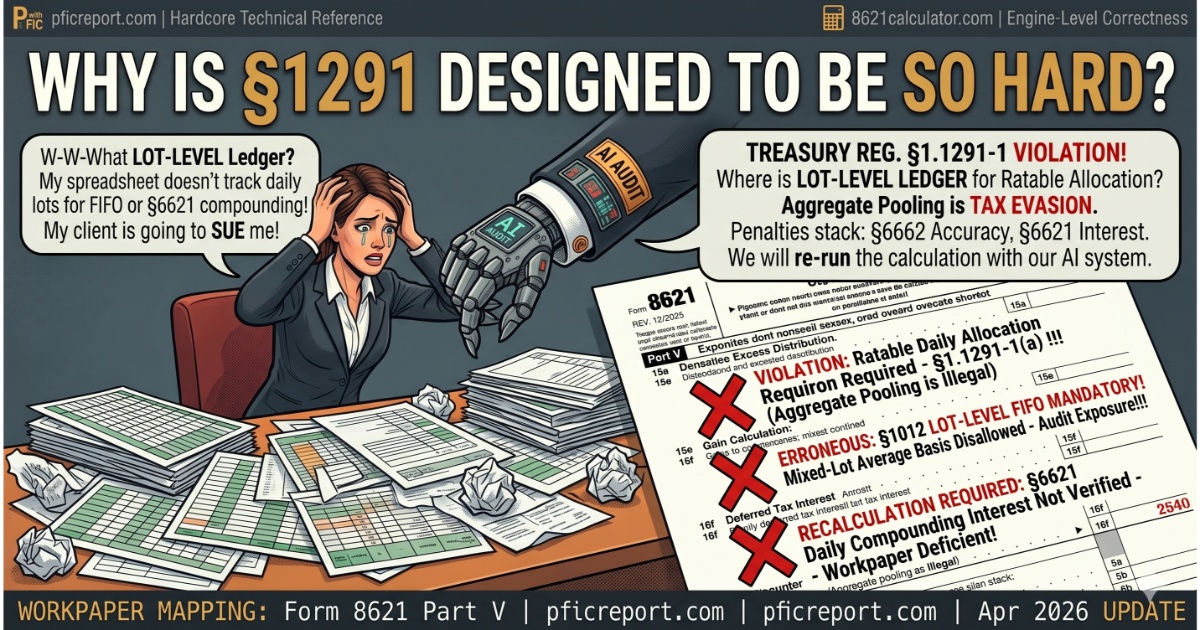
Lots may be consolidated only where acquisition date and cost basis are identical (e.g., same-day, same-price purchases). Otherwise, each lot must be tracked separately. Averaging across multiple lots is not permissible under §1291.
PFIC Share-by-Share (Lot-Level) §1291 Calculation Requirements
Authority: IRC §1291(a)(1), (a)(3); Treas. Reg. §1.1012-1(c); Instructions for Form 8621, Part V.
The §1291 allocation is driven by each lot's acquisition date. Different lots purchased at different times have different holding periods, different prior-year rate compositions, and different interest accrual periods. A single blended position average will produce wrong numbers.
Lot-level (§1291) computation structure:

PFIC §1291 Calculation Branches
├── Distribution
│   ├── Allocate distributions to each lot based on holding period
│   ├── Compute Line 15a (total distributions)
│   ├── Compute Line 15b / 15c / 15d (non-excess vs excess portions)
│   ├── Derive Line 15e (Excess Distribution)
│   └── Allocate across prior years → Line 16b–16f (tax + interest)
│
└── Disposition
    ├── Match sales to lots using FIFO
    ├── Compute holding period and gain/loss per lot
    ├── Report gain on Line 15f
└── Allocate across prior years → Line 16b–16f (tax + interest)This avoids unnecessary aggregation and preserves full lot-level traceability, which is the most audit-defensible approach under §1291.
Non-PFIC Years and the "Once a PFIC, Always a PFIC" Taint Rule
Authority: IRC §1298(b)(1); IRC §1291(a)(1), (a)(3); Instructions for Form 8621, Part V.
Excess Distribution Allocation Across PFIC & Non-PFIC Periods
Under §1291, the excess distribution is allocated ratably over the entire holding period, regardless of whether the corporation was a PFIC in each year.
Portions allocated to PFIC years are subject to tax at the highest applicable rate and an interest charge. All other portions — including periods where the corporation was not a PFIC or before the taxpayer became subject to U.S. tax — are treated as current-year ordinary income and are not subject to the §1291 interest regime.
All days in the holding period remain in the allocation denominator. As a result, non-PFIC periods reduce the portion allocated to PFIC years, but do not create a separate category of tax computation.
Purging and Resetting §1291 PFIC Exposure
Once a shareholder has held a PFIC during any part of the holding period, §1291 applies by default unless the taint is effectively reset.
There are two primary ways to reset prior §1291 exposure:
- Purging election (§1291(d)(2)): A deemed sale or deemed dividend election recognizes the built-in gain and resets the shareholder’s basis, eliminating prior §1291 exposure going forward.
- Full disposition: Selling all PFIC shares ends the existing holding period. Any subsequent acquisition is treated as a new investment with a fresh holding period.
Changes in the corporation’s status (e.g., becoming a CFC) may affect how PFIC rules apply in certain years, but do not by themselves eliminate prior §1291 exposure.
Allocating Excess Distributions to Pre-PFIC Holding Periods
Authority: IRC §1291(a)(1)(B); Instructions for Form 8621, Part V, Line 16b.
If a taxpayer acquired shares before the corporation first became a PFIC, the years of ownership before PFIC status are "pre-PFIC years." Treatment is identical to non-PFIC years: zero DTA, zero interest, but days still count in the holding period denominator.
The practical implication: appreciation from the pre-PFIC era is not subject to §1291's highest-rate tax or interest charge. Only appreciation ratably attributable to the years when the corporation was actually a PFIC — and no election was in force — runs through the full punitive calculation.
8621calculator.com performs day-level allocation to precisely separate pre-PFIC holding periods from PFIC years, ensuring only the PFIC-period portion is subjected to §1291 computation.
Coordination of §1291 and §1296 Mark-to-Market (MTM) Elections
Regulatory basis: §1296(j); Reg. §1.1296-1(i)
When a taxpayer holds PFIC stock under §1291 for multiple years and then makes an MTM election under §1296, IRC §1296(j) and Treas. Reg. §1.1296-1(i) establish a mandatory first-year coordination mechanism. This statutory transition rule taxes accumulated pre-MTM appreciation under §1291 rules without requiring a separate elective purge.
MTM Coordination Year Transition Workflow
- Identify the coordination year. The first year the MTM election is in effect, if the stock had prior §1291 PFIC years without a QEF election covering all such years.
- Compute the deemed disposition gain required by §1296(j) and Treas. Reg. §1.1296-1(i)(2)(ii). Treat the stock as sold at its year-end FMV on the last day of the coordination year. Compute total gain: Year-End FMV − Adjusted Basis.
- Run the full §1291 allocation. Allocate the total gain across all holding period years using the standard ratable daily method. Compute DTA and interest charge for each prior §1291 PFIC year.
- Current-year (coordination year) slice. The ratable portion of the deemed gain allocated to the coordination year is included as current-year ordinary income under §1291(a)(1)(B). This portion is not subject to the interest charge, as it is not allocated to prior years. Although economically similar to MTM income, it is technically a §1291 inclusion rather than an inclusion under §1296.
- Establish UNI. The amount of gain subjected to the §1291 rules (excluding the interest charge) is treated as part of the Unreversed Inclusions (UNI) for §1296 purposes under Reg. §1.1296-1(a)(3)(ii), which may limit future MTM loss deductions.
- Post-coordination. From year two of the MTM election onward, the stock operates under pure §1296 MTM rules. Prior §1291 exposure is resolved through the statutory first-year coordination.
For such cases, a practical workflow is to first run a §1291 calculation using a deemed sale (year-end FMV) to determine total gain across all lots, and then separately apply §1296 MTM treatment for the first election year based on the adjusted FMV. The results must be combined manually.
Full automation of this coordination process is planned for a future release.
Historical Cost Basis Rules for PFIC §1291 Calculations
Under the default §1291 regime, the adjusted basis of PFIC shares is strictly determined by the historical cost, converted into U.S. Dollars (USD) using the spot exchange rate on the date of acquisition. Unless a specific statutory adjustment applies (such as a purging election), this historical cost basis remains fixed.
No Step-Up for New U.S. Residents: Furthermore, §1291 provides no automatic basis step-up for individuals who become U.S. tax residents. A new resident must use their original historical cost—converted to USD at the exchange rate on the original purchase date—as their basis. All subsequent §1291 calculations must rely on this historical basis across the full holding period.
This is a critical issue for taxpayers who acquire PFIC holdings before becoming U.S. tax residents. Once U.S. tax residency begins, §1291 applies across the full holding period upon a disposition or excess distribution. There is no general statutory basis step-up upon establishing U.S. tax residency.
However, under IRC §1296(l) and Treas. Reg. §1.1296-1(d)(5), if a taxpayer makes a timely §1296 Mark-to-Market election for their first taxable year of U.S. residency, the transition starting basis for MTM purposes is set to the higher of FMV or adjusted basis on the first day of that taxable year.
Foreign Currency (FX) Translation Rules for Form 8621
Authority: IRC §1291(b)(3)(E); Instructions for Form 8621, Part V, Lines 15a–15e(2); Treas. Reg. §1.988-1(a)(2)(ii).
Functional Currency vs. USD: Translation for Form 8621
The treatment of foreign currency depends strictly on the type of §1291 event and must follow U.S. functional currency principles (USD-based reporting).
-
Dispositions (Form 8621 Line 15f): Computed entirely in USD.
You must translate the acquisition cost at the spot rate on the purchase date to establish the USD basis,
and translate the sale proceeds at the spot rate on the disposition date.
The gain is then calculated directly in USD:
USD Gain = (Sale Proceeds × FX at sale date) − (Purchase Cost × FX at purchase date)
Common Error (Critical): Do not compute the gain in foreign currency first and then convert the net gain into USD using the sale-date exchange rate. This approach is inconsistent with U.S. tax principles and may materially misstate PFIC gains. - Distributions (Form 8621 Lines 15a–15e): In general, calculate the excess distribution in USD. However, under IRS Form 8621 Instructions, if all distributions received in the current year and the preceding 3 tax years were denominated in a single foreign currency, compute the 125% test (Lines 15a–15e(1)) in that foreign currency. Translate the apportioned excess distribution into USD on Line 15e(2) using the spot exchange rate on the date of the applicable distribution.
Why IRC §988 Does Not Apply Separately to PFIC Stock Sales
Under Treas. Reg. §1.988-1(a)(2)(ii), gains and losses from the sale of stock are generally not treated as separate §988 transactions. This means foreign exchange movements are embedded within the overall USD gain or loss computed under §1291. Do not bifurcate FX gains separately from the PFIC disposition calculation.
New U.S. Residents, Dual-Status Tax Years, and PFIC Exposure
When Does the §1291 Holding Period Start for New Residents?
For a taxpayer who becomes a U.S. person, the §1291 holding period includes the entire period the stock was held. Under default Section 1291 rules, disposition gains are allocated day-by-day across the full holding period.
First-Year Election Rules for New Residents
In the first year of U.S. residency, an immigrant shareholder may evaluate making a timely election on their first return:
- Under IRC §1296(l) and Treas. Reg. §1.1296-1(d)(5), making a timely first-year §1296 MTM election establishes a starting basis equal to the higher of FMV or adjusted basis on the first day of the initial U.S. taxable year, insulating pre-immigration unrealized appreciation from MTM inclusions.
- If the default §1291 regime continues, any subsequent sale allocates gain across the entire holding period, including pre-residency years, without a general statutory basis step-up.
Foreign Tax Credit (FTC) Interaction with §1291(g) Taxes
Regulatory basis: §1291(g)
Taxes paid to foreign governments on PFIC excess distributions (such as foreign withholding taxes) may qualify for a Foreign Tax Credit (FTC) under IRC §1291(g). This credit is subject to the general FTC limitation rules under IRC §904 and is typically sourced to the passive category income basket.
Algorithmic Impact on Tax and Interest: Mechanically, the allowable FTC is allocated ratably across the holding period. For prior PFIC years, the allocated FTC offsets the calculated increase in tax (Deferred Tax Amount) for each specific year before the interest charge is computed. Because the §1291 interest is calculated on the net increase in tax (Form 8621, Line 16e), applying the FTC effectively reduces the basis upon which interest is assessed, thereby lowering both the total tax and the associated interest burden.
8621calculator.com follows the Form 8621 computational sequence, applying FTC to each year’s §1291 tax before interest is calculated. This directly reduces the interest base. The system does not determine FTC eligibility or §904 limitations — users must provide correct foreign tax inputs.
Step-by-Step Guide: Mapping §1291 Results to Form 8621 Part V
The Rule: IF your PFIC distribution was paid in a foreign currency, you MUST calculate Lines 15a through 15e(1) in that exact foreign currency.
You cannot convert any numbers to U.S. Dollars (USD) to run the math. The IRS only allows translation to USD at the very final step (Line 15e(2)). Pre-converting your amounts to USD beforehand is an automatic compliance failure.
Mapping to Form 8621 Part V: Tax and Interest Lines
| Line | Official Description | Calculation Mapping (Engine Logic) | Authority |
|---|---|---|---|
| 15a | Total distributions from §1291 fund during current year | Sum of all distributions received in the current tax year for this specific PFIC. | §1291(b)(1) |
| 15b | Prior 3 years' total distributions (minus prior excess distributions) | Sum of distributions from the 3 preceding tax years. Critical adjustment: Exclude prior excess distributions, except to the extent included in gross income under §1291(a)(1)(B). |
§1291(b)(2)(A); §1291(b)(2)(B) |
| 15c | 15b divided by 3 | 3-year average annual distribution (or average over actual holding period if shorter). | §1291(b)(2)(A)(ii) |
| 15d | 15c × 125% | The 125% baseline threshold. | §1291(b)(2)(A)(i) |
| 15e(1) | Excess distribution in foreign currency | 15a - 15d. If negative, cap at zero. (System retains original foreign currency denomination here). | §1291(b)(1) |
| 15e(2) | 15e(1) converted to USD | Apply spot exchange rate on the actual date of distribution. | §989(b)(1) |
| 15f | Gain or loss from disposition of §1291 fund stock | Realized gain/loss (proceeds minus historical basis). If gain: treated as excess distribution (Proceed to Line 16). If loss: enter in brackets, halt §1291 calculation. | §1291(a)(2) |
| 16a | Attach statement allocating excess distribution/gain | System Core Output: Generates the year-by-year array allocating the amount, tracking holding period days, applying highest statutory rates, compiling DTA, and calculating quarterly §6621 interest. | §1291(a)(1)(A) |
| 16b | Portions allocable to current year and pre-PFIC years | Current-year ratable portion plus pre-PFIC year portions. Included in gross income as Ordinary Income (transferred to Form 1040, Schedule 1). | §1291(a)(1)(B) |
| 16c | Aggregate increases in tax (before credits) | Sum of Deferred Tax Amounts (DTA) calculated for all prior §1291 PFIC years. | §1291(c)(1) |
| 16d | Foreign tax credits against Line 16c | Allowable FTC under §1291(g) and §904 limitations. Reduces prior-year gross DTA. | §1291(g) |
| 16e | Net additional tax (Line 16c minus 16d) | Net DTA after FTC offset → Form 1040, line 16, box 3 (entry: 1291TAX). |
§1291(c)(1) |
| 16f | Interest on deferred tax (§6621 method) | Sum of compounded daily interest charges → Form 1040, Schedule 2, line 17p (entry: 1291INT). |
§1291(c)(3); §6621; §6622 |
Line 16a Allocation Statement and Recommended Workpaper Detail
IRS Form 8621 Instructions expressly require an attached schedule showing the holding period, day count, and ratable allocation. To ensure reconciliation-ready compliance, calculation workpapers should clearly present for each prior §1291 PFIC year:
- The specific prior tax year (e.g., "2022")
- The number of holding-period days and ratable dollar portion allocated to that year
- The statutory highest ordinary income rate in effect under IRC §1
- The gross deferred tax amount (ratable portion × highest statutory rate)
- The unextended return due date for that prior year and for the current tax year
- The applicable quarterly §6621 floating rates and compounding day count
- The resulting daily compounded interest charge under IRC §6622
8621calculator.com generates the full calculation workpapers underlying all amounts reported on Form 8621, including per-year allocations, Deferred Tax Amounts (DTA), and §6621 interest computations.
These workpapers provide a transparent calculation trail and assemble a compliant Line 16a supplemental statement. For more details on the mandatory disclosure requirements, see our guide on Form 8621 Line 16a Statements.
Form 8621 Reporting Compliance and IRC §6501(c)(8) Statute Risk
Regulatory basis: §1298(f); §6501(c)(8)
A separate Form 8621 must be filed for each PFIC in which a U.S. person is a direct or indirect shareholder if any of the following conditions apply:
- An excess distribution is received
- A disposition of §1291 fund stock occurs (gain or loss)
- An election is made or maintained (reported in Part II)
- The taxpayer is required to file under §1298(f), subject to applicable exceptions
Limited small-holder exception: If the aggregate value of all §1291 fund stock does not exceed $25,000 ($50,000 for joint filers) at year-end, and no excess distribution or disposition occurs for the specific PFIC, the taxpayer may qualify for an exception from annual Form 8621 filing. This exception does not apply if an excess distribution was received or a disposition occurred during the year.
§6501(c)(8) — Statute of Limitations Risk: Failure to furnish required §1298(f) information can extend the assessment period for the entire return until three years after the information is furnished. If the failure is established to be due to reasonable cause and not willful neglect, the extended assessment period is limited strictly to items related to the reporting failure.
Note on Indirect Ownership and Basis:
PFIC attribution rules under §1298(a) determine indirect ownership (e.g., through partnerships or trusts), but do not affect the §1291 calculation methodology and are therefore excluded from this analysis.
Gifted and inherited PFIC positions affect basis and holding period inputs. These must be resolved prior to applying the §1291 calculation.