
The Canadian Account Map: PFIC Risk by Account Type
For U.S. citizens and residents in Canada, the most important distinction is that PFIC rules generally look through to the underlying investment, not merely the account wrapper. RRSPs and RRIFs are the major exception: under Article XVIII of the U.S.–Canada income tax treaty and Revenue Procedure 2014-55, eligible taxpayers generally receive automatic U.S. tax deferral on undistributed income inside those plans. This treatment is best understood as treaty-based deferral for eligible Canadian retirement plans, not as a conclusion that the underlying funds cease to be PFICs. For TFSAs, RESPs, FHSAs, RDSPs, and non-registered accounts, the account wrapper usually does not prevent PFIC reporting if the underlying holding is a Canadian mutual fund or ETF.
| Account Type | U.S. Treaty / IRS Recognition |
Canadian Mutual Funds Inside — PFIC? | TSX ETFs Inside — PFIC? | Form 8621 Required? | Risk Level |
|---|---|---|---|---|---|
| RRSP / RRIF | Yes — Article XVIII + Rev. Proc. 2014-55 | Generally deferred inside the plan | Generally deferred inside the plan | Generally not for undistributed plan income | Protected |
| TFSA | None — treaty does not provide RRSP-style deferral | Yes — PFIC rules generally apply | Yes — PFIC rules generally apply | Yes — per fund, per year | High Risk |
| RESP | No clear RRSP-style treaty protection | Yes — PFIC rules generally apply | Yes — PFIC rules generally apply | Yes — per fund, per year | High Risk |
| Non-Registered Taxable Account | N/A | Yes — PFIC rules fully apply | Yes — PFIC rules fully apply | Yes — per fund, per year | High Risk |
| FHSA | No specific U.S. treaty recognition | Yes, if Canadian mutual funds are held | Yes, if Canadian-domiciled ETFs are held | Likely, if Canadian funds or ETFs are held | High Risk / Review |
| RDSP | No clear RRSP-style treaty protection | Likely, if Canadian mutual funds are held | Likely, if Canadian-domiciled ETFs are held | Likely, if Canadian funds or ETFs are held | High Risk / Review |
| Locked-In Plans (LIRA / LRSP) | Generally RRSP-like, but plan-specific review required | Generally deferred if treated as an eligible Canadian retirement plan | Generally deferred if treated as an eligible Canadian retirement plan | Generally not for undistributed plan income if eligible | Lower Risk / Review |
The RRSP and RRIF: The Main Protected Zone
RRSPs and RRIFs are usually the lowest-risk Canadian account wrappers for U.S. PFIC purposes. Under Article XVIII of the U.S.–Canada income tax treaty and Revenue Procedure 2014-55, eligible U.S. taxpayers generally receive automatic deferral on undistributed income inside these plans. As a result, Canadian mutual funds and ETFs held inside an eligible RRSP or RRIF are usually far less problematic than the same funds held in a TFSA, RESP, FHSA, RDSP, or non-registered account.
This protection has limits. RRSP and RRIF accounts may still be reportable on FBAR and Form 8938, and distributions are generally taxable on the U.S. return when received. The treaty-based deferral also does not extend to TFSAs, RESPs, FHSAs, RDSPs, or ordinary taxable brokerage accounts.
The TFSA Trap: Canadian Tax-Free Treatment Does Not Control U.S. PFIC Reporting
The TFSA is one of the most commonly misunderstood Canadian accounts for U.S. taxpayers. In Canada, a TFSA can provide tax-free growth and tax-free withdrawals. For U.S. tax purposes, however, a TFSA generally does not receive RRSP-style treaty deferral. Income inside the account may still be taxable on the U.S. return, and Canadian-domiciled mutual funds or ETFs inside the TFSA may create separate Form 8621 reporting under the PFIC rules.
- Tax-free investment growth
- Tax-free withdrawals
- Annual contribution room, with unused room carried forward
- 2026 annual dollar limit: CAD $7,000
- No RRSP-style treaty deferral
- Interest, dividends, and gains may be taxable on Form 1040
- Canadian mutual funds and ETFs may be PFICs
- Each PFIC holding may require a separate Form 8621
Why TFSA Holdings Create a PFIC Problem
The account wrapper is not the main issue. The underlying investment is. A TFSA holding cash or GICs may create U.S.-taxable income but usually does not create PFIC reporting. A TFSA holding Canadian mutual funds or Canadian-domiciled ETFs is different: each fund may be treated as a separate PFIC, with its own Form 8621 analysis.
- Cash or GICs: generally U.S.-taxable interest, but usually no PFIC issue.
- Individual operating-company shares: generally not PFICs, but dividends and gains remain reportable under normal U.S. rules.
- Canadian mutual funds or ETFs: commonly PFICs, often requiring Form 8621 reporting.
The RESP Trap: Education Savings Can Still Create PFIC Reporting
RESPs are another common source of surprise for U.S. taxpayers in Canada. Under Canadian rules, an RESP is a tax-favored education savings plan. For U.S. tax purposes, however, it generally does not receive RRSP-style treaty deferral. If the RESP holds Canadian mutual funds or Canadian-domiciled ETFs, each fund may create its own PFIC and Form 8621 analysis.
Where the RESP Problem Usually Comes From
- No RRSP-style treaty deferral: RESPs generally do not receive the same U.S. treaty treatment as RRSPs and RRIFs.
- Canadian grants and growth: CESG amounts and investment income may require separate U.S. tax analysis.
- PFIC holdings: Canadian mutual funds and Canadian-domiciled ETFs inside the RESP are commonly PFICs.
- Multiple filings: A family RESP with several funds can create multiple Form 8621 calculations each year.
- Possible trust reporting: Some practitioners also review whether RESP structures raise Form 3520 or Form 3520-A issues.
Existing RESP: Practical Review Points
For U.S. taxpayers who already have an RESP, the first step is not to close the account automatically. The practical review starts with the holdings. Cash and GICs may create U.S.-taxable income but usually do not create PFIC reporting. Individual operating-company shares generally avoid PFIC classification. Canadian mutual funds and ETFs are the main Form 8621 problem.
- Cash or GICs: usually simpler from a PFIC perspective, though income may still be U.S.-taxable.
- Individual operating-company shares: generally not PFICs, but dividends and gains still need normal U.S. reporting.
- Canadian mutual funds or ETFs: commonly PFICs, requiring election analysis and possible annual Form 8621 filings.
The FHSA: New Account, No Clear U.S. Treaty Protection
The FHSA is a newer Canadian registered account, introduced in 2023 for first-time home buyers. Although it receives favorable Canadian tax treatment, it does not currently have the same clear U.S. treaty-based deferral treatment as an RRSP or RRIF. For U.S. taxpayers, FHSA contributions, income, and withdrawals may require separate U.S. tax analysis.
From a PFIC perspective, the key issue is the underlying investment. Cash or GICs may create U.S.-taxable income but usually no PFIC problem. Canadian mutual funds or Canadian-domiciled ETFs inside an FHSA may create PFIC classification issues and possible Form 8621 reporting.
When Must You Actually File Form 8621?
The Form 8621 filing obligation is typically triggered in four scenarios. Crucially, you do not need to receive cash to trigger a filing:
- Distributions: Receiving a dividend or capital gain distribution (including DRIP / reinvested distributions where no cash leaves the account).
- Dispositions: Selling the fund, or making a fund switch (e.g., exchanging one mutual fund for another).
- Elections: Making a QEF or MTM election for the year.
- Threshold exception: A limited annual reporting exception may apply when aggregate PFIC holdings are below USD $25,000, or USD $50,000 for joint filers, and no distribution, disposition, gain recognition, or election triggers Form 8621 reporting.
Compliance Note: If you report an excess distribution or disposition gain under the §1291 rules, the IRS requires a supporting Line 16a statement providing recomputable mathematical proof.
Canadian Fund PFIC Status & Structure Directory
Canadian PFIC risk is not limited to ordinary equity ETFs. HISA ETFs, crypto ETFs, covered-call ETFs, swap-based ETFs, and one-ticket portfolio ETFs can all create Form 8621 exposure when held outside RRSP/RRIF-style protected accounts. In this table, any 8621 count greater than 1 means the fund is a nested or fund-of-funds structure that requires underlying PFIC review.
🟢 = AIS available / QEF possible;
🟡 = MTM / §1291;
🔴 = §1291 only;
⚪ = Review.
8621 Count:
1 = single PFIC;
>1 = nested structure / underlying PFIC review.
Per fund = one Form 8621 per fund.
| Ticker / Fund | Election | 8621 Count |
|---|---|---|
| VFV / VUN / VCN | 🟢 | 1 |
| VIU / VEE / VAB / VDY | 🟢 | 1 |
| VEQT / XGRO | 🟢 | 5 |
| VGRO | 🟢 | 7 |
| VXC / XEQT / XAW | 🟢 | 3 |
| ZSP / ZCN / ZAG | 🟢 | 1 |
| XUU / XIC / XIU | 🟢 | 1 |
| XEF / XEC | 🟢 | 1 |
| HXT / HXS | 🟡 | 1 |
| CASH.TO / CSAV / PSA | 🟡 | 1 |
| BTCC / BTCX / ETHX | 🟡 | 1 |
| ZWC / ZWB | 🟢 | 1 |
| HDIV / HYLD | 🟡 | >1 |
| Manulife (Selected) | 🟢 | Per fund |
| TD (Selected) | ⚪ | Per fund |
| RBC / Scotia / Sun Life | 🔴 | Per fund |
| Canadian REITs | ⚪ | Review |
HISA ETFs and crypto ETFs are especially easy to miss: the investor may think they hold cash or Bitcoin, but for U.S. PFIC purposes they often hold shares of a Canadian-domiciled fund.
VGRO, XEQT & Nested PFICs: Why One Ticker Requires Multiple Forms 8621
A count of 1 means one Form 8621. A count above 1 means the ETF is a nested fund-of-funds. Each Canadian-domiciled underlying fund may require its own Form 8621.
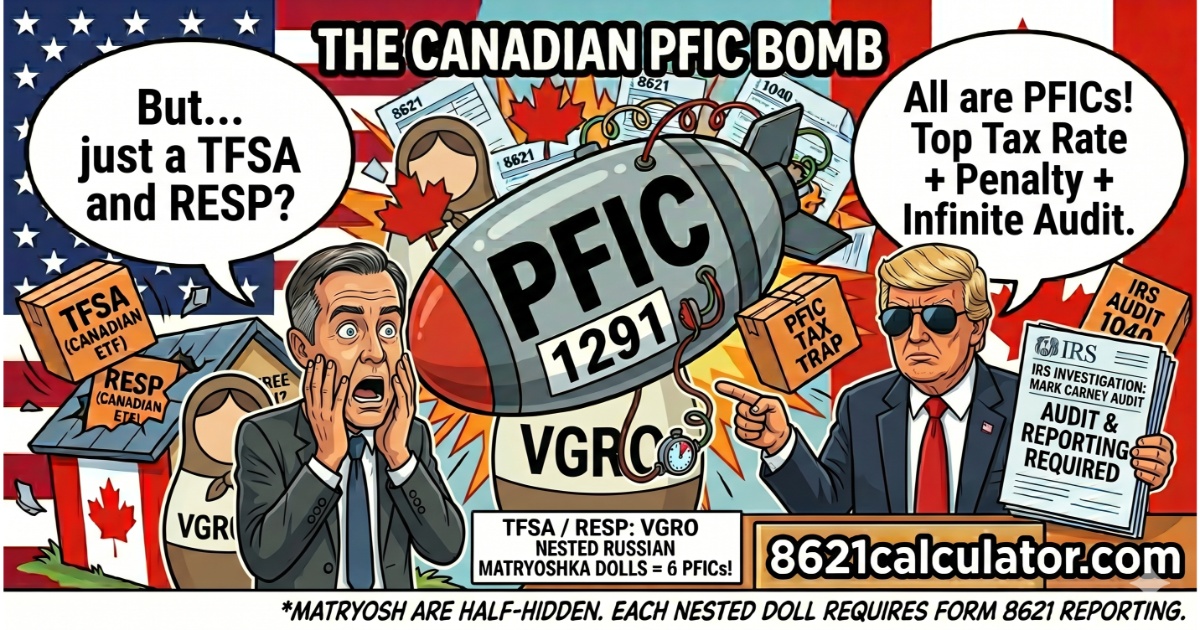
For example, VGRO may require 7 Forms 8621, even though it appears as a single ticker in the brokerage account.
To put this in perspective: a small TFSA position in a nested ETF such as VGRO can create a filing workload that is completely out of proportion to the investment size. A CAD $5,000 VGRO holding may produce only modest investment income or gain, but the U.S. PFIC analysis can still require up to seven Form 8621 work items. That is the practical absurdity of nested Canadian PFICs: the compliance cost can easily overwhelm the tax result.
QEF Election for Canadian Funds: The PFIC "Golden Ticket"
The previous table shows the bad news: Canadian PFICs are common, and nested ETFs can multiply the Form 8621 workload. Canada’s advantage is that QEF is not always just a theoretical election. Some Canadian fund providers publish PFIC Annual Information Statements (AIS) for selected funds and tax years.
Do not assume every Canadian fund provides an AIS. Some ETF providers maintain PFIC reporting resources, and selected fund families such as Manulife may publish an AIS for specific funds. But many traditional bank mutual funds still require fund-by-fund and year-by-year confirmation. The AIS is the "golden ticket": without it, QEF is usually off the table; with it, the entire Form 8621 calculation path changes.
- Annual FMV increase is ordinary income
- No capital gains character on annual MTM inclusions
- No §1291 interest charge after election
- Losses limited by unreversed inclusions
- Available only for marketable PFIC stock
- Does not require fund AIS
- Requires a valid PFIC Annual Information Statement
- Ordinary earnings reported as ordinary income
- Net capital gain may retain long-term capital gain treatment
- No §1291 interest charge after election
- No MTM unreversed-inclusion loss limitation
- Usually better when AIS is available
The tax character difference can be material. For example, a fund with USD $50,000 of net capital gain could produce a USD $8,500 federal rate difference if the gain is taxed at 20% long-term capital gains rates under QEF rather than 37% ordinary income treatment under MTM. The exact result depends on the taxpayer’s facts, but the direction is clear: when AIS is available, QEF can be significantly more favorable than MTM.
VFV PFIC Example: Form 8621 Under QEF, MTM, and §1291
For PFIC investors, QEF is often the clean path and §1291 is the trap. But the difference is hard to appreciate until the numbers are side by side. The VFV simulation below compares the same one-buy, one-sell investment under QEF, MTM, and §1291.
| Date | Detail | Price | Units | Value CAD |
|---|---|---|---|---|
| 2016-01-04 | Buy | 49.76 | 2,009 | 99,968 |
| 2025-12-31 | Sale | 166.62 | -2,009 | 334,740 |
The trade produces an approximate gain of CAD 234,772. To isolate the PFIC method difference, this simulation ignores FX, dividends, DRIP, withholding tax, state tax, and annual distribution reporting. The comparison below uses a 24% ordinary income rate and a 15% long-term capital gains rate.
| Method | Tax Burden | Tax on Gain | Comment |
|---|---|---|---|
| §1291 | 48.45% | 113,746.91 | Deferred tax plus interest at sale. |
| MTM | 24% | 56,345.22 | Annual ordinary-income taxation. |
| QEF | 15% | 35,215.76 | AIS-based annual inclusion; capital-gain character preserved. |
| VOO | 15% | 35,215.76 | Non-PFIC capital-gain baseline. |
The result is straightforward: MTM creates annual cash-flow pressure, QEF can keep the result closer to capital-gain treatment when AIS is available, and §1291 defers the pain until sale — then adds interest.
CAD to USD Conversion for Form 8621: Why Transaction Dates Matter
Canadian PFIC records are usually in CAD, but Form 8621 is filed in USD. The FX burden is mainly a §1291 and MTM problem: §1291 needs transaction-date basis, distributions, and sale proceeds; MTM needs year-end FMV translated at the valuation date.
QEF is different. If the PFIC Annual Information Statement reports ordinary earnings and net capital gain in USD, those AIS figures generally feed directly into Form 8621 Part III. The taxpayer does not need to recreate transaction-date FX for the AIS income itself.
To make matters worse, many Canadian brokers and banks provide only limited online history, often around 7 to 10 years.
Practical Takeaway: Download and keep your full transaction ledger indefinitely (dates, units, CAD amounts, FX source). Do not rely on your broker's history.
The practical takeaway is simple: keep the full transaction ledger. For each PFIC holding, preserve the date, transaction type, units, CAD amount, and the exchange-rate source used for USD conversion. If QEF is available, preserve the exact AIS for the fund and tax year.
Canadian-Listed ETF vs. U.S. ETF: PFIC vs. Non-PFIC Domicile Logic
A Canadian broker does not automatically make an investment a Canadian PFIC. The key issue is fund domicile. A U.S.-domiciled ETF bought through a Canadian broker is generally not a PFIC, while a Canadian-domiciled ETF tracking the same index may still be a PFIC.
| Canadian-Domiciled PFIC | U.S.-Domiciled Alternative | Key Difference |
|---|---|---|
| VFV / ZSP | VOO / SPY / IVV | Similar S&P 500 exposure, different fund domicile. |
| XUU | VTI / ITOT | Similar U.S. market exposure, different wrapper. |
| XEF | EFA / IEFA | Similar international exposure, different fund domicile. |
| VEQT / XEQT | U.S.-domiciled allocation ETFs | Different wrapper and underlying fund structure. |
This is why checking only the index is not enough. VFV may look like VOO because both provide S&P 500 exposure, but VFV is a Canadian-domiciled ETF and VOO is a U.S.-domiciled ETF. For PFIC purposes, that difference controls the Form 8621 analysis.
Relocation Case Study: The Canada-to-U.S. PFIC Trap
One of the most complex PFIC scenarios occurs when a Canadian resident moves to the United States while holding Canadian-domiciled ETFs (e.g., XEQT, VUN, VGRO). As discussed in practitioner circles and communities like r/tax, the primary danger is not just the reporting, but the lack of a cost-basis "step-up" for U.S. tax purposes upon arrival.
First-Year Election Strategies
Once U.S. residency begins, the taxpayer has a narrow window to mitigate the §1291 default regime. The decision tree often looks like this:
- The "Tax Reset" (Cleanest): Sell all Canadian-domiciled ETFs before becoming a U.S. tax resident. This realizes the gain in Canada (often covered by the departure tax) and allows for repurchasing U.S.-domiciled equivalents (like VOO or VTI) with a fresh U.S. cost basis and no PFIC exposure.
- QEF Election: If the fund (like Vanguard Canada or iShares Canada) provides a PFIC Annual Information Statement (AIS), a QEF election can be made in the first U.S. tax year. This avoids the §1291 interest charge but requires annual income inclusion.
- MTM Election: If the ETF is "regularly traded" on a qualified exchange (like the TSX), a Mark-to-Market election is possible. However, this taxes all unrealized appreciation from the arrival date onward as ordinary income every year.
Common PFIC Reporting Mistakes for U.S. Persons in Canada
PFIC compliance in Canada is deceptively complex, but the greatest risk is often procedural rather than mathematical. Under IRC §6501(c)(8), failing to furnish required PFIC information can suspend the normal statute of limitations. Without reasonable cause, the exposure may extend beyond the PFIC item itself; where reasonable cause is established, the suspension may be limited to items related to the missing information. This is why a missing or incomplete Form 8621 is not just a tax-computation issue — it can become a procedural audit-risk issue.
Below are the most frequent errors identified by cross-border practitioners that trigger this exposure:
| Mistake | Why It Happens in Canada | Consequence |
|---|---|---|
| Treating TFSA income as tax-free for U.S. purposes | The TFSA label — "Tax-Free" — is domestically accurate but misleading for U.S. persons | Unreported PFIC income; potentially unreported foreign trust income; open statute of limitations |
| Assuming the US-Canada treaty eliminates Form 8621 obligations | The treaty is comprehensive and well-known; it is easy to assume it covers everything | Missing Form 8621 filings; §6501(c)(8) indefinite statute; potential penalties |
| Ignoring the investment composition of RRSP/RRIF accounts entirely | RRSP/RRIF treaty deferral can cause preparers to stop analysis at the account level | May cause errors when analyzing distributions, treaty deferral, Form 8938/FBAR reporting, or account-level tax characterization |
| Treating a fund switch inside a TFSA or RRSP as a non-event | No cash leaves the account; appears invisible | Fund switch may be a PFIC disposition; unreported excess distribution on the gain |
| Using the IRS annual average CAD/USD rate for basis and proceeds | The annual average rate is prominently published for FBAR purposes and used by many preparers | Wrong USD basis and USD proceeds; materially incorrect gain calculation under Separate Conversion Method |
| Ignoring reinvested distributions as PFIC events | No cash received; account statements may not distinguish between reinvestment and capital growth | Reinvested distributions are still distributions for §1291 purposes; understated Line 15a; corrupted 3-year average |
| Assuming Canadian income tax paid fully offsets U.S. PFIC tax via FTC | Canada taxes investment income; preparers apply FTC as a full offset | The §6621 interest component of §1291 tax is not eligible for FTC; the FTC cannot eliminate the interest charge |
| Not filing a separate Form 8621 for each Canadian fund held | Large fund families (e.g., RBC, TD, Fidelity Canada) with multiple funds may be grouped | Each PFIC requires its own Form 8621; consolidated reporting is not permitted |
| Not recognizing the TFSA or RESP as a potential foreign trust | Focus on the investments inside the account; the account structure itself is overlooked | Potential Forms 3520/3520-A exposure and separate foreign-trust penalty risk if no exception applies |
| Applying MTM rules to unlisted Canadian mutual funds | MTM appears simpler than §1291; preparer applies it without verifying "marketable stock" status | MTM is not available for unlisted funds; the election is invalid; §1291 default applies retroactively |
| Assuming the §1298(f) small-account exception covers distributions received | The $25,000/$50,000 exception is narrow; many preparers apply it too broadly | Any year with a distribution, disposition, or election requires Form 8621 regardless of account size |
| Not tracking individual FIFO lot dates for funds with multiple purchase dates | Monthly automatic contributions to TFSA/RRSP create dozens of lots per year; treated as a single position | Wrong holding period per lot; wrong deferred interest computation; wrong excess distribution allocation |
Frequently Asked Questions
🇨🇦 Canadian Account Rules: TFSA, RRSP, RESP & PFIC
📈 PFIC Status of Specific Funds: VFV, VGRO, CASH.TO
🗳️ PFIC Elections, Thresholds & Reporting Rules
For eligible non-willful taxpayers living outside the United States, the Streamlined Foreign Offshore Procedures may provide a practical compliance path. The procedure generally requires 3 years of delinquent or amended returns, 6 years of FBARs, and a non-willfulness certification, and may help qualifying taxpayers resolve prior-year offshore reporting failures.