💡 Key Takeaways: Form 8621 Line 15e Compliance
- The 2025 Revision: Line 15e is split into 15e(1) (excess distribution in computation currency) and 15e(2) (USD excess distribution amount), clarifying the statutory sequence.
- General USD Rule vs. Single Foreign Currency Exception: Excess distributions are generally calculated in USD. If all distributions to be taken into account are in a single foreign currency, Lines 15a through 15e(1) are completed in that foreign currency before translating to USD on Line 15e(2).
- Spot Rate Translation: Foreign currency excess distribution amounts must be translated into USD at Line 15e(2) using the transaction-date spot rate supported by IRC §989(b)(1) and Proposed Reg. § 1.1291-2(d)(4).
- Elections E/G/H Routing: Deemed dividends from purging elections bypass the 125% historical averaging test and flow directly into Line 15e(2) in USD.
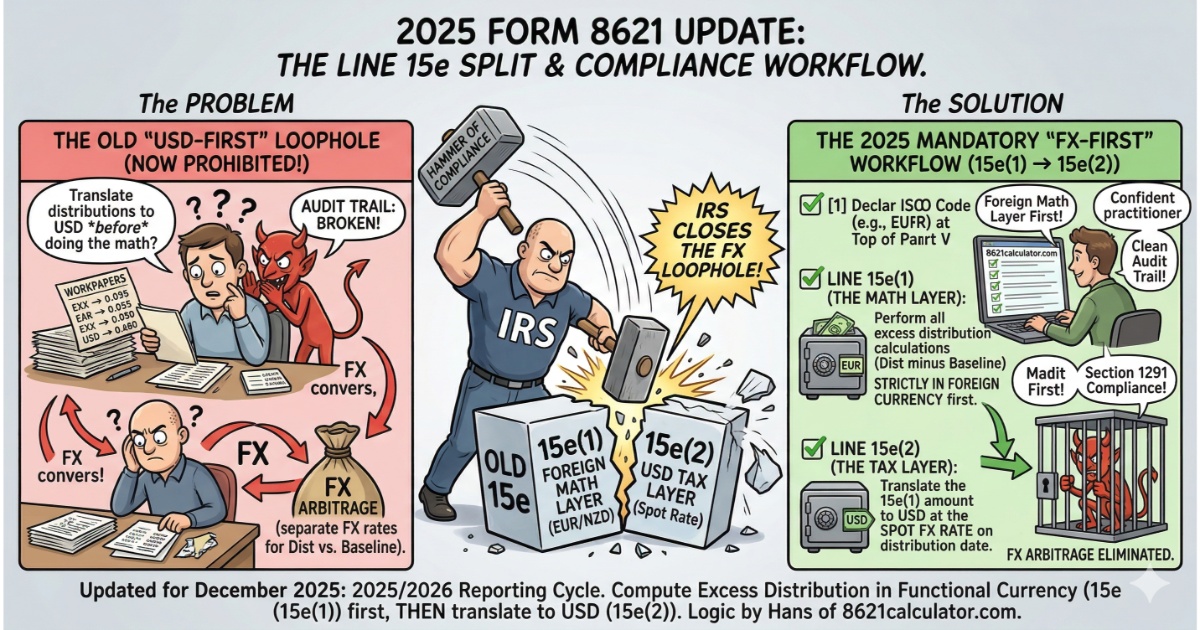
Form 8621 Line 15e Architecture: The Part V §1291 Calculation Chain
Currency Rules: General USD Rule vs. Single-Foreign-Currency Exception
Single-Foreign-Currency Exception: When all distributions taken into account for the §1291 excess distribution calculation are in the same foreign currency, determinations on Lines 15a through 15e(1) are made in that foreign currency. The total excess distribution is then translated into U.S. dollars on Line 15e(2).
Enter the foreign currency ISO code. Perform the entire calculation through Line 15e(1) in that foreign currency. The total excess distribution is then apportioned among the actual distributions and translated to USD at Line 15e(2) using the spot exchange rate on each distribution date.
Enter "USD" as the Currency Code. Each distribution is converted to USD at its transaction-date spot rate before entering Line 15a. Complete Lines 15a through 15e(1) in USD, and Line 15e(2) simply equals Line 15e(1).
Purging Elections (E, G, H): Why Deemed Dividends Bypass Line 15a
Three specific Part II elections bypass the Lines 15a through 15e(1) reporting sequence entirely, routing directly to Line 15e(2). This is one of the most misunderstood routing mechanics in the 2025 form structure.
- Election E (Deemed Dividend, QEF transition): "Enter the excess distribution on line 15e(2) of Part V."
- Election G (Deemed Dividend, former PFIC): "Enter the excess distribution on line 15e(2), Part V."
- Election H (§1298(b)(1) deemed dividend): "Enter the excess distribution on line 15e(2), Part V."
Elections E, G, H vs. Actual Distributions: Line 15e Routing Table
| Event Type | Description | Bypasses 15a–15e(1)? | Enters On | Currency |
|---|---|---|---|---|
| Election E | Deemed dividend on QEF transition (purging election) | Yes — Complete bypass | Line 15e(2) directly | USD |
| Election G | Deemed dividend under former PFIC rules | Yes — Complete bypass | Line 15e(2) directly | USD |
| Election H | Deemed dividend under PFIC-to-CFC transition rules | Yes — Complete bypass | Line 15e(2) directly | USD |
| Election F | Deemed sale — transition to QEF or MTM | Yes — Bypasses 15e entirely | Line 15f directly | USD |
| Actual Distributions | Cash or DRIP distributions received during the year | No — Subject to 125% test | Line 15a → 15e(1) | Computation currency → Translated at 15e(2) |
Note on MTM Transitions: Under IRC §1296(j), transitioning an unpedigreed §1291 fund to Mark-to-Market involves a December 31 deemed disposition recognized on Line 15f, while actual distributions during that transition year remain on Line 15e. For detailed step-by-step reporting and two-step calculator workflows, see our dedicated PFIC §1291 to MTM Transition & Deemed Sale Guide.
Form 8621 Line 15e(2) Translation: Distribution-Date Spot Rate Requirements
IRC §1291(b)(3)(E) provides the statutory PFIC rule: when all distributions taken into account are in a single foreign currency, the §1291 determination must be made in that currency on Lines 15a through 15e(1), and the excess distribution determined in that currency is then translated into U.S. dollars on Line 15e(2).
Under Proposed Reg. § 1.1291-2(d)(4) and IRC §989(b)(1), actual distributions are translated using the spot exchange rate on the date of distribution. This is why a transaction-date spot rate is required rather than an annual average or year-end rate.
Applying Spot Rates to Multiple Distribution Dates: Per-Transaction Accuracy
Each distribution included in Line 15e(2) should be translated into USD using the spot rate on the date of receipt, rather than any averaged or period-based rate.
The 8621calculator.com engine follows this transaction-date methodology by applying verifiable daily FX rates (e.g., OANDA historical rates) to each distribution event.
| Rate Type | Appropriate when translating a foreign-currency Line 15e(1) to Line 15e(2)? |
Authority / Basis | Tax Impact |
|---|---|---|---|
| Daily spot rate on exact transaction date | ✔ Yes — Required | Prop. Reg. § 1.1291-2(d)(4); IRC §989(b) | Accurately reflects realization and timing of excess distribution |
| Treasury annual average rate | ✖ Not appropriate | — | Does not reflect transaction-date realization; distorts interest compounding |
| Annual average rate (OANDA / Bloomberg) | ✖ Not appropriate | — | Still a blended rate, not transaction-specific |
| Year-end rate | ✖ Not appropriate | — | Mismatches timing of income recognition across lookback periods |
| Verifiable daily rate source (OANDA, Bloomberg, bank feed) | ✔ Acceptable | Supports transaction-date translation | Must retain supporting documentation |
Why Line 15e(1) May Result in Zero: Three Legal Excess Distribution Scenarios
The Form 8621 instruction provides that if Line 15e(1) is zero or less, and no disposition occurred, the remainder of Part V is not completed.
However, a zero result at Line 15e(1) can arise from different legal conditions, each with distinct implications.
| Cause of 15e(1) = 0 | Legal Basis | Meaning | Form 8621 Action | Tax Treatment |
|---|---|---|---|---|
| Line 15a ≤ Line 15d | IRC §1291(b) | Current distribution is a non-excess distribution under the 125% test | Stop at Line 15e(1) | Taxed under §301; reported on Form 1040 dividend lines to the extent of E&P |
| First Year of Holding | IRC §1291(b)(2)(B) | Statute prohibits excess distributions in the initial year | Complete Line 15a only; if no disposition, stop | Taxed under §301; to the extent §301(c)(1) applies, reported as a dividend |
| Zero Distributions | N/A | No triggering event occurred during the tax year | Do not complete Part V (unless disposition applies) | No distribution income for the year |
Not all zero results at Line 15e(1) are the same.
- 125% test → non-excess distribution (taxed under §301)
- First-year rule → excess disallowed by statute (taxed under §301)
- No distribution → no triggering event
A blank Part V does not necessarily mean that Form 8621 itself is not required. Annual reporting under §1298(f) must be analyzed separately, including applicable exceptions (such as the $25,000 / $50,000 Part I exception for certain section 1291 fund holdings where the aggregate-value requirement is satisfied and no excess distribution or disposition gain is recognized under Treas. Reg. § 1.1298-1).
The Calculation Pipeline: Flowing Line 15e(2) into the Line 16 Lookback Allocation
Line 15e(2) is the final output of the excess distribution determination. It is the USD amount used in the §1291 lookback computation at Line 16.
The "Reporting Gap": Why Line 15e(1) ≠ Line 15a minus Line 15d
A common error among practitioners is assuming that Line 15e(1) = Line 15a − Line 15d as a single annual total.
The problem is not the subtraction itself; Form 8621 performs this subtraction at Line 15e(1). At the individual applicable-stock block level, Line 15e(1) is Line 15a minus Line 15d. The gap described here arises when different holding-period blocks are incorrectly combined into one annual aggregate.
IRC §1291(b)(3)(A) requires the determination to be made on a share-by-share basis, although shares with the same holding period may generally be grouped.
This statutory filter is the primary cause of the "gap." It dictates that any lot acquired in the current tax year produces zero excess distribution, regardless of the distribution amount.
Case Study: Per-Lot Line 15e(1) Calculation with First-Year Exclusion
You have the following activity:
| Date | Details | Units | Value |
|---|---|---|---|
| 2024-01-15 | Purchase | 200 | 500 |
| 2024-05-15 | Purchase | 200 | 600 |
| 2024-09-15 | Purchase | 200 | 600 |
| 2025-05-15 | Purchase | 200 | 700 |
| 2025-09-15 | Purchase | 200 | 700 |
| 2025-12-15 | Distribution | — | 300 |
Step 1 — Total holdings at distribution date
Total units: 200 × 5 = 1,000 units
Step 2 — Allocate distribution per unit
2025-12 Distribution: 300
Per unit distribution: 300 ÷ 1,000 = 0.30
So each 200-unit lot receives → 200 × 0.30 = 60
Step 3 — Form 8621 Per-Lot Structure
| Lot | Purchase Date | Units | Distribution Allocation |
Holding Year |
15d (Threshold) |
15e (Excess) |
|---|---|---|---|---|---|---|
| Lot 1 | 2024-01-15 | 200 | 60 | 1 | 0 | 60 |
| Lot 2 | 2024-05-15 | 200 | 60 | 1 | 0 | 60 |
| Lot 3 | 2024-09-15 | 200 | 60 | 1 | 0 | 60 |
| Lot 4 | 2025-05-15 | 200 | 60 | 0 | — | 0 |
| Lot 5 | 2025-09-15 | 200 | 60 | 0 | — | 0 |
*Algorithmic excess = 0. On the filed Form 8621, first-year applicable stock stops after Line 15a if there is no disposition.
Step 4 — Apply §1291 rules (The Result)
- Line 15a = 300
- Old lots portion = 60 × 3 = 180
- Current-year lots portion = 60 × 2 = 120
Maximum 180
At most 180 can enter the 15e(1) excess distribution test. (Subject to the 125% historical average test).
Zero Excess
Per §1291(b)(2)(B), the 120 cannot produce excess distribution in the first year of the holding period.
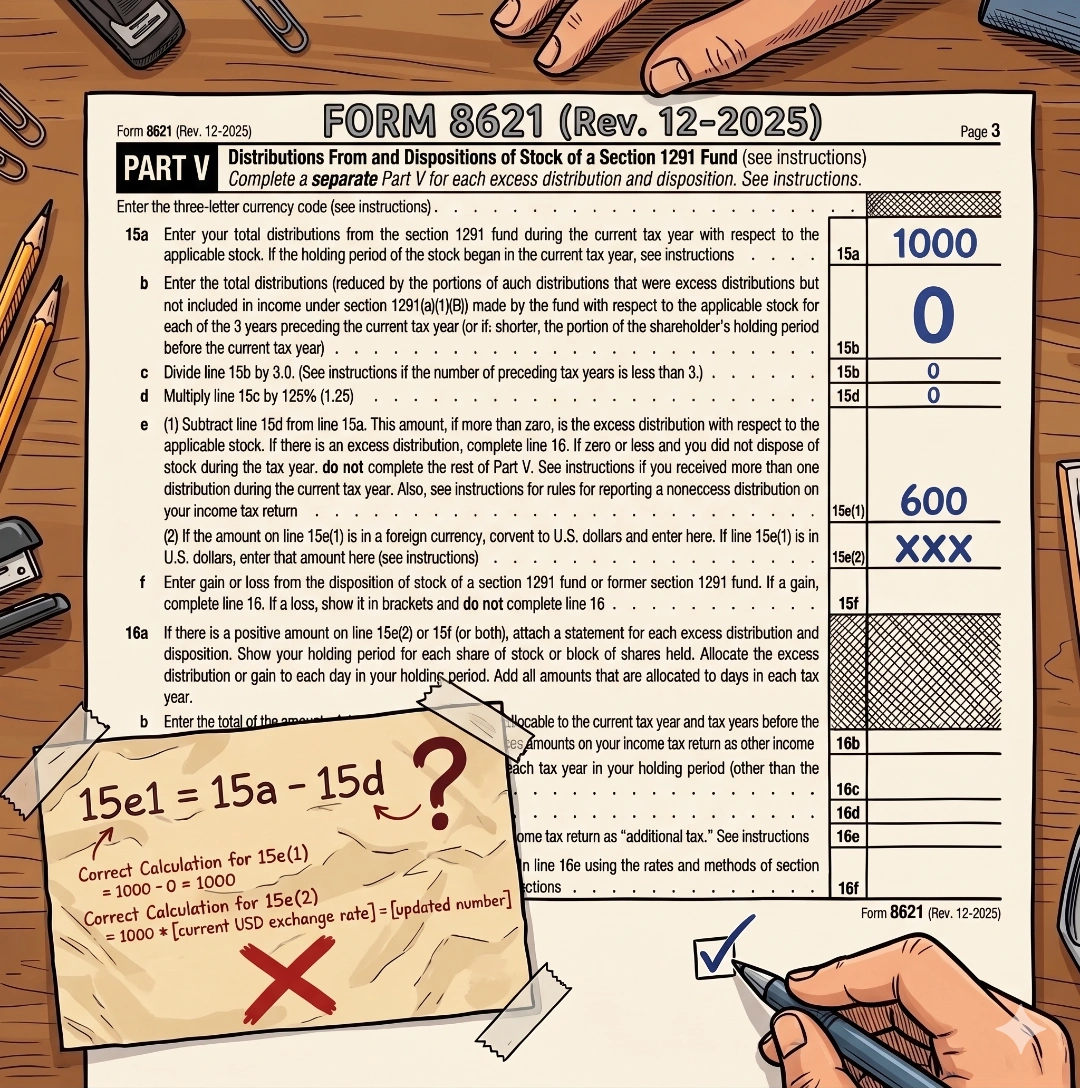
Line 15a shows the full 300 distribution, but only the 180 allocated to pre-2025 lots can enter the §1291 excess-distribution test. The $120 allocated to first-year stock is not an excess distribution and is taxed under §301; to the extent §301(c)(1) applies, it is treated as a dividend.
In short, that missing 120 is:
- ✔️ included in Line 15a
- ❌ excluded from Line 15e(1)
- ✔️ taxed according to §301
The First-Year Exclusion (§1291(b)(2)(B)) dictates that the $120 does not generate an excess distribution; for the actual first-year Part V, reporting stops after Line 15a if there is no disposition. The amount is taxed under §301 (as dividend income on Form 1040 to the extent of E&P).

Technical Audit: Systematic Form 8621 Line 15e Calculation Errors
What Happens: Current-year lots incorrectly generate excess distributions because aggregation ignores holding-period structure.
Direction: Excess overstated.
Fix: Compute per lot first, then aggregate. Excess must be determined at the lot level. First-year lots must contribute zero to Line 15e.
What Happens: USD excess distorted because distributions are translated using averaged rates instead of transaction-date rates.
Direction: Either direction.
Fix: Use daily spot rate (e.g., OANDA) for each distribution date. §1291 excess distributions are transaction-based, not annual aggregates.
What Happens: Artificial gain/loss created from FX movement when all distributions were in a single foreign currency.
Direction: Either direction.
Fix: When all distributions are in the same foreign currency, perform all computations through Line 15e(1) in that computation currency; translate to USD only at Line 15e(2).
What Happens: Deemed dividends from purging elections (E, G, or H) are incorrectly subjected to the 125% historical average test.
Direction: Routing error.
Fix: Per Form 8621 instructions, deemed dividends from purging elections flow directly into Line 15e(2) in USD. They completely bypass the 125% test logic of Lines 15a–15d.
What Happens: Multiple distributions translated at an incorrect uniform rate, ignoring timing differences.
Direction: Either direction.
Fix: Under the single-foreign-currency rule, apportion the total excess distribution among the actual distributions and translate each apportioned amount using the spot rate for its distribution date.
What Happens: IRS cannot verify holding-period allocation of excess distribution.
Direction: Filing exposure.
Fix: Provide a detailed allocation statement (Line 16a support) whenever Line 15e(2) or Line 15f is positive.
What Happens: §1291 methodology incorrectly applied to funds under a different regime.
Direction: Wrong regime.
Fix: QEF and MTM regimes generally use Parts III and IV, respectively, but §1291 overlays can remain for an unpedigreed QEF and in the first year of certain MTM elections under §1296(j) and Treas. Reg. § 1.1296-1(i).
All Line 15e errors share the same root cause: failure to respect the three structural rules of §1291 computation:
- Lot-level determination precedes aggregation.
- Distributions are transaction-based, not annual totals.
- Currency translation occurs only after excess is determined (under single foreign currency rule).
Any system that violates one of these will produce systematically incorrect Line 15e results.
Practitioner FAQ: Form 8621 Line 15e & §1291 Compliance
Why is Form 8621 Line 15e lower than Line 15a minus Line 15d?
Does Form 8621 Line 15e(2) round to a whole dollar or include cents?
How do I calculate Line 15e if my PFIC distributes in multiple currencies?
Do monthly PFIC distributions require 12 separate Form 8621 Line 16a statements?
If Line 15e(2) is zero but Line 15f is positive, is the Line 16a allocation still required?
Can a late QEF or MTM election avoid §1291 Line 15e excess distribution tax?
What is the difference between Line 15e(1) and Line 15e(2) on the 2025 Form 8621?
How does a purging election (like Election E, G, or H) route on Form 8621 relative to Line 15e?
Can I use the IRS annual average exchange rate to translate Line 15e(1) into Line 15e(2)?
If my PFIC had zero distributions during the year, do I still need to calculate Line 15e?
Official Sources and References
- 🔗 Purging §1291 Taint & MTM Transition: PFIC §1291 to MTM Transition & Deemed Sale Guide — Complete Form 8621 line routing and workpapers for §1296(j) coordination.
- 🔗 IRS Form 8621 (PDF): Official IRS PDF form for Passive Foreign Investment Company reporting.
- 🔗 Instructions for Form 8621 (PDF): Official IRS instructions for completing Form 8621 (Rev. December 2025).
- 🔗 Proposed Treas. Reg. § 1.1291-2(d)(4): Operational rules for foreign currency excess distribution calculations and multi-distribution apportionment (cited in Form 8621 Instructions).
- 🔗 IRC §1291: Statutory tax rules for PFIC excess distributions and interest calculations.
- 🔗 IRC §989(b)(1): Statutory spot rate translation rules for actual distributions.
- 🔗 IRC §6621: Compounded interest rate rules on underpayment and PFIC deferrals.
Content reflects Form 8621 (Rev. 12/2025), applicable Treasury Regulations, IRS guidance, and other authorities cited on this page.