
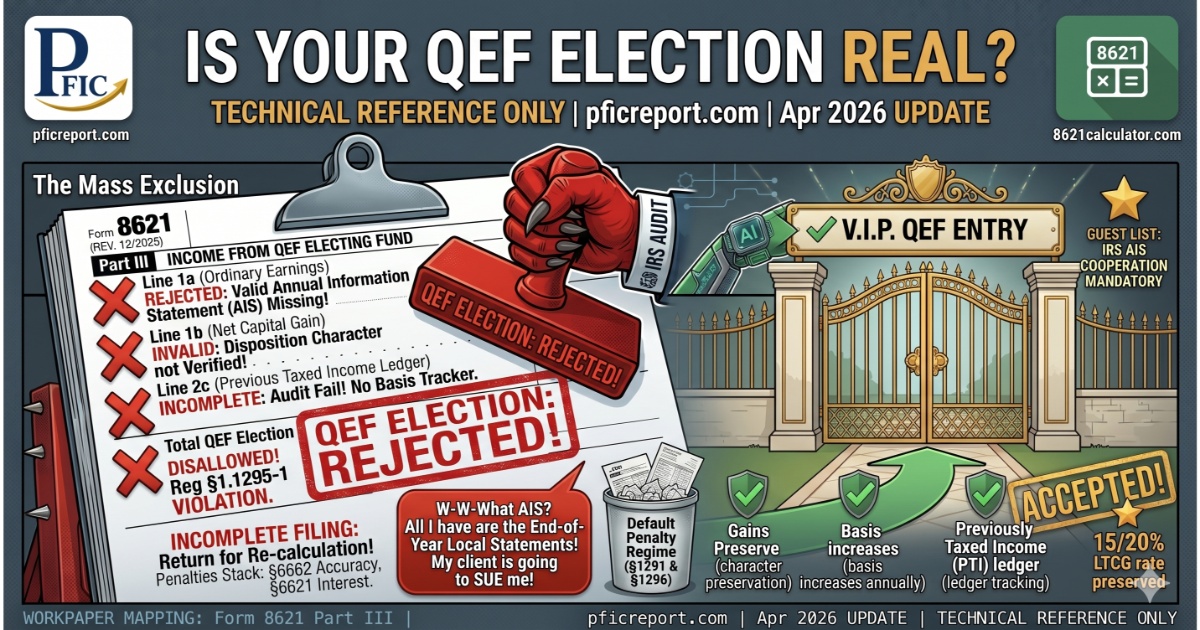
Annual Information Statement (AIS): PFIC QEF Election Requirements
QEF Availability by Asset Class:
- U.S.-domiciled funds and direct equities: normally are not PFICs, so a QEF election is generally not relevant.
- Canadian funds: major issuers (Vanguard, iShares, BMO, CI) routinely publish compliant statements. See our dedicated guide to Canadian ETF AIS.
- European UCITS & other foreign funds: European PRIIPs KIDs or KIIDs do not satisfy IRS AIS rules; review our European AIS & KID Guide. Other foreign funds rarely provide an AIS, making timely QEF elections unavailable in practice.
Under Treas. Reg. §1.1295-1(g)(1), an Annual Information Statement must provide either the shareholder's pro-rata share of earnings or sufficient information to enable the shareholder to calculate their pro-rata ordinary earnings and net capital gain, alongside required administrative representations:
- ✅ Pro-Rata Ordinary Earnings — the shareholder's pro-rata share of ordinary earnings (as defined in §1293(b)) computed under U.S. tax accounting principles, or sufficient per-share / allocation data to calculate this amount.
- ✅ Pro-Rata Net Capital Gain — the shareholder's pro-rata share of net capital gain (excess of net long-term capital gain over net short-term capital loss), or sufficient per-share / allocation data.
- ✅ Distributions — the amount of cash and the fair market value of other property distributed or deemed distributed to the shareholder during the PFIC's taxable year (or per-share distribution figures).
- ✅ IRS Inspection Representation — a written statement by an authorized officer of the PFIC confirming that the fund will permit the IRS to inspect and copy its permanent books of account and records (or a designated U.S. representative statement). Omitting this representation invalidates the AIS.
- ✅ PFIC Identification & Tax Year — fund legal name, address, taxpayer identification number (if any), and the taxable year of the PFIC to which the statement applies.
Annual Documentation: In each subsequent year, the shareholder must obtain a compliant AIS to support the annual Part III income inclusion. If the fund fails to provide an AIS in a subsequent year, the taxpayer cannot compute the annual QEF inclusion and faces potential invalidation or termination of QEF status upon IRS audit, but the election does not automatically vanish without legal process.
Alternative PFIC AIS & Intermediary Statements (Treas. Reg. §1.1295-1(g)(2)–(3))
A PFIC may provide an Alternative AIS or an Annual Intermediary Statement addressed through a nominee/brokerage rather than directly to each individual U.S. shareholder. This structure is common for institutional European UCITS or Canadian funds delivering AIS data through custodial networks.
Form 8621 Part III Calculation: Step-by-Step QEF Election Example
The core logic of the QEF election is highly counterintuitive for most taxpayers. It revolves around two concepts: Phantom Income (paying tax on money you haven't received) and Basis Adjustment (protecting you from being taxed twice). Let's walk through a realistic 1-year scenario to see how the math actually works.
• Ordinary earnings per share = $0.48
• Net capital gain per share = $1.12
• Total distributions per share = $0.65
Initial Basis at start of 2025: $25,000.
The 3-Step "Basis Breathing" Process
- Step 1: The Inclusion (Lines 6a & 7a). Even though the fund only distributed $0.65 per share, you are taxed on its actual earnings. You must report $1,200 of ordinary income on Line 6a (2,500 × $0.48) and $2,800 of net capital gain on Line 7a (2,500 × $1.12). This total $4,000 "phantom income" goes on your current year tax return.
- Step 2: The Distribution. Assume the $1,625 distribution is previously taxed QEF income. It is not taxed again.
- Step 3: The Basis Adjustment. To prevent you from paying tax on that $4,000 again when you eventually sell the fund, basis increases by the $4,000 inclusion. Because this example assumes the the previously taxed $1,625 distribution. Net basis increases by $2,375.
🧮 Interactive QEF Basis Calculator
Adjust the inputs below to see exactly how different earnings and distributions change your tax liability and your adjusted cost basis. (Values are pre-loaded with our UCITS example).
📝 Form 8621 Inclusions
🛡️ Basis Adjustment
QEF vs. §1291: 5-Year Tax Comparison & Savings Analysis
Looking at the single-year math above, the QEF election might seem like a burden—you are paying taxes out-of-pocket today on "phantom" income you haven't received. So why do CPAs insist on it?
The true value of QEF only becomes obvious when you zoom out. If you do not make the QEF election, you fall into the default §1291 Throwback Regime. Under §1291, the IRS punishes you for deferring taxes by deploying three aggressive tax traps when you eventually sell the fund:
- Loss of Capital Gains Rates: Under QEF, capital gains keep their preferential rates (15% or 20%). Under §1291, all gains are converted to ordinary income.
- The Highest Bracket Penalty: The IRS allocates your gain evenly across your entire holding period. Past years' gains are taxed at the highest possible statutory tax rate for those years (e.g., 37% or 39.6%), regardless of your actual income bracket back then.
- Compounding Interest Charge: On top of the maximum tax, the IRS charges you daily compounding interest for "late payment" on the gains allocated to past years.
Here is how that exact same UCITS fund from our example performs over a 5-year holding period under QEF versus the default §1291 regime.
| Tax Metric | §1295 QEF (5 years) | §1291 Default (5 years) | QEF Advantage |
|---|---|---|---|
| Annual tax on OI | $1,200 × 37% = $444/yr | $0 (deferred) | QEF pays as you go |
| Annual tax on CG | $2,800 × 15% = $420/yr | $0 (deferred) | CG taxed at preferential rate |
| §1291 lookback interest (5 yrs) | $0 | ~$1,200–$1,800 | Saves $1,200–$1,800 |
| §1291 throwback rate on gain | N/A — QEF regime | Top ordinary rates (no LTCG) | CG rate saves 17–22% |
| Total 5-yr estimated tax (on $20K total gain) | ~$4,320 | ~$8,000–$9,200 | ~$3,700–$4,900 less |
| Basis at end of period | Fully stepped up | Original cost only | No double tax on sale |
Illustrative scenario only. Actual results depend on the fund's income, tax rates, holding period and distributions.
Section 986(c) Foreign Currency Gap in QEF Reporting
One of the most complex and frequently audited aspects of QEF reporting is the mandatory dual-rate system for foreign currency funds:
- The Inclusion (§ 989(b)(3)): Your annual QEF ordinary earnings must be translated into USD using the weighted average exchange rate for the entire tax year.
- The Distribution (§ 1293(c)): When those previously taxed earnings (PTI) are actually distributed, they are translated at the spot rate on the exact date of distribution.
Pedigreed vs. Unpedigreed QEF: Purging §1291 Taint
Not all QEF elections start with a clean slate. The distinction between pedigreed and unpedigreed QEF is one of the most practically important — and most misunderstood — aspects of the §1295 election.
| Attribute | Pedigreed QEF | Unpedigreed QEF |
|---|---|---|
| Definition | QEF election made in the first tax year the shareholder held the PFIC (and the fund was a PFIC) | QEF election made after one or more years of §1291 exposure |
| §1291 taint | None — §1291 never applied | §1291 taint exists for prior years; remains until purged |
| On future gains/distributions | Full QEF treatment — no lookback | Future distributions still subject to §1291 lookback unless purging election made |
| Purging election needed? | No | Yes — Election E (Deemed Dividend) or Deemed Sale to clear prior §1291 taint |
| Practical result | Clean — all future income under QEF regime | Complex — need to compute §1291 on purge event, then QEF going forward |
Retroactive QEF Election (§1295): The Exclusive Relief Rules
A missed QEF election cannot be fixed merely by filing an amended return. Treas. Reg. §1.1295-3 provides the exclusive rules for a retroactive QEF election, and Rev. Proc. 2026-10 supplies the current consent-request procedure. General extension relief under Treas. Reg. §§301.9100-1 through -3 is not available for a QEF election.
There are two regulatory paths:
- Protective-regime path: Treas. Reg. §1.1295-3(b) can apply only when the shareholder timely filed the prescribed protective statement, reasonably believed the corporation was not a PFIC, and complied with the statement's continuing requirements.
- IRS-consent path: A shareholder who does not qualify for the protective regime must
request the Commissioner's consent under Treas. Reg. §1.1295-3(f). Rev. Proc. 2026-10 requires a formal
ruling submission, taxpayer and adviser affidavits, eligibility representations, historical QEF
computations, and the applicable user fee.
2026 fee note: the standard fee for an "all other" letter-ruling request is $43,700, not the §301.9100 fee. Reduced fees of $3,450 or $9,775 may apply based on gross income, and separate fees generally apply to each PFIC. Confirm the fee schedule in effect on the submission date.
Common Form 8621 Errors: Why QEF Elections Get Disallowed by the IRS
Avoid these six common pitfalls that frequently trigger IRS audits and result in the disallowance of QEF elections.
| Error | What Taxpayers Do | Why It's Wrong | Consequence |
|---|---|---|---|
| Filing Part III without the required annual information | Elect QEF and estimate Part III income without obtaining a direct or intermediary statement or qualifying alternative documentation | The shareholder may be unable to support the QEF calculation and required representations. | The QEF reporting position may be challenged; corrections, additional tax, interest, or penalties may apply depending on the resulting treatment and available defenses. |
| Confusing an ongoing election with annual substantiation | Make the QEF election in Year 1, then stop collecting the information needed for later Part III reporting | A QEF election generally continues until revoked or terminated, but the shareholder still needs the annual information required to compute and support each year’s §1293 inclusions. | The annual return may be incomplete or unsupported. Review the statement, intermediary, and unusual-circumstances rules before deciding how to correct the year. |
| Making an unpedigreed QEF without a purge | Switch from §1291 to QEF mid-holding without making a deemed-sale or deemed-dividend purging election | Prior §1291 taint remains. Future distributions may trigger §1291 lookback on the unpurged prior period. | Ongoing §1291 exposure despite paying annual QEF inclusions — double burden with no clean outcome. |
| Missing the first-year election deadline | Acquire PFIC in Year 1, realize QEF election should be made in Year 2 (after filing deadline) | The first-year election window is closed. Year 1 is now a §1291 year, creating the unpedigreed QEF problem for all future years. | A retroactive election is available only under Treas. Reg. §1.1295-3. Otherwise, evaluate an unpedigreed QEF and any purging election under the taxpayer's facts. |
| Using estimated or translated AIS figures | Fund provides AIS in local currency or local accounting standards; taxpayer translates without adjusting to U.S. tax concepts | AIS must reflect U.S. tax accounting concepts. Crucially: If AIS data is in foreign currency, adjustments to U.S. tax standards must be made in the native currency FIRST, before applying the § 989 weighted average rate. Local GAAP ordinary income ≠ U.S. tax "ordinary earnings" under §1293(b). | Incorrect Part III inclusions. Potential underpayment or overpayment, and IRS challenge on examination. |
| Not increasing basis for QEF inclusions | Report QEF inclusions annually but fail to track basis adjustments; sell at unadjusted original cost basis | §1293(d) requires basis to be increased by included amounts. Failure to do so results in double taxation on sale. | Overpayment of tax on sale — gain reported on sale includes amounts already taxed as QEF inclusions. |
QEF Substantiation and Assessment-Period Risk
Public QEF-specific case law is limited, so this guide relies on the Code, Treasury Regulations, current Form 8621 instructions, and published IRS procedures rather than unverifiable examination anecdotes.
Retroactive QEF: Treas. Reg. §1.1295-3 is the exclusive relief rule; general §301.9100 relief is unavailable. Without valid supporting information, the QEF position may fail and §1291 may apply.
- Corrected tax treatment — §1291 may apply to an excess distribution or disposition if no valid QEF treatment controls
- Interest — underpayment interest and any §1291 interest charge are computed under their separate rules
- Penalties — §6662 or a failure-to-pay provision may apply only when its requirements are met, subject to applicable reasonable-cause and other defenses
- §6501(c)(8) assessment-period suspension — the period generally remains open until three years after the required information is furnished; reasonable cause can limit the expanded scope to items related to the reporting failure
Compliance FAQ: QEF Elections & Calculations
My broker says my fund is a QEF — do I still need an AIS?
Can I switch from QEF back to §1291 if QEF becomes too costly?
My PFIC fund had zero income or a net loss this year — do I still need to file Part III?
If I make a QEF election and pay annual inclusions, do I pay tax again when I sell?
Can I make a QEF election for a PFIC inside a U.S. IRA or 401(k)?
No Filing Requirement: For assets held in Traditional IRAs, Roth IRAs, 401(k)s, and 403(b)s, the requirement to file Form 8621 is generally waived. Since the income inside these accounts is already tax-deferred or tax-exempt under other IRC sections, the PFIC rules "step aside."
No Tax or Interest Charges: Because these accounts are exempt from current taxation, there are no "excess distributions" to tax, and the § 1291 interest charge never triggers. Making a QEF election would be redundant as it aims to provide a tax benefit you already possess via the account structure.
Important Exception — Foreign Pensions: This regulatory "safe harbor" applies strictly to U.S. qualified plans. Foreign retirement accounts—such as a Canadian TFSA or Australian Superannuation—do not automatically qualify for this exemption. Unless a specific tax treaty provides look-through protection, those accounts remain subject to full PFIC reporting and potential § 1291/QEF/MTM requirements.
Can a QEF election be made on a jointly held PFIC?
How do I calculate QEF inclusions when I didn't hold the PFIC for the full tax year?
Is QEF always better than MTM when both elections are available?
Official Sources and References
- 🔗 IRC §1295: Statutory framework governing the Passive Foreign Investment Company QEF election.
- 🔗 IRC §1293: Rules for current-year tax inclusions of QEF ordinary earnings and capital gains.
- 🔗 Treas. Reg. §1.1295-1: IRS regulatory requirements for the QEF Annual Information Statement (AIS).
- 🔗 Treas. Reg. §1.1295-3: Exclusive statutory rules for retroactive QEF election relief (excluding §301.9100).
- 🔗 Rev. Proc. 2026-10: Current IRS ruling procedure for §1.1295-3(f) retroactive QEF consent requests.
- 🔗 Rev. Proc. 2026-1: 2026 letter-ruling user-fee schedule, including reduced-fee thresholds.
- 🔗 IRC §6621: Determination of federal underpayment rates applied to PFIC interest calculations.
- 🔗 Treas. Reg. §1.1291-1: General rules and tax coordination for Passive Foreign Investment Companies.
Content reflects Form 8621 (Rev. 12/2025), applicable Treasury Regulations, IRS guidance, and other authorities cited on this page.