TECHNICAL CASE STUDY · 10-YEAR LONGITUDINAL MODEL

PFIC §1291 vs. §1296 MTM: Tax Consequences of Holding a Foreign ETF for 10 Years

This case study compares the precise U.S. tax consequences of holding a foreign S&P 500 ETF under the PFIC §1291 default rules versus the §1296 mark-to-market election. To ensure a flawless comparison, our model isolates pure capital gain: USD only, no FX variations, no dividends, and no fees.

Model Assumptions: Gain-Only PFIC Tax Comparison

To isolate one thing—how the same gain is taxed under different regimes—we use a clean, gain-only comparison based on historical price data.

Item Assumption
Asset Foreign-domiciled S&P 500 ETF
PFIC status Assumed PFIC under IRC §1297
Initial cost $100,000
Gross gain $276,360
Taxpayer rate 24% Ordinary Rate
Variables Excluded FX, Dividends, Fees, NIIT, State Tax (Not modeled)

Why the Same ETF Triggers PFIC Tax Treatment

Under IRC §1297, a foreign corporation is a PFIC if it triggers either the Income or Asset test. A foreign-domiciled ETF holding portfolio stocks almost always meets these criteria, regardless of its local exchange listing (VFV, USF, VUAG, etc.).

Test Trigger Threshold
Passive Income Test 75% or more passive income
Passive Asset Test 50% or more passive assets

The Foreign ETF Gain: $100,000 to $376,360

Event Date Price Units Total Value
Buy 2016-01-04 $5.33 18,761.7 $100,000
Sell 2025-12-31 $20.06 18,761.7 $376,360

Total Gross Gain: $276,360

Asset Growth Model (涨幅百分数)
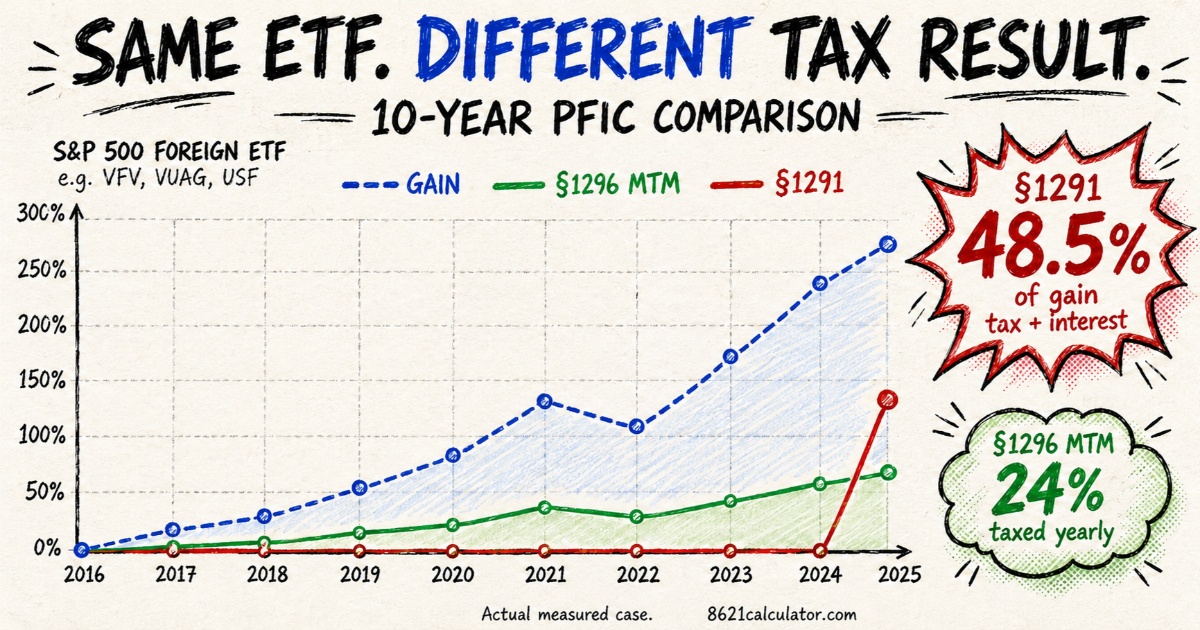
Representative 10-year tracking of foreign S&P 500 growth.

§1291 Tax Consequences: Excess Distribution and Interest Charge

Under IRC §1291, the taxpayer does not pay annually. The tax hits on sale. The $276,360 gain becomes an "excess distribution." The gain is allocated across the holding period. Prior-year buckets are taxed under the §1291 highest-rate rule, then charged IRS interest.

Item Amount
Gross gain $276,360
Estimated §1291 tax + interest $134,035
After-tax gain $142,325
Gain retained 51.5%

§1291 punishes deferral. The longer the holding period, the more gain gets pushed into prior-year buckets. Interest compounds the damage.

§1296 MTM Tax Consequences: Annual Ordinary Income

Under IRC §1296, the taxpayer elects MTM. The ETF is marked to market each year. Annual appreciation is ordinary income. This model assumes the taxpayer’s ordinary income rate is 24% every year.

Item Amount
Gross gain taxed through MTM $276,360
Tax at 24% $66,326
After-tax gain $210,034
Gain retained 76.0%

MTM does not wait for sale. It taxes gain annually. No §1291 interest charge builds up.

10-Year PFIC Comparison: §1291 Compounding Interest Bomb vs. §1296 MTM Yearly Tax
10-Year PFIC Comparison: §1296 MTM bleeds you yearly for paper gains you haven't even touched, while §1291 waits patiently for you to sell, just so the IRS can drop a compounding interest bomb and forcibly "share your victory."

Side-by-Side Tax Result: §1291 vs MTM

PFIC Tax Burden Path: §1291 vs. §1296 MTM
Tax + Interest as a % of cumulative profit. Historical §6621 rates applied.
Method Code Tax Engine Tax Result
Default PFIC §1291 Sale gain allocated backward + highest-rate rule + interest $134,035
Mark-to-Market §1296 Annual ordinary income at taxpayer’s 24% rate $66,326

What the 24% Tax Rate Means in This Model

The 24% rate is only the taxpayer’s assumed ordinary income bracket. It applies to the MTM model because §1296 inclusions are ordinary income. It does not replace the §1291 prior-year highest-rate rule. §1291 has its own statutory tax-and-interest engine.

Key Takeaways: PFIC Tax Consequences Comparison

Fact Pattern Result
High-growth foreign ETF §1291 becomes expensive
10-year holding period Interest charge matters
No QEF election Default PFIC regime applies
Valid MTM from year one Annual taxation avoids §1291 buildup
Hans
🛠️ Developer’s Note: Keep the Engines Pure

For §1291: allocate gain by holding-period days, split by tax year, apply highest-rate logic to prior-year buckets, then compute IRS interest. For §1296: mark FMV annually, include positive annual gain as ordinary income, tax at the taxpayer’s selected ordinary rate, and adjust basis.

Do not mix the engines. Do not apply the MTM tax rate to §1291 prior-year buckets. Do not let FX, dividends, or fees contaminate a gain-only comparison.

Form 8621 Reporting: Disclosure Is Not Taxation

  • FBAR: Reports foreign accounts.
  • Form 8938: Reports foreign financial assets.
  • Form 8621: Reports PFIC tax consequences.

Disclosure is not taxation. PFIC tax is computed specifically on Form 8621.

PFIC Tax Consequences FAQ: Strategic Comparisons

Common technical questions regarding the long-term impact of IRC §1291 vs. §1296 MTM election.

What is the difference between PFIC §1291 and MTM election?

PFIC §1291 is the default regime. It waits until sale or excess distribution, allocates gain backward across the holding period, applies the highest-rate rule to prior-year buckets, and adds IRS interest. MTM election under IRC §1296 taxes annual unrealized gain as ordinary income. Same foreign ETF, same gain, different Form 8621 tax result.

Why is PFIC §1291 tax so punitive?

IRC §1291 is punitive because it charges for deferral. The IRS does not simply tax the gain in the sale year. It pushes prior-year portions into historical PFIC years, applies the highest-rate rule, and adds interest. For long-held foreign ETFs, the interest charge can become the real damage.

Is PFIC mark-to-market election better than §1291?

MTM is not always better, but in this 10-year high-growth foreign ETF model, §1296 MTM produces the cleaner tax result. It taxes annual gain at the taxpayer’s assumed ordinary rate and prevents the §1291 interest charge from building up. The tradeoff is annual tax on unrealized gain.

Does PFIC MTM election create phantom income?

Yes. Under IRC §1296, a marketable PFIC is marked to market each year. If the ETF rises, the taxpayer reports ordinary income even without selling shares. That is phantom income. MTM creates annual cash-flow pressure, but it avoids the larger §1291 exit-year tax and interest problem.

What happens if I missed the first-year PFIC MTM election?

A late MTM election does not erase old §1291 history. The foreign ETF may become an unpurged PFIC: old years remain under §1291, while future years may move into MTM. To clean the position, the taxpayer may need a purging election, usually through a deemed sale.

How are PFIC losses treated under §1291 vs MTM?

Under §1291, the regime mainly targets excess distributions and gain on sale; it does not give the same annual loss recovery mechanism. Under §1296 MTM, losses can be deducted only up to prior unreversed MTM inclusions. MTM gives a limited loss shield, not unlimited ordinary-loss treatment.

Do I need Form 8621 for a foreign ETF?

A U.S. taxpayer may need Form 8621 if the foreign ETF is a PFIC and there is a distribution, sale, MTM election, QEF election, or annual PFIC reporting requirement. FBAR and Form 8938 disclose foreign accounts or assets. Form 8621 reports PFIC tax consequences.
PFIC 101
Learn why a foreign ETF becomes a PFIC under §1297.
Election Guide
Compare QEF election tax consequences against MTM.
Disclaimer: This simulation isolates gain-only tax effects for technical comparison. Real-world results vary based on individual tax brackets, actual IRS interest rates, and foreign tax credits. Consult a U.S. tax professional.
Current as of May 2026 · Based on Form 8621 (Rev. 12/2025)