ALGORITHM · IRC §1298(f) · UPDATED AUGUST 14, 2026
Form 8621 Threshold and PFIC Filing Exceptions
Do you need to file Form 8621 every year? This guide explains the $25,000 PFIC reporting threshold, the $50,000 joint-return threshold, and the income, gain, distribution, and election triggers that can prevent the de minimis exception from applying.
$25,000Individual Threshold
$50,000Joint Return Threshold
ExemptFiling
Exceptions
Filing Compliance
📅 Updated August 14, 2026⏱️ 10 min read📂 Technical Reference
The most expensive mistake PFIC investors make is assuming: “My holdings are under
$25,000, so I don't need to file.” That assumption is often wrong.
Not sure whether a PFIC filing trigger applies before reaching the threshold analysis?
Start with the free Do I Need to File
Form 8621? filing test, then use the four-condition test below for the limited annual-reporting
exception.
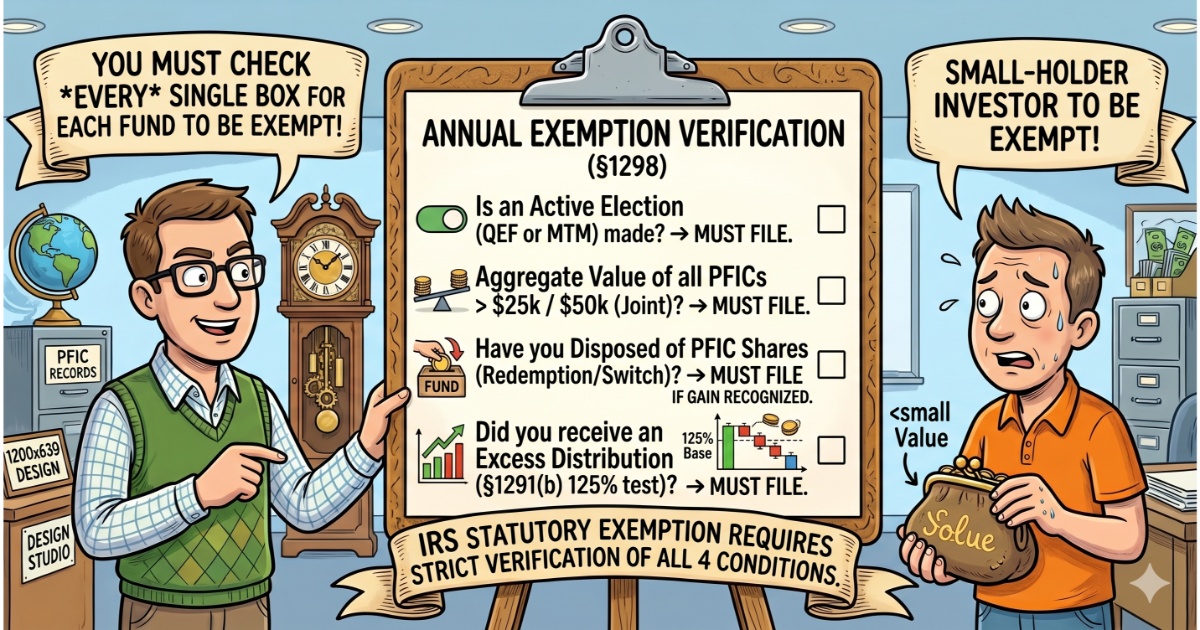
Form 8621 $25,000 Threshold: The §1298(f) Four-Condition Test
Form 8621 Exemption Condition Verification: IRC Section 1298(f)
Checklist for the $25,000 PFIC Small-Holder Exception.
Under Treas. Reg. §1.1298-1, every U.S. person that is a direct or indirect
shareholder of
a PFIC must file Form 8621 annually. Run each foreign fund you hold through this exact sequence to determine
if you qualify for a legal exemption.
Step 1: Active QEF or Mark-to-Market (MTM) Election Check
Section 1295 or Section 1296
Yes:You must file. The small-holder filing exception applies
only to default Section 1291 PFICs.
No: The PFIC is under default Section 1291. Proceed below.
Step 2: Aggregate PFIC Value Threshold ($25,000 / $50,000)
$50,000 for Joint Filers · Special $5,000 Indirect Rule
Yes, and held for > 30 days:You must file. The §1298(f) annual
reporting rule applies based on the aggregate year-end value of all PFICs, not per fund.
Yes, but held for ≤ 30 days: The short-term ownership exception under Treas. Reg.
§1.1298-1(c)(7) may apply, but only if no gains or distributions were recognized. Proceed below.
Indirect PFIC Holdings: Under Treas. Reg. §1.1298-1(c)(2)(ii), a separate $5,000 de minimis exception applies to specific PFICs owned indirectly through other foreign entities if the value of the indirect stock does not exceed $5,000 (and no distributions/elections apply). If an upper-tier U.S. domestic partnership files Form 8621, indirect shareholders may also be relieved under tiered entity rules (Treas. Reg. §1.1298-1(c)(1)).
No: Total value is below $25,000 ($50,000 MFJ). Proceed below.
Step 3: PFIC Share Dispositions & Gain Recognition
Sales, Redemptions, or Fund
Switches
Yes:You must file if you recognized a gain
treated as an excess distribution (Treas. Reg. § 1.1298-1(c)(2)(i)(B)). A disposition at a
loss does not by itself void the small-holder filing exemption, provided no other
excess distributions occurred.
No: No disposition, or no gain. Proceed below.
Step 4: §1291 Excess Distribution Verification
The §1291(b) 125% Historical
Test.
Yes:You must file. Any Excess Distribution
(including reinvested dividends) triggers mandatory reporting and §1291 tax, even if your account is
under the $25,000 threshold.
No: Zero distributions occurred, or your distributions were not "excess" under
the 125% rule.
Form 8621 Small-Holder Exemption: All Four Conditions Must Be “No”
If every answer above is “No,” you generally fall within the Form 8621
small-holder filing exception for this PFIC this year. In other words, a PFIC under $25,000 may be
exempt only if there is no active QEF or MTM election, no disposition producing gain treated as an excess distribution, and no excess distribution.
Before Claiming Exemption: Run the §1291 Excess Distribution & Lot-by-Lot Gain
Tests
A PFIC holding with a value below $25,000 does not automatically qualify for a filing exemption.
Before electing not to file Form 8621, you must strictly perform two independent calculations:
Excess Distribution Test: You must apply the "125% historical baseline test" to
determine if any distribution received during the year constitutes an excess distribution.
Disposition Gain Test: You must conduct a "lot-by-lot" analysis to determine if
any
sale, redemption, or fund switch resulted in a disposition gain. Note: Loss lots
generally cannot be used to offset gain lots.
Form 8621 Is Per-PFIC, Not Per-Account — FBAR Cannot Substitute
Form 8621 filing is not based only on profit. The filing exception must be
tested per PFIC, not per brokerage account, and filing FBAR or Form 8938 does not satisfy PFIC
reporting.
Form 8621 Threshold and PFIC Filing Exception FAQ
Does Each Foreign Fund Require a Separate Form 8621?
Yes. Obligations attach to each individual PFIC (foreign ETF, mutual fund,
etc.), not the brokerage account. If one account holds five PFICs, you generally need five Forms 8621.
Indirect Holdings: Under Treas. Reg. §1.1298-1(c)(2)(ii), a separate $5,000 de minimis exception applies to specific PFICs owned indirectly through another foreign entity (if the value of that specific indirect PFIC stock is $5,000 or less and no distributions or elections apply). Additionally, tiered reporting exceptions apply when a domestic pass-through entity files Form 8621 on behalf of its owners (Treas. Reg. §1.1298-1(c)(1)).
Does FBAR or Form 8938 Satisfy PFIC Form 8621 Reporting?
No. FBAR and 8938 are asset disclosures; Form 8621 is a tax and election
record. Under IRC §6501(c)(8), a reporting failure generally suspends the assessment period until three
years after the required information is furnished. Reasonable cause may limit the suspension to related items.
What Happens If You Miss the Form 8621 Filing Requirement?
There is generally no automatic standalone $10,000 penalty. A reporting failure
may suspend the assessment period under §6501(c)(8), subject to the reasonable-cause rule.
Does a PFIC Loss Exempt You From Filing Form 8621?
It depends on your total holdings. If an election is in effect or if your total
PFIC value exceeds the $25,000 threshold ($50,000 for joint filers), you must file even if you had a
loss. However, if you are below the threshold and your only disposition was at a loss (with no other
excess distributions), you may still qualify for the filing exemption.
Form 8621 Filing Deadline: Due With Your Annual Tax Return
Form 8621 is generally filed with the taxpayer’s income tax return, including
extensions. It is not filed immediately when a distribution, sale, switch, or election occurs.
Which IRS Exchange Rate Applies to the $25,000 PFIC Filing Threshold?
You must use the year-end spot rate (the rate on the last day
of
your tax year). Using annual average rates to suppress asset values is not permitted. For PFICs
denominated in volatile currencies, a single-day fluctuation at year-end can push your account value
over $25,000, resulting in the accidental loss of your filing exemption.
Do Foreign Pension Funds (KiwiSaver, Super, RRSP) Count Toward the PFIC $25,000 Filing Threshold?
This depends on the Tax Treaty. If your country has a
tax-deferral treaty with the U.S. (e.g., Canada’s RRSP or certain UK pensions), PFICs held within these
plans may qualify for a reporting exception under Treas. Reg. §1.1298-1(c)(4). Other pensions require
entity, trust, beneficial-ownership and treaty analysis before deciding whether underlying funds are owned or counted.
PFIC Filing Threshold for Married Filing Jointly: $50,000 or $25,000?
For MFJ taxpayers, the aggregate threshold is increased to
$50,000,
regardless of which spouse holds the assets. Crucial Note: If you are married to a
Non-Resident Alien (NRA), the usual status is Married Filing Separately unless a valid §6013 election or
another filing-status rule applies. The applicable Form 8621 threshold follows the actual filing status.
The PFIC Statute of Limitations Risk: Why Miscalculating the Exemption Is Costly
If you accurately meet the small-holder exemption, you have no filing
obligation. However, if an audit later reveals your calculation was off by even $1 (e.g., an overlooked
distribution or a slightly different spot rate that puts you at $25,001), your exemption is voided. Under IRC §6501(c)(8), failing to furnish required information keeps the assessment period open until three years after the required information is furnished, with the extension limited to related items if the failure was due to reasonable cause and not willful neglect.
Do US-Domiciled ETFs and Index Funds (e.g., Vanguard) Require Form 8621?
No. As long as the mutual fund or ETF is U.S.-domiciled, PFIC
rules do not apply to the investor, even if the fund invests 100% in foreign stocks. You will receive a
standard Form 1099, and the fund company handles all internal PFIC compliance. The 8621 mandate is
strictly for foreign-domiciled investment products.
Do I Need to File Form 8621 Every Year?
Form 8621 is generally an annual form when a filing trigger applies. A shareholder of a section 1291 fund may avoid annual filing under the $25,000 aggregate-value exception ($50,000 for a joint return) only when the requirements are met and no excess distribution or disposition gain must be reported. Elections and other filing triggers can require the form even below those amounts.
Do I Need Form 8621 If the PFIC Had No Income?
No income does not automatically eliminate Form 8621. The answer depends on the applicable regime, whether an election is in effect or being made, whether there was a distribution or disposition, and whether the $25,000 or $50,000 reporting exception applies.
Next Step:
Learn how to perform the complex §1291 calculations for excess
distributions.
Disclaimer: This site provides global PFIC compliance guides, cross-border tax analysis, and the technical architecture supporting our calculation tools. It is intended for educational and technical reference purposes and does not provide individualized tax, legal, or investment advice. If you require professional U.S. tax return preparation or Form 8621 filing services, please visit ustaxpilot.com ↗. Tax treatment depends on individual facts and circumstances; users should independently verify any tax position before filing.
Content reflects Form 8621 (Rev. 12/2025), applicable Treasury Regulations, IRS guidance, and other authorities cited on this page.