
PFIC Exchange Rate Rules: Spot Rates for Form 8621
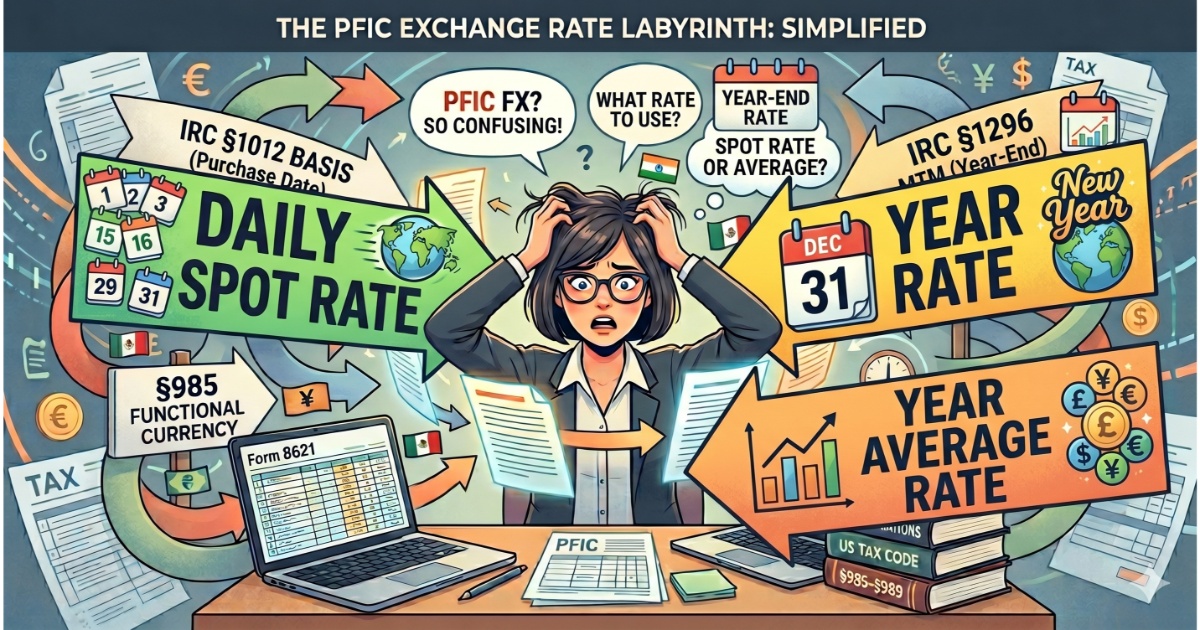
PFIC FX is event-based. Each action uses its own exchange-rate date. Annual average rates generally do not apply. This is a critical tracking requirement for non-USD assets, such as JPY-denominated PFIC holdings in Japan, EUR-denominated ETFs held in a German Depot, INR-denominated Indian mutual funds, or TWD-denominated Taiwan ETFs.
If you want to first understand the clean USD mechanics before adding FX translation, start with this simple USD Form 8621 example.
| Action | Authority | FX Rule |
|---|---|---|
| Buy | IRC §1012 | Use acquisition-date spot rate. |
| Sell | IRC §1001; §1291 | Sale-date rate for proceeds; acquisition-date rate for basis. |
| Distribution | IRC §1291(b)(3)(E); §989(b) | 15e(2): distribution-date spot rate. |
| MTM | IRC §1296; Reg. §1.1296-1 | Use year-end spot rate to translate year-end FMV into USD. |
| QEF | IRC §1293; §989(b)(3) | Use PFIC taxable-year average rate for foreign-currency AIS. |
In short: buy date controls basis, sale date controls proceeds, distribution rules control Part V, and year-end date controls MTM value.
IRS Acceptable Exchange Rate Sources (Fed H.10)
The IRS does not provide one official exchange rate. It generally accepts any posted exchange rate used consistently. For PFIC calculations, the source must match the required rate type: daily spot rate, year-end spot rate, or yearly average rate.
| Source | Best Use |
|---|---|
| Federal Reserve H.10 | Daily spot rates for transaction-date PFIC calculations. |
| Treasury Reporting Rates of Exchange | Quarterly government exchange rates; useful where quarterly rates are appropriate. |
| IRS yearly average rates | Average-rate items, including foreign-currency QEF AIS under §989(b)(3). |
| Broker or bank rate | Use when it shows the actual rate applied to the transaction. |
Keep the source, date, and rate used. Do not use an annual average rate where the PFIC rule requires a transaction-date or year-end spot rate.
PFIC Case Study: MTM Transaction & FX Translation Sequence
Assume the PFIC is reported in NZD and the FX rate is NZD per USD.
PFIC Transaction & Historic Cost Record
| Date | Action | Units | Value NZD |
|---|---|---|---|
| 2023-06-15 | Buy | 100 | 1,000 |
| 2023-10-30 | Buy | 200 | 3,000 |
| 2024-03-15 | Distribution | 0 | 50 |
| 2024-06-30 | Distribution | 0 | 80 |
| 2024-10-30 | Sell | -150 | 1,875 |
Daily FX Spot Rates Applied
| Date | NZD / USD |
|---|---|
| 2023-06-15 | 1.61264 |
| 2023-10-30 | 1.71472 |
| 2024-03-15 | 1.64081 |
| 2024-06-30 | 1.64140 |
| 2024-10-30 | 1.67329 |
For MTM valuation: 2023-12-31 FMV (NZD 2,800) and the year-end spot rate (1.585).
Section 1296 MTM FX Revaluation Calculation
MTM uses the 2023-12-31 year-end spot rate: NZD 2,800 ÷ 1.585 = USD 1,766.56.
| Item | Calculation | USD Result |
|---|---|---|
| 2023 year-end FMV | NZD 2,800 ÷ 1.585 | USD 1,766.56 |
Section 1291 Distribution & FX Translation
Both 2024 distributions are excess distributions; Line 15e(2) uses each distribution-date daily spot rate.
| Date | NZD Distribution | FX Rate | USD Amount if Included in Line 15e(2) |
|---|---|---|---|
| 2024-03-15 | NZD 50 | 1.64081 | 50 ÷ 1.64081 = USD 30.47 |
| 2024-06-30 | NZD 80 | 1.64140 | 80 ÷ 1.64140 = USD 48.74 |
PFIC Sale Calculation: FX Gain & Basis Tracking
For a sale, both proceeds and basis are converted using daily rates: proceeds use the sale-date daily rate, while each FIFO lot’s basis keeps its original purchase-date daily rate.
Total sale: 150 units sold for NZD 1,875.
Sale price per unit = NZD 1,875 ÷ 150 = NZD 12.50
USD sale price per unit = NZD 12.50 ÷ 1.67329 = USD 7.47
FIFO matching: 100 units from Lot 1 and 50 units from Lot 2.
Lot 1 — sell 100 units
USD proceeds = 100 × USD 7.47 = USD 747.03
USD basis = NZD 1,000 ÷ 1.61264 = USD 620.10
Gain = 747.03 − 620.10 = USD 126.93
Lot 2 — sell 50 units
USD proceeds = 50 × USD 7.47 = USD 373.51
Sold basis = 50 / 200 × NZD 3,000 = NZD 750
USD basis = NZD 750 ÷ 1.71472 = USD 437.39
Gain = 373.51 − 437.39 = -USD 63.88
Lot-level result
Lot 1 gain: USD 126.93
Lot 2 loss: -USD 63.88
Under MTM, each lot is calculated separately: Lot 1 has a USD 126.93 gain, and Lot 2 has a USD 63.88 loss. The gain and loss are not netted between lots; each lot keeps its own result. The same lot-by-lot principle also matters under §1291.
Country Examples and Brokerage Records
Use the rules above with the transaction records available in your market:
- India: CAMS INR gains and a worked USD comparison.
- India: SIP allotments, IDCW and redemption records.
- Canada: reconstructing CAD purchases and DRIP lots.
- UK: accumulation-fund records, equalisation and GBP data.
- UAE: distinguishing AED, USD and other fund currencies.
FAQ: Form 8621 & PFIC FX Translation
Can I use the IRS annual average rate for simplicity?
Why does my brokerage statement’s USD gain differ from the Form 8621 calculation?
Can I use a daily average exchange rate if I trade multiple times in one day?
Why does QEF use an "annual average rate" while MTM uses a "year-end spot rate"?
What if I lost the exchange rate data for a purchase from a decade ago?
Do I report foreign exchange gain/loss (§988) separately from PFIC gain?
Technical References & Statutory Authority
- 📊 Federal Reserve H.10 Daily Rates
- ⚖️ IRC §1001 — Gain or Loss from Disposition
- ⚖️ IRC §1012 — Cost Basis
- ⚖️ IRC §989(b)(3) — QEF Average Exchange Rate
- ⚖️ IRC §1291 — Excess Distribution Rules
- ⚖️ IRC §1293 — QEF Inclusions
- ⚖️ IRC §1296 — Mark-to-Market Election
- ⚖️ Treas. Reg. §1.1296-1 — MTM Rules
- 📄 IRS Form 8621 Instructions
Content reflects Form 8621 (Rev. 12/2025), applicable Treasury Regulations, IRS guidance, and other authorities cited on this page.