
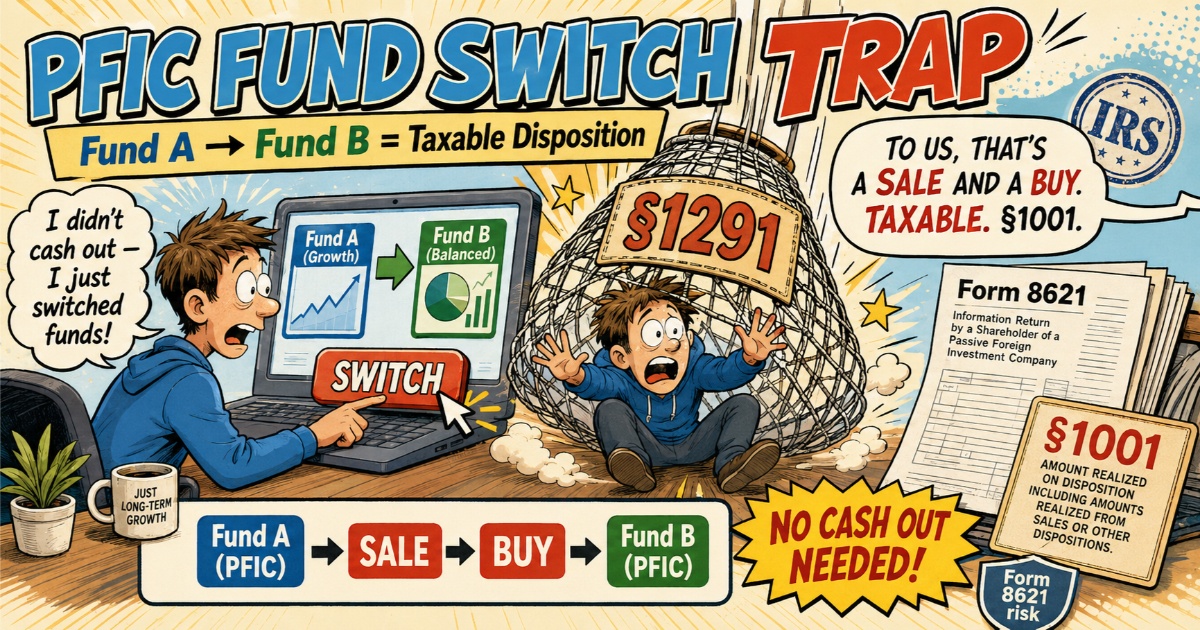
What defines a “Switch” as a PFIC Disposition?
Under IRC §1001(a) and Treas. Reg. §1.1001-1(a), a conversion of property into cash, or an exchange for materially different property, realizes gain or loss. A platform label like “switch,” “rebalance,” “fund change,” or “risk profile migration” does not control the U.S. tax result. The mechanics control it: redemption of Fund A units plus acquisition of Fund B units.
Under IRC §1291(a)(2), once the redeemed fund is a PFIC and the taxpayer recognizes gain, that gain is not ordinary capital-gain workflow. It is pushed into the §1291 excess-distribution engine.
| Platform action | U.S. tax lens | PFIC risk |
|---|---|---|
| Sell foreign mutual fund | Sale / disposition under §1001 | High |
| Switch Fund A to Fund B | Redemption + subscription | High |
| Move “Growth” to “Balanced” option | Possible disposition of underlying units | High |
| Change manager but same legal units | Fact-specific | Medium |
| Internal fund merger | Nonrecognition analysis required | High |
The Three PFIC Regimes: Same Switch, Different Tax Result
A PFIC switch is always a disposition. The old PFIC is sold. The new PFIC is acquired. The tax result depends on the regime attached to the old fund.
| PFIC regime | What the switch does | Tax result |
|---|---|---|
| §1291 Default PFIC | Disposes of the old PFIC | Gain becomes an excess distribution. Interest charge risk. |
| QEF §1295 | Disposes of the old PFIC | Gain is handled through QEF basis and prior annual inclusions. No default §1291 bomb if the QEF is clean. |
| MTM §1296 | Disposes of the old PFIC | Gain is ordinary under MTM rules. Prior annual marks reduce the catch-up. |
QEF and MTM do not erase the switch. They only change the tax engine.
The new fund starts its own PFIC analysis. A QEF or MTM election on Fund A does not automatically carry to Fund B.
This risk commonly affects German investors switching between Depot ETFs, individuals managing Swiss Pillar 3a fund switch events, and DEGIRO users rebalancing VWCE positions in the Netherlands.
Hardcore FAQ
Does a PFIC switch count as a sale if I never withdrew cash?
Is a PFIC switch always a §1291 tax bomb?
Does a QEF or MTM election carry over to the new fund?
Does automatic rebalancing create multiple PFIC disposals?
Does a foreign tax-free wrapper stop U.S. PFIC tax?
Content reflects Form 8621 (Rev. 12/2025), applicable Treasury Regulations, IRS guidance, and other authorities cited on this page.