🇨🇦 CANADA · PFIC RISK GUIDE · Updated May 2026

Canada PFIC Guide for U.S. Taxpayers Holding TFSA, RESP and Canadian ETFs

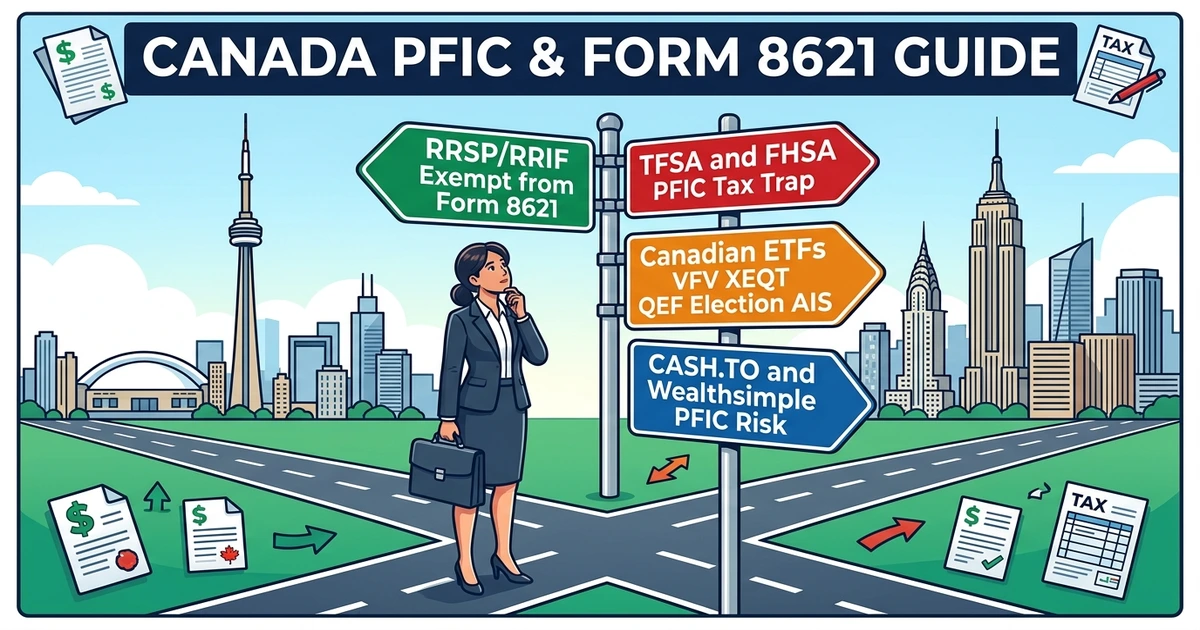
Canada is one of the easiest countries for U.S. persons to create accidental PFIC exposure. A normal Canadian portfolio — TFSA, RESP, FHSA, robo-advisor account, CASH.TO, VFV, XEQT, or VGRO — can look clean under CRA rules while creating Form 8621, §1291, QEF, MTM, FX, and missing-filing problems on the U.S. side.

HighPFIC Risk
QEF PossibleSelect Funds
Art. XVIIIRRSP Treaty

Canada gives investors clean statements and familiar tickers. The IRS sees foreign pooled funds, unreconciled CAD lots, missing elections, and a holding-period problem that compounds quietly until sale. The damage starts when the taxpayer treats a Canadian wrapper as a U.S. shelter.

Why Canada is a High-Risk PFIC Jurisdiction for U.S. Taxpayers

Canada is a PFIC high-risk jurisdiction because the default retail portfolio is built from Canadian pooled funds. U.S. citizens, green card holders, and U.S. tax residents buy Canadian ETFs and mutual funds inside TFSAs, RESPs, FHSAs, RRSPs, RRIFs, and non-registered accounts. CRA treats this as ordinary investing. The IRS often treats the same holdings as PFICs, with Form 8621 filings, election deadlines, and §1291 exposure attached.

The risk is ubiquitous because a single Canadian household rarely holds just one fund in one account.

To maximize savings, a typical resident will naturally spread their investments across multiple wrappers—holding VFV in a TFSA, XEQT in an RESP for their children, and XIC in a non-registered account. Combine this with automated robo-advisor rebalancing and routine DRIPs, and you quickly aggregate a massive multi-account portfolio.

This is exactly why Canada is such a high-risk jurisdiction: without doing anything exotic, a regular investor can easily create multiple PFIC reporting positions across an everyday Canadian portfolio.

Canada PFIC Risk Table: TFSA, RRSP, RESP, FHSA, ETFs and Mutual Funds

🔴 High — Form 8621 review usually required

🟡 Review — structure controls the result

🟢 Low — usually outside PFIC rules

Local Asset / Platform Risk Fatal Defect (U.S. Perspective)
TFSA holding Canadian ETFs or funds 🔴 No Treaty Deferral: Canadian shelter does not neutralize PFIC.
Non-Registered Account holding VFV, XEQT, XIC, ZSP 🔴 Direct PFIC Exposure: Foreign pooled fund, no U.S. wrapper.
Robo-Advisors: Wealthsimple, Questwealth 🔴 Algorithmic Tax Bomb: Auto-rebalancing creates unplanned PFIC dispositions.
VGRO / XEQT / XGRO / VEQT 🔴 Layered PFIC Review: Fund-of-funds structure multiplies reporting analysis.
Bank Mutual Funds: RBC, TD, BMO, Scotiabank, CIBC 🔴 Data Black Hole: T3/T5 slips do not solve U.S. basis, FX, or QEF data.
TD e-Series Funds 🔴 Legacy Fund Trap: Low-cost Canadian fund, still foreign pooled stock.
CASH.TO / PSA / HISA ETFs 🔴 Cash Illusion: ETF wrapper, not a U.S.-recognized bank deposit.
FHSA holding Canadian ETFs or funds 🔴 New Wrapper Mismatch: No established U.S. shelter treatment.
RESP holding Canadian ETFs or funds 🔴 Education Trap: PFIC assets plus possible foreign trust reporting.
RDSP with fund options 🔴 Policy Relief Gap: Canadian benefit design does not erase U.S. reporting.
RRSP holding Canadian ETFs or mutual funds 🟡 Treaty Deferral: Strong shelter, but not blanket U.S. reporting immunity.
RRIF holding Canadian ETFs or mutual funds 🟡 Distribution Review: Deferral helps, but withdrawals still require U.S. review.
Corporate-Class Mutual Funds 🔴 Switching Risk: Investor-level switches can trigger PFIC events.
Canadian Segregated Funds 🔴/🟡 Insurance Wrapper Risk: Ownership and fund classification require review.
Canadian Holdco Investment Portfolio 🔴/🟡 Entity Classification Risk: Holdco status can create separate U.S. tax problems.
Individual Canadian Stocks: RY, TD, ENB, SHOP 🟢/🟡 Operating Company Test: Usually safer; investment-heavy entities need review.
GICs / HISAs / Term Deposits 🟡 Not PFIC Stock: Still creates income, FX, FBAR, and Form 8938 issues.
U.S.-Domiciled ETFs: VOO, VTI, IVV, SPY 🟢 U.S. Wrapper: Avoids PFIC classification; FX still tracked.

Canada-U.S. Tax Treaty: PFIC Treatment of TFSA, RESP, FHSA vs. RRSP

The Canada-U.S. tax treaty does not give TFSAs, RESPs, FHSAs, or ordinary taxable brokerage accounts the same U.S. deferral framework as RRSPs and RRIFs. For U.S. citizens, green card holders, and U.S. tax residents, the treaty does not convert Canadian ETFs or mutual funds into U.S. assets, and it does not switch off Form 8621 when PFIC triggers exist.

RRSPs and RRIFs receive stronger Canada-U.S. treaty protection than TFSAs, RESPs, FHSAs, and taxable accounts. That protection can reduce annual PFIC filing friction, but it does not turn Canadian funds into U.S.-domiciled ETFs or eliminate all U.S. reporting issues.

The fatal planning mistake is simple: treating Canadian account recognition as U.S. tax recognition. Canada can shelter the wrapper while the IRS still taxes or reports the underlying asset.

Technical illustration: TFSA and RESP shelter Canadian tax but not PFIC rules. Canadian-domiciled funds like VGRO can trigger Form 8621 review and may fall under §1291 if no valid QEF or MTM election applies.
TFSA and RESP shelter Canadian tax, not PFIC. Canadian ETFs and mutual funds can still trigger Form 8621 and §1291.

Form 8621 Filing Triggers: When do Canadian ETFs Require U.S. Reporting?

Canadian Action PFIC Trigger Canada-Specific Example
ETF or mutual fund distribution PFIC distribution analysis VFV / XEQT / CASH.TO distribution
ETF sale Direct disposition Sell VFV, ZSP, XEQT, or XIC
Mutual fund switch Disposition or exchange review Bank fund switch
Robo-advisor rebalance Automated PFIC dispositions Wealthsimple / Questwealth rebalance
DRIP reinvestment Lot, basis, and FX multiplication Fractional CAD reinvestment lots
Move to the United States Residency onboarding risk Canadian PFIC lots enter U.S. file
QEF or MTM election year Annual Form 8621 reporting Election continuation year
No election, later sale §1291 default regime Long-held Canadian ETF exit

DRIP does not just grow the portfolio. Each reinvested CAD distribution creates another purchase date, another USD basis point, and another FX conversion.

The Form 8621 threshold exception is not a shelter. It collapses when the taxpayer sells, receives an excess distribution, uses QEF or MTM treatment, or otherwise triggers annual PFIC reporting. (IRS)

Common Canada PFIC Tax Traps: TFSA, XEQT, and Robo-Advisors

Scenario 1 — TFSA ETF Trap

A dual U.S.-Canadian citizen holds VFV and XEQT inside a TFSA. Canada reports no taxable income. The U.S. file still sees Canadian-domiciled pooled funds, CAD distributions, share lots, FX conversions, and possible Form 8621 exposure.

The TFSA does not neutralize PFIC status. It only removes the income from the Canadian return.

Scenario 2 — One-Ticker ETF Trap

The investor buys XEQT or VGRO and sees one line item on the brokerage screen. PFIC analysis sees a recursive reporting problem: fund-of-funds structure, underlying ETF layers, annual information statement questions, and election-path dependency.

One ticker does not mean one compliance object.

Scenario 3 — Robo-Advisor and DRIP Trap

A Wealthsimple or Questwealth portfolio sells small amounts of Canadian ETFs during automated rebalancing. DRIPs then add fractional units after each CAD distribution. The investor sees routine automation. The U.S. file sees dispositions, purchase dates, USD basis points, and FX conversions.

Micro-trades still count. Automatic does not mean tax-neutral.

Scenario 4 — The Exit Sale Trap

The taxpayer ignores PFIC filings for 20 years, then sells Canadian ETFs to fund a home purchase. The gain does not automatically become clean long-term capital gain. Under default §1291 mechanics, gain treated as an excess distribution gets allocated across the holding period, taxed through prior-year ordinary rate logic, and loaded with a compounding interest charge.

The purpose of this model is to show time risk, not market risk. A Canadian ETF can look harmless on a brokerage screen for decades while the §1291 interest engine runs silently in the background.

As the table demonstrates on a modeled $10,000 gain, a 20-year holding period results in 60.3% of the profit being consumed by U.S. tax and interest. Push that holding period to 35 years—a standard retirement lifecycle—and it produces a 106.1% wealth-shrinkage effect. The combined tax and interest literally consume more than the original gain. That is not a statutory rate; it is the mathematical reality of long holding periods, missing elections, and late exits.

The most expensive sentence in cross-border investing is not “I bought the wrong ETF.” It is “I will deal with it when I sell.”

Table A: PFIC §1291 Interest Calculation Over Time

PFIC tax and interest calculation on a $10,000 gain
(Single purchase on yyyy-01-01 → sale on 2025-12-31)
Period Tax Interest % Consumed
5 years $3,440 $590 40.3%
10 years $3,622 $1,227 48.5%
20 years $3,630 $2,396 60.3%
30 years $3,689 $4,891 85.8%
33 years $3,714 $6,200 99.1%
35 years $3,679 $6,930 106.1%
Rate basis for Form 8621: actual historical U.S. tax rates by allocation year, with IRS §6621 quarterly underpayment interest compounded through the disposition date.

VFV PFIC Example: Form 8621 Under QEF, MTM, and §1291

Hans
The Canadian QEF Advantage
Canadian ETFs are unusual because some major fund managers publish PFIC Annual Information Statements. That may make QEF possible if the election is timely. But AIS does not automatically fix prior non-QEF years. Late files may still require §1291 reconstruction, purging analysis, MTM review, or §301.9100 relief.

For PFIC investors, QEF is often the clean path and §1291 is the trap. But the difference is hard to appreciate until the numbers are side by side. The VFV simulation below compares the same one-buy, one-sell investment under QEF, MTM, and §1291.

Date Detail Price Units Value CAD
2016-01-04 Buy 49.76 2,009 99,968
2025-12-31 Sale 166.62 -2,009 334,740

The trade produces an approximate gain of CAD 234,772. To isolate the PFIC method difference, this simulation ignores FX, dividends, DRIP, withholding tax, state tax, and annual distribution reporting. The comparison below uses a 24% ordinary income rate and a 15% long-term capital gains rate.

VFV PFIC Tax Paths: QEF, VOO Benchmark, MTM and §1291
VFV PFIC methods vs. VOO long-term capital gains benchmark · simplified 10-year model
Method Tax Burden Tax on Gain Comment
§1291 48.45% 113,746.91 Deferred tax plus interest at sale.
MTM 24% 56,345.22 Annual ordinary-income taxation.
QEF 15% 35,215.76 AIS-based annual inclusion; capital-gain character preserved.
VOO 15% 35,215.76 Non-PFIC capital-gain baseline.

The result is straightforward: MTM creates annual cash-flow pressure, QEF can keep the result closer to capital-gain treatment when AIS is available, and §1291 defers the pain until sale — then adds interest.

Hans
The PFIC Trap in One Number
In this VFV example, the investment gained CAD 234,772. Under the default §1291 calculation produced by 8621calculator.com, CAD 113,746.91 is consumed by U.S. PFIC tax and interest — 48.45% of the gain before professional fees (This doesn't include the opportunity cost of lost Foreign Tax Credits on the interest portion).

Canada PFIC Case Studies: Real-World Form 8621 Reporting Scenarios

Case 1 — Toronto Dual Citizen: TFSA, FHSA, No U.S. Returns

Original Case Source: Reddit r/USExpatTaxes Discussion ↗

Profile: U.S.-Canadian dual citizen living in Toronto. RRSP is maxed. Extra cash goes into a TFSA and FHSA. Three years of U.S. returns are missing.

Local asset: CAD 50,000 in TFSA and CAD 20,000 in FHSA, mostly Canadian ETFs or mutual funds.

Fatal assumption: “Canada shelters it. My U.S. filing can wait.”

Trigger: The taxpayer starts catching up before using the money for a home purchase.

U.S. tax trap: TFSA and FHSA do not get RRSP-style treaty deferral. Canadian ETFs and mutual funds inside the accounts can trigger PFIC analysis, Form 8621, FBAR, Form 8938, income reporting, and election review.

Damage:

  • TFSA is not U.S. tax-free.
  • FHSA has no established U.S. shelter treatment.
  • Each Canadian fund can become a separate PFIC position.
  • Missing Form 8621 can keep affected years open.

Compliant fix: Use the correct catch-up path. Non-willful facts may qualify for Streamlined (SFCP): 3 years of returns, 6 years of FBARs, missing Form 8621 work, tax, interest, and a non-willful certification. Foreign Streamlined may avoid the offshore penalty. Domestic Streamlined generally carries a 5% penalty. Willful files do not belong in Streamlined.

Case 2 — The Vancouver Move: Three Canadian ETFs and a $27k First-Year PFIC Bill

Original Case Source: Reddit r/tax Discussion & Technical Post ↗

Profile: Canadian taxpayer moves from Vancouver to the United States and becomes a U.S. tax resident. The taxpayer is not a U.S. citizen or green card holder.

Local asset: Three Canadian ETFs are still held after the move: XEQT, VUN, and XEC.

Fatal assumption: “I did not sell anything before moving, so there is no U.S. tax event yet.”

Trigger: The taxpayer enters the U.S. tax system while still holding Canadian-domiciled ETFs.

U.S. tax trap: The mistake happened before the first U.S. return. The ETFs were not sold before U.S. residency began, so they entered the Form 1040 file as PFIC assets. In the first U.S. tax year, the taxpayer now faces QEF, MTM, or §1291 treatment.

The Financial Damage (Direct Quote): “We own some Canadian ETFs in a brokerage in Canada. Knew these will be PFICs. But I was not aware how bad it will be. Even with the QEF deemed sale election, the tentative owing is looking to be around 27k. I’m having to pay taxes on paper gains on these ETFs which I haven’t sold yet.”

Why it hurts: No sale does not mean no PFIC problem. Once U.S. residency starts, the taxpayer has to deal with Form 8621, election timing, unrealized appreciation, and future exit risk. QEF or MTM can create current tax pressure. §1291 can defer the pain but poison the future sale.

Fix: The clean move was to sell or restructure before becoming a U.S. tax resident. If you entered the U.S. system while still holding the assets, your first-year election choice is critical. Full Case Study: New U.S. Resident PFIC Reporting ↗

8621 Calculator
Calculate Your Canadian ETF PFIC History
Have years of TFSA, FHSA, or non-registered ETF transaction history? Use 8621calculator.com to generate Form 8621-style §1291 or MTM workpapers from transaction-level CAD data, including DRIPs, fund switches, and lot-level tracking.
Launch Calculator →

Canada PFIC FAQ: Joint Accounts, Losses, Gifts, Bank Funds and FX

If I jointly hold Canadian ETFs with my non-U.S. spouse, do I report 100% of the PFIC?

Not automatically. The U.S. file needs ownership allocation: account title, source of funds, beneficial ownership, and local property-law facts. A 50/50 split is common in practice, but it is not a magic rule.

The damage does not require 100% ownership. Even a partial U.S. share can create Form 8621 work for distributions, sales, DRIPs, FX, and §1291 reconstruction.

Can I use a Shopify capital loss to offset §1291 gain from a Canadian mutual fund?

No clean offset. §1291 does not behave like normal capital-gain reporting. Gain treated as an excess distribution is allocated across the PFIC holding period and loaded with an interest charge.

A normal stock loss can help the regular capital-gain schedule. It does not erase the separate §1291 tax-and-interest engine.

If my Canadian mutual fund is underwater, can I sell it and ignore Form 8621?

Do not assume that. A loss sale usually avoids the §1291 tax bomb because there is no gain to allocate, but the PFIC file still needs review.

The key question is not “did I lose money?” The key question is whether a Form 8621 trigger still exists because of distributions, elections, annual reporting, prior-year positions, or other PFIC holdings.

Can I gift TFSA Canadian ETFs to my non-U.S. adult child to escape PFIC?

No clean escape. A PFIC transfer is not a delete key. Gifts can raise PFIC transfer-rule questions, carryover-history issues, reporting, gift-tax, and foreign-account issues.

The safer analysis happens before the transfer: identify the PFICs, model §1291/QEF/MTM outcomes, and decide whether sale, election cleanup, or future divestment creates the least damage.

Are Canadian bank mutual funds safer than listed ETFs?

Usually not. Bank mutual funds can be worse because the Canadian slip package solves the CRA file, not the IRS file.

The hard question is data availability. If the fund does not provide a usable PFIC Annual Information Statement, QEF planning may fail and the taxpayer may be pushed toward MTM, if available, or §1291.

Why can my U.S. accountant show PFIC gain when my Canadian account shows little or no CAD gain?

FX. Form 8621 is built in U.S. dollars. Purchases, distributions, DRIPs, sales, and year-end values need USD translation.

A flat CAD result can still create USD gain when exchange rates move. That phantom gain then feeds the PFIC calculation instead of the Canadian brokerage screen.

Does CASH.TO count as cash for PFIC purposes?

No. CASH.TO, PSA, CSAV, and similar HISA ETFs look like cash-management tools in Canada, but the investor owns units of a Canadian fund. That is exactly why they need PFIC review.

A bank deposit is one thing. A Canadian ETF holding deposits is another.

Can I fix old Canadian PFIC years by making a QEF election now?

Not cleanly. A current-year QEF election does not automatically sanitize prior non-QEF years.

The file may need a purging election, deemed-sale analysis, MTM review, or §1291 reconstruction. The first question is not “can I elect?” It is “what is the PFIC’s history before the election?”

Sources and References

Topical Authority Cloud
IRC §1296 MTM RRSP Treaty Art. XVIII TFSA & FHSA US Tax RESP & RESP PFIC QEF Calculator Rev. Proc. 2014-55 Form 8621 Library Australia Guide NZ Guide UK Guide
Disclaimer: This site provides global PFIC compliance guides, cross-border risk analysis, and the algorithmic architecture powering our calculation engines. We engineer tax compliance technology; we do not prepare tax returns. All content is strictly for technical reference and does not constitute official tax advice. Verify all tax positions independently.
Current as of May 2026 · Based on Form 8621 (Rev. 12/2025)