
Quick Answers for U.S. Taxpayers with Singapore CPFIS, SRS and Unit Trusts
Are CPFIS or SRS investments PFICs for U.S. taxpayers?
Are Endowus CPF/SRS portfolios PFICs?
Are VWRA, CSPX, IWDA, VUAA or other UCITS ETFs PFICs?
Are StashAway Simple, Syfe Cash+, or FSMOne cash funds PFICs?
Why CPFIS, SRS, Endowus and Unit Trusts Create PFIC Risk
For U.S. citizens in Singapore, CPFIS and SRS can become PFIC traps when the account holds non-U.S. pooled investments. The account wrapper is not the issue. The underlying fund is.
Approval by the Central Provident Fund (CPF) Board, SRS tax relief, regulation by the Monetary Authority of Singapore (MAS), SGX listing, and local tax-free growth do not control U.S. PFIC classification. Under U.S. tax code IRC §1297(a), the U.S. Internal Revenue Service (IRS) tests whether a foreign fund constitutes a PFIC based on passive income and passive asset thresholds.
Under IRC §1298(a), ownership can be direct, indirect, or constructive. The U.S. analysis follows the underlying entity, not the Singapore account label. Singapore unit trusts authorized by MAS, Ireland-domiciled UCITS ETFs, ILP sub-funds, cash-management funds, and non-U.S. money market funds commonly require PFIC review. If no reporting exception applies, Form 8621 can be triggered under IRC §1298(f).
See: What Is a PFIC? For Singapore ILPs, separate the insurance wrapper from the underlying funds using the foreign life insurance U.S. tax and reporting guide.
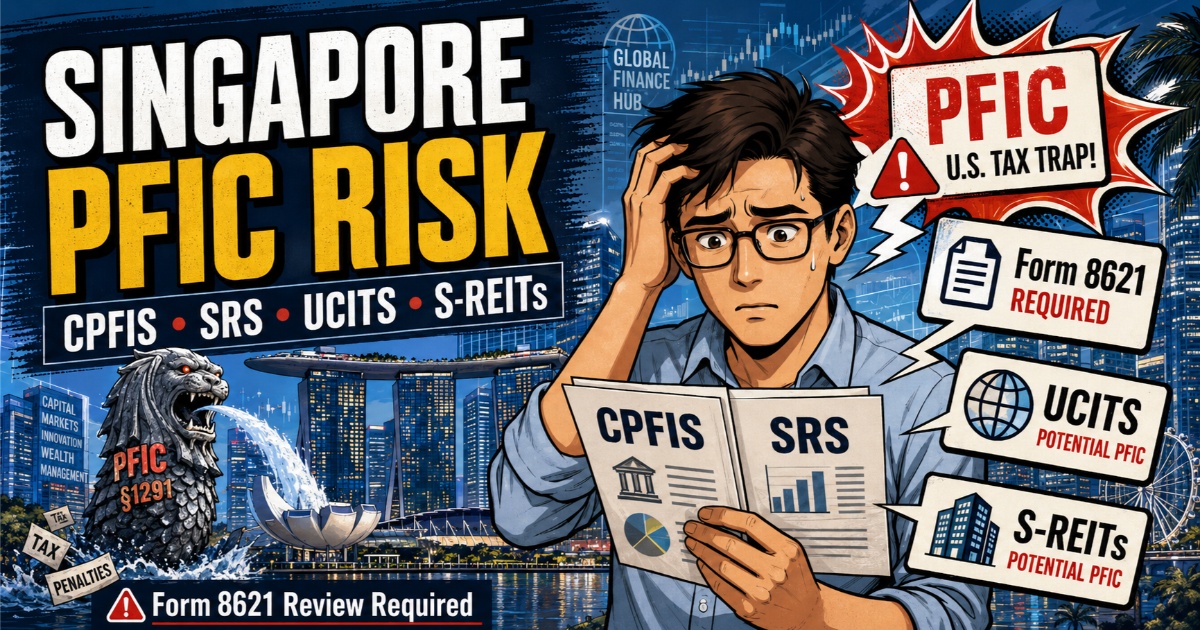
Singapore PFIC Risk Matrix: CPFIS, SRS, Endowus, UCITS ETFs, ILPs and S-REITs
🔴 High — Form 8621 review usually required
🟡 Review — Structure controls the result
🟢 Low — Usually outside PFIC rules
| Singapore Asset / Platform | Risk | U.S. PFIC / Form 8621 Issue |
|---|---|---|
| CPFIS-OA Unit Trusts via DBS, OCBC, UOB, FSMOne | 🔴 | CPF approval does not override IRC §1297. |
| CPFIS-SA Unit Trusts | 🔴 | Retirement lock-up does not control §1291 or §1298(f) analysis. |
| CPFIS Investment-Linked Policies / ILPs | 🔴/🟡 | Insurance classification and sub-fund ownership require review. |
| SRS Unit Trusts via DBS, POEMS, FSMOne | 🔴 | SRS tax deferral does not control U.S. PFIC reporting. |
| SRS SGX-listed ETFs via POEMS, DBS, OCBC, UOB | 🔴 | SGX listing does not change fund domicile. |
| London-listed UCITS ETFs like VWRA, CSPX, IWDA, VUAA | 🔴 | Ireland/Luxembourg fund domicile commonly requires PFIC review. |
| Endowus CPF/SRS Portfolios | 🔴 | Underlying non-U.S. funds may create multiple PFIC review tracks. |
| FSMOne Unit Trust Switches | 🔴 | Fund switches may create disposition or exchange review. |
| POEMS SRS Wrap / Managed Accounts | 🔴 | One wrapper may hold multiple non-U.S. pooled funds requiring separate review. |
| Singapore ILPs via Prudential, AIA, Great Eastern, Manulife | 🔴/🟡 | Insurance classification and underlying sub-funds require separate U.S. review. |
| StashAway / Syfe Robo Portfolios | 🔴/🟡 | Underlying ETFs, cash funds and rebalancing activity control the PFIC result. |
| StashAway Simple / Syfe Cash+ / FSMOne cash funds | 🔴 | Cash-like product may still hold non-U.S. money market funds or unit trusts. |
| Singapore REITs / S-REITs: CapitaLand, Mapletree, Frasers | 🟡 | Issuer-level PFIC testing required; rental-income and active-business exceptions depend on facts. |
| SGX Individual Operating Stocks like DBS, OCBC, SIA, Singtel | 🟢 | Operating companies usually fall outside PFIC. |
| Singapore Government Securities / T-bills / SSBs | 🟢 | Direct debt is not PFIC stock. |
| CPF Cash / SRS Cash Balance | 🟢 | Cash alone is not PFIC stock. |
| U.S.-domiciled ETFs via IBKR, Saxo, Tiger, Moomoo | 🟢 | U.S. fund wrapper generally avoids PFIC classification; account, FX and withholding still need review. |
Singapore Fund and Platform PFIC Examples: CPFIS, SRS, Endowus, FSMOne, VWRA and Syfe Cash+
Common investment products and platforms in Singapore and their U.S. tax implications. The underlying fund vehicle's registration and structure determine the PFIC outcome, not the broker or local tax relief status.
| Singapore product / platform | Common use | U.S. Form 8621 issue |
|---|---|---|
| CPFIS-OA unit trusts via DBS / OCBC / UOB | CPF investment option | CPF approval does not remove fund-level PFIC review |
| SRS unit trusts via FSMOne / POEMS | Tax-deferred retirement investing | SRS wrapper does not control PFIC classification |
| Endowus CPF/SRS portfolios | Advised portfolio | Underlying non-U.S. funds may create multiple PFIC tracks |
| VWRA / CSPX / IWDA / VUAA | UCITS ETF exposure | Ireland-domiciled ETF, not a U.S. ETF |
| StashAway Simple / Syfe Cash+ | Cash-management yield | Cash-like product may hold non-U.S. money market funds |
| Singapore ILPs | Insurance-linked investment | Sub-funds may require separate PFIC review if U.S. insurance status fails |
| S-REITs (CapitaLand, Mapletree, Frasers) | Singapore real estate exposure | Issuer-level PFIC testing required |
| DBS / OCBC / UOB shares | Operating bank shares | Usually lower PFIC risk; investment-heavy facts need review |
| Singapore T-bills / SSBs | Direct government debt | Generally not PFIC stock |
| VOO / VTI / SPY via IBKR or Saxo | U.S.-domiciled ETFs | Generally not PFIC stock |
U.S.–Singapore Tax Treaty Gap: CPFIS, SRS and PFIC Classification
Singapore does not have a comprehensive income tax treaty with the United States. Without a treaty-based retirement article, account wrappers such as SRS, CPFIS, or Endowus portfolios do not automatically shield underlying non-U.S. pooled funds from U.S. PFIC classification.
- The SRS wrapper does not eliminate Form 8621 review.
- The CPFIS wrapper does not eliminate Form 8621 review.
- The Endowus CPF/SRS wrapper does not eliminate Form 8621 review.
Form 8621 can be triggered by a PFIC distribution, sale, exchange, fund switch treated as a disposition, QEF election under IRC §1295, MTM election under IRC §1296, or annual reporting duty under IRC §1298(f).
Form 8621 Filing Triggers for Singapore CPFIS, SRS and UCITS ETFs
| Singapore Action | PFIC Trigger | Singapore-Specific Example |
|---|---|---|
| CPFIS unit trust distribution | PFIC distribution analysis | DBS / OCBC / UOB / FSMOne CPFIS fund payout |
| CPFIS unit trust sale | PFIC disposition review | Sell CPFIS-OA unit trust before U.S. filing |
| CPFIS or SRS fund switch | Disposition or exchange review | FSMOne / POEMS / Endowus model switch |
| SRS ETF sale | PFIC disposition review | Sell SGX-listed ETF or UCITS ETF inside SRS |
| SRS unit trust distribution | PFIC distribution analysis | DBS / POEMS / FSMOne SRS fund distribution |
| Robo-advisor rebalance | Automated disposition review | StashAway / Syfe / Endowus rebalance |
| ILP fund allocation change | Sub-fund disposition review | AIA / Prudential / Great Eastern / Manulife ILP switch |
| UCITS ETF distribution or sale | Foreign ETF PFIC reporting review | VWRA / CSPX / IWDA / VUAA via IBKR or Saxo |
| Cash-management fund redemption | Money market fund disposition review | StashAway Simple / Syfe Cash+ / FSMOne cash fund |
| QEF or MTM election year | Form 8621 election reporting | Initial election year and each continuation year |
Many Singapore platform actions create no obvious local tax event. Under PFIC rules, they are not invisible. CPFIS switches, SRS ETF sales, robo-advisor rebalances, ILP fund changes, UCITS ETF trades, cash-management redemptions, elections, and distributions can all feed a Form 8621 workpaper review.
A defective or missing Form 8621 can keep the limitations period open under IRC §6501(c)(8) for items related to the missing information. If the failure is not due to reasonable cause, the exposure can extend beyond the PFIC item.
Already held Singapore PFICs without filing? Start here: What to Do After Discovering a PFIC.
Singapore Portfolio Financing and PFIC Pledging Risk under IRC §1298(b)(6)
Singapore brokers and private banks (such as DBS, UOB, OCBC, and Interactive Brokers) often allow investors to borrow against their investment portfolios using share financing or portfolio leverage. For a U.S. taxpayer, pledging PFIC assets (such as Singapore unit trusts, S-REITs, or UCITS ETFs) as collateral for a loan or margin account involves significant U.S. tax risks. IRC §1298(b)(6) can cause certain pledges of PFIC stock to be treated as dispositions. Portfolio financing should therefore be reviewed before assuming no PFIC event occurred, as a constructive disposition can trigger taxable events under the §1291 default rules even if no shares are sold.
Risk Scenario: PFIC §1291 Tax and Interest Cost Over Time
Table A models a $10,000 PFIC gain under §1291 using actual historical U.S. tax rates and IRS quarterly underpayment interest rates. The tax stays roughly in the $3,400–$3,700 range, but the interest compounds with time: $590 after 5 years, $2,396 after 20 years, $4,891 after 30 years, and $6,930 after 35 years. At that point, tax and interest consume 106.1% of the gain.
Delaying resolution of unreported PFICs can increase both interest and compliance costs because §1291 allocates gain and distributions across the entire holding period. For years of unreported Singapore unit trusts or UCITS ETFs, U.S. taxpayers may look to IRS voluntary disclosure options or the Streamlined Filing Compliance Procedures to restore compliance.
Table A: PFIC §1291 Interest Calculation Over Time
(Single purchase on yyyy-01-01 → sale on 2025-12-31)
| Period | Tax | Interest | % Consumed |
|---|---|---|---|
| 5 years | $3,440 | $590 | 40.3% |
| 10 years | $3,622 | $1,227 | 48.5% |
| 20 years | $3,630 | $2,396 | 60.3% |
| 30 years | $3,689 | $4,891 | 85.8% |
| 33 years | $3,714 | $6,200 | 99.1% |
| 35 years | $3,679 | $6,930 | 106.1% |
Singapore unit trusts and S-REITs are often long-term holdings. Without QEF information or a valid MTM election, a later sale, redemption, or fund switch can trigger §1291 excess-distribution treatment, deferred tax, and IRC §6621 interest. See our §1291 vs MTM 10-Year Tax Comparison to model the cost.
Singapore PFIC Case Studies: S-REITs, Fund-of-Funds and Form 8621
Case 1 — S-REITs: Rental Income and Active-Business Testing
Original Case Source: Reddit r/USExpatTaxes Discussion ↗
Bad assumption: “A Singapore REIT owns real estate, so it is not a PFIC.”
PFIC issue: Under IRC §1297(a), a foreign corporation is a PFIC if it meets the 75% passive-income test or 50% passive-asset test. Rental income is passive unless the active-rent exception applies.
Technical catch: Under IRC §1297(b)(2)(C), rental income escapes passive treatment only when derived in the active conduct of a trade or business. Some S-REIT structures use external REIT managers or property managers, which may complicate the active-rent analysis.
U.S. Result: Form 1099-DIV does not clear IRC §1297. Each S-REIT needs entity-level PFIC testing. If the active-rent exception is unavailable and the PFIC income or asset tests are met, Form 8621 may be required.
Case 2 — Singapore Fund-of-Funds: One Fund Can Hide Multiple PFICs
Original Case Source: Reddit r/tax Discussion ↗
Bad assumption: “One Singapore fund means one PFIC.”
PFIC issue: Under IRC §1297(a), the top fund may be a PFIC. Under IRC §1298(a), lower-tier foreign funds can also be pulled into the U.S. analysis.
Technical catch: Fund-of-funds structures stack PFIC layers. Each layer needs separate testing for ownership, holding period, distributions, and dispositions.
U.S. Result: Without a PFIC Annual Information Statement, a QEF election is usually unavailable. Without marketable stock under IRC §1296, an MTM election is unavailable. In these situations, the default §1291 rules control, allocating excess distributions and gains over the holding period.
🔗 Detailed Analysis: What Is the PFIC Risk of Fund-of-Funds?
Singapore Form 8621 Filing Guide: CPFIS, SRS, Endowus, UCITS ETFs and ILPs
Step 1: Identify the Account Wrapper
The wrapper does not decide PFIC status. The underlying asset does.
- CPF / SRS cash: usually no PFIC.
- CPFIS / SRS unit trusts: fund-level PFIC review.
- SGX or London-listed ETFs: check fund domicile.
- Robo portfolios: test each ETF or fund position.
- ILPs: if not respected as U.S. insurance, test each sub-fund.
Step 2: Identify the Fund Domicile
Ticker and exchange do not control PFIC status. Domicile controls the first screen.
| Fund | Ticker | Domicile |
|---|---|---|
| Vanguard FTSE All-World | VWRA | Ireland |
| iShares Core S&P 500 | CSPX | Ireland |
| iShares Core MSCI World | IWDA | Ireland |
| Vanguard S&P 500 | VUAA | Ireland |
Ireland or Luxembourg UCITS status usually means PFIC review, not U.S. ETF treatment.
Step 3: Count the PFIC Entities
Form 8621 exposure usually scales by PFIC entity, not brokerage account.
- 4 Singapore unit trusts: usually 4 PFIC tracks.
- 6 CPFIS non-U.S. funds: usually 6 PFIC tracks.
- 8 Endowus underlying funds: potentially 8 PFIC tracks.
- 100% U.S.-domiciled ETFs: usually no Form 8621.
De minimis rule: Under Treas. Reg. §1.1298-1(c)(2), the $25,000 single / $50,000 joint threshold can remove annual §1298(f) reporting for dormant §1291 funds only when there is no excess distribution and no gain from sale or disposition.
Step 4: Choose the Treatment Path
| Regime | Singapore Reality |
|---|---|
| §1291 Default | Default for most Singapore unit trusts. Triggers excess-distribution tax and IRC §6621 interest. |
| §1296 MTM | Possible only for marketable PFIC stock regularly traded on a qualified exchange. |
| §1295 QEF | Usually unavailable because Singapore retail funds rarely provide PFIC Annual Information Statements. |
Related PFIC Technical Guides
PFIC Classification and Filing Basics
- 🔗 What Is a PFIC under IRC §1297?
- 🔗 Form 8621 Filing Exemption Rules for PFIC Stock
- 🔗 What to Do After Discovering a PFIC
- 🔗 Never Filed Form 8621 for a PFIC?
PFIC Tax Calculations and Singapore CPFIS / SRS Data
- 🔗 §1291 Excess Distribution and Interest Calculation
- 🔗 §1291 vs MTM 10-Year PFIC Tax Comparison
- 🔗 PFIC Foreign Exchange Translation Rules for SGD and USD
- 🔗 PFIC Fund Switch and §1291 Disposition Trap
- 🔗 Standardized Form 8621 Line 16a Statement
PFIC Election Strategy: §1291, MTM, and QEF
Choosing Professional Help for Singapore PFIC Cleanup

Singapore PFIC Core FAQ
Do CPFIS or SRS investments require Form 8621?
Are Endowus CPF or SRS portfolios PFICs?
Are Singapore REITs / S-REITs PFICs?
Do CPFIS or SRS fund switches trigger PFIC dispositions?
Can I make a Mark-to-Market election on UCITS ETFs?
Can I make a QEF election for Singapore unit trusts or UCITS ETFs?
Is my CPF account a foreign trust for U.S. tax purposes?
How do I report Singapore Investment-Linked Policies?
Sources and References
- 🔗 IRS Form 8621 and Instructions: Official IRS guidance for PFIC reporting obligations.
- 🔗 IRC §§1291–1298: Statutory framework governing PFIC taxation.
- 🔗 Treas. Reg. §1.1296-1: Regulatory rules for Mark-to-Market elections.
- 🔗 CPF Singapore Investment Scheme: Official CPF investment parameters.
- 🔗 MAS Collective Investment Schemes: Monetary Authority of Singapore (MAS) investment fund regulatory framework.
- 🔗 IRAS Supplementary Retirement Scheme (SRS): Inland Revenue Authority of Singapore (IRAS) guidelines for SRS.