
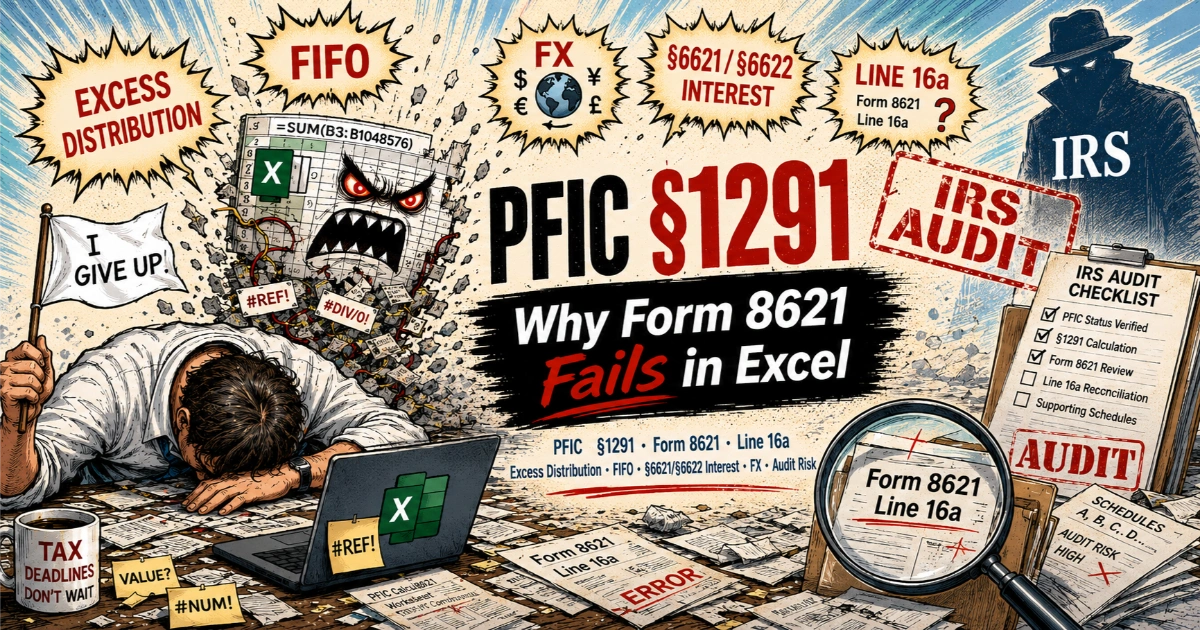
All references cite 26 U.S.C. §1291, §6621, and the official Instructions for Form 8621 (Rev. 12-2024).
Review 1 — Carry Forward the Correct Line 15b Base
§1291 requires a 3-year historical average of distributions to compute the 125% threshold for current-year excess distributions. This is mechanically simple but operationally fragile.
Excel can maintain these histories. The workpaper needs explicit carryforward logic, version control, and reconciliation to prior-year calculations so a copied value does not silently change later results.
Review 2 — Validate Historical Interest Rates and Dates
Under §1291(c)(3), deferred tax portions allocated to PFIC years must accrue interest using quarterly §6621 rates, applied with daily compounding. The Form 8621 instructions repeat this requirement for Line 16f.
Keep a dated source record for the interest-rate table and check that the calculation covers every required period.
For a full breakdown of how statutory due dates, IRC §7503 weekend rules, and §6622 daily
compounding interact, see:
PFIC §1291 Interest Calculation
— Due Date Rules & Daily Compounding.
Review 3 — Reconcile Multiple Acquisition Lots
Most PFIC investors acquire shares through recurring purchases. Each lot has its own basis and holding period; §1291(b)(3)(A) requires per-block (per-holding-period) treatment.
As the lot count grows, review purchases, disposals, and remaining quantities against the broker records. The number of lots alone does not determine whether a spreadsheet is reliable.
Review 4 — Track Partial Disposals and Remaining Lots
Partial disposals require FIFO unless specific identification rules are met. Each sale must consume oldest lots first, update remaining quantities, and recompute holding periods and interest.
Test row insertions, changes in transaction order, and corrected historical inputs before relying on a lot-tracking workbook. Reconcile the resulting inventory after each sale.
What a Reviewable PFIC Workbook Needs
A spreadsheet can support PFIC calculations when its formulas, source data, and carryforwards are correct and reviewable. Dedicated software also requires validated inputs and output checks.
Review the workbook against these calculation requirements:
- Stateful inventory logic (FIFO)
- Per-block tax computations across dozens of holding periods
- Daily §6621 interest across multi-year timelines
- Historical top-rate applications under §1/§11
- Cross-year rolling averages dependent on prior-year income recognition
PFIC §1291 Excel FAQ
Can Form 8621 Section 1291 calculations be reliably done in Excel?
Yes, if the workbook correctly implements the applicable rules and is tested. Multi-year cases require particular care with lot inventory, historical interest rates, rolling distribution bases, and cross-year dependencies.
Why does Section 6621 interest make PFIC Excel workpapers risky?
Section 1291 deferred tax portions require interest using quarterly Section 6621 rates with daily compounding. A manual spreadsheet must maintain historical rate tables, date logic, and compounding periods without drift.
What should a Form 8621 Section 1291 workpaper show?
A defensible workpaper should show lot-level basis and proceeds, FIFO matching, excess-distribution allocation, prior-year tax portions, Section 6621 interest, and a clear Line 16a supporting schedule.
Content reflects Form 8621 (Rev. 12/2025), applicable Treasury Regulations, IRS guidance, and other authorities cited on this page.