
Quick Answers for U.S. Taxpayers with Luxembourg Funds
Do Luxembourg SICAVs, FCPs and UCITS funds create PFIC risk?
Is an LU ISIN a reliable PFIC warning sign?
Does holding Luxembourg funds through private banking or insurance wrappers avoid PFIC?
Why Luxembourg PFIC Risk Is Global for U.S. Taxpayers
The Commission de Surveillance du Secteur Financier (CSSF) is the public supervisory authority in charge of regulating Luxembourg's financial sector. Under CSSF oversight, Luxembourg has grown into the largest investment fund center in Europe. However, the U.S. Internal Revenue Service (IRS) enforces strict tax classification rules that do not align with European regulatory labels. Luxembourg PFIC risk often appears globally: many U.S. taxpayers never open a Luxembourg bank account and never live in the country, but still face Form 8621 issues because of CSSF-registered cross-border fund distribution.
Common routes that expose U.S. citizens to Luxembourg PFICs include:
- Managed portfolios with Swiss private banks;
- French assurance-vie contracts and Belgian Branch 23 insurance policies;
- Singapore portfolio bonds and wealth platforms;
- Hong Kong wealth management accounts;
- UAE expat investment plans;
- Standard European brokerage accounts.
The investor often believes they own a standard Fidelity, Franklin Templeton, BlackRock, Amundi, Pictet, or JPMorgan fund. For U.S. tax purposes, the marketing brand is not the controlling fact. If the underlying vehicle is a Luxembourg SICAV, FCP, UCITS fund, or similar pooled fund, it is a strong PFIC review signal. Furthermore, complex SICAV sub-fund structures create layered PFIC risk when held inside discretionary private banking or robo-advisory accounts.
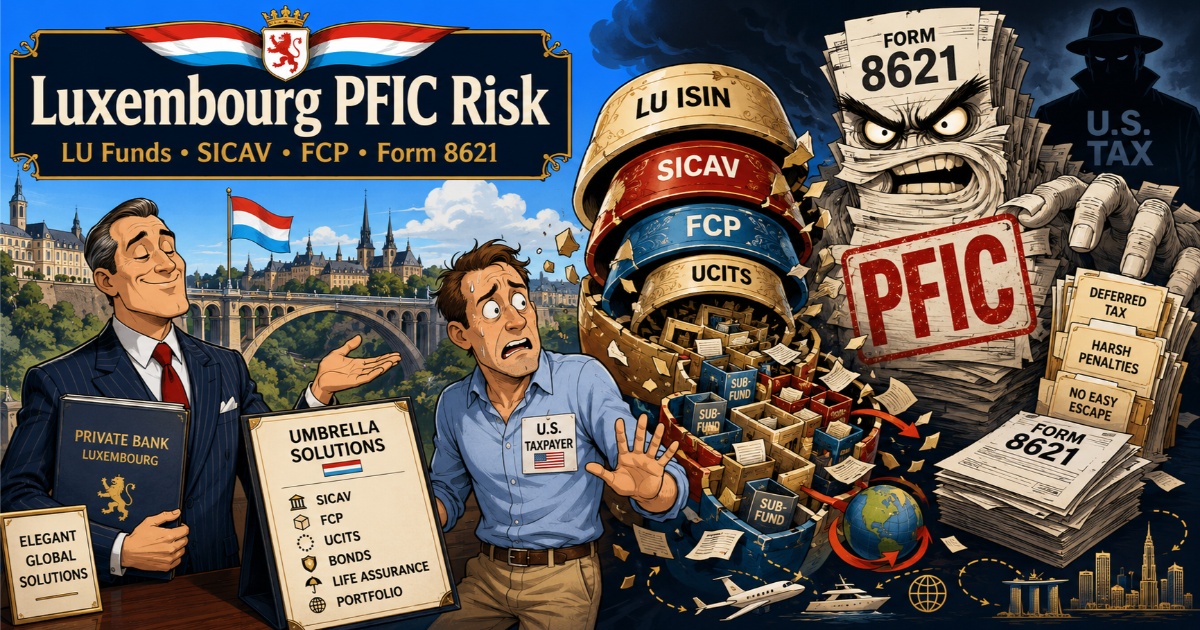
LU ISIN PFIC Risk: The First Warning Sign
For practical review, the ISIN is often the fastest screen. A fund with an LU prefix is Luxembourg-domiciled. That does not by itself complete the U.S. tax analysis, but it is a strong PFIC warning sign.
The brand name does not decide PFIC status. A U.S.-registered Fidelity, Franklin Templeton or BlackRock fund may be non-PFIC. A Luxembourg SICAV or FCP version from the same manager can be a PFIC. They share the same brand but utilize different tax wrappers.
U.S. tax preparers must verify the ISIN, legal form, fund domicile, umbrella name, sub-fund, share class, acquisition dates, distributions, sales, and year-end value for each position.
Common Luxembourg Fund Families That Need PFIC Review
Many global fund managers operate both U.S.-registered funds and Luxembourg-domiciled international funds. The brand name is not enough. The following fund platforms commonly require Form 8621 screening:
- Franklin Templeton Investment Funds: Luxembourg SICAV sub-fund structures where each compartment may require separate Form 8621 review.
- Fidelity Funds SICAV: Luxembourg-domiciled international fund range, distinct from U.S.-registered Fidelity mutual funds.
- BlackRock Global Funds: Global Luxembourg SICAV range; brand names do not govern U.S. tax classification.
- Amundi Funds: Luxembourg SICAV/UCITS structures frequently held in European retail and private banking portfolios.
- Pictet Funds: Common in Swiss private banking portfolios; Luxembourg sub-funds can create separate PFIC tracks.
- JPMorgan Funds Luxembourg: International Luxembourg fund range where each sub-fund compartment requires structured review.
- Schroders / Allianz / DWS / Invesco Luxembourg Funds: Common European fund platforms where the LU ISIN and foreign legal wrapper drive the U.S. PFIC review.
Luxembourg PFIC Risk Summary
- SICAVs: High PFIC risk. A Luxembourg SICAV is a foreign investment company wrapper that commonly holds portfolio securities and earns passive income.
- FCPs: High review risk. Although organized differently from a SICAV, an FCP can still create PFIC or Form 8621 exposure depending on U.S. entity classification, investor rights, and fund documents.
- UCITS Funds: High PFIC risk. UCITS is an EU regulatory label, not a U.S. tax exemption. Luxembourg UCITS funds commonly require PFIC review for U.S. taxpayers.
- LU ISINs: Domicile warning. If the ISIN starts with "LU", the fund is domiciled in Luxembourg and must be tested for PFIC.
- Money Market Funds: High review risk. Units in a Luxembourg money market SICAV or FCP are not bank cash deposits and commonly require PFIC review.
- Alternative Funds (RAIF/SIF): High review risk. Ownership rights, underlying assets, and legal entity classification must be reviewed to determine if they trigger Form 8621.
Luxembourg PFIC Risk Matrix: SICAVs, FCPs, UCITS Funds and Private Bank Wrappers
🔴 High Risk — Form 8621 review and annual reporting usually required
🟡 Review Required — Legal structure and asset holdings control the tax result
🟢 Low Risk — Typically excluded from PFIC rules; standard asset reporting applies
| Asset / Wrapper | Risk | U.S. Issue |
|---|---|---|
| Luxembourg SICAV | 🔴 | Foreign investment company wrapper; strong PFIC signal. |
| Luxembourg FCP | 🔴/🟡 | Entity classification and fund documents must be reviewed. |
| Luxembourg UCITS ETF | 🔴 | UCITS status does not remove PFIC review. |
| LU ISIN fund | 🔴/🟡 | Luxembourg domicile signal; fund-level review required. |
| Luxembourg money market fund | 🔴 | Cash-like strategy, but fund units are not bank deposits. |
| Alternative funds (RAIF / SIF) | 🔴/🟡 | Entity classification and asset mix control the result. |
| Private bank managed mandate | 🔴 | Underlying fund list may contain multiple PFICs. |
| Insurance wrappers / portfolio bonds | 🔴/🟡 | U.S. insurance treatment and investor-control analysis matter. |
| Direct bank deposits / savings | 🟢 | Standard interest tax rules and FBAR/8938 reporting apply. |
| U.S.-domiciled ETFs | 🟢 | Generally not PFIC stock. |
Form 8621 Filing Triggers for Luxembourg Funds
Common events that may create Form 8621 calculations or PFIC disposition review:
- Fund Payouts: Dividends or capital gains distributions from Luxembourg SICAVs or FCPs.
- Redemptions and Sales: Liquidating units in a Luxembourg UCITS ETF.
- Sub-Fund Switches: Exchanging units between different compartments of an umbrella fund. This may require U.S. disposition analysis even if the broker describes it as a tax-neutral rebalance.
- Share Class Conversions: Moving from accumulating to distributing share classes can trigger disposition analysis.
- Discretionary Trades: Automated rebalancing trades executed by a private bank on your behalf.
- Fund Mergers: Luxembourg UCITS mergers, absorptions, or reorganizations may require U.S. corporate-action and disposition review.
- Insurance Fund Switches: Switching internal funds inside a life assurance policy or portfolio bond may create separate PFIC disposition analysis.
PFIC §1291 vs MTM for Luxembourg Funds
Luxembourg funds held without a timely election fall under default §1291 rules. Gain on disposition and excess distributions are generally allocated across the holding period. The portion allocated to prior years is taxed at the highest historical ordinary income rate, with compounding interest added under IRC §6621.
Table A models the effect of §1291 tax and interest on a $10,000 PFIC gain.
| Period | Tax | Interest | % Consumed |
|---|---|---|---|
| 5 years | $3,440 | $590 | 40.3% |
| 10 years | $3,622 | $1,227 | 48.5% |
| 20 years | $3,630 | $2,396 | 60.3% |
| 30 years | $3,689 | $4,891 | 85.8% |
| 33 years | $3,714 | $6,200 | 99.1% |
| 35 years | $3,679 | $6,930 | 106.1% |
By year 33, U.S. tax and compounding interest consume 99.1% of the gain. By year 35, the total liability exceeds the gain entirely. For marketable Luxembourg funds, a timely MTM election may avoid the §1291 interest regime. See our §1291 vs MTM 10-Year Tax Comparison.
Luxembourg Form 8621 Filing Guide for LU-ISIN Funds
Step 1: Identify the Wrapper
Examine where your funds are held. Determine if they sit in a discretionary private bank portfolio, an insurance wrapper (assurance-vie, portfolio bond), or a standard retail brokerage account. This step sets your reporting boundaries.
Step 2: Identify the Exact Fund Positions
For each fund, collect the official name, the ISIN (LU prefix), the share class (accumulating vs. distributing), the exact acquisition/sale history in Euros, the distributions, and the year-end values. Do not rely on consolidated statements; the IRS requires detail for every individual fund lot.
Step 3: Count the PFIC Tracks
PFIC exposure scale is dictated by the number of funds, not the number of accounts. For example, a single private bank portfolio containing 8 Luxembourg SICAV sub-funds may create 8 separate Form 8621 review tracks.
Step 4: Choose the U.S. Tax Election
Determine which U.S. tax treatment applies. Most standard retail Luxembourg funds do not provide PFIC Annual Information Statements suitable for QEF reporting. Confirm AIS availability fund by fund. Therefore, your practical choices are MTM (if the fund is marketable on a public exchange) or default §1291.
Luxembourg PFIC Case Studies
Case 1 — Swiss Private Bank: Discretionary Mandate Mismatch
A U.S. citizen living in Switzerland holds a discretionary portfolio managed by a Swiss private bank. The statement shows a single high-level asset family, but the underlying assets actually hold five separate Luxembourg SICAV compartments. Although the bank manages this as one portfolio, the taxpayer may have five separate PFIC tracks. The tax preparer must track purchases, sales, EUR/USD exchange rates, and distributions for each sub-fund separately on five Forms 8621.
Case 2 — French Assurance-Vie: Luxembourg Funds Inside the Wrapper
A U.S. green-card holder in France holds a French assurance-vie policy. The insurance menu contains Luxembourg FCP fund units. If the policy fails U.S. insurance treatment, or if investor-control issues cause the policyholder to be treated as owning the underlying assets, the Luxembourg FCP units may become separate Form 8621 review tracks. Lacking a timely first-year election, subsequent distributions or redemptions can trigger default §1291 throwback tax and compounded interest.
Case 3 — Brand Name Trap: Familiar Names, Foreign Domiciles
A U.S. expat in Dubai purchases a "Fidelity" or "BlackRock" global equity fund through a local financial planner. Recognizing the brand, the expat assumes U.S. mutual fund rules apply. However, the fund is domiciled in Luxembourg with an LU ISIN. Because it is a Luxembourg pooled fund vehicle, it is a strong PFIC review signal and may require Form 8621 reporting. The taxpayer may need to reconstruct the holding ledger, distributions, sales, year-end values, and election history despite the familiar brand name.
Data Needed for Form 8621: ISIN, Share Class, EUR Basis and Fund Switches
To prepare Form 8621 for Luxembourg holdings, you need the following documents:
| Source Document | Information Required |
|---|---|
| Bank / Broker Statements | ISINs, annual purchase and sale transactions, year-end fair market values. |
| Insurance / Portfolio Bond Statement | Policy terms, surrender value, fund menu, internal switches, sub-fund names. |
| Prospectus / Factsheet | Fund domicile, legal vehicle type, share class, distributing or accumulating status. |
| Transaction History | Exact acquisition dates, lot costs, sale dates, fund switches. |
| Distribution Reports | Gross dividend payments, reinvestment details, local withholding tax. |
Lower-PFIC-Risk Options for U.S. Taxpayers Holding Luxembourg Funds
If you want to reduce U.S. PFIC reporting complexity, consider the following alternatives:
- U.S.-Domiciled ETFs: Purchasing U.S.-registered ETFs (like VOO or VT) avoids PFIC classification. Note that EU regulatory rules (PRIIPs) may restrict direct access to U.S. ETFs through European brokers.
- Direct Equities: Individual operating company shares (e.g., direct corporate stocks) do not trigger PFIC status.
- Direct Bonds: Government or corporate bonds held directly avoid Form 8621.
- Bank Deposits: Direct cash savings accounts are not PFICs. Standard interest tax rules and FBAR/8938 reporting still apply.
Related PFIC Technical Guides
- 🔗 What Is a PFIC under IRC §1297?
- 🔗 Form 8621 Filing Exemption Rules for PFIC Stock
- 🔗 What to Do After Discovering a PFIC
- 🔗 Never Filed Form 8621 for a PFIC?
- 🔗 §1291 Excess Distribution and Interest Calculation
- 🔗 §1291 vs MTM 10-Year PFIC Tax Comparison
- 🔗 PFIC Foreign Exchange Translation Rules for EUR and USD
- 🔗 PFIC Fund Switch and §1291 Disposition Trap
- 🔗 PFIC Election Strategy: §1291 vs MTM vs QEF
Luxembourg PFIC Frequently Asked Questions
Are Luxembourg SICAVs PFICs?
Are Luxembourg FCPs PFICs?
Are Luxembourg UCITS ETFs PFICs?
Is an LU ISIN a PFIC warning sign?
Is a Luxembourg money market fund a PFIC?
Does a private bank discretionary portfolio shield me from PFIC?
Does a Luxembourg life assurance policy avoid PFIC?
Can I make a QEF election for Luxembourg funds?
Can I make a Mark-to-Market (MTM) election?
Does the $25,000 de minimis exemption apply?
Official Sources and References
- 🔗 IRS Form 8621 and Instructions: Official IRS guidance for PFIC reporting obligations.
- 🔗 IRC §§1291–1298: Statutory framework governing Passive Foreign Investment Companies.
- 🔗 Treas. Reg. §1.1296-1: Regulatory rules for Mark-to-Market elections.
- 🔗 Treas. Reg. §1.1298-1: Regulatory rules for PFIC annual reporting and de minimis thresholds.
- 🔗 CSSF UCI Authorisation and Official List Guidance: Luxembourg regulatory list framework for authorised undertakings.
- 🔗 CSSF UCITS / Part I UCI Regulatory Framework: Luxembourg UCI and UCITS supervisory legal materials.
- 🔗 Luxembourg RAIF Legal Framework: Reserved Alternative Investment Fund law and regulatory materials.
- 🔗 EU PRIIPs / KID Regulatory Framework: European Key Information Documents (KID) framework for retail packages.