
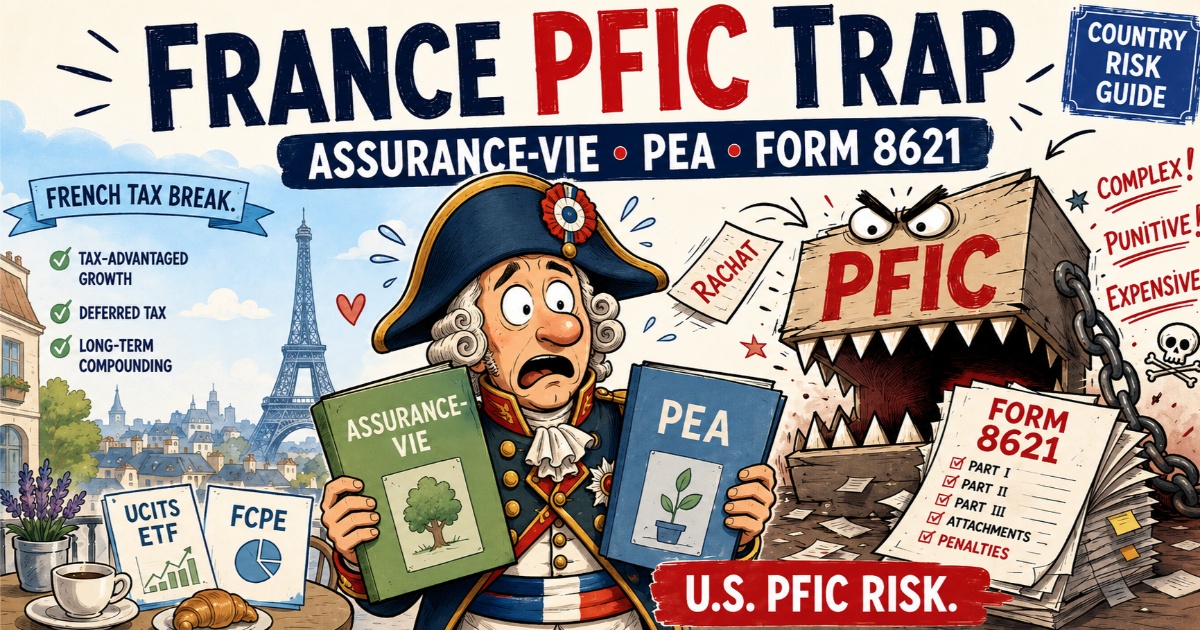
France PFIC Quick Answers: Assurance-Vie, PEA, and Form 8621
Is French Assurance-Vie a PFIC for U.S. tax purposes?
Do I need Form 8621 for a French PEA?
What happens if I make a rachat from my Assurance-Vie?
Why France Is a High-PFIC-Risk Country
France is high-risk because the normal French retail portfolio is built around pooled investment products.
A French household may see an Assurance-Vie contract, a PEA, an employee savings plan, or a PER. A U.S. tax return may see foreign funds, indirect ownership, fund switches, redemptions, and Form 8621 filings.
The danger is not that the investor bought something exotic. The danger is that ordinary French products often hold SICAVs, FCPs, OPCVMs, UCITS ETFs, FCPE funds, SCPI, or OPCI vehicles.
That is the France PFIC problem.
Who Needs a France PFIC Review
You should review your French accounts if you are a U.S. citizen, green card holder, U.S. tax resident, American living in France, or dual U.S.–French citizen and you hold: (part of our regional Europe PFIC & PRIIPs Hub)
- Assurance-Vie with unités de compte
- PEA with ETFs or OPCVM funds
- CTO with European ETFs
- FCPE inside PEE, PERCO, or employee savings plans
- PER with fund allocations
- SCPI or OPCI funds
- Amundi, Lyxor, BNP Paribas Easy, Xtrackers, iShares Europe, or Vanguard Ireland UCITS funds
French Terms That Trigger U.S. PFIC Review
| French Term | U.S. PFIC Review |
|---|---|
| Assurance-Vie | Wrapper; review underlying unités de compte |
| Unité de compte | High PFIC review risk |
| Arbitrage | Possible fund switch / disposition |
| Rachat partiel | Possible redemption event |
| Rachat total | Full surrender; high-risk PFIC cleanup event |
| Fonds en euros | Usually lower fund-level PFIC risk, but wrapper reporting still needs review |
| PEA | Wrapper; review ETFs and funds inside |
| CTO / Compte-Titres Ordinaire | Taxable brokerage account; PFIC risk depends on holdings |
| OPCVM / SICAV / FCP | High PFIC review risk |
| FCPE | Employer savings fund; PFIC review still needed |
| SCPI / OPCI | Real estate fund classification review |
| Livret A | Usually not PFIC, but U.S.-taxable interest |
| PER | Retirement-style wrapper; review treaty position and underlying funds |
France PFIC Risk Matrix
🔴 HIGH — Form 8621 review usually required
🟡 REVIEW — structure controls the result
🟢 LOW — usually outside PFIC rules
| French Asset or Account | PFIC Risk | U.S. PFIC Review Issue |
|---|---|---|
| Assurance-Vie with unités de compte | 🔴 | Assurance-Vie is a French wrapper, but the U.S. PFIC issue usually sits in the underlying unités de compte. Each non-U.S. fund may require Form 8621 review. |
| Unités de compte inside Assurance-Vie | 🔴 | Unit-linked holdings often reference SICAVs, FCPs, UCITS ETFs, SCPI, OPCI, or other non-U.S. pooled funds. |
| PEA with UCITS ETFs or OPCVM funds | 🔴 | A PEA is not a U.S.-recognized PFIC shelter. The holdings inside the PEA control the Form 8621 risk. |
| PEA-eligible UCITS ETFs | 🔴 | A UCITS ETF can be a PFIC even when it tracks the S&P 500, Nasdaq 100, MSCI World, or another U.S. or global index. |
| Compte-Titres Ordinaire / CTO with European funds | 🔴 | A taxable French brokerage account becomes a PFIC file when it holds European ETFs, SICAVs, FCPs, or mutual funds. |
| OPCVM / SICAV / FCP | 🔴 | French pooled funds are high-risk PFIC assets because they are non-U.S. fund vehicles with passive income and passive assets. |
| FCPE inside PEE / PERCO employee savings plans | 🔴 | French employer-plan status does not remove PFIC review when the plan holds pooled employee investment funds. |
| PER with fund allocations | 🟡 | A PER requires separate review for pension treatment, treaty position, contribution treatment, and underlying fund PFIC exposure. |
| SCPI / OPCI real estate funds | 🟡 | Real estate exposure does not automatically remove PFIC risk. The entity and asset structure must be reviewed. |
| Livret A / LDDS / LEP | 🟢 | These are usually bank savings products, not pooled foreign investment funds. The interest may still be taxable on a U.S. return. |
| French bank checking or savings account | 🟢 | A normal bank account is not usually a PFIC, but it may still count for FBAR and Form 8938 thresholds. |
| Direct French listed shares | 🟢 / 🟡 | Direct operating-company shares are usually different from foreign pooled funds, but passive-heavy companies still need screening. |
| U.S.-domiciled ETFs held from France | 🟢 | U.S.-domiciled ETFs are generally not PFICs, but French and EU retail platforms may block access under PRIIPs/KID rules. |
Platform name does not control PFIC status. The holdings do.
French platforms commonly seen in France PFIC reviews include AXA, Generali, BNP Paribas Cardif, Crédit Agricole, Société Générale, Linxea, Yomoni, Nalo, Goodvest, BoursoBank, Fortuneo, Bourse Direct, Saxo Banque, Trade Republic, DEGIRO, and Interactive Brokers.
The France ETF Lock: PRIIPs Blocks U.S. ETFs, UCITS Creates PFICs
Many U.S. taxpayers in France first discover PFIC after trying to buy a normal U.S.-domiciled ETF.
The clean U.S. tax answer is often simple: U.S.-domiciled ETFs such as VOO, VTI, VT, or SPY are generally not PFICs. French and EU retail brokerage rules often block that path because many U.S. ETFs do not provide a PRIIPs Key Information Document.
The investor then buys the available substitute: Amundi, Lyxor, BNP Paribas Easy, Xtrackers, iShares Europe, Vanguard Ireland, or another UCITS ETF.
That solves the French brokerage problem. It creates the U.S. PFIC problem.
A UCITS ETF can track the S&P 500, Nasdaq 100, MSCI World, or global bonds. The index does not control PFIC status. The non-U.S. fund wrapper triggers the review.
Assurance-Vie PFIC Risk: Wrapper, Arbitrage, Rachat
Assurance-Vie is a French wrapper, but the U.S. PFIC issue usually sits in the unités de compte inside the contract.
The U.S. review splits into two files:
Wrapper file: foreign insurance, foreign financial account, foreign trust, or other reportable arrangement.
For the wrapper-level FBAR, Form 8938, cash surrender value and foreign insurance questions, use the foreign life insurance U.S. tax guide; this France page remains focused on Assurance-Vie, unités de compte and French-product PFIC consequences.
Asset file: unités de compte holding SICAVs, FCPs, UCITS ETFs, SCPI, OPCI, or other PFIC-risk funds.
Form 8621 does not automatically solve the wrapper question. Form 3520 or Form 3520-A may require separate review in some structures.
Two events create the highest risk:
Arbitrage: a switch between unités de compte. French view: internal allocation change. U.S. view: possible PFIC disposition.
Rachat partiel or rachat total: a partial withdrawal or full surrender. French view: contract withdrawal. U.S. view: possible redemption of underlying fund units requiring fund-level disposition review.
A large rachat after years of unreported fund growth is one of the highest-risk France PFIC cleanup events.
PEA and UCITS ETF PFIC Risk
A PEA is not a U.S.-recognized PFIC shelter. The holdings inside the PEA control the Form 8621 risk.
A PEA holding direct French operating-company shares is different from a PEA holding Amundi, Lyxor, BNP Paribas Easy, Xtrackers, iShares Europe, or Vanguard Ireland UCITS ETFs.
The wrapper is the same. The PFIC result may not be.
The U.S. review asks:
- Was the asset a direct company share?
- Was it a UCITS ETF?
- Was it a SICAV, FCP, or OPCVM?
- Where was the fund domiciled?
- Was there a dividend, sale, switch, liquidation, or PEA closure?
French tax efficiency does not create a U.S. PFIC exemption. A PEA may reduce French income tax after the holding period, but if little or no French tax was paid, there may be little or no foreign tax credit available against the U.S. result.
Accumulating UCITS ETFs do not bypass PFIC review. No cash dividend does not mean no PFIC issue. The trigger may appear later on sale, switch, transfer, liquidation, PEA closure, or Assurance-Vie rachat funded by selling fund units.
No Treaty Shortcut for French Assurance-Vie or PEA
The U.S.–France tax treaty does not create a blanket PFIC exemption for Assurance-Vie, PEA, UCITS ETFs, SICAVs, FCPs, or FCPE funds.
A French tax benefit does not control the U.S. classification:
- PEA exemption → does not eliminate Form 8621 review.
- Assurance-Vie deferral → does not control U.S. PFIC timing.
- Livret A exemption → does not make the interest U.S.-tax-free.
- French fund reports → usually do not provide QEF Annual Information Statement data.
- FBAR / Form 8938 → do not replace Form 8621.
France Form 8621 Regime Snapshot
QEF is usually difficult because French retail funds rarely provide a U.S. PFIC Annual Information Statement.
MTM may be possible for some exchange-listed UCITS ETFs if they qualify as marketable stock.
§1291 default treatment is the common cleanup problem for unreported Assurance-Vie unités de compte, PEA funds, SICAVs, FCPs, FCPEs, and UCITS ETFs.
Before a sale, switch, rachat, distribution, or PEA closure, the regime history must be checked.
Common France PFIC Trigger Events
Assurance-Vie rachat or arbitrage
A switch between unités de compte or a partial/full surrender may require fund-level PFIC disposition review.
PEA UCITS ETF sale or closure
A sale after the French holding period may still require Form 8621 if the PEA held non-U.S. ETFs, SICAVs, FCPs, or OPCVMs.
FCPE / PEE / PERCO withdrawal
Employer savings plans can hold pooled employee funds. Unlocking, switching, or withdrawing the plan can require PFIC review.
CTO or app-based UCITS ETF sale
French brokers and apps can create many small PFIC lots through recurring ETF purchases, dividend reinvestment, or fractional investing. A later sale may require lot-level Form 8621 review.
Common France PFIC Mistakes
- Treating Assurance-Vie like a U.S. retirement account.
- Filing one Form 8621 for the entire Assurance-Vie instead of reviewing underlying funds.
- Ignoring arbitrage between unités de compte.
- Using the French rachat formula for U.S. PFIC reporting.
- Assuming the PEA exemption applies to the United States.
- Ignoring FCPE funds inside PEE or PERCO plans.
- Assuming FBAR or Form 8938 replaces Form 8621.
- Assuming accumulating UCITS ETFs are safe because no cash dividend was paid.
Start the Review Before the Rachat, Sale, Switch, or Closure
French tax logic stops at the wrapper. U.S. PFIC logic starts at the fund.
Assurance-Vie, PEA, CTO, FCPE, PER, and UCITS positions must be reduced to asset-level data: fund name, ISIN, domicile, legal form, lot date, sale date, switch date, rachat date, distributions, prior Form 8621 history, and election status.
The IRS does not price the wrapper. It tests the asset.
Upload the French EUR transaction file. 8621calculator.com converts it into a Form 8621-ready PFIC workpaper for review.
France PFIC FAQ: Assurance-Vie, PEA, UCITS, and Form 8621
Is Assurance-Vie considered French life insurance for U.S. tax purposes?
Do American citizens in France need Form 8621 for Assurance-Vie?
Is a French PEA taxable in the United States?
Are Amundi or Lyxor ETFs PFICs for U.S. taxpayers?
Should I review PFIC before closing a PEA or making an Assurance-Vie rachat?
Does Form 8938 or FBAR replace Form 8621?
Can I file one Form 8621 for my whole Assurance-Vie?
Does inheriting Assurance-Vie create a PFIC problem?
Can Streamlined Filing fix missed Form 8621 for French accounts?
What should I export from BoursoBank, Fortuneo, DEGIRO, Trade Republic, or Interactive Brokers?
Related PFIC Technical Guides
- What Is a PFIC under IRC §1297?
- PFIC §1291 Form 8621 Filing Exception Tests
- Never Filed Form 8621 for a PFIC?
- §1291 Excess Distribution and Interest Calculation
- PFIC Foreign Exchange Translation Rules for EUR and USD
- PFIC Fund Switch and §1291 Disposition Trap
- QEF Election and PFIC Annual Information Statement Review
- Streamlined Procedures and Late QEF / MTM Elections
- EA vs CPA vs Tax Attorney for PFIC, FBAR, and Streamlined Filing

Sources and References
This guide applies U.S. PFIC rules to French Assurance-Vie, PEA, OPCVM, SICAV, FCP, FCPE, PER, SCPI, OPCI, UCITS ETFs, French broker reports, and PRIIPs access constraints. PFIC status, AIS availability, and elections must be tested holding by holding.
References should be checked against the current IRS Form 8621 and instructions for the filing year being prepared.
- IRS Form 8621 Instructions: Form 8621 filing triggers, QEF reporting, §1296 MTM election reporting, and reporting exceptions.
- IRC §1297: PFIC passive income and passive asset tests.
- IRC §§1291-1298: Statutory framework governing PFIC taxation.
- Treas. Reg. §1.1296-1: Regulatory rules for Mark-to-Market elections.
- Treas. Reg. §1.1298-1: PFIC shareholder reporting and exception rules.
- France–U.S. Income Tax Treaty: Treaty context for French-source income and U.S. taxpayers.
- AMF Savings and Investment Products: French retail investment product context, including funds and wrappers.
- European Commission PRIIPs: PRIIPs Key Information Document framework for European retail products.
Content reflects Form 8621 (Rev. 12/2025), applicable Treasury Regulations, IRS guidance, and other authorities cited on this page.