
Quick Answers: Can You File Form 8621 Yourself?
Can I file Form 8621 myself?
Will a CPA accept my DIY PFIC calculation?
Is there a Form 8621 calculator for PFIC tax?
Can TurboTax calculate PFIC §1291 tax?
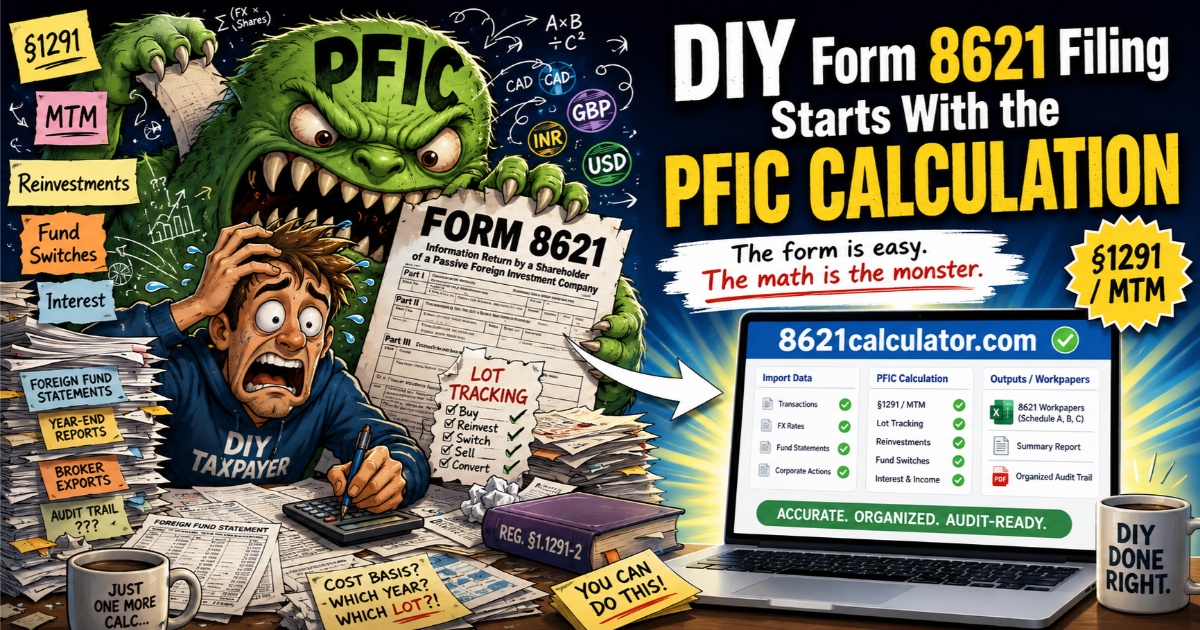
Form 8621 Is a Calculation Problem, Not Just a Tax Form
Many taxpayers discover Form 8621 only after their foreign mutual funds, ETFs, UCITS funds, Canadian ETFs, Indian mutual funds, UK OEICs, or other non-U.S. pooled funds are already several years old.
The mistake is thinking Form 8621 is only a disclosure form. In many PFIC cases, the form depends on a separate calculation engine to resolve the following:
- Which lots were purchased?
- Which units were sold?
- Were there distributions or reinvestments?
- Were there fund switches or robo-advisor rebalances?
- Was the fund held in a foreign currency?
- Is the taxpayer using default §1291, §1296 MTM, or QEF?
- Does Line 16a need supporting schedules?
- Was Form 8621 missed in prior years?
For a simple fund with no transactions, the form may be manageable. For a long-held PFIC with sales, distributions, DRIPs, switches, or foreign currency movement, the calculation can become the real filing problem.
Can You File Form 8621 Yourself as a PFIC DIY Filer?
A taxpayer can prepare Form 8621 themselves, but the key question is not whether the form can be filled. The key question is whether the calculation behind the form can be supported.
The Reality Check: Is Your PFIC Case Actually DIY-Friendly?
Before you try to file Form 8621 yourself, separate data entry from tax calculation. The form may look short, but the PFIC calculation behind it can become difficult when there are sales, DRIPs, fund switches, foreign currency, or missed prior years.
| More DIY-Friendly | Use a Calculator or Professional Review |
|---|---|
|
|
The practical middle ground is to use calculation workpapers, then have the final tax position reviewed by a CPA, EA, or tax attorney where needed.
Form 8621 Software and Spreadsheet Limits for DIY Filers
Consumer tax software may allow limited Form 8621 entry, PDF attachment, or manual forms workflows, but it usually does not perform the PFIC tax calculation behind the form. A separate PFIC calculation engine can calculate §1291 or §1296 MTM results, generate line support and workpapers, and help the taxpayer or preparer decide how to enter, attach, or paper-file the final return.
Many taxpayers search for Form 8621 inside TurboTax, H&R Block, TaxAct, or other consumer tax software and assume the software will perform the PFIC calculation. Usually, it will not.
Retail software is built for form entry, not PFIC computation. A full §1291 calculation may require:
- Original acquisition date.
- Sale date.
- Holding period allocation.
- Excess distribution allocation.
- Historical highest tax rates.
- IRS underpayment interest rates.
- Compounding.
- Foreign currency conversion.
- Lot-level basis tracking.
- Line 16a schedules.
Even if the software allows limited Form 8621 entry, it generally does not reconstruct the PFIC calculation from raw brokerage data. That is why many taxpayers use separate PFIC workpapers before deciding how the return should be entered, attached, reviewed, or paper-filed.
When DIY Form 8621 Filing Is Realistic (and When It Is Not)
DIY calculation may not be enough if:
- Several years of Form 8621 were missed.
- The taxpayer is entering Streamlined Procedures.
- There may be willfulness concerns.
- The PFIC was held through a trust, pension, insurance policy, company, HUF, SIPP, RRSP, or other wrapper.
- There were fund mergers, plan switches, gifts, pledges, or transfers.
- The taxpayer needs a late QEF or MTM election.
- The taxpayer is facing an IRS notice or audit.
- The records are incomplete.
In those cases, the calculation may still be useful, but the filing position should be reviewed by an appropriate tax professional.
What Data You Need Before Calculating: Handling Missing Records
Before starting the calculation, gather the full PFIC transaction history.
For each PFIC, you generally need:
- Fund name.
- Share class, ticker, ISIN, CUSIP, or other identifier if available.
- Transaction date.
- Transaction type.
- Units purchased or sold.
- Original-currency amount.
- Distributions.
- Reinvestments or DRIPs.
- Fund switches.
- Mergers or plan changes.
- Year-end fair market value where MTM is used.
- Foreign taxes withheld, if relevant.
- Ownership percentage.
- Currency.
- U.S. tax year.
One PFIC should be separated from another. One brokerage statement may contain many funds, but each PFIC may need its own Form 8621 review and workpaper.
How the Form 8621 DIY PFIC Calculator Workflow Works
From raw brokerage data to Form 8621 workpapers.
Step 1: Organize Your PFIC Transaction History
The foundation of any DIY PFIC calculation is structured transaction history. Instead of relying on summarized annual broker tax slips (which do not compute U.S. PFIC tax), you must consolidate the transaction history for each fund into a structured format.
Required columns for calculation:
| Column | Filing Purpose |
|---|---|
| Date | YYYY-MM-DD format to trace exact holding periods |
| Details | Action label such as Purchase, Sale, Distribution, Reinvestment |
| Units | Quantity of shares or units (negative values for sales) |
| Value | The cash amount in the fund's original currency |
Example structure:
| Date | Details | Units | Value |
|---|---|---|---|
| 2020-03-05 | Purchase | 1000 | 5000.00 |
| 2021-06-15 | Distribution | 0 | 200.00 |
| 2022-05-10 | Sale | -200 | -1200.00 |
Critical data consolidation rules:
- Use YYYY-MM-DD date format.
- Sales or redemptions must use negative units.
- Cash distributions normally use zero units.
- Do not pre-convert foreign currency into USD (preserve original currency).
- Maintain separate records for each PFIC fund.
Step 2: Cleanse and Validate Your Transaction Data
Before executing the calculation, the transaction data must be checked for completeness and formatting. Common data errors can break the multi-year compound interest calculations. Verify that:
- All transaction dates are in a standard, consistent format (such as YYYY-MM-DD) for accurate holding period tracking.
- No text or currency symbols (like $, €, or ₹) are left in numeric columns.
- There are no missing values or blank rows in your history.
- Each fund is isolated—combining multiple different ETFs or mutual funds into a single calculation will yield incorrect results.
Addressing these data issues upfront ensures that the lot-matching algorithms and foreign exchange conversions run smoothly.
Step 3: Classify PFIC Transactions Correctly
Every transaction in your brokerage statement must be classified into a standard PFIC transaction type. The IRS treats purchases, sales, cash distributions, and reinvested dividends under completely different tax mechanisms.
Standard classification guidelines:
| Units | Value | Statement Description | PFIC Classification |
|---|---|---|---|
| > 0 | > 0 | Buy / Purchase / Subscription / Contribution | Purchase |
| > 0 | Any | DRIP / Reinvest / Dividend reinvested | Reinvestment |
| < 0 | Any | Sell / Sale / Redemption / Switch-out | Sale |
| = 0 | > 0 | Dividend / Distribution / Interest | Distribution |
| = 0 | Any | Return of capital / ROC | Return of Capital |
| Any | Any | Prior-year QEF or MTM basis adjustment | Cost Base Adjustment |
| Any | Any | Metadata / internal platform note | Ignore |
A zero value may be a broker placeholder. Do not classify an entry as a reinvestment unless the statement supports a real cash distribution or reinvested amount. Small distributions, fractional DRIPs, robo-advisor rebalances, fund switches, and partial sales can still affect Form 8621.
Step 4: Establish Key Calculation Parameters
To run the calculation engine, you must define the tax parameters specific to your filing year and personal tax situation. Key settings that dictate the outcome include:
- Filing Tax Year: The current tax year you are preparing Form 8621 for.
- Original Transaction Currency: The currency of the fund's primary exchange (e.g., CAD, INR, GBP, EUR).
- Ownership Percentage: Typically 100% for individual accounts, or 50% for standard joint accounts.
- PFIC Start Year: The first year you owned the fund, which determines the multi-year holding period.
- U.S. Residency Start Date: Crucial for taxpayers who became U.S. tax residents after purchasing the PFIC.
- Method Selection: Choosing between default Section 1291 (excess distribution) and Section 1296 Mark-to-Market (MTM). QEF is handled separately through the simple QEF online calculator when the fund provides usable annual information.
For new U.S. tax residents, the PFIC start date and residency start date may affect the analysis. The taxpayer should not assume that pre-U.S. purchases automatically eliminate future PFIC reporting. Ownership percentage also matters: a joint account does not always mean 50/50, and complex ownership facts may require professional review.
Step 5: Execute the §1291 or §1296 Mark-to-Market Calculations
With clean data, mapped transactions, and correct parameters, the PFIC calculation engine executes the multi-year tax formulas.
For default §1291 (Excess Distribution Method), the engine performs:
- FIFO Lot Matching: Tracking which purchase lots are sold during a disposition.
- Excess Distribution Analysis: Determining if current-year distributions exceed 125% of the 3-year average.
- Prior-Year Allocation: Allocating the excess distribution and gains daily across the holding period.
- §6621 Interest Calculation: Applying IRS underpayment interest rates compounded daily (§6622) to prior-year tax liabilities.
For §1296 Mark-to-Market (MTM), the engine performs:
- Year-End FMV Valuation: Determining the mark-to-market gain or loss based on year-end prices.
- Unreversed Inclusion (URI) Tracking: Computing the limit for ordinary loss deductions.
- Basis Adjustments: Keeping a running record of adjusted cost basis for future sales.
Step 6: Generate and Audit Your Supporting Workpapers
The final step in the workflow is generating the supporting workpapers (such as in Excel or PDF format) to review the calculation traces before entering the results onto Form 8621.
Typical reviewable calculation sheets include:
| Worksheet | Audit Purpose |
|---|---|
| Summary_8621 | Provides the exact numbers to fill into specific Form 8621 lines |
| PFIC WS | Shows the step-by-step lot tracking and currency conversions |
| 16a_Summary | Consolidates the total gain, excess distribution, tax, and interest for Line 16a |
| 16a_Disposition | Details the capital gain calculations for every lot sold |
| 16a_Excess_Distribution | Details the daily allocation of excess distributions across prior years |
A thorough DIY review involves checking whether every transaction matches your underlying broker records, confirming the lot matching (FIFO) order, and verifying that the FX source and conversion dates are consistent across the workpapers.
Form 8621 Line 16a Statement: What the Workpapers Support
Form 8621 Line 16a may require supporting information when gain, excess distributions, and interest allocations are reported under §1291.
The calculation output can help support:
- PFIC gain or disposition calculations.
- Excess distribution allocation.
- Prior-year tax allocation.
- Interest calculation.
- FX conversion.
- FIFO matching.
- Supporting schedules attached to the return.
The calculator generates workpapers. The taxpayer or tax professional decides which materials, if any, should be attached to the filed return. Line 16a is one reason consumer tax software often fails. The issue is not only entering a number. The issue is supporting how the number was computed.
Common PFIC CSV, FX and Transaction Mapping Errors
Frequent Form 8621 calculation errors include:
| Error | Why it matters |
|---|---|
| Missing early purchase records | Cost basis and holding period become wrong |
| Wrong date format | CSV validation or FX conversion may fail |
| Pre-converting to USD | Can distort basis, proceeds, and gain |
| Positive units for sales | Sale may be treated as purchase |
| Ignoring distributions | Excess distribution analysis may be wrong |
| Treating DRIPs as ordinary purchases only | Distribution and reinvestment may both matter |
| Ignoring fund switches | Switches may be dispositions |
| Combining multiple PFICs into one CSV | Fund-level Form 8621 analysis may break |
| Using broker tax slips only | Local tax reports are not PFIC workpapers |
| Assuming loss means no filing issue | Filing triggers may still exist |
The most dangerous error is treating Form 8621 as a simple disclosure form when the facts require a tax calculation.
Form 8621 DIY Review Checklist: Accounting for DRIP and Fund Switches
Before using the output, review:
- Is this one PFIC or multiple PFICs?
- Is the full transaction history included?
- Are purchases, sales, distributions, DRIPs, switches, and fees classified correctly?
- Are sales shown with negative units?
- Is the currency original currency, not pre-converted USD?
- Is the tax year correct?
- Is the ownership percentage correct?
- Was the correct PFIC regime selected?
- Are there prior-year missed Form 8621 filings?
- Does Line 16a require supporting schedules?
- Should a CPA, EA, or tax attorney review the result?
DIY does not mean no review. It means the taxpayer controls the data and calculation workflow before deciding how to file.
How to Generate Form 8621 Workpapers for Your Records
If you already have PFIC transaction history, 8621calculator.com can calculate §1291 or §1296 MTM results from that data and generate Form 8621-style workpapers for review.
The calculator can help produce:
- Summary_8621 worksheet.
- PFIC WS worksheet.
- Line 16a supporting schedules.
- Disposition schedules.
- Excess distribution schedules.
- FIFO lot matching.
- Foreign currency conversion.
- §1291 tax and interest calculations.
- §1296 MTM basis tracking.
No tax return is filed by the calculator. The output is a calculation workpaper for taxpayer or professional review.
For a complete worked example showing how a single transaction flows through these prior-year rates and compounding interest rules, see our downloadable Form 8621 sample Excel workpaper.
FAQ: One Form per PFIC, de minimis Exception, TaxAct and TurboTax Limits
Do I need to file Form 8621 every year?
Do I need one Form 8621 for each PFIC?
What happens if I don’t file Form 8621?
Why doesn’t TurboTax calculate PFIC §1291 tax?
How reliable is a PFIC calculator for Form 8621?
My broker only shows limited years of data. Can I still calculate Form 8621?
Which exchange rate should I use for non-USD PFIC transactions?
Is dividend reinvestment treated as a new PFIC purchase?
Do I need to file Form 8621 if my PFICs are under $25,000?
Can I use last year's Form 8621 as an example?
Official Sources & References
- 🔗 IRS Form 8621: Official IRS PDF form for Passive Foreign Investment Company reporting.
- 🔗 Instructions for Form 8621: Official IRS instructions for completing Form 8621.
- 🔗 8621 Calculator: Automated Form 8621 computation engine for multi-year PFIC holdings.
Recommended Reading
- 🔗 Do I Need to File Form 8621? Free Filing Test
- 🔗 §1291 Excess Distribution Calculation Guide
- 🔗 §1296 Mark-to-Market (MTM) Calculation Guide
- 🔗 PFIC Election Comparison: §1291 vs MTM vs QEF
Content reflects Form 8621 (Rev. 12/2025), applicable Treasury Regulations, IRS guidance, and other authorities cited on this page.