
Quick PFIC Answers for U.S. Expats in Hong Kong
Is my Hong Kong MPF / 強積金 automatically exempt from PFIC review?
Are Hong Kong unit trusts / 單位信託基金 PFICs for U.S. taxpayers?
Hong Kong Terms Used in This Guide
Chinese-speaking taxpayers may search for this issue as 強積金 美國報稅, 香港 MPF 美國稅, or 盈富基金 2800 美國稅. In U.S. tax practice, the issue is usually analyzed through Form 8621, PFIC, FBAR, Form 8938 and foreign pension classification.
| Hong Kong term | Common Chinese name | U.S. tax review issue |
|---|---|---|
| MPF | 強積金 / 强积金 | Foreign pension, trust, PFIC, FBAR, Form 8938 |
| TraHK / Tracker Fund of Hong Kong / 2800 | 盈富基金 | PFIC and Form 8621 review |
| Unit trusts | 單位信託基金 / 单位信托基金 | Usually high PFIC risk |
| ILAS | 投資相連壽險計劃 | Insurance contract classification first |
| eMPF | 積金易 | Record download may not be enough for Form 8621 |
| ORSO | 職業退休計劃 | Plan classification and foreign asset reporting |
Do I Need Form 8621 for a Hong Kong MPF Account?
Maybe. A Hong Kong MPF account, commonly called 強積金 or 强积金, is not automatically exempt from Form 8621 merely because it is a retirement arrangement under Hong Kong law. The answer depends on U.S. classification of the MPF arrangement, whether the taxpayer is treated as directly or indirectly owning underlying PFIC stock, and whether a Form 8621 filing trigger applies.
If the taxpayer is treated as owning interests in MPF constituent funds, each relevant fund may require separate PFIC review. If the taxpayer is treated only as holding a pension or trust-type interest, the Form 8621 result may differ. This is why MPF cases should start with classification before any PFIC calculation.
Is the Hong Kong MPF Account Itself a PFIC, or Are the Underlying Funds PFICs?
The MPF wrapper itself is not the starting point of the PFIC test. The first step is to classify the MPF arrangement under U.S. tax rules. The practical PFIC issue usually arises from the underlying MPF constituent funds, where the U.S. taxpayer may be treated as directly or indirectly owning foreign fund interests.
This distinction matters because one MPF account can contain several constituent funds. For FBAR or Form 8938, the account may be reported as one foreign financial account. For Form 8621, the analysis may need to be performed fund by fund if the taxpayer is treated as owning PFIC stock directly or indirectly.
Is TraHK / Tracker Fund of Hong Kong / 盈富基金 2800 a PFIC?
In most U.S. tax workpapers, TraHK / Tracker Fund of Hong Kong / 盈富基金 2800 should be treated as a high-risk PFIC candidate and prepared as a PFIC unless a contrary U.S. classification position is documented. It is a Hong Kong-law unit trust ETF listed on SEHK, not a U.S.-domiciled ETF.
If PFIC treatment applies, a sale of TraHK units may trigger a §1291 excess-distribution calculation unless a valid QEF or mark-to-market election changes the result. Because TraHK is exchange-traded, it may also be a candidate for §1296 marketable-stock analysis after PFIC classification.
The Hong Kong PFIC Trap: MPF Is Not Automatically Protected for U.S. Tax Purposes
A U.S. citizen working in Hong Kong may contribute to a Mandatory Provident Fund / MPF / 強積金 account, add Tax Deductible Voluntary Contributions (TVC) / 可扣稅自願性供款, select constituent funds through eMPF, and assume the Hong Kong retirement wrapper ends the U.S. analysis.
It does not.
MPF and TVC accounts allocate money into investment options. Where U.S. tax classification treats the member as directly or indirectly holding interests in foreign fund entities, each relevant holding must be reviewed for PFIC treatment. Under the IRS test, a foreign corporation is a PFIC if at least 75% of its gross income is passive income or at least 50% of its average assets produce, or are held to produce, passive income. A separate Form 8621 is generally required for each PFIC held directly or indirectly when a filing trigger applies.
This collides directly with Hong Kong product design:
- MPF / 強積金 and TVC / 可扣稅自願性供款 allocate contributions into constituent funds.
- eMPF now administers MPF schemes, including contribution accounts and TVC accounts.
- TraHK / Tracker Fund of Hong Kong / 盈富基金 (2800) is a Hong Kong-law unit trust ETF listed on SEHK and designed to track the Hang Seng Index.
- HSBC Hong Kong, Hang Seng, BOCHK and other wealth platforms distribute unit trusts and offshore funds.
- ILAS / 投資相連壽險計劃 — Insurance wrapper with investment-linked options; the policyholder does not directly own the insurer's underlying assets under Hong Kong product terms.
- Luxembourg or Ireland SICAV funds sold through Hong Kong platforms remain foreign-fund classification problems; the sales platform does not control the U.S. result.
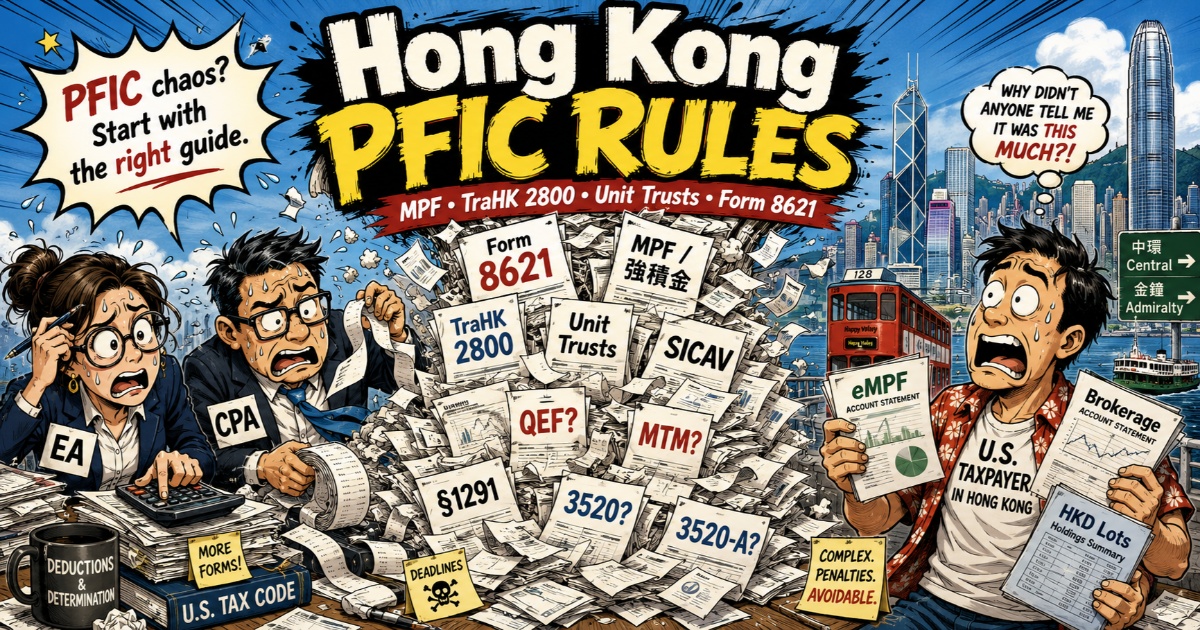
Hong Kong Asset PFIC Risk Table
🔴 High — high-priority U.S. classification and Form 8621 review; not final PFIC status
🟡 Review — structure controls the result
🟢 Low — usually outside PFIC rules
| Local Asset & Platform | Risk | The U.S. Catch |
|---|---|---|
| Hong Kong MPF / 強積金 / 强积金 — MPF constituent funds, DIS, CAF, A65F | 🔴 | The retirement wrapper does not bypass U.S. classification; multiple underlying fund interests can create multiple Form 8621 workstreams. |
| TVC / 可扣稅自願性供款 account funds — eMPF-managed TVC accounts and MPFA-listed schemes | 🔴 | Hong Kong tax deductibility does not create a U.S. treaty pension exception. |
| TraHK / Tracker Fund of Hong Kong / 盈富基金 2800 — HKEX-listed unit trust ETF | 🔴 | A Hong Kong-law listed unit trust ETF requires classification and PFIC testing; a sale can trigger §1291 analysis if PFIC treatment applies. |
| Hong Kong-listed ETFs — TraHK 2800, Hang Seng TECH ETF 3032, CSOP index ETFs | 🔴 | Exchange listing does not eliminate PFIC review. HKEX-listed ETFs such as TraHK 2800 or Hang Seng TECH ETF 3032 may support §1296 marketable-stock analysis only after PFIC classification. |
| Hong Kong unit trusts / 單位信託基金 / 单位信托基金 — Bank-sold funds through HSBC, Hang Seng, BOCHK or brokers | 🔴 | Subscription creates a potential PFIC position; a switch or redemption can become a disposition event after classification. |
| Offshore SICAV funds sold in Hong Kong — Luxembourg or Ireland domiciled products | 🔴 | Hong Kong distribution does not change the foreign-fund entity analysis. Review each fund separately. |
| ILAS policy / 投資相連壽險計劃 | 🟡 | An ILAS is an insurance contract, not direct fund ownership under Hong Kong product terms. Classify the contract under U.S. rules before determining any PFIC exposure. |
| ORSO occupational retirement schemes / 職業退休計劃 | 🟡 | Scheme-level pension and foreign-trust treatment must be tested separately from any underlying fund exposure. |
| Direct shares of operating companies listed in Hong Kong | 🟡 | HKEX listing alone is not the test; a foreign issuer can still be a PFIC if it meets §1297. |
| HKD savings accounts and time deposits | 🟢 | A bank deposit is not PFIC stock; separate FBAR and Form 8938 review may still apply. |
No U.S.-Hong Kong Income Tax Treaty Shield
The United States–China income tax treaty does not apply to Hong Kong. Form 8621 instructions provide a limited Part I exception for a participant or beneficiary in an arrangement treated as a foreign pension fund under an applicable U.S. income tax treaty that owns PFIC stock. Hong Kong MPF cannot rely on that treaty-based Part I exception merely because it is a local retirement arrangement.
The MPF wrapper does not eliminate Form 8621 review.
MPF and U.S. Foreign-Trust Reporting Relief: Rev. Proc. 2020-17 and Proposed Regulations
MPF raises a second U.S. issue separate from PFIC classification: whether the arrangement is treated as a foreign trust and whether Forms 3520 and 3520-A reporting relief is available.
Revenue Procedure 2020-17 can provide §6048 reporting relief for an eligible individual holding an applicable tax-favored foreign retirement trust that satisfies its requirements. Those requirements include retirement purpose, local tax-favored status, local information reporting, contribution limits and withdrawal restrictions.
As of June 2026, the IRS also states that eligible individuals may rely on proposed regulations under IRC §6048 for applicable tax years ending after May 8, 2024 and beginning on or before final regulations are published, provided the proposed regulations are applied in their entirety and consistently by the eligible individual and related persons.
| Question | Required Analysis |
|---|---|
| Is MPF a foreign trust for U.S. tax purposes? | Test the scheme structure and member relationship |
| Does Rev. Proc. 2020-17 remove Forms 3520 / 3520-A reporting? | Test eligibility and plan requirements |
| Do proposed regulations under §6048 provide a separate relief path? | Test applicability, timing and consistent-application requirements |
| Does that relief itself eliminate PFIC review? | No. The revenue procedure addresses §6048 reporting, not an automatic PFIC exclusion |
| Does it eliminate FBAR or Form 8938 review? | No automatic conclusion; test separately |
Rev. Proc. 2020-17 and the proposed §6048 regulations address foreign-trust information reporting. Neither is a fund-level PFIC classification rule.
How Hong Kong Holdings Enter a Form 8621 Calculation
The IRS requires a U.S. person who is a direct or indirect PFIC shareholder to file Form 8621 in specified circumstances, including receiving certain distributions, recognizing gain on disposition, reporting a QEF or mark-to-market election, making a reportable election, or filing the annual report required by §1298(f). A separate Form 8621 is generally required for each PFIC held directly or indirectly; see Form 8621 Filing Exemption Rules.
Classification Layer
Do not start with gain calculations. Start with the asset map and the basic What Is a PFIC? classification test.
| Input | Engine Decision |
|---|---|
| MPF / 強積金, TVC / 可扣稅自願性供款, ORSO / 職業退休計劃, ILAS / 投資相連壽险計劃, unit trust / 單位信託基金, ETF, SICAV or direct equity | Identify legal holder, wrapper and U.S. entity classification |
| Fund legal form and domicile | Determine whether the holding can be treated as stock of a foreign corporation |
| Underlying fund chain | Identify potential indirect or lower-tier PFIC exposure |
| Annual fund data | Apply the 75% income test and 50% asset test where applicable |
| Transaction records | Identify distributions, redemptions, switches and sales |
Regime Layer
| PFIC Regime | Hong Kong Use Case | Required Data |
|---|---|---|
| §1291 default regime | Common where no valid QEF or mark-to-market election is in place | Every acquisition lot, distribution, disposal, holding period and documented currency conversion |
| QEF election under §1295 | Available only where compliant PFIC annual information is supplied | PFIC Annual Information Statement or qualifying intermediary statement |
| Mark-to-market election under §1296 | Potentially relevant for qualifying marketable PFIC stock, including certain exchange-traded holdings | Year-end fair market value, adjusted basis and election-year transition calculations |
Without a QEF or mark-to-market election, a PFIC is generally treated as a §1291 fund. Gain on disposition and excess distributions allocate over the holding period; prior PFIC-year allocations are subject to separate tax and the §1291 interest charge.
QEF Election: The Data Requirement
A QEF election cannot be created from an ordinary marketing factsheet. The IRS requires a PFIC Annual Information Statement, qualifying Annual Intermediary Statement, or compliant combined statement containing the shareholder's pro rata ordinary earnings and net capital gain, or sufficient information to calculate them.
For Hong Kong-distributed funds, QEF availability must be checked fund by fund. Do not assume availability. Do not assume impossibility. For election mechanics, see PFIC QEF Calculation Rules.
Mark-to-Market Election: HKEX Listing Helps, Daily NAV Alone Does Not
A §1296 mark-to-market election is available only for marketable stock. Marketable stock includes PFIC stock regularly traded on specified U.S. markets or on a qualifying foreign securities exchange regulated or supervised by the relevant governmental authority.
| Holding | §1296 Position |
|---|---|
| TraHK / 2800 traded on SEHK | Candidate for marketable-stock analysis after PFIC classification |
| Other HKEX-listed ETF interests | Candidate for analysis; listing does not itself establish PFIC status or election eligibility |
| Unlisted bank-distributed unit trusts | Daily NAV alone does not establish §1296 eligibility |
| Unlisted SICAV funds | Pricing frequency alone does not establish §1296 eligibility |
| MPF constituent funds | Do not assume eligibility; first test ownership and the nature of the interest |
A late mark-to-market election can lock in a §1291 transition calculation: when the election is made after the first year of PFIC ownership and no QEF election applies, the IRS generally treats the PFIC stock as sold at fair market value on the last day of the election year, with gain treated as an excess distribution under §1291. For more detail, see PFIC Mark-to-Market Calculation.
Six Hong Kong PFIC Filing Errors That Break the Workpaper
| Filing Error | Why It Breaks the Workpaper |
|---|---|
| Error 1: Treating eMPF Year-End Value as a Complete PFIC Record | A year-end MPF balance does not reconstruct contribution lots, fund switches or applicable dealing values. A §1291 workpaper requires transaction-level records, not only annual account value. |
| Error 2: Treating TraHK / 盈富基金 (2800) Like a U.S.-Domiciled ETF | TraHK is a Hong Kong-law unit trust ETF listed and traded on SEHK. Exchange trading can support valuation and possible §1296 analysis after classification. It does not bypass PFIC testing. |
| Error 3: Ignoring Fund Switches Inside HSBC, Hang Seng, BOCHK or eMPF | A local platform may display a fund switch as one instruction. For U.S. PFIC workpapers, the original fund may require a disposition calculation and the replacement fund may begin a new acquisition record, even where no cash is withdrawn. |
| Error 4: Assuming Daily NAV Makes an Unlisted Fund Eligible for Mark-to-Market | A §1296 election requires qualifying marketable stock. Daily pricing for an unlisted unit trust or SICAV does not by itself establish eligibility. |
| Error 5: Using an Ordinary Fund Factsheet as QEF Data | A QEF election requires compliant PFIC annual information or qualifying intermediary reporting. Portfolio holdings, annual returns and marketing factsheets do not supply the required shareholder-level ordinary earnings and net capital gain data. |
| Error 6: Uploading Year-End Values Without Acquisition Lots | A §1291 workpaper cannot be reliably reconstructed from annual account value alone. The calculation requires acquisition dates, units, HKD amounts, distributions, redemptions, switches, fees and documented currency-conversion data. |
Practical Ways to Reduce Hong Kong PFIC Complexity
For U.S. tax purposes, the practical goal is not to make a Hong Kong account look simpler than it is. The goal is to reduce avoidable foreign-fund exposure and preserve transaction records before the Form 8621 workpaper becomes impossible to reconstruct.
- MPF mandatory contributions: The contribution requirement itself may not be avoidable, but the member should review which constituent funds are selected and whether fund switches create U.S. disposition events.
- MPF conservative or money-market funds: These may reduce market volatility and PFIC calculation complexity, but they still require fund-level classification. Do not assume “conservative” means non-PFIC.
- Voluntary investments outside MPF: A U.S. taxpayer may consider whether direct stocks or U.S.-domiciled ETFs are more U.S.-tax manageable than Hong Kong unit trusts, SICAVs or HK-listed ETFs.
- Fund switches: A Hong Kong platform may treat a switch as tax-free locally, but for U.S. PFIC workpapers the outgoing fund may require a disposition calculation.
- Full MPF withdrawal or permanent departure: A lump-sum withdrawal may create income, reporting and PFIC cleanup issues. Do not wait until the withdrawal year to reconstruct fund history.
This is not investment advice. The point is to separate investment choice from U.S. tax classification, Form 8621 workpapers, FBAR and Form 8938 reporting.
Modeled Hong Kong PFIC Calculation Scenarios
These are modeled calculation examples based on the stated transaction facts. They are not reported IRS cases or client outcomes.
Scenario 1: Monthly TraHK / 盈富基金 (2800) Purchases Over Four Years
Facts: A U.S. taxpayer purchases TraHK monthly for four years through a Hong Kong brokerage account.
Modeled Assumption: For this calculation example only, the TraHK interest has been classified as PFIC stock and no valid QEF or §1296 election is in effect.
| Input | Modeled Fact |
|---|---|
| Monthly purchases | 48 lots |
| Total HKD invested | HKD 480,000 |
| Sale proceeds | HKD 610,000 |
| Gross HKD gain before fees | HKD 130,000 |
| Election on file | None |
Why the calculation expands: Without a valid QEF or §1296 election, each acquisition lot must be mapped into the §1291 holding-period calculation. The investor does not have one simple ETF sale. The workpaper must reconstruct 48 acquisition lots, review distributions and calculate the final sale under the applicable PFIC regime.
Data Required: 48 purchase confirmations; dividend records; sale confirmation; fees; documented HKD/USD conversion data; any prior Form 8621 election record.
Scenario 2: MPF Constituent-Fund Switch Through eMPF
Facts: A regular employee earning HKD 50,000 per month is generally subject to mandatory employer MPF contributions capped at HKD 1,500 per month, or HKD 18,000 per year. Over eight years, the member accumulates regular contribution allocations and later switches the entire constituent-fund balance through eMPF.
| Input | Modeled Fact |
|---|---|
| Contribution period | 8 years |
| Monthly contribution periods | 96 before any multi-fund allocations or switch events |
| Fund switch | Full balance |
| Election data available | Unknown |
Why the calculation expands: If the outgoing constituent-fund interest is classified as PFIC stock owned by the taxpayer, the switch may require a disposition analysis for the old holding and a new acquisition record for the replacement fund. The required switch value must follow the applicable scheme dealing record, not an assumed generic NAV date.
Scenario 3: HSBC or Hang Seng Unit Trust Switch Without Cash Withdrawal
Facts: A taxpayer holds a unit trust through a Hong Kong bank platform and switches the entire balance into another unit trust.
| User View | U.S. Workpaper View |
|---|---|
| "I changed funds inside the same account." | The original holding may require a disposition calculation. |
| "No money entered my bank account." | Cash withdrawal is not the controlling question. |
| "The platform generated one switch confirmation." | The workpaper needs the outgoing holding value and the replacement holding acquisition record. |
For more on this transaction pattern, see PFIC Fund Switch Dispositions.
Developer's Technical Note: Hong Kong Data Is Wrapper-First, Tax-Lot-Last
Hong Kong financial reporting is built for account value and member choice, not U.S. PFIC reconstruction.
An MPF statement can show contributions, units and end-of-period values while omitting the lot-level data needed to allocate §1291 gain across every acquisition date. eMPF makes fund management easier locally, but each switch expands the U.S. workpaper: the original fund may require a disposition calculation, while the replacement fund begins a new acquisition record. Neither step can be reconstructed accurately without the original transaction history.
TraHK / 2800 is cleaner because exchange-traded pricing can support year-end value extraction for a mark-to-market candidate. The classification question still comes first. "Listed ETF" is not a bypass flag.
HSBC, Hang Seng and BOCHK unit-trust platforms expose the most common transaction error. A fund "switch" may appear locally as one instruction. For U.S. PFIC workpapers, it may require two records: the redemption of the original fund and the acquisition of the replacement fund. If the original holding is classified as PFIC stock, the redemption may trigger §1291 analysis even when no cash is transferred back to the investor's bank account.
SICAV funds sold through Hong Kong banking platforms require domicile capture. The platform name is not the fund jurisdiction. The engine needs the legal fund name, identifier and domicile before it can open a PFIC workstream.
ILAS is harder because the starting point is contract-level classification. The statement may report policy value and referenced investment options, but that does not mean the policyholder directly owns the insurer's underlying assets under Hong Kong product terms. Use the foreign life insurance U.S. tax guide to screen ILAS cash value, FBAR, Form 8938 and possible fund-linked PFIC issues separately.
Required Hong Kong Data for a PFIC Workpaper
| Data Required | Why It Matters |
|---|---|
| Account wrapper and provider | Separates MPF, TVC, bank fund platform and brokerage records |
| Fund legal name, identifier and domicile | Distinguishes TraHK, unit trusts, SICAV funds and replacement holdings |
| Transaction date and transaction type | Identifies subscriptions, switches, redemptions, sales and distributions |
| Units and HKD amount | Reconstructs acquisition lots and disposal proceeds |
| Fees and distributions | Supports §1291 gain and excess-distribution calculations |
| Year-end value | Supports annual reporting and possible §1296 analysis |
| Documented HKD/USD conversion method | Converts amounts into U.S. dollar workpaper values consistently |
| Election history | Determines whether §1291, QEF or §1296 rules apply |
What to Download Before U.S. Classification and Form 8621 Preparation
| Hong Kong Source | Documents and Data |
|---|---|
| eMPF | Contribution allocations, constituent-fund switches, applicable dealing values, unit balances and year-end values. |
| HSBC / Hang Seng / BOCHK | Subscription records, switch confirmations, redemption proceeds, distributions and fund identifiers. |
| Hong Kong Brokerage for TraHK / 2800 | Contract notes, dividend records, monthly acquisition lots, year-end holdings and sale confirmations. |
| ILAS | Policy schedule, investment-option history, allocation changes, premium ledger and surrender-value statements for contract-level review. |
Hong Kong PFIC FAQ
What is the Form 8938 threshold for Hong Kong MPF / 強積金 and investment accounts?
For U.S. taxpayers living abroad, Form 8938 generally applies when specified foreign financial assets exceed US$200,000 on the last day of the year or US$300,000 at any time during the year for single or married-filing-separately taxpayers. For married taxpayers filing jointly and living abroad, the thresholds are generally US$400,000 at year-end or US$600,000 at any time during the year.
These thresholds are separate from FBAR and Form 8621. A Hong Kong MPF, bank account, brokerage account, unit trust account or ILAS policy may need to be reviewed under more than one filing regime.
Are employer MPF contributions excluded by the Foreign Earned Income Exclusion?
Not automatically. Employer MPF contributions raise a separate U.S. income-tax question from Form 8621. FEIE, foreign pension taxation, employer contributions and PFIC reporting should be reviewed separately. Excluding salary under Form 2555 does not by itself eliminate foreign-account reporting or PFIC analysis.
Does every Hong Kong MPF / 強積金 holder file Form 8621 annually?
Does eMPF provide enough records for Form 8621?
No. eMPF may make MPF administration and year-end balance reporting easier, but a Form 8621 workpaper usually needs more than an annual account value. For §1291 calculations, the preparer may need contribution dates, fund allocation dates, units, HKD subscription amounts, switch confirmations, redemption values, distributions and documented HKD/USD conversion data.
If an MPF scheme migrated to eMPF, the taxpayer should keep the old trustee statements and historical transaction records. A simplified eMPF balance summary may not reconstruct pre-migration tax lots or old fund switches.
Does a TVC / 可扣稅自願性供款 tax deduction protect me from PFIC reporting?
Does Rev. Proc. 2020-17 exempt MPF from Form 8621?
Does switching MPF funds through eMPF create a U.S. PFIC calculation?
Are SICAV funds bought through a Hong Kong bank PFIC candidates?
Is a Hong Kong ILAS / 投資相連壽險計劃 automatically treated as a PFIC holding?
Can a Hong Kong-listed ETF use mark-to-market treatment?
Is there a small PFIC filing exception?
Are Form 8621, FBAR and Form 8938 the same filing obligation?
Related PFIC Technical Guides
PFIC Classification and Filing Basics
- 🔗 What Is a PFIC under IRC §1297?
- 🔗 Form 8621 Filing Exemption Rules for PFIC Stock
- 🔗 What to Do After Discovering a PFIC
- 🔗 Never Filed Form 8621 for a PFIC?
PFIC Tax Calculations and Foreign Fund Data
- 🔗 §1291 Excess Distribution and Interest Calculation
- 🔗 §1291 vs MTM 10-Year PFIC Tax Comparison
- 🔗 PFIC Foreign Exchange Translation Rules for CAD and USD
- 🔗 PFIC Fund Switch and §1291 Disposition Trap
- 🔗 Standardized Form 8621 Line 16a Statement
PFIC Election Strategy: §1291, MTM, and QEF
Choosing Professional Help for PFIC, FBAR and Streamlined Filing
Sources and References
This guide applies IRS rules to official Hong Kong product and platform documentation. PFIC status and election availability must be tested holding by holding.
- 🔗 IRS Form 8621 and Instructions: PFIC tests, Form 8621 filing triggers, QEF, §1296 and reporting exceptions.
- 🔗 IRS Publication 901: Hong Kong treaty position in U.S. Tax Treaties.
- 🔗 IRS Revenue Procedure 2020-17: Foreign trust reporting relief for certain tax-favored foreign retirement trusts.
- 🔗 IRS Foreign Trust Reporting: Current foreign-trust relief position, including proposed-regulations reliance.
- 🔗 MPFA Mandatory Contributions: Mandatory Contributions for Employees.
- 🔗 MPFA Tax Deductible Voluntary Contributions: Official MPFA TVC guidance.
- 🔗 eMPF Platform: Member FAQ and eMPF platform administration.
- 🔗 Tracker Fund of Hong Kong: Product Key Facts / Prospectus for TraHK / SEHK: 2800.
- 🔗 IFEC ILAS Guidance: Compare ILAS and funds.
- 🔗 IRC §§1291-1298: Statutory framework governing PFIC taxation.
- 🔗 Treas. Reg. §1.1296-1: Regulatory rules for Mark-to-Market elections.
- 🔗 Treas. Reg. §1.1298-1: PFIC shareholder reporting and exception rules.
- 🔗 IRC §6501(c)(8): Statute of limitations rules for failure to report foreign assets.