
Quick Answers for U.S. Taxpayers in Ireland and Europe
Are Irish UCITS ETFs PFICs for U.S. taxpayers?
Is an Irish PRSA or occupational pension exempt from PFIC rules?
Why can't a U.S. citizen in Ireland just buy VOO or VTI instead?
What happens if I bought VWRA before moving to the U.S. or getting a green card?
Why Irish UCITS ETFs Become PFICs
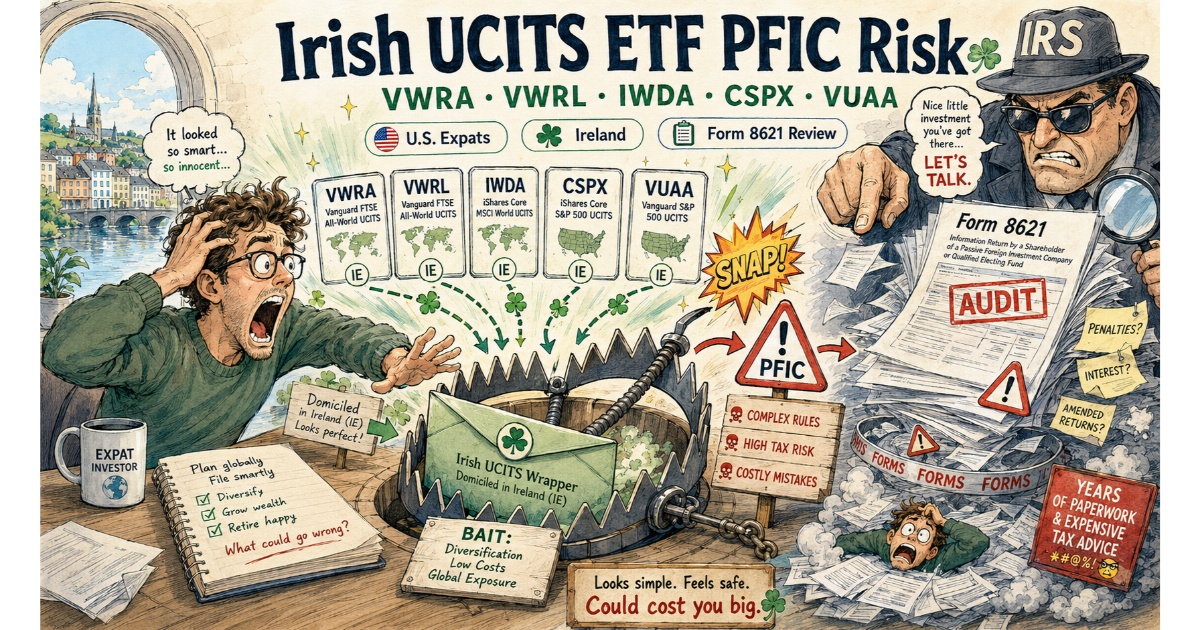
Irish UCITS ETFs carry high PFIC risk for U.S. taxpayers because the problem is structural. The fund may track the S&P 500, MSCI World, FTSE All-World, Nasdaq 100, or another familiar index, but the wrapper is still foreign. For U.S. tax, an Irish-domiciled UCITS ETF is not a U.S. mutual fund and not a U.S.-domiciled ETF. Under the PFIC tests, the problem is usually the fund's passive income and passive investment assets. There is no general UCITS exception for U.S. taxpayers. The ticker is not the controlling input; the domicile and fund wrapper are.
VWRA, VWRL, IWDA, CSPX, and VUAA are usually organized as Irish UCITS funds with IE-prefixed ISINs and traded through European brokers such as Interactive Brokers, DEGIRO, Trading 212, Revolut, and Saxo. The underlying holdings may be U.S. stocks or global equities, but the fund entity remains Irish.
That structure creates the PFIC risk stack:
- Irish fund domicile
- Foreign fund wrapper
- Portfolio securities
- Passive investment income
- U.S. citizen, green card holder, or U.S. tax resident
Accumulating status, distributing status, UCITS regulation, Irish tax efficiency, PRIIPs restrictions, Irish pension wrappers, and European broker reports do not control U.S. PFIC classification. A U.S. taxpayer should screen each Irish UCITS ETF position before Form 8621 analysis. Start with the base definition here: What Is a PFIC? Additionally, holding these ETFs through managed accounts or robo-advisory portfolios can trigger complex fund-of-funds PFIC look-through risk.
Ireland PFIC Risk Matrix: Local Assets & Wrappers
🔴 High Risk — Form 8621 review usually required; filing depends on facts and exceptions
🟡 Review Required — Legal structure and asset holdings control the tax result
🟢 Low Risk — Typically excluded from PFIC rules; standard asset reporting applies
| Local Asset / Wrapper Platform | Risk Rating | U.S. Tax Treatment & Trap Details |
|---|---|---|
| VWRA / IE00BK5BQT80 — Vanguard FTSE All-World UCITS ETF Acc on IBKR, DEGIRO, Trading 212 | 🔴 | VWRA PFIC risk: Accumulating dividends stay inside NAV; no cash dividend does not remove Form 8621 review. |
| VWRL / IE00B3RBWM25 — Vanguard FTSE All-World UCITS ETF Dist on IBKR or DEGIRO | 🔴 | VWRL PFIC risk: Cash distributions still come from an Irish-domiciled foreign fund. |
| IWDA / IE00B4L5Y983 — iShares Core MSCI World UCITS ETF Acc on IBKR, DEGIRO, Trading 212 | 🔴 | IWDA PFIC risk: MSCI World exposure does not override the Irish UCITS ETF wrapper; recurring buys create lot-level tracking. |
| CSPX / IE00B5BMR087 — iShares Core S&P 500 UCITS ETF Acc on IBKR or Saxo | 🔴 | CSPX PFIC risk: S&P 500 exposure sits inside an Irish fund, not a U.S.-domiciled ETF. |
| VUAA / IE00BFMXXD54 — Vanguard S&P 500 UCITS ETF Acc on IBKR, Revolut, Trading 212 | 🔴 | VUAA PFIC risk: VOO-like exposure does not make the fund U.S.-domiciled. |
| EQQQ, IUIT, SWDA, VWCE — UCITS ETFs on European brokers | 🔴 | UCITS ETF PFIC risk: Different ticker, same IE/LU foreign fund review for U.S. citizens, green card holders, and U.S. tax residents. |
| Trading 212 pies / recurring Irish UCITS ETF buys | 🔴 | Automated fractional purchases create messy PFIC lot history before Form 8621 analysis. |
| Revolut ETF positions / app-based UCITS investing | 🔴 | App summaries rarely provide the ISIN, lot history, year-end value, and transfer trail needed for PFIC review. |
| Irish PRSA / occupational pension holding UCITS funds | 🟡 | Irish pension PFIC risk: Do not assume exemption; PRSA status, treaty treatment, and underlying UCITS funds need review. |
| VOO, VTI, VT, IVV — U.S.-domiciled ETFs affected by PRIIPs / KID access rules | 🟢 | Lower PFIC risk: U.S.-domiciled ETFs are usually cleaner for PFIC purposes, but EU PRIIPs rules may block European retail purchases. |
| Irish bank deposit / cash savings account | 🟢 | Cash is not stock of a foreign investment company; PFIC rules usually do not apply. |
Broker reports are inputs. They are not PFIC classification workpapers.
The risk column is a screen, not the final filing answer. Form 8621 exposure still depends on ownership, value, distributions, dispositions, elections, and whether the PRSA or occupational pension qualifies for the foreign pension fund reporting exception under Treas. Reg. §1.1298-1(c)(4).
Treaty and Local Tax Treatment
The U.S.-Ireland treaty does not convert Irish UCITS ETFs into U.S. funds.
The treaty may affect certain income categories, but it does not remove the PFIC classification step for a U.S. citizen or resident.
| Local Assumption | U.S. Result |
|---|---|
| Ireland treats the fund efficiently. | Local tax treatment does not control PFIC status. |
| UCITS funds are regulated. | Regulation does not equal U.S. domicile. |
| The ETF holds U.S. stocks. | The fund wrapper is still foreign. |
| My broker issued a tax report. | Broker reporting is not Form 8621 analysis. |
| It is inside a pension account. | Wrapper-level review is still required. |
The local account wrapper does not eliminate Form 8621 review.
Form 8621 Filing Triggers: When Irish UCITS ETFs Need U.S. Review
| Ireland / Europe action | PFIC trigger | Ireland-specific example |
|---|---|---|
| Irish UCITS ETF distribution | PFIC distribution review | VWRL quarterly dividend on IBKR or DEGIRO |
| Irish UCITS ETF sale | PFIC disposition review | Sell VWRA, IWDA, CSPX, VUAA, or VWRL |
| Accumulating ETF held for years | Deferred PFIC gain review at exit | VWRA, IWDA, CSPX, or VUAA held with no cash dividends |
| ETF switch or rebalance | Disposition or exchange review | Switch CSPX to VUAA; sell IWDA to buy VWRA |
| Trading 212 pie rebalance | Automated PFIC disposition review | Pie sells part of IWDA and buys VUAA |
| Recurring ETF investment | New PFIC lot creation | Monthly VWRA or IWDA purchases |
| Broker transfer | Transfer-vs-sale documentation | Move VWRA from DEGIRO to Interactive Brokers |
| Irish PRSA or occupational pension fund change | Pension wrapper and underlying fund review | PRSA switches between UCITS fund options |
| U.S. citizen in Ireland blocked from U.S. ETFs | PRIIPs access problem | Cannot buy VOO, VTI, VT, or IVV through EU broker |
| Moving to the U.S. or getting a green card | U.S. tax residency onboarding risk | Pre-U.S. VWRA or IWDA lots enter PFIC review |
Many Irish and European platform actions create no obvious local tax event. Under U.S. PFIC rules, they may still require tracking because recurring buys create new lots, app-based rebalances can create dispositions, and broker transfers must be documented as transfers rather than sales.
Related guide: PFIC §1291 Form 8621 Filing Exception Tests
AIS / QEF Screen: Does the Irish Fund Provide U.S. PFIC Data?
Some Irish-domiciled funds may provide a PFIC Annual Information Statement (AIS) for specific fund years. If a valid AIS exists, a U.S. taxpayer may be able to evaluate a QEF election on Form 8621.
Do not assume AIS exists because the fund is large, Irish-regulated, or listed on a major exchange. AIS availability is fund-specific and year-specific. VWRA, VWRL, IWDA, CSPX, VUAA, PRSA fund options, and other UCITS holdings must be checked separately.
| AIS / QEF Question | Why It Matters |
|---|---|
| Does the fund publish a PFIC Annual Information Statement? | Without AIS data, QEF may not be usable. |
| Does the AIS cover the exact tax year? | Prior or later AIS documents do not automatically cover the filing year. |
| Does the AIS match the exact fund / share class / ISIN? | Similar tickers or share classes are not enough. |
| Was the QEF election timely? | Late election issues can change the filing path. |
| Is the holding inside PRSA or occupational pension? | Wrapper treatment and underlying fund data both need review. |
The AIS question is not an algorithm detail. It is a classification and filing-path screen. Broker reports are inputs; they are not PFIC Annual Information Statements. For a visual case example comparing QEF, MTM, and §1291 outcomes, see the Canada PFIC Form 8621 guide.
High-Risk Irish UCITS PFIC Scenarios
Scenario 1: Holding VWRA Accumulating ETF
| Missed by | VWRA pays no dividend, so there is no U.S. tax issue. |
|---|---|
| PFIC Impact | Accumulating status does not remove PFIC review or Form 8621 exposure. |
| Audit Trail | Buy dates, quantities, cost basis, broker, ISIN, year-end value. |
VWRA is not clean because it accumulates. It is harder to document because it accumulates.
Scenario 2: Switching CSPX to VUAA
| Missed by | Both track the S&P 500, so I only rebalanced. |
|---|---|
| PFIC Impact | A switch can be treated as a disposition of CSPX and a new purchase of VUAA. |
| Audit Trail | CSPX sale note, VUAA purchase note, dates, quantities, proceeds, basis. |
A broker may show a clean switch. U.S. tax reads two events.
Related guide: When PFIC Fund Switches and Rebalances Become Dispositions
Scenario 3: Becoming a U.S. Tax Resident With Irish UCITS ETFs
| Missed by | I bought VWRA before I became a U.S. taxpayer. |
|---|---|
| PFIC Impact | Once U.S. tax residency starts, future ownership and dispositions enter PFIC review. |
| Audit Trail | Original acquisition date, residency start date, value at start date, future sales. |
This applies to green card holders, substantial presence taxpayers, and investors moving to the United States.
The Silently Compounding Penalty: PFIC §1291 Deferral Cost
The most dangerous sentence in cross-border financial planning is: "I will deal with the U.S. tax when I sell the fund."
Under the default §1291 rules, gain realized upon the sale or exchange of PFIC shares is generally treated as an excess distribution. In a standard §1291 case, the gain is allocated ratably across the holding period. The portion allocated to prior tax years is taxed at the highest rate of tax in effect for each relevant prior year, with underpayment interest added under IRC §1291 and §6621, and compounded daily under IRC §6622.
Table A displays the actual tax and interest consumption on a modeled $10,000 gain under §1291, assuming a single buy-and-sell transaction.
During the first few years, the tax burden is high but manageable. However, as the holding period extends toward standard retirement lifecycles (20 to 35 years), the daily compounding interest begins to eclipse the original investment profit.
By year 33, U.S. tax and interest consume 99.1% of the entire profit. By year 35, the modeled liability exceeds the gain, resulting in a 106.1% tax-and-interest-to-gain ratio. Late compliance or delaying exit can turn a manageable PFIC problem into a severe after-tax wealth reduction.
Table A: §1291 Deferral Penalty Simulation
| Period | Tax | Interest | % Consumed |
|---|---|---|---|
| 5 years | $3,440 | $590 | 40.3% |
| 10 years | $3,622 | $1,227 | 48.5% |
| 20 years | $3,630 | $2,396 | 60.3% |
| 30 years | $3,689 | $4,891 | 85.8% |
| 33 years | $3,714 | $6,200 | 99.1% |
| 35 years | $3,679 | $6,930 | 106.1% |
An Irish PRSA, occupational pension, or UCITS ETF position can become a long-term PFIC trap because the Irish wrapper encourages investors to hold local ETF and pooled fund exposure for years without U.S. reporting. When the Irish UCITS ETF is marketable PFIC stock and a timely §1296 MTM election is properly made, MTM treatment can prevent years of §1291 interest-charge buildup. See our §1291 vs MTM 10-Year Tax Comparison.
FAQ
Do Irish UCITS ETFs become PFICs only after I move to the United States?
If I bought VWRA, IWDA, CSPX, or VUAA before becoming a U.S. tax resident, is only the post-U.S. gain relevant?
Can Irish UCITS ETFs provide AIS data for a QEF election?
Is a PRIIPs KID or UCITS KIID enough for QEF?
Can I use Mark-to-Market instead of default §1291 treatment for Irish UCITS ETFs?
Is an Irish PRSA or occupational pension automatically exempt from PFIC reporting?
Do Trading 212 pies, Revolut recurring investments, or fractional ETF purchases create PFIC lots?
Does transferring Irish UCITS ETFs between brokers trigger PFIC tax?
Does FBAR or Form 8938 replace Form 8621?
What is the biggest PFIC mistake for U.S. taxpayers in Ireland?
Related PFIC Technical Guides
PFIC Classification and Filing Basics
- What Is a PFIC under IRC §1297?
- PFIC §1291 Form 8621 Filing Exception Tests
- What to Do After Discovering a PFIC
- Never Filed Form 8621 for a PFIC?
Irish UCITS ETF Calculations and Broker Data
- §1291 Excess Distribution and Interest Calculation
- §1291 vs MTM 10-Year PFIC Tax Comparison
- PFIC Foreign Exchange Translation Rules for EUR, GBP, and USD
- PFIC Fund Switch and §1291 Disposition Trap
- Standardized Form 8621 Line 16a Statement
PFIC Election Strategy: §1291, MTM, and QEF
- PFIC Election Strategy: §1291 vs MTM vs QEF
- QEF Election and PFIC Annual Information Statement Review
- Streamlined Procedures and Late QEF / MTM Elections
Professional Help for Irish UCITS PFIC Cleanup
Sources and References
This guide applies U.S. PFIC rules to Irish UCITS ETFs, Irish pension wrappers, European broker reports, and PRIIPs access constraints. PFIC status, AIS availability, and elections must be tested holding by holding.
References should be checked against the current IRS Form 8621 and instructions for the filing year being prepared.
- IRS Form 8621 Instructions: Form 8621 filing triggers, QEF reporting, §1296 MTM election reporting, and reporting exceptions.
- IRC §1297: PFIC passive income and passive asset tests.
- IRC §§1291-1298: Statutory framework governing PFIC taxation.
- Treas. Reg. §1.1296-1: Regulatory rules for Mark-to-Market elections.
- Treas. Reg. §1.1298-1: PFIC shareholder reporting and exception rules.
- Irish Revenue Pensions Manual: Irish pension framework and local wrapper context.
- Central Bank of Ireland UCITS: Irish UCITS fund regulatory framework.
- European Commission PRIIPs: PRIIPs Key Information Document framework for European retail products.
Content reflects Form 8621 (Rev. 12/2025), applicable Treasury Regulations, IRS guidance, and other authorities cited on this page.