
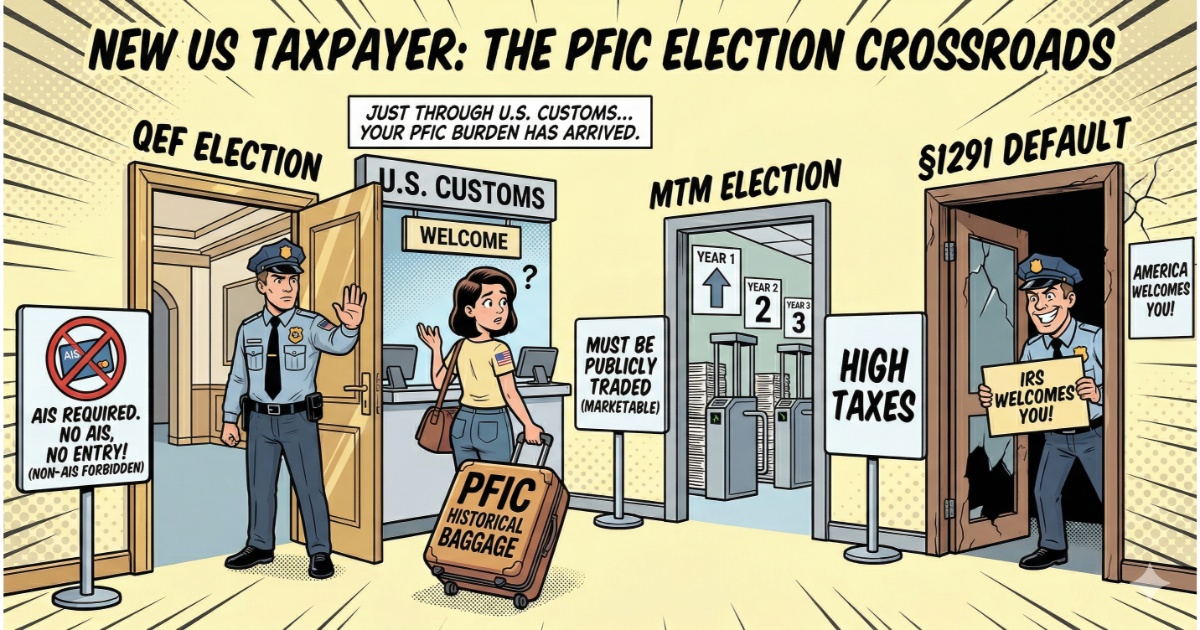
In practice, many CPAs follow a simple rule of thumb: QEF election first, Mark-to-Market (MTM) second, and §1291 only as a last resort. However, practitioners who regularly work with PFIC reporting know that the reality is often more complex. When foreign funds were acquired before becoming a U.S. taxpayer, the choice of first-year PFIC election can significantly affect how those gains are treated on Form 8621.
A poor election on Form 8621 may result in higher tax, taxation of gains earned before U.S. residency, or substantially higher tax when the investment is eventually sold — and in some situations, the often-criticized §1291 regime may actually produce the optimal outcome.
What Is the PFIC First-Year Election Problem for New U.S. Residents?
A PFIC is a foreign corporation that meets the 75% passive-income test or 50% passive-asset test in IRC §1297. Foreign funds commonly require review, but classification is entity- and year-specific.
Timing matters. A first-year QEF or MTM election can avoid later §1291 complications. A later election may require coordination with prior §1291 years.
Is There a PFIC “First-Year Exception” for New U.S. Residents?
There is no blanket “PFIC first-year exception” that makes foreign funds tax-free for a new U.S. tax resident. What does exist is a first-year election window: a timely QEF election under IRC §1295(b)(2) — made without a purging election in the first year — or a §1296 MTM election for marketable PFIC stock. If no valid election is made by the deadline, the §1291 default regime applies automatically. The real opportunity is making the right first-year election before the tax return due date.
First-Year PFIC Reporting Timeline
- Residency Start Date — Determine the first U.S.-resident day under §7701(b).
- December 31 of the First Tax Year — MTM year-end mark-to-market calculation date; fund FMV snapshot required for §1296 reporting
- Return Due Date — Attach Form 8621 to the timely return, including extensions.
- After the Deadline — Treas. Reg. §1.1295-3 / Rev. Proc. 2026-10 consent relief may apply for certain retroactive QEF elections (exclusive rules; §301.9100 relief unavailable); late-election remedies are limited and granted only at IRS discretion
Foreign Funds Held Before Becoming a U.S. Tax Resident
The first-year PFIC problem is most acute for taxpayers who accumulated foreign fund investments before immigrating. These funds may carry years of unrealized appreciation, no prior QEF history, and often no AIS. The first-year election must account for this pre-residency gain — how it is taxed depends entirely on which regime applies going forward.
This challenge is highly relevant for Indian nationals moving to the US with existing mutual fund portfolios, Chinese nationals with A-share or WMP holdings, UK residents relocating to the US with ISA or SIPP accounts, and Japanese nationals with NISA/iDeCo balances.
The single most important preliminary question is: Does your fund provide a PFIC Annual Information Statement (AIS)? This determines whether a QEF election is even available. For most foreign funds, the answer is no — which means the real first-year choice is MTM vs §1291.
| Foreign asset held before U.S. residency | Typical first-year PFIC issue | AIS available? | Country guide |
|---|---|---|---|
| Indian mutual funds / SIP / ELSS | §1291 or MTM; INR FX conversion; no AIS in most cases | ✗ Rarely | India PFIC Guide |
| Canadian ETFs (XEQT, VUN, VGRO) | AIS may exist for some ETFs; QEF/MTM/§1291 all require analysis | ✓ Some funds | Canada PFIC Guide |
| UK ISA / OEIC / UCITS funds | IRS does not recognize ISA tax exemption; MTM common election | ✗ Rarely | UK PFIC Guide |
| Irish-domiciled ETFs (VWRA, IWDA, CSPX, VUAA) | UCITS classified as PFIC; §1296 MTM most practical election | ✗ | Ireland ETF Guide |
| Taiwan ETFs (0050, 0056, 00878) | TWD FX conversion; dividend withholding; MTM vs §1291 analysis | ✗ | Taiwan PFIC Guide |
| Australian managed funds / ETFs | AMMA statements are not PFIC AIS; §1291 or MTM likely | ✗ | Australia PFIC Guide |
| Singapore CPF / unit trusts / SRS | Wrapper vs underlying fund; CPF exemption not recognized by IRS | ✗ Rarely | Singapore PFIC Guide |
Comparing First-Year PFIC Elections on Form 8621: QEF, §1296 MTM, and §1291
First-Year QEF Election: IRC §1295(b)(2) and the AIS Requirement
A common misconception among new U.S. taxpayers—and the core source of the $27,000 panic in our case analysis—is the belief that they must perform a "deemed sale" to activate a QEF election for previously held foreign funds.
In fact, under IRC §1295(b)(2), a QEF election applies only to the shareholder’s holding period during which the shareholder is a United States person. The Instructions for Form 8621 (Part II – Elections / QEF Election) further clarify that if a taxpayer makes a QEF election in the first year they are a U.S. shareholder of the PFIC, the PFIC will generally be treated as a QEF for the entire U.S. holding period. In this situation, no purging election is required.
First-Year §1296 MTM Election for New U.S. Tax Residents
If QEF information is unavailable, MTM may be available for marketable stock. Compare its annual ordinary-income cost with §1291.
MTM Eligibility: Marketable PFIC Stock
Under IRC §1296, MTM is available only for stock that meets the qualified-exchange and regular-trading tests in Treas. Reg. §1.1296-2. A listing alone is not enough.
§1296(l) Starting Basis: The Basis Adjustment for New Residents
A first-year MTM election under §1296(l) is not a true cost basis reset. Under IRC §1296(l) and Treas. Reg. §1.1296-1(d)(5), when an individual becomes a U.S. person and makes a timely MTM election, the basis for MTM purposes starts at the greater of fair market value or adjusted basis on the first day of the taxable year. This allows the PFIC to enter the MTM regime without a purging election and without immediate recognition of pre-residency appreciation as ordinary MTM income.
While §1296(l) prevents pre-residency appreciation from being taxed as ordinary MTM income, pre-residency gains cannot be permanently eliminated. Upon a subsequent taxable disposition, pre-residency built-in appreciation is recognized under general tax rules (IRC §1001), preserving its potential character as long-term capital gain rather than annual MTM ordinary income.
MTM Annual Obligation, Ordinary Rate Treatment, and Irrevocability
Once a §1296 MTM election is made, it applies to every subsequent tax year in which you hold the PFIC stock as a U.S. person. Each year, you must include in income the excess of the fund’s year-end FMV over its adjusted basis — taxed at ordinary income rates, not capital gains rates. This is the core trade-off: MTM eliminates §1291 throwback complexity but converts annual appreciation into ordinary income. Per the IRS Form 8621 Instructions, the MTM election must be made by the due date of the return for the tax year in which the stock is first marked to market, including extensions. Once made, the election is generally irrevocable unless the PFIC ceases to be marketable or the IRS grants consent to revoke.
Default §1291 Regime: What Happens If No First-Year Election Is Made
If no valid election is made—or if the taxpayer fails to meet the specific requirements for QEF or MTM—the asset automatically falls into the Section 1291 default regime.
- Basis Continuity: Becoming a U.S. resident does not by itself provide a general fair-market-value step-up. The original adjusted tax basis therefore remains important unless a specific rule, such as the limited §1296(l) MTM transition rule, applies.
- Pre-Residency Appreciation: Treas. Reg. §1.1291-9(j)(1) does not treat the corporation as a PFIC with respect to days when the shareholder was not a U.S. person. Even so, appreciation from before arrival is not automatically excluded from gain recognized on a sale while the shareholder is a U.S. person.
- §1291 Calculation: Gain on a disposition is treated as an excess distribution. Amounts allocated to prior PFIC years are generally subject to the highest rate and an interest charge, while current-year and pre-PFIC-period amounts are handled under separate rules.
This technical burden can create concern that PFIC liabilities continue after a taxpayer moves abroad. Under IRC §1291(a) and Treas. Reg. §1.1291-9(j)(1), a foreign corporation is not treated as a PFIC with respect to a shareholder for days in the holding period when the shareholder was not a United States person. That rule does not make physical departure a tax event or automatically end U.S. status. A later sale must be analyzed only after confirming the taxpayer’s legal residency-termination date and considering dual-status reporting, source and effectively connected income rules, treaty positions, and any §877A expatriation consequences.
Form 8621 Decision Matrix for U.S. Residents: QEF vs. MTM vs. Section 1291
1. Conditions: High (AIS required)
2. Cost Basis: Original Cost. No step-up allowed; pre-arrival gains remain taxable.
3. Starting Status: Pedigreed. Avoids throwback tax if elected in Year 1.
4. Holding Period: Annual tax on fund earnings; remaining gain deferred.
5. Tax Character: Ordinary earnings are ordinary income; net capital gain is taxed under the applicable net-capital-gain rules, which may include 0%, 15%, or 20% federal rates, plus possible NIIT and state tax.
6. Sale: Capital gain on appreciation over basis.
7. Ending Status: Determine the legal residency-termination date and the PFIC’s tax-year inclusions; physical departure does not create an automatic QEF cutoff.
8. Complexity: Minimal. Direct data entry from PFIC annual information statement.
1. Conditions: Medium (Marketable)
2. Cost Basis: Adjusted (MTM). FMV starting point for MTM inclusions; historical gain remains taxable.
3. Starting Status: Clean Entry. Avoids throwback tax if elected in Year 1.
4. Holding Period: Annual tax on mark-to-market gains at ordinary rates.
5. Tax Rate: Medium (Ordinary rates)
6. Sale: Gain measured from the MTM basis is ordinary. Under §1296(l), pre-U.S. built-in gain measured from the regular tax basis may retain capital character.
7. Ending Status: Final-year MTM and disposition treatment depends on the effective residency-termination date, ownership dates, and events during the tax year.
8. Complexity: Very High. Lot tracking, basis maintenance, and "Unreversed Inclusion" (UI) monitoring.
1. Conditions: None (Universal)
2. Cost Basis: Original Cost. No step-up allowed; pre-arrival gains remain taxable.
3. Starting Status: Tainted. Throwback exposure across holding period.
4. Holding Period: No annual tax; gain accumulates under §1291.
5. Tax Treatment: Current-year and prior-year allocations are treated differently; prior PFIC years can carry the highest-rate tax and interest charge.
6. Sale: Gain is treated as an excess distribution and allocated under §1291.
7. Ending Status: No automatic cutoff at departure; confirm the final U.S.-person period and any distributions, dispositions, expatriation event, or dual-status consequences.
8. Complexity: Extreme. Full holding-period reconstruction and throwback interest calculations.
Leaving the country does not automatically end U.S. tax residency. Visa holders must apply §7701(b); citizens remain U.S. persons, and green card holders generally remain residents until that status ends.
Long-term residents should also review §877A and Form 8854.
Form 8621 Case Study: Canadian ETFs Brought Into the U.S. Tax System (Real-World Scenario)
This technical analysis is based on a real-world scenario from the r/tax community. It illustrates the immediate tax impact of foreign holdings when the complexity of U.S. international tax rules meets the shock of “phantom” taxation on non-U.S. assets.
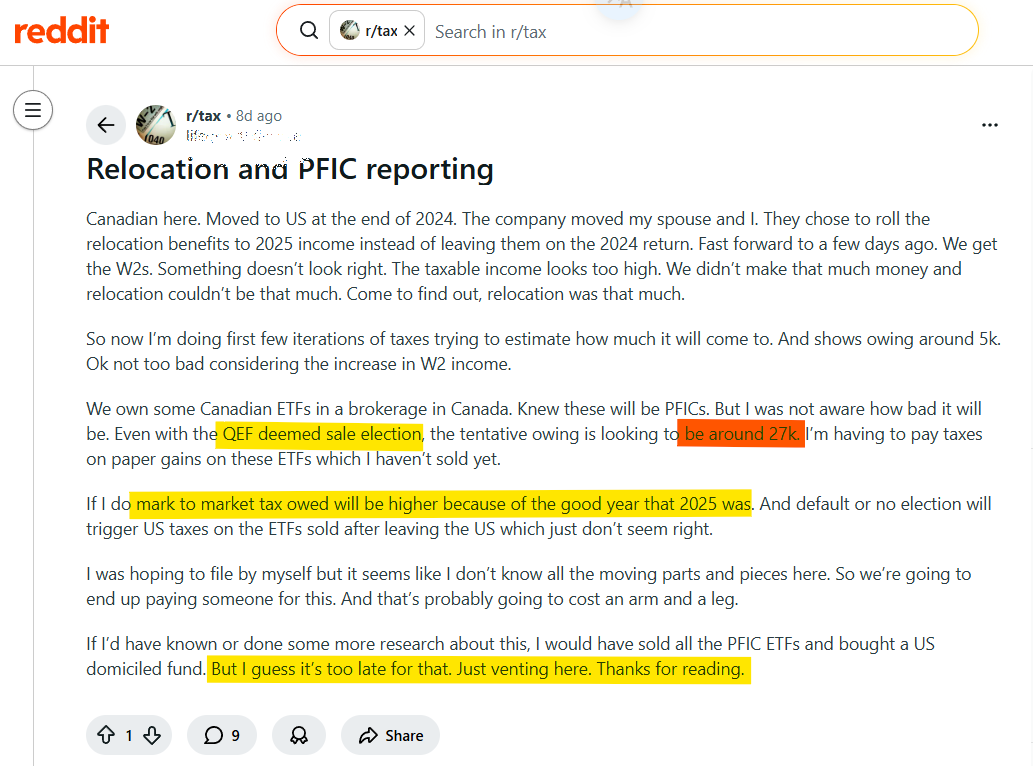
- The Relocation Benefit Trap: Company benefits rolled into the following year’s income, bloating the W-2 and creating an unexpectedly high base tax liability before PFIC is even considered.
- The $27k “Paper Tax” Shock: Attempting a QEF “Deemed Sale” purging election to start clean, only to find it requires paying massive tax on unrealized gains in funds that have not been sold.
- Market Timing Misery: Fear that choosing MTM during a bull market (like 2025) will result in even higher taxes than the QEF route, creating a “no-win” scenario.
- Section 1291 “Ghost” Method: Panic over the default method’s complexity and the fear it will trigger U.S. taxes on ETFs long after the taxpayer leaves the U.S.
- Avoidable Regret: The realization that simply liquidating all PFIC funds before moving would have solved everything, but it is now “too late for that.”
- “Cost an Arm and a Leg”: The feeling that the reporting is too complex to handle alone, and expert help will be prohibitively expensive.
Form 8621 Exit Strategy: Does PFIC Tax Apply After Terminating U.S. Residency?
A major source of anxiety—among temporary U.S. residents—is the fear that PFIC liabilities follow you like a "ghost" after a move abroad. The answer depends first on whether and when U.S. tax residency legally terminates, not simply on a flight date or visa label.
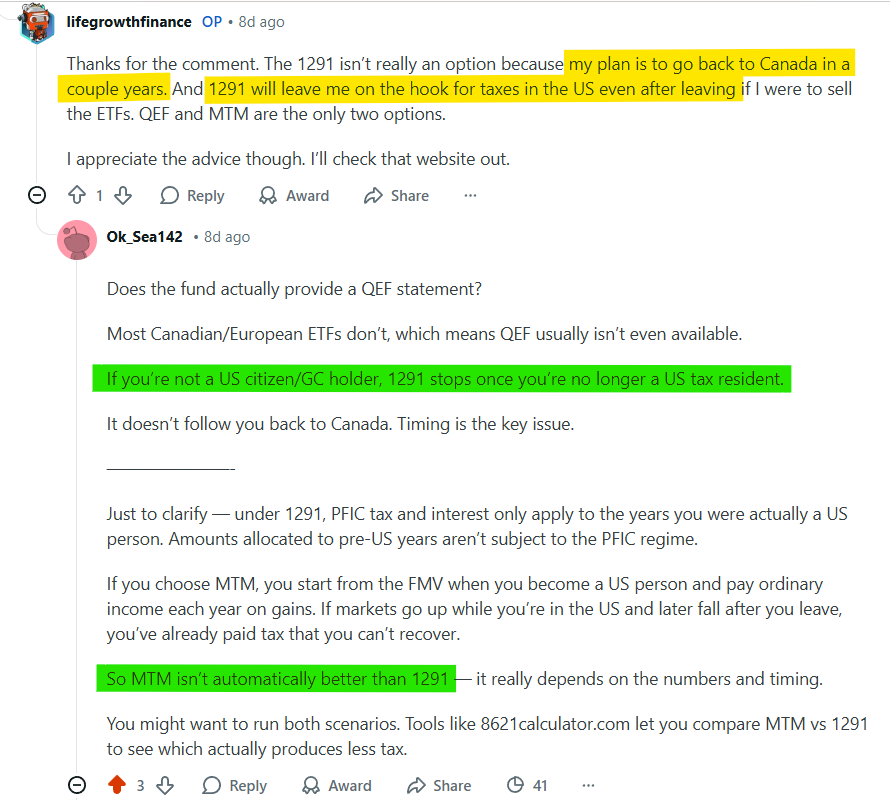
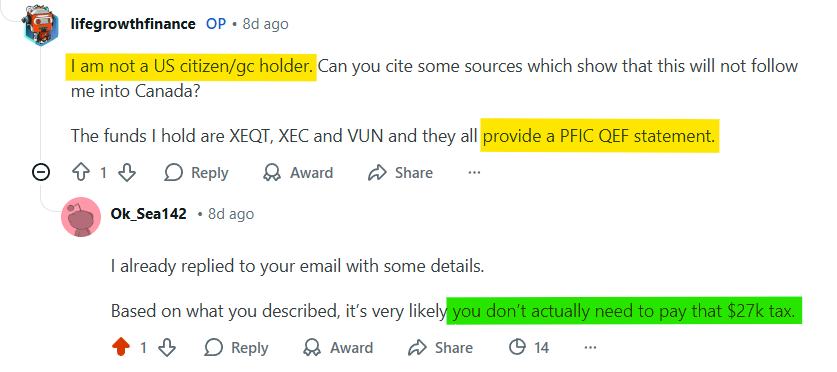
The Jurisdictional Anchor for PFIC Liabilities
Under IRC §1291, the excess distribution regime applies only when a United States person receives a distribution or disposes of PFIC stock. Treasury Regulation §1.1291-1 further clarifies that PFIC rules apply only during periods in which the shareholder is a United States person.
Implication for Former U.S. Taxpayers Selling PFICs
After an individual validly ceases to be a U.S. person, a later sale of foreign stock by a nonresident alien may generally fall outside the PFIC regime and may be foreign-source under IRC §865. This is not a safe harbor: U.S. citizenship, green-card or treaty status, dual-status-year rules, effectively connected income, special source rules, and a deemed sale or other consequence under §877A can change the result.
Practical Conclusion on Pre-Residency Fund Sales
Before planning a post-departure sale, document the residency-termination date under §7701(b), the required closer-connection or treaty disclosures, the shareholder’s final U.S.-person tax year, and whether §877A or Form 8854 applies. Only then should the source and U.S. tax treatment of the later sale be determined.
PFIC Tax Savings Comparison: Simulating QEF vs. MTM vs. Section 1291 Scenarios
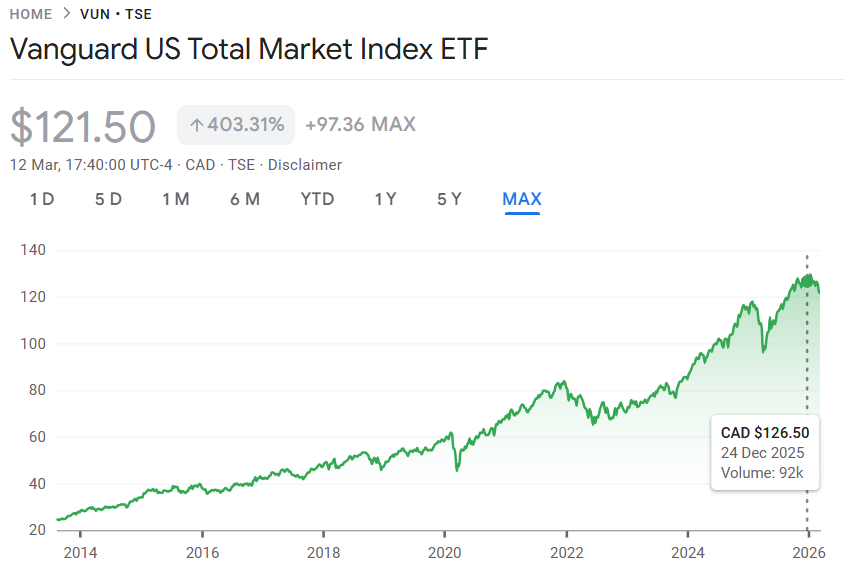
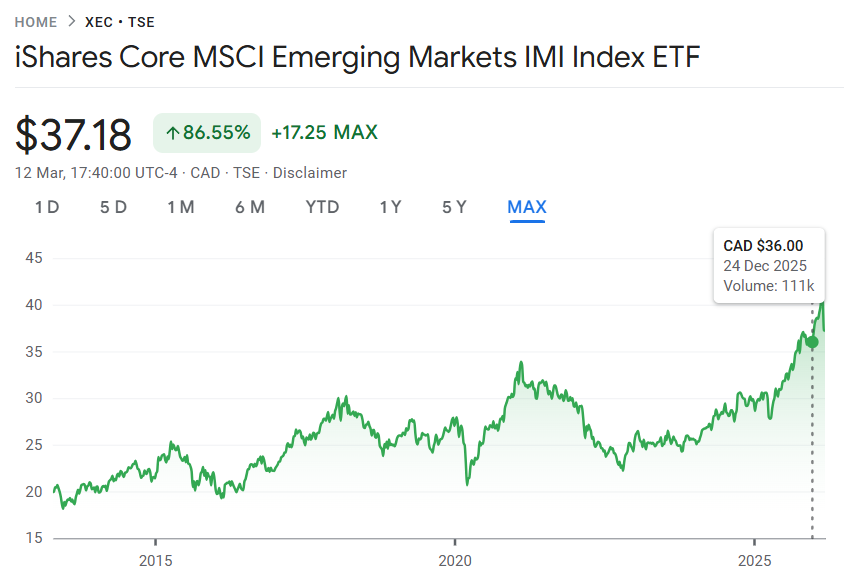
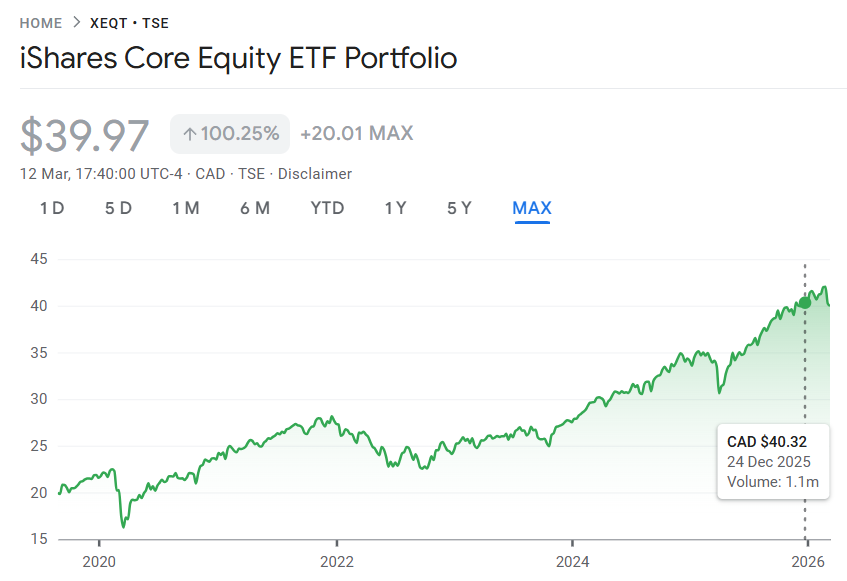
Based on the actual growth trajectories of VUN, XEC, and XEQT from 2020 to 2025, it is clear why the investor hesitated to liquidate. For internationally mobile professionals, the choice of reporting method can materially change the timing, character, and compliance cost of those gains.
Form 8621 Simulation Model: 3-Year PFIC Tax Projection
To calculate the mathematical impact, we use a simulation based on the investor's likely $1,000,000 portfolio (derived from the $30k+ MTM tax exposure in 2025). We assume the investor continues to hold (no sales) these assets until departing the U.S. in late 2027.
- Portfolio FMV: ~$1,000,000 (CAD/USD equivalent total).
- Growth Trajectory: Assumed 10% annual appreciation.
- Scenario Window: 3 Tax Years (2025 – 2027) for direct comparison.
- Professional Fees: $300 benchmark fee per Form 8621 annually.
- Reporting Volume: Assumed 6 Forms 8621; confirm the actual direct and indirect PFICs each year.
Note: All figures below represent the 3-year cumulative totals (2025–2027) for the simulation.
This illustration holds the published 2024 AIS inputs constant; it is not a 2025–2027 forecast. Sources: iShares Canada Tax Center (XEQT) and Vanguard Canada Tax Center (VUN) AIS filings.
| IRS Tax Liability | $10,200 |
| Professional Compliance | $5,400 |
| Total Cost | $15,600 |
Taxing 10% annual paper growth at ordinary rates. Purely a cost center in a bull market.
| IRS Tax Liability | $106,000 |
| Professional Compliance | $5,400 |
| Total Cost | $111,400 |
Maintaining default status with zero distributions and no sales during U.S. stay.
| IRS Tax Liability | $0 |
| Professional Compliance | $5,400 |
| Total Cost | $5,400 |
- QEF Election: Preserves long-term capital gains character on subsequent disposition, but requires annual AIS tax inclusions.
- Mark-to-Market (MTM): Eliminates §1291 interest and applies §1296(l) starting basis rules, but taxes annual unrealized appreciation during U.S. residency as ordinary income.
- Section 1291 Default: If liquidated after multi-year U.S. residency, triggers ordinary tax rates and daily compounding §6621 interest allocated across post-arrival days.
No Basis Step-up utilized.
| Gain | $650,000 |
| AIS Tax | $10,200 |
| Sales Tax (LTCG) | $130,000 |
| CPA & Compliance Fee | $5,400 |
| Liquidation Total | $145,600 |
A sale can also recognize the pre-U.S. built-in gain preserved by §1296(l).
| Gain (2027) | $100,000 |
| Prior MTM Tax (25-26) | $71,000 |
| Sales Tax (2027) | $35,000 |
| Historical Gain Tax (assumed 20% federal rate) | $70,000 |
| CPA & Compliance Fee | $5,400 |
| Liquidation Total | $181,400 |
Interest only accrued from 2025 residency.
| Gain | $650,000 |
| Pre-Resident Tax | $150,300 |
| Resident Tax + Interest | $94,700 |
| CPA & Compliance Fee | $5,400 |
| Liquidation Total | $250,400 |
Frequently Asked Questions: PFIC First-Year Election for New U.S. Tax Residents
1. Is there a PFIC first-year exception for new U.S. residents?
There is no blanket “PFIC first-year exception” that makes foreign funds tax-free. The real opportunity is a first-year election window. If the fund is a PFIC, a timely QEF election may be available if the fund provides a valid PFIC Annual Information Statement, or a §1296 MTM election may be available for marketable PFIC stock. If no valid election applies, §1291 generally controls excess distributions and dispositions.
2. What is a PFIC, and do foreign mutual funds or ETFs usually qualify?
A PFIC is a foreign corporation that meets the passive income test or passive asset test under IRC §1297. Foreign mutual funds, ETFs, UCITS funds, unit trusts, investment-linked funds, and similar pooled investment vehicles commonly require PFIC review. They should not be treated like ordinary foreign stocks without checking the fund structure.
3. What if my foreign fund does not provide a PFIC Annual Information Statement?
Without a valid PFIC Annual Information Statement, a QEF election is generally unavailable. This is common for many non-U.S. mutual funds, ETFs, UCITS funds, and investment-linked products. For a new U.S. tax resident, the practical first-year question then becomes whether §1296 MTM is available or whether the fund remains under default §1291.
4. How do I know if my foreign fund is eligible for MTM?
A §1296 MTM election generally requires marketable PFIC stock. Publicly traded foreign ETFs or listed funds may qualify, but private funds, insurance-linked funds, non-listed mutual funds, and many pooled products may not. The exchange, trading status, fund structure, and ownership record should be checked before assuming MTM is available.
What if I miss the first-year MTM election and want to switch to Mark-to-Market later?
If you hold marketable PFIC stock under the default §1291 regime and later decide to make a §1296 Mark-to-Market election, mandatory coordination rules under IRC §1296(j) and Treas. Reg. §1.1296-1(i) require a deemed disposition on December 31 of the first MTM year. That year-end deemed sale purges the historical §1291 taint and establishes a clean opening basis for future MTM reporting. For full details on line mapping, two-step calculator workflows, and avoiding double counting, see our dedicated PFIC §1291 to MTM Transition & Deemed Sale Guide.
5. When does my Form 8621 reporting obligation begin as a new U.S. tax resident?
Form 8621 reporting generally begins once you are a U.S. person and hold, dispose of, receive certain distributions from, or make an election for PFIC stock. For H-1B, L-1, O-1, or TN visa holders, the start date depends on the Substantial Presence Test and the residency start date rules under IRC §7701(b). For green card holders, U.S. tax residency generally begins when lawful permanent residence status starts.
6. Does the $25,000 / $50,000 PFIC reporting exception apply in the first U.S. tax year?
Possibly, but it is limited. The small PFIC exception may reduce annual §1298(f) reporting for certain low-value PFIC holdings, but it does not apply to every situation. It generally does not protect a taxpayer who has an excess distribution, a disposition gain treated under §1291, or a QEF/MTM election requirement. Small balances still need trigger-by-trigger review.
7. Does a foreign tax-free account protect me from PFIC rules?
Usually not by itself. A foreign account may be tax-free or tax-deferred in the local country, but the U.S. may still review the underlying foreign funds for PFIC purposes. ISAs, TFSAs, NRE/NRO investment holdings, and other foreign wrappers need U.S. analysis. Pension or employment-based retirement arrangements should be reviewed separately because treaty, trust, and account-classification issues may also apply.
8. Can a green card holder use the same PFIC exit strategy as an H-1B or L-1 holder?
Not automatically. Visa holders must determine when residency ends under §7701(b). Green card holders generally remain residents until that status ends; U.S. citizens remain U.S. persons abroad.
9. Can the Foreign Tax Credit offset PFIC tax and interest?
Foreign tax credits may help with the tax portion in some PFIC calculations, but they do not simply erase PFIC exposure. Under the default §1291 regime, the interest charge is a separate problem and may not be fully offset by foreign tax credits. FTC treatment depends on the income basket, foreign tax type, timing, and the specific Form 8621 calculation.
10. What records should a new U.S. resident collect for first-year Form 8621?
Collect complete fund-level records before preparing the first U.S. return: purchase dates, sale dates, units, distributions, reinvestments, switches, year-end values, currency, exchange rates, cost basis records, broker statements, AIS documents if any, and the exact U.S. residency start date. Form 8621 is usually a transaction-level calculation problem, not just a yes/no filing question.
Not Tax Advice: This case study is provided for educational and illustrative purposes only and does not constitute tax, legal, or investment advice. The analysis is based on simplified assumptions and rounded figures used solely to illustrate PFIC mechanics and potential strategic outcomes. Actual tax results depend on the taxpayer’s specific facts, elections, holding periods, and applicable IRS guidance. This material should not be relied upon for preparing a tax return. Tax laws and interpretations may change, and readers should consult a qualified tax professional for advice specific to their situation. Constructive feedback from the tax community is welcome, and any technical corrections are appreciated.
Content reflects Form 8621 (Rev. 12/2025), applicable Treasury Regulations, IRS guidance, and other authorities cited on this page.