Quick Answer: Where Can I Find a Form 8621 Example, Sample Form, or PFIC Calculation?
You can find Form 8621 examples and sample forms online, but a sample form is only useful if it comes with the PFIC calculation workpaper behind it. Under the default §1291 rules, a simple PFIC sale may require line 15f gain, excess distribution allocation, prior-year tax rates, line 16b current-year allocation, line 16c tax, line 16e net tax, and line 16f interest. A blank form or basic Excel template can show the layout, but it usually cannot safely handle multiple lots, DRIPs, partial sales, foreign currency, prior-year tax rates, or long holding periods.
If you are preparing the return yourself, start with the DIY Form 8621 calculation guide before copying any sample form.
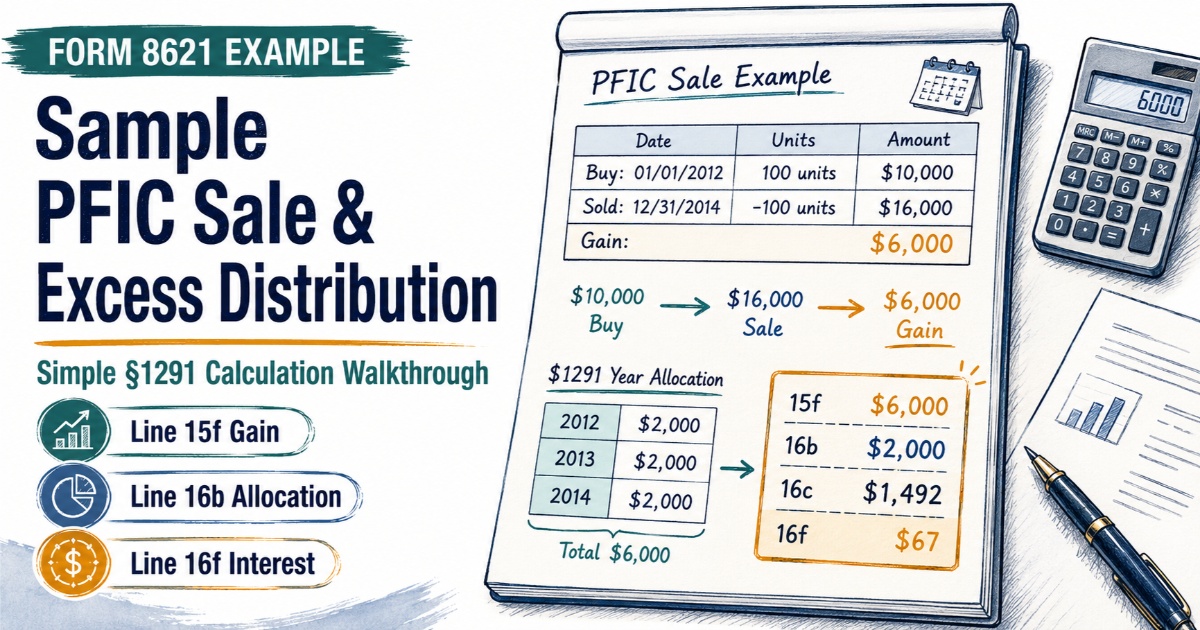
Form 8621 Sample Case: One PFIC Purchase and One Sale
This Form 8621 sample case uses the simplified PFIC sale example published by HodgenLaw: a U.S. citizen buys 100 shares of a foreign mutual fund for $10,000 on January 1, 2012, sells the shares for $16,000 on December 31, 2014, and has no QEF or MTM election.
Form 8621 Sample Case Facts and Transaction Data
The transaction data is intentionally clean:
| Date | Details | Units | Value |
|---|---|---|---|
| 2012-01-01 | Buy | 100 | $10,000 |
| 2014-12-31 | Sold | -100 | $16,000 |
We ran those facts through 8621calculator.com to show how the $6,000 gain becomes a Form 8621-style §1291 excess distribution workpaper, including line 15f, line 16b, line 16c, line 16e and line 16f.
Step 1: Calculate Line 15f Gain From PFIC Disposition
The first calculation is straightforward:
| Line 15f | Gain from disposition of stock of a section 1291 fund | $6,000 |
|---|
For the full mechanics behind this default regime, see the §1291 excess distribution calculation guide. For the detailed gain, loss, USD basis and no-netting rules behind this sale step, see the Form 8621 Line 15f guide. A cash dividend follows a different path, illustrated in the PFIC dividend example.
Step 2: PFIC Excess Distribution Calculation by Holding Days
Under §1291, the gain is allocated ratably to each day in the taxpayer's holding period for the stock.
How 1,095 Days Is Derived — Why It Is Exact, Not a Simplification
The HodgenLaw article states "ignoring leap years, 365 days × 3 = 1,095 days." That phrasing can be read as an approximation, but the 1,095 figure is actually exact for this case. Here is why:
- The acquisition date is excluded from the holding period. Under standard tax holding-period rules, you begin counting the day after you acquire the stock. The purchase date of January 1, 2012 is day zero; the holding period starts January 2, 2012.
- 2012 contributes exactly 365 days. Although 2012 is a leap year with 366 calendar days, the holding period runs from January 2 through December 31 — exactly 365 days. The leap day (February 29) is included, but January 1 is excluded, so the net count is still 365.
- 2013 and 2014 each contribute 365 days (January 1 through December 31 in non-leap years).
- Total: 365 + 365 + 365 = 1,095 days. The HodgenLaw case was structured so that buying on the first day of a leap year, the excluded acquisition date exactly offsets the leap day, producing a clean 365-day count for 2012.
In real cases, the acquisition date and sale date conventions, leap years, and lot-level tracking all affect the day count. This case was deliberately designed to produce a clean 1,095-day holding period. Do not assume every three-year holding period will yield 1,095 days.
Daily Allocation Rate: Precision vs. Display
The daily allocation rate is:
Important: The $5.48 figure is a rounded display value only. It must not be used as an input for further arithmetic. In a real workpaper, the full-precision daily rate is retained internally, and the per-year amounts are rounded only at the final reporting step. In this simplified case the rounding is imperceptible — each year gets exactly $2,000 — but in real cases with irregular holding periods, rounding mid-calculation can create cumulative errors.
Real cases often require exact date counting, acquisition-date rules, sale-date rules, leap years, partial sales, multiple lots and foreign currency support.
Step 3: Form 8621 Line 16b Current-Year and Pre-PFIC Allocation
The current year is 2014, the sale year. The two prior PFIC years are 2012 and 2013. In this simplified example, there are no pre-PFIC years, so line 16b equals the 2014 current-year allocation. The prior-year amounts do not simply become current-year income; they are used to compute the aggregate increase in tax and interest.
| Year | Days | Gain |
|---|---|---|
| 2012 | 365 | $2,000 |
| 2013 | 365 | $2,000 |
| 2014 | 365 | $2,000 |
The “Gain” column shows the portion of the $6,000 PFIC gain allocated to each year under the §1291 excess distribution method.
The 2014 amount is the current-year allocation for line 16b. The 2012 and 2013 amounts are prior-year PFIC allocations used to compute line 16c tax and line 16f interest.
| Line 16b | Amount allocated to the current tax year and pre-PFIC years | $2,000 |
|---|
Step 4: Form 8621 Line 16c, 16e and 16f Tax and Interest
For the prior-year PFIC periods, the allocated amount for each year is multiplied by the highest tax rate applicable for that year. Then a daily-compounded §6621 interest charge is calculated on each year's tax, running from the due date of that year's return to the due date of the sale-year return.
Annual Workpaper — Full Precision
The table below shows each prior-year allocation with cent-level precision, including the interest accrual window and the unrounded interest amount before final rounding to whole dollars on the form.
| Year | Days | Allocated Gain | Highest Rate | Tax (line 16c) | Interest accrues from | Interest accrues to | Interest (unrounded) | Interest (form) |
|---|---|---|---|---|---|---|---|---|
| 2012 (prior PFIC) |
365 | $2,000.00 | 35% | $700.00 | Apr 15, 2013 | Apr 15, 2015 | $43.28 | $43 |
| 2013 (prior PFIC) |
365 | $2,000.00 | 39.6% | $792.00 | Apr 15, 2014 | Apr 15, 2015 | $24.12 | $24 |
| 2014 (current year) |
365 | $2,000.00 | — | — | — | — | — | — |
| Prior-year aggregate increase in tax / interest total | $1,492.00 | $67.40 | $67 | |||||
Why the Interest Shows $67.40 in the Workpaper but $67 on the Form
The §6621 daily-compounding calculation produces $43.28 for the 2012 underpayment period and $24.12 for the 2013 underpayment period, totaling $67.40. The original HodgenLaw article states the result as "about $67" — consistent with rounding the aggregate to the nearest dollar before entering it on Form 8621, line 16f. There is no discrepancy; the $67.40 → $67 difference is the standard rounding step at the final form line, not a calculation error.
How the interest dates work: Under §1291(c)(3), each year's aggregate increase in tax is treated as an underpayment of tax due on the due date of the individual return for that year (April 15 of the following year), and interest accrues from that due date through the due date of the return for the sale year (April 15, 2015 for the 2014 return). The 2012 tax of $700 therefore accrues interest for approximately two years (Apr 15, 2013 → Apr 15, 2015), and the 2013 tax of $792 accrues for approximately one year (Apr 15, 2014 → Apr 15, 2015).
In Form 8621 terms, the "Tax" columns support line 16c, and the "Interest" columns support line 16f.
Those prior-year tax amounts are aggregated on line 16c. In this simplified workpaper, there is no foreign tax credit on line 16d, so line 16e equals line 16c. The interest charge is reported on line 16f.
For a deeper explanation of the interest mechanics, see the Form 8621 line 16f interest calculation guide.
Form 8621 Example Calculation Result
The simplified result is:
| Line | Meaning | Amount |
|---|---|---|
| 15f | Gain from disposition of PFIC stock | $6,000 |
| 16b | Amount allocated to current year and pre-PFIC years | $2,000 |
| 16c | Aggregate increases in tax for prior PFIC years | $1,492 |
| 16d | Foreign tax credit | $0 |
| 16e | Net aggregate increase in tax | $1,492 |
| 16f | Interest charge | $67 |
Condensed Workpaper View
| Line 15f | Holding Start | Holding End | Holding Days | Excess Per Day | Line 16b | Line 16c | Line 16d | Line 16e | Line 16f |
|---|---|---|---|---|---|---|---|---|---|
| $6,000 | 01/01/2012 | 12/31/2014 | 1,095 | $5.48 | $2,000 | $1,492 | $0 | $1,492 | $67 |
Download a Form 8621 Sample Excel Workpaper
This completed Form 8621 Excel example shows how the HodgenLaw §1291 PFIC sale case flows into line 15f, line 16b, line 16c, and line 16f interest.
If you need to attach or preserve a supporting statement, compare this sample workpaper with the Form 8621 Line 16a statement example.

Why This Is Not a Normal Long-Term Capital Gain Calculation
DIY filers often start with the brokerage statement and think the result is simple: sell price minus cost basis equals long-term capital gain. That is not the default PFIC §1291 method.
In this example, the $6,000 gain is not simply reported as a clean long-term capital gain. It is first treated as a PFIC disposition gain, allocated over 1,095 holding days, split into current-year and prior-year PFIC portions, and then subjected to prior-year tax and interest mechanics. That is why a Form 8621 example must include the calculation support, not only a filled form layout.
PFIC Calculation Check: Is My Form 8621 Calculation Correct?
Many DIY filers are not only looking for a sample Form 8621. They are trying to answer a more practical question: is my PFIC calculation correct? A workpaper is the sanity check. It should show the source transaction, line 15f gain, holding days, daily allocation, line 16b current-year amount, line 16c prior-year tax, any line 16d foreign tax credit, line 16e net tax, and line 16f interest.
If your result cannot be traced from broker records to Form 8621 lines, a preparer or calculator will have a hard time reviewing it. A sample form can show what the answer might look like, but the workpaper shows why the numbers are there.
What This Simple Form 8621 Sample Leaves Out
This sample case is intentionally clean. Real DIY PFIC calculations often become harder when any of these facts appear:
- Foreign currency: CAD, GBP, EUR or INR basis and proceeds may need historical USD translation.
- Multiple purchases or DCA: each lot may create a separate holding-period allocation problem.
- DRIPs: reinvested distributions can create new units, basis and holding periods.
- Partial sales: sold units and remaining basis must be tracked accurately.
- Pre-U.S. residency years: allocated gain may require separate classification.
If your PFIC was bought or sold in CAD, GBP, EUR, INR or another non-USD currency, review the PFIC foreign currency translation rules before relying on a simple USD example.
Use a PFIC Calculator Before Copying a Sample Form 8621
Form 8621 Example and Sample Form FAQ
Where can I find a Form 8621 sample form?
Is there a Form 8621 Excel sample workpaper available for download?
How do I know if my Form 8621 calculation is correct?
Is PFIC gain reported as capital gain or excess distribution?
How is Form 8621 line 15f calculated?
How is Form 8621 line 16f interest calculated?
Can I use this Form 8621 example for TaxAct, TurboTax, OLT or H&R Block?
Does this example cover MTM or QEF?
Sources
- IRS: About Form 8621.
- IRS: Instructions for Form 8621.
- HodgenLaw: Back to Basics: How to Report Gain on the Sale of a PFIC.
Related Form 8621 Calculation Guides
- Can I File Form 8621 Myself? DIY PFIC Calculation Guide
- Form 8621 Line 16a Statement Example
- §1291 Interest Calculation for Form 8621 Line 16f
- PFIC Foreign Currency Translation Rules for Form 8621
- PFIC Tax and Form 8621 Rules
Content reflects Form 8621 (Rev. 12/2025), applicable Treasury Regulations, IRS guidance, and other authorities cited on this page.