Quick Answer: What Is PFIC Tax and Form 8621 Tax?
PFIC tax is the U.S. tax regime that can apply when a U.S. person owns a passive foreign investment company, such as many foreign ETFs, non-U.S. mutual funds, UCITS funds, Canadian ETFs, Indian mutual funds, Japanese NISA funds, and other foreign pooled investments.
What many taxpayers call “Form 8621 tax” is usually the PFIC tax reported through Form 8621. It may include a §1291 increase in tax and interest calculation, §1296 mark-to-market ordinary income, or QEF annual inclusions, depending on the election history.
PFIC tax is difficult because the result is not based on one fixed tax rate. The calculation may require holding-period allocation, historical highest ordinary tax rates, IRS interest, FX conversion, basis tracking, and Form 8621 supporting workpapers.
PFIC Tax Comparison Example: §1291 vs MTM vs QEF on the Same Investment
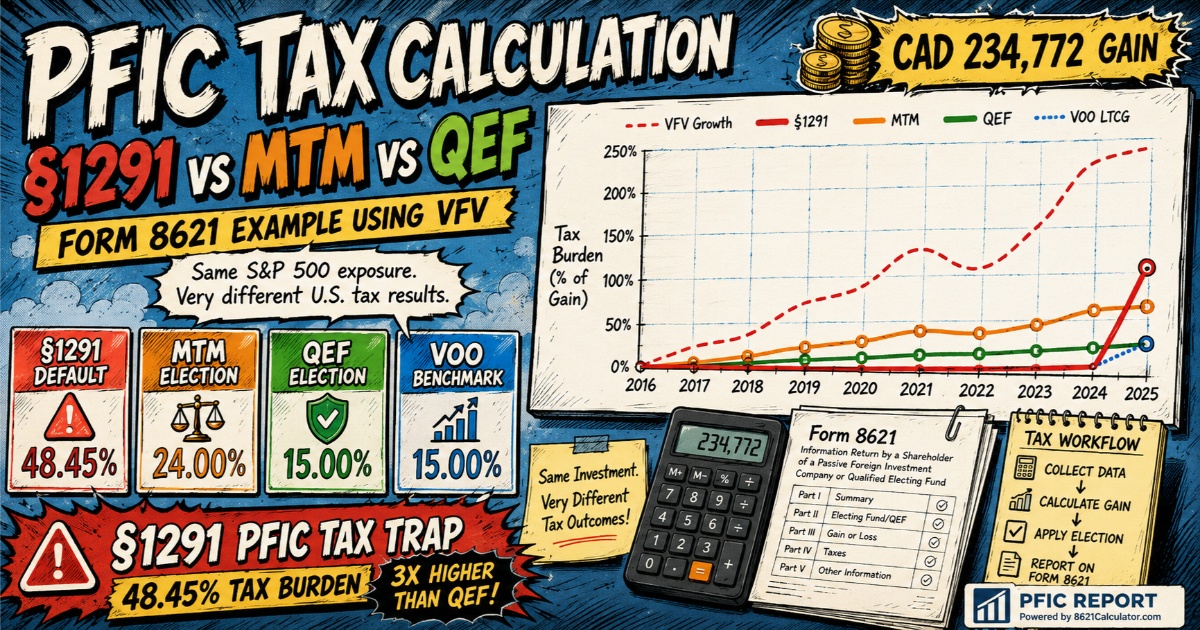
The following simplified example uses VFV, a Canadian-domiciled ETF, to show how the same economic investment gain can produce a very different Form 8621 tax result when the fund is treated as a PFIC.
In this simplified example, the taxpayer invests about CAD 100,000 in VFV on January 4, 2016, and sells the full position on December 31, 2025 for CAD 334,740, producing an approximate CAD 234,772 gain.
The table below compares that same gain under default §1291, §1296 MTM, QEF, and a non-PFIC VOO benchmark.
| Date | Detail | Price (CAD) | Units | Value (CAD) |
|---|---|---|---|---|
| 2016-01-04 | Buy | 49.76 | 2,009 | 99,968 |
| 2025-12-31 | Sale | 166.62 | −2,009 | 334,740 |
Same VFV investment, same CAD 234,772 gain: §1291 consumes approximately 48.45% in modeled tax and interest, versus 24% under MTM and 15% under the simplified QEF benchmark.
By contrast, the QEF result is closest to the long-term capital gain benchmark, assuming the required PFIC Annual Information Statement data exists and the election was timely made. MTM avoids the worst §1291 deferral results, but it creates annual ordinary-income inclusion and cash-flow pressure.
Want to know which PFIC regime is actually available to you? See the PFIC Election Guide: §1291 vs MTM vs QEF.
Only comparing the two regimes commonly available for marketable foreign ETFs? See the 10-year foreign ETF §1291 vs MTM tax consequences case study.
For the broader Canadian ETF context, including VFV, XEQT, Canadian PFIC Annual Information Statements, TFSA, RRSP, and Canadian brokerage issues, see the Canada PFIC guide.
PFIC Tax Rules Comparison: §1291 vs MTM vs QEF
The table below compares the modeled U.S. tax burden under the three main PFIC tax rules: the default §1291 regime, the §1296 MTM election, and the QEF election. This comparison assumes a 24% ordinary income rate and a 15% long-term capital gains benchmark, ignoring FX, state taxes, and annual distributions to isolate the impact of the PFIC regime.
| Calculation Method | Effective Tax Burden | Tax on Gain (CAD) | Calculation Impact |
|---|---|---|---|
| §1291 Default Regime | 48.45% | 113,746.91 | Gain allocated across the holding period, plus deferred tax and §6621 interest. |
| §1296 MTM Election | 24.00% | 56,345.22 | Annual mark-to-market inclusion as ordinary income; no default §1291 interest charge for elected years. |
| QEF Election | 15.00% | 35,215.76 | AIS-based annual inclusion; net capital gain character may be preserved when requirements are met. |
| VOO Benchmark | 15.00% | 35,215.76 | Non-PFIC U.S.-domiciled ETF benchmark using simplified long-term capital gain treatment. |
How Is a PFIC Sale Taxed?
How a PFIC sale is taxed depends on the regime and election history. Under the default §1291 rules, gain on the sale is treated as an excess distribution and allocated across the holding period; prior-year portions are generally subject to historical highest ordinary rates and an interest charge. With a valid §1296 mark-to-market election, annual appreciation is generally included as ordinary income. A timely QEF election can produce annual inclusions and may preserve net capital gain character when the required PFIC Annual Information Statement data is available.
The sale price and economic gain can be identical while the U.S. tax result differs substantially. That is why PFIC tax on sale must be calculated under the applicable Form 8621 regime rather than assumed to follow ordinary Schedule D treatment.
Are PFIC Gains Taxed as Capital Gains?
Not necessarily. A PFIC gain does not automatically receive normal long-term capital gain treatment:
- §1291: Gain on disposition is treated as an excess distribution; the prior-year allocations do not receive ordinary long-term capital gain treatment.
- §1296 MTM: Mark-to-market inclusions are generally ordinary income, subject to the statutory rules for allowable losses.
- QEF: A shareholder’s pro-rata share of the QEF’s net capital gain may retain long-term capital gain character when the election and information requirements are satisfied.
Why Is PFIC Tax So High?
When taxpayers search for “section 1291 tax from Form 8621,” they are usually referring to the default PFIC tax calculation that applies when no valid QEF or MTM election is in place. In practice, the phrase “Form 8621 tax” often refers to this §1291 tax and interest result, because the taxpayer sees the additional tax computed through Form 8621 rather than through a normal capital gains schedule.
The default §1291 regime is the punitive fallback method when no valid QEF or MTM election applies. When a taxpayer sells a PFIC or receives an excess distribution, the gain is not treated like ordinary long-term capital gain. Instead, the calculation allocates the excess amount across the PFIC holding period.
The amounts allocated to prior years are taxed at the highest individual ordinary income tax rate applicable for those years (e.g., 37% or 39.6% depending on the tax year), regardless of your actual tax bracket. On top of that, the IRS adds an interest charge under Section 6621 mechanics, which is compounded daily from the due date of the return for each prior tax year. Over a long holding period, the interest charge can materially increase the effective PFIC tax burden, especially when the gain is back-loaded into a sale year after many years of ownership.
The §1291 method requires precise holding-period calculations and daily interest rate tracking, necessitating detailed Form 8621 Line 16a supporting statements for the tax return. For a deeper breakdown of this mechanism, see the §1291 excess distribution calculation guide and the PFIC interest charge guide.
Can PFIC Tax Exceed 100% of the Gain?
In a sufficiently long-held §1291 fund, the modeled tax and interest charge can theoretically equal or exceed the economic gain. The result depends on the holding period, how the gain is allocated across prior PFIC years, the historical highest tax rates, and the applicable §6621 interest rates. It is not a fixed outcome for every PFIC, but the interest component can become increasingly important as the deferral period grows.
For the year-by-year mechanics and long-holding-period examples, see the PFIC §1291 interest calculation guide.
Form 8621 Increase in Tax and Interest Calculations
The phrase “increase in tax and interest” usually refers to the additional tax and IRS interest charge calculated under the default §1291 PFIC regime. This can apply when a U.S. taxpayer sells a PFIC at a gain or receives an excess distribution without a valid QEF election or §1296 mark-to-market election.
Under §1291, the gain or excess distribution is allocated across the PFIC holding period. Amounts allocated to prior tax years are generally taxed using the highest ordinary income tax rate for those years, and an IRS interest charge is added for the deferral period.
This is why Form 8621 tax can be much higher than a normal capital gains calculation. The hard part is not only entering numbers on Form 8621, but also preparing the supporting calculation that explains how the increase in tax and interest was computed.
For a detailed breakdown showing how these tax brackets and daily compounding interest penalties flow into actual form lines, see our Form 8621 §1291 tax example.
How MTM Changes the PFIC Tax Calculation
For marketable PFICs, a Section 1296 mark-to-market (MTM) election offers a way to move away from the §1291 deferral-and-interest regime. Under MTM, you treat the investment as if it were sold for its fair market value on the last business day of your tax year.
Any unrealized appreciation is included in your income and taxed as ordinary income in the current year. While MTM removes the IRS interest charge and prior-year allocations for elected years, it converts all gains into ordinary income, stripping away the benefit of lower long-term capital gains rates. Furthermore, you must pay tax on "paper" gains before actually realizing cash from a sale, creating annual cash-flow requirements.
For a technical overview of calculations and basis adjustments under this regime, see the §1296 mark-to-market guide.
How QEF Can Reduce PFIC Tax When AIS Data Exists
The Qualified Electing Fund (QEF) election is generally the cleanest path because it aligns closest to U.S. mutual fund taxation. A QEF election may preserve net capital gain character when valid PFIC Annual Information Statement data is available and the election is timely made.
This path can avoid the default §1291 interest-charge regime for properly elected QEF years. However, making a QEF election requires the fund manager to provide a PFIC Annual Information Statement (AIS) containing precise per-share, per-day income figures. While some Canadian fund managers publish these statements, many UCITS funds do not provide PFIC Annual Information Statements, which often makes QEF impractical.
A QEF election is cleanest when made in the first PFIC year. If made later, prior non-QEF years may still require §1291 reconstruction, a purging election, or late-election relief analysis. For more details, see the QEF election calculation guide.
PFIC Tax Rates: Why There Is No Single PFIC Tax Rate
There is no single fixed PFIC tax rate. The tax burden depends on the PFIC regime, election history, holding period, income character, and whether §1291 interest applies:
- §1291: Variable. Gains allocated to prior years are taxed at the highest statutory ordinary rate for those years, plus compounding interest under §6621.
- §1296 MTM: The taxpayer's marginal ordinary income tax rate (ranging up to 37% or 39.6% at the federal level), applied annually to unrealized gains.
- QEF: Pro-rata share of fund ordinary earnings (ordinary income rates) and net capital gains (long-term capital gains rates).
Excess Distribution Regime
Applies when no election is made. Gain allocated across holding period, taxed at prior-year rates, plus IRS interest charge. Most complex path.
Most PunitiveQualified Electing Fund
Annual inclusion of ordinary earnings and net capital gain based on PFIC Annual Information Statement data; may preserve net capital gain character when the required data and timely election are available.
Cleanest PathForm 8621 Workpapers for PFIC Tax and §1291 Interest
PFIC tax calculations are difficult to manage reliably in ordinary spreadsheets when the case involves multi-year §1291 allocations, daily interest, FX conversion, partial sales, multiple lots, or MTM basis tracking.
For CPAs, EAs, and advanced taxpayers, accurate lot-level calculation workpapers are often needed to verify the amounts reported on Form 8621 and to support Line 16a statements for §1291 allocations or Section 1296 schedules.

When Do You Need a PFIC Tax Advisor?
A PFIC tax advisor may be needed when the taxpayer has multiple PFICs, missing cost basis, late QEF or MTM elections, prior non-filing years, Streamlined filing, amended returns, inherited PFIC holdings, foreign-currency issues, partial sales, DRIP transactions, or a large unrealized gain.
The advisor’s role is usually to review the filing position, election history, compliance risk, and return strategy. But the advisor still needs reliable numbers. That is where Form 8621 workpapers for §1291 tax, interest, MTM income, QEF inclusions, FX conversion, and basis tracking become important.
Common PFIC Tax Mistakes
- Treating foreign ETFs like U.S. ETFs: Many foreign ETFs and mutual funds are treated as PFICs because they are foreign corporations or foreign pooled vehicles that primarily hold passive assets or earn passive income.
- Assuming no sale means no Form 8621: Annual Form 8621 reporting may still apply under §1298(f), even without a sale or distribution, unless an exception applies.
- Assuming QEF without AIS data: A QEF election generally requires PFIC Annual Information Statement data from the fund. Ordinary fund fact sheets or annual reports usually do not provide enough information for QEF reporting.
- Ignoring prior non-QEF years: Making a QEF election in a later year does not clean up prior years. The fund remains subject to §1291 unless a purging election is executed.
- FX translation errors: PFIC calculations often require careful FX treatment for acquisition cost, sale proceeds, distributions, and Form 8621 reporting lines. Using a shortcut FX method can distort the result.
PFIC Tax FAQs
What is PFIC tax?
What is Form 8621 tax?
What does “increase in tax and interest” mean on Form 8621?
How is Section 1291 tax from Form 8621 calculated?
Is there a fixed PFIC tax rate?
Do I need a PFIC tax advisor?
Do I need Form 8621 workpapers for PFIC tax?
IRS Sources & Official References
- 🔗 IRS Form 8621 PDF: Official IRS PDF form — Information Return by a Shareholder of a Passive Foreign Investment Company or Qualified Electing Fund.
- 🔗 IRS Form 8621 Instructions: Official IRS instructions covering §1291, §1296, QEF elections, and PFIC reporting requirements (Web and PDF formats).
Recommended Reading
- 🔗 Form 8621 Overview Guide — Reporting Requirements and Elections
- 🔗 §1291 Excess Distribution Calculation Guide
- 🔗 §1296 Mark-to-Market Election Guide
- 🔗 QEF Election Calculation Guide
- 🔗 PFIC §1291 Interest Charge Calculation
- 🔗 Canada PFIC Guide — VFV, XEQT, TFSA, RRSP, and Canadian ETFs
Content reflects Form 8621 (Rev. 12/2025), applicable Treasury Regulations, IRS guidance, and other authorities cited on this page.