💡 Key Takeaways: Form 8621 Line 15f Compliance
- USD Cost Basis & proceeds: Under IRC §1012 and IRC §1001(b), U.S. taxpayers must calculate PFIC cost basis and sale proceeds in USD on transaction dates.
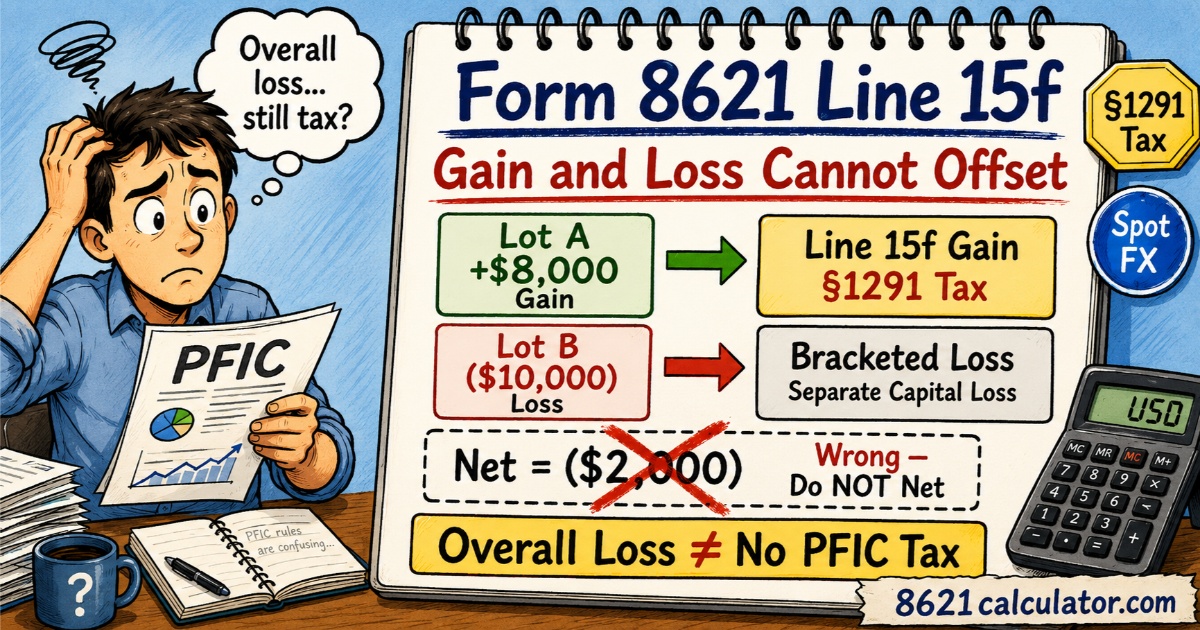
- The No-Netting Mandate: Under §1291, gain lots and loss lots cannot be netted on Line 15f. Gains flow to Line 16 for throwback tax, while losses are reported in brackets.
- Separate Conversion Method: Do not convert the net foreign currency gain to USD at a single rate. Use transaction-date spot FX rates for each purchase and sale separately.
- Loss treatment: A Line 15f loss is not taken into account under §1291 and does not reduce gain subject to the §1291 regime. The loss may be recognized under another applicable provision of the Code.
PFIC Foreign Currency Gain Calculation: USD Basis and USD Proceeds
For a PFIC held in EUR, GBP, AUD, or any non-USD currency, the gain calculation starts in U.S. dollars. For an individual U.S. taxpayer who does not maintain a separate qualified business unit using a functional currency, the PFIC gain calculation is reported in U.S. dollars. The practical result is simple: basis and proceeds must be measured in USD before §1291 is applied. IRC §1012 fixes the USD cost basis on the acquisition date. IRC §1001(b) fixes the USD amount realized on the disposition date.
Use the Separate Conversion Method. Convert each transaction separately. The purchase price converts into USD using the spot rate on the purchase date. The sale proceeds convert into USD using the spot rate on the sale date. Form 8621 Line 15f reports the USD gain:
When the result is a positive USD gain, §1291 treats the full gain as an excess distribution and sends it to Line 16 for the interest-charge computation. Under §1291, asset appreciation and currency movement aggregate into one USD gain. The regime taxes the combined result.
PFIC Losses and the No-Netting Rule on Line 15f
A PFIC disposition loss is still reported on Line 15f. Enter the loss amount in brackets and leave Line 16 blank for that loss item.
When the same PFIC disposition includes both gain lots and loss lots, do not net them. Use separate Part V entries: one Line 15f for the gain lot with Line 16 completed, and another Line 15f for the loss lot in brackets with no Line 16.
| Lot | USD Result | Correct Treatment |
|---|---|---|
| Lot A | $8,000 gain | Line 15f positive amount; complete Line 16. |
| Lot B | ($1,800) loss | Show in brackets; no Line 16. |
| Lot C | $88 gain | Line 15f positive amount; complete Line 16. |
Do not net the three lots into one $6,288 Line 15f result.
Lot A and Lot C are positive disposition gains and move into the Section 1291 calculation. Lot B is reported as a loss and does not reduce the gain subject to Section 1291.
If the lots have different holding periods, complete Line 15f separately for each block of shares with the same holding period. The corresponding gain blocks must also retain their separate holding-period allocations in the Line 16a supporting statement.
Common scenarios for this non-netting rule include VWRA/IWDA disposals reported on Line 15f where different blocks are sold, or calculating the Taiwan ETF 0050 disposition gain basis across multiple historical purchase lots.
To see Line 15f carried through Lines 16b–16f in a complete disposition, use the worked Form 8621 PFIC sale example.
Form 8621 Line 15e(2) vs Line 15f
| Issue | Line 15e(2) | Line 15f |
|---|---|---|
| What it reports | Distribution excess | Sale gain or loss |
| Trigger | 125% excess-distribution test | Disposition result |
| Line 16 | Yes, if above zero | Yes, if above zero |
| Loss | Not applicable | Brackets only; no Line 16 |
Some software calculates Line 15e(2) as a negative number, then uses it to reduce Line 15f before running Line 16. That is wrong.
PFIC Gain Calculation Example: Form 8621 Line 15f Exchange Rate
A taxpayer asked us to review two different Form 8621 Line 15f calculations for the same Indian mutual fund disposition.
| Date | Detail | Value(INR) | FX Rate |
|---|---|---|---|
| 09/28/2021 | Buy | 100,000 | 74.0358 |
| 10/17/2025 | Sold | -152,291 | 87.9684 |
An India CPA workpaper reported $594.00 of Section 1291 disposition gain, while the 8621Calculator lot-level USD basis-and-proceeds calculation produced $380.50.
The material difference examined here arose before the Section 1291 allocation and interest calculation began: the two calculations started with different U.S.-dollar gains for Line 15f.
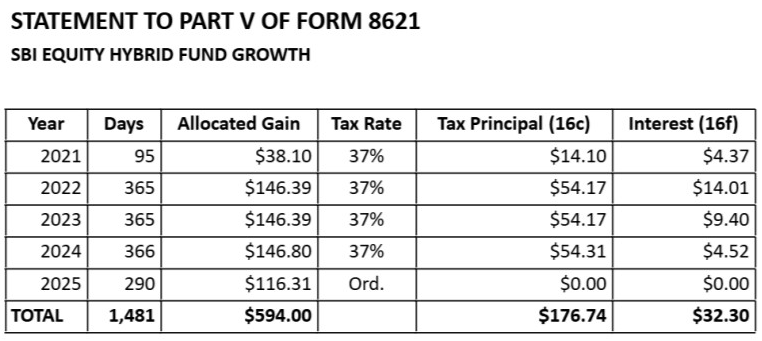
How the $594 Gain Was Calculated
According to the taxpayer's explanation of the professional calculation, the preparer first determined the gain in Indian rupees (often copied straight from a CAMS Capital Gains Statement) and then translated that net INR gain using the exchange rate on the disposition date.
The professional workpaper reported the starting disposition gain as $594.00.
Separate USD Basis and Proceeds Method
The 8621Calculator calculation does not translate the net INR gain at a single exchange rate. The acquisition cost is translated into U.S. dollars using the acquisition-date exchange rate, and the disposition proceeds are translated using the disposition-date exchange rate.
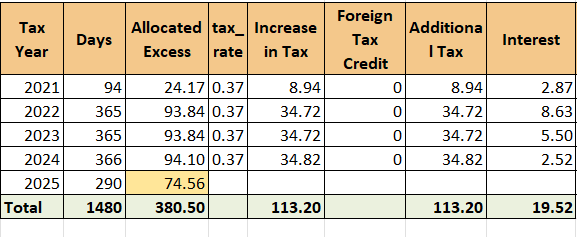
Note: The CPA workpaper also overstates the holding period by one day. It counts both the acquisition date and disposition date, producing 1,481 days instead of the actual 1,480-day elapsed period. This is separate from the FX error discussed above.
USD amount realized − USD basis = (₹152,291 ÷ 87.9684) − (₹100,000 ÷ 74.0358) = $380.50
Using separate acquisition-date and disposition-date currency conversions produced $380.50 of U.S.-dollar disposition gain rather than $594.00.
The difference is therefore not created by the later Section 1291 allocation. The starting gain entering that calculation is already different: $594.00 versus $380.50.
Example: FX Movement Alone Can Create a Line 15f §1291 Gain
Buy PFIC shares for £100 when GBP/USD is 1.00. USD basis is $100 under IRC §1012.
Sell the same shares for £100 when GBP/USD is 2.00. USD amount realized is $200 under IRC §1001(b).
Line 15f gain is $100:
Under IRC §1291(a)(2), the resulting $100 disposition gain is treated as an excess distribution. The investment had no gain in GBP, but it had a $100 gain when measured in U.S. dollars.
Line 15f Workpaper Checklist
A defensible Line 15f workpaper should preserve:
- PFIC name and identifying number
- Lot-level acquisition date
- Foreign purchase price
- Purchase-date spot FX rate
- USD basis under IRC §1012
- Disposition date
- Foreign sale proceeds
- Sale-date spot FX rate
- USD amount realized under IRC §1001(b)
- USD gain or loss
- §1291 holding-period allocation support

Form 8621 Line 15f Final Takeaway
For a Section 1291 PFIC disposition, determine the U.S.-dollar gain or loss before applying the Section 1291 regime. Establish USD basis and USD amount realized using the applicable transaction-date exchange rates. A positive Line 15f gain moves to Line 16; a loss does not reduce gain subject to Section 1291 and may instead be recognized under another applicable Code provision.
Keep blocks with different holding periods separate. And remember: saying that disposition gain is “treated as an excess distribution” describes its Section 1291 tax treatment—it does not turn the sale into a Line 15e distribution calculation.
Form 8621 Line 15f Frequently Asked Questions
Do I need Form 8621 if I sold the PFIC at a loss?
Not necessarily solely because the disposition produced a loss.
Line 15f provides for reporting a disposition loss when Part V is required, but a loss does not itself constitute gain treated as an excess distribution. Whether Form 8621 is otherwise required depends on the applicable filing rules and exceptions.
Can I put a foreign-currency gain on Line 15f?
No. Line 15f reports USD gain or loss. Compute USD proceeds under IRC §1001(b), subtract USD basis under IRC §1012, then apply §1291.
I bought the fund before becoming a U.S. taxpayer. Do I only count the U.S. years?
No.
The original purchase date still matters.
You need the full timeline: purchase date, U.S. residency date, PFIC years, sale date, basis, FX rates, and holding period.
Do not treat this as a “from green card date only” calculation.
Can capital losses offset a positive Line 15f §1291 gain?
No. A positive Line 15f amount enters §1291. Capital losses do not reduce the Line 16 tax-and-interest charge.
What if the PFIC was liquidated, redeemed, or became worthless?
Still analyze Line 15f.
If you received cash, use it as proceeds. If it became worthless, proceeds may be zero.
Either way, compute the USD gain or loss against USD basis.
How is a §1291 deemed sale reported on Line 15f when transitioning to Mark-to-Market (MTM)?
Under IRC §1296(j) and Treas. Reg. §1.1296-1(i), transitioning an unpedigreed PFIC to Mark-to-Market requires a deemed disposition on December 31 of the first MTM year. The deemed disposition gain is reported on Line 15f (not Part IV) to compute the §1291 throwback tax and §6621 compounding interest. For line mapping, two-step calculator workflows, and workpaper preparation, see our dedicated PFIC §1291 to MTM Transition & Deemed Sale Guide.
Can I calculate a PFIC sale gain in INR first and convert the net gain to USD?
For a Line 15f disposition, do not apply a single sale-date exchange rate to the net foreign-currency gain. Determine USD amount realized and USD basis separately, then calculate the U.S.-dollar disposition gain.
The foreign-currency rules for Line 15e apply to excess distributions; they do not turn a PFIC sale into a Line 15e distribution calculation.
Does IRC §988 split out the FX gain from PFIC stock?
No. For a §1291 PFIC stock disposition, Line 15f reports one USD stock gain: USD amount realized under IRC §1001(b) minus USD basis under IRC §1012. IRC §988 does not carve the currency movement out of the PFIC stock disposition merely because the share price is denominated in foreign currency.
Form 8621 Line 15f Sources and References
- 🔗 Purging §1291 Taint & MTM Transition: PFIC §1291 to MTM Transition & Deemed Sale Guide — Step-by-step rules for reporting the December 31 deemed disposition on Line 15f under IRC §1296(j).
- 🔗 Instructions for Form 8621: Official IRS instructions for completing Form 8621.
- 🔗 IRC §985: Functional currency rules.
- 🔗 IRC §1001: Amount realized and gain/loss rules.
- 🔗 IRC §1012: Basis rules.
- 🔗 IRC §1291: PFIC excess distribution and disposition rules.
- 🔗 IRS Form 8621 Instructions: Current IRS instructions for Section 1291 fund disposition gain, Line 15f, and deemed sale routing.
- 🔗 Toso v. Commissioner summary: Practitioner summary of the Tax Court's PFIC gain/loss no-netting holding.
Content reflects Form 8621 (Rev. 12/2025), applicable Treasury Regulations, IRS guidance, and other authorities cited on this page.