
1. Austria PFIC & ETF Tax Map for U.S. Citizens
An investor living in Austria must address two independent tax systems that classify collective investment vehicles differently:
| Asset / Investment Vehicle | Austrian Tax Treatment (BMF / InvFG) | U.S. Tax Treatment (IRS) | Primary Cross-Border Risk |
|---|---|---|---|
| Direct Operating Equities (e.g., Apple, Microsoft, OMV, Erste Group) |
27.5% Austrian Capital Gains Tax (Kapitalertragsteuer - KESt) on dividends and realized gains. | Standard Form 1040 Schedule D. Direct operating companies are outside pooled PFIC rules. | Clean alignment. Foreign tax credits (FTC) on Form 1116 generally match realization timing. |
| OeKB Reporting Fund (Meldefonds) (e.g., Vanguard FTSE All-World UCITS ETF - VWCE) |
27.5% KESt on actual distributions and annual deemed distributions (ausschüttungsgleiche Erträge). | Classified as a foreign corporate PFIC under IRC §1297. Commonly triggers Form 8621 reporting. | Timing and character mismatch under default §1291. OeKB tax data is not a U.S. QEF AIS. |
| Non-Reporting Fund (Nicht-Meldefonds) (e.g., Unregistered foreign funds or certain U.S. ETFs) |
Deemed income tax based on statutory formula: 90% of annual NAV increase (minimum 10% of year-end NAV). | If foreign fund: Section 1291 PFIC. If U.S. ETF: Domestic asset, zero PFIC risk. | Dual adverse tax treatment if a foreign fund is simultaneously a Nicht-Meldefonds in Austria and a PFIC in the U.S. |
| U.S.-Domiciled ETF (e.g., VOO, VTI, IVV) |
Evaluated under OeKB database. If unregistered → 90%/10% deemed income rules apply unless self-proved. | Domestic U.S. asset. Zero PFIC risk. Standard Form 1099 reporting. | EU PRIIPs rules restrict retail purchase access; Austrian tax authorities levy annual deemed income if unlisted on OeKB. |
2. OeKB Meldefonds Explained: Austrian Reporting Funds and Tax Data
Under the Austrian Investment Fund Act 2011 (Investmentfondsgesetz 2011 - InvFG 2011), the Oesterreichische Kontrollbank (OeKB) acts as the central reporting and notification agency for the Austrian Federal Ministry of Finance (BMF).
A fund is classified as a Meldefonds (Reporting Fund) when its Austrian tax representative submits certified tax data to the OeKB. The OeKB publishes:
- Actual cash distributions per unit;
- Annual deemed distributions (ausschüttungsgleiche Erträge);
- Austrian tax data used by domestic brokers to calculate 27.5% KESt withholding; and
- Adjusted tax acquisition cost factors (steuerlicher Anschaffungswert) to prevent double taxation upon ultimate sale.
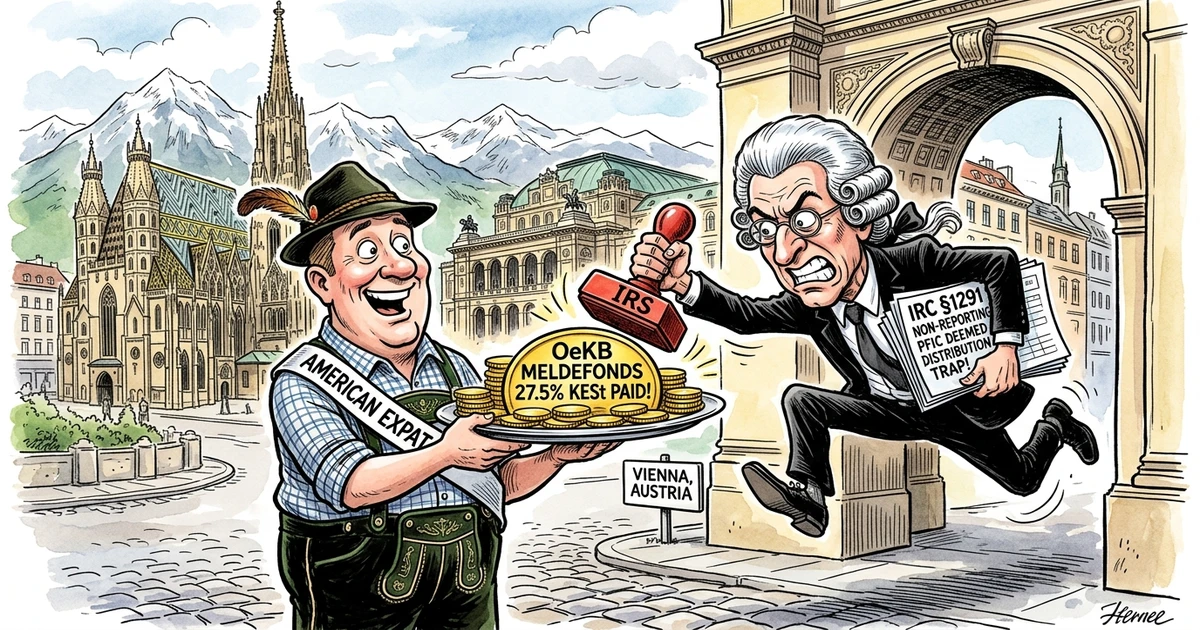
3. Nicht-Meldefonds in Austria: 90%/10% Deemed-Income Rule and Self-Proof
When an investment fund does not report data through an Austrian tax representative to the OeKB, the BMF classifies it as a Nicht-Meldefonds (Non-Reporting Fund) under §186 InvFG 2011.
90% of the positive price difference between the first and last redemption price of the calendar year, with a statutory minimum of 10% of the year-end redemption price.
Tax is levied at 27.5% KESt on this deemed amount annually, regardless of the fund's actual accounting earnings.
The Self-Proof Mechanism (Selbstnachweis): Under Austrian administrative guidelines, an investor in a Nicht-Meldefonds may submit a formal self-proof calculation (Selbstnachweis) to the Austrian tax office (Finanzamt) to establish actual income. However, the documentation must adhere to Austrian fund tax accounting standards and provide verified underlying financial records.
4. Ausschüttungsgleiche Erträge: How Accumulating ETFs Are Taxed in Austria
In Austria, accumulating (thesaurierende) ETFs do not pay cash dividends. Instead, they reinvest income internally. Under §186 InvFG 2011, this retained income is treated as deemed distributed income (ausschüttungsgleiche Erträge).
Operational mechanics for Austrian residents:
- OeKB Tax Processing: Austrian brokers use OeKB notification data to determine taxable deemed income and execute associated basis adjustments.
- Automatic Cash Deduction (e.g., Flatex): Austrian tax-deducting brokers debit the 27.5% KESt from the investor's cash account on the tax valuation date, even though no cash was distributed by the ETF.
- Austrian Basis Step-Up: The deemed distribution taxed in Austria increases the investor's acquisition cost (Anschaffungskosten). When the ETF is eventually sold, this stepped-up basis prevents Austrian double taxation.
- U.S. Tax Disconnect: For U.S. tax purposes, accumulating PFIC shares have zero recognized distribution under §1291. The U.S. basis remains strictly the historical USD purchase price without step-up, setting up a major cross-border collision upon sale.
5. Flatex Austria vs. IBKR for U.S. Citizens: KESt, FATCA & Self-Reporting
U.S. citizens in Austria must evaluate both brokerage compliance policies and Austrian tax reporting mechanics:
| Platform Feature | Austrian Broker (e.g., Flatex Austria) | International Broker (e.g., Interactive Brokers - IBKR) |
|---|---|---|
| Austrian Tax Compliance | Steuereinfach (Automatic): Automatically calculates and withholds 27.5% KESt, processes loss-offsetting pools (Verlustverrechnungstopf), and tracks stepped-up basis. | Non-Steuereinfach (Self-Report): No Austrian withholding. The investor must manually look up OeKB tax figures and report deemed/realized income on Form E1kv. |
| U.S. Person Onboarding | Account-Specific Review: Flatex maintains U.S. tax document workflows (including Form W-9), but individual onboarding eligibility should be confirmed directly with the broker. | Standard U.S. Onboarding: IBKR accepts U.S. persons, provides dual-reporting infrastructure (Form 1099 or annual statement export), and supports multi-currency accounting. |
| Form 8621 Workpaper Creation | Requires manual reconstruction of euro transactions into USD historical cost lots. | Enables direct CSV transaction export for automated Section 1291 and §1296 workpaper generation. |
6. Austrian Meldefonds vs. U.S. PFIC Rules: Why OeKB Status Does Not Solve Form 8621
An investor who purchases an OeKB-registered European UCITS ETF satisfies Austrian tax documentation requirements. However, from the U.S. tax standpoint:
- IRC §1297 PFIC Status: The UCITS ETF is a foreign corporation whose assets and income are passive. It is subject to U.S. PFIC classification rules.
- Form 8621 Requirements: Form 8621 reporting may be required depending on ownership value, distributions, dispositions, and elections.
- Default Section 1291 Mechanics: In the absence of a timely QEF or MTM election, disposition gains are allocated across the holding period, taxed at the highest marginal rates in effect for each allocated prior year, plus compounding statutory interest under IRC §6621.
7. U.S.-Domiciled ETFs in Austria: OeKB Status, PRIIPs & U.S. Tax
Holding U.S.-domiciled ETFs (such as Vanguard VOO, VTI, or iShares IVV) avoids U.S. PFIC classification. However, Austrian resident taxpayers must note:
- PRIIPs Distribution Rules: Under EU Regulation 1286/2014, Austrian brokers cannot execute retail buy orders for U.S. ETFs without an EU Key Information Document (KID).
- OeKB Status Verification: A U.S.-domiciled ETF is not automatically a Nicht-Meldefonds. Taxpayers must check the exact ISIN in the OeKB database for the relevant tax year. If unregistered, Austrian 90%/10% deemed income rules apply unless substantiated through the Selbstnachweis process.
8. OeKB Tax Reports vs. PFIC Annual Information Statements
Can an Austrian investor use the annual tax data downloaded from the OeKB portal to make a Qualified Electing Fund (QEF) election on Form 8621?
Austrian reports compute income under Austrian tax accounting rules (InvFG & EStG). A valid U.S. QEF election requires certified pro-rata ordinary earnings and net capital gains computed under U.S. federal income tax accounting principles.
👉 Read our dedicated guide: European Fund Documents vs. PFIC Annual Information Statements →
9. Austria–U.S. Tax Timing: KESt, §1291, MTM & Foreign Tax Credits
The interaction of Austrian KESt and U.S. Section 1291 creates a structural timing mismatch:
- Austria levies KESt (27.5%) annually on deemed distributions.
- The U.S. under default §1291 recognizes zero current income on accumulating shares during holding years, but allocates cumulative gains retroactively upon sale.
- Because the U.S. tax event occurs in the disposition year while Austrian taxes were paid in prior holding years, utilizing Foreign Tax Credits (FTC) on Form 1116 requires careful analysis of carryover and limitation categories.
10. Section 1296 MTM for Austrian UCITS ETFs: Eligibility Before Election
For exchange-traded UCITS ETFs where shares satisfy the Section 1296 marketable-stock rules—including trading on a qualified exchange or other market and meeting applicable regularly-traded requirements under Treas. Reg. §1.1296-2—a U.S. taxpayer can elect Mark-to-Market on Form 8621 Part II Box C.
Crucial Distinction: OeKB Meldefonds registration under Austrian law and §1296 marketable-stock eligibility under U.S. law are independent legal tests. OeKB status does not itself establish MTM eligibility under U.S. regulations.
11. Moving to or Leaving Austria With U.S. Investments: Entry Basis & Exit Tax
Cross-border moves between the United States and Austria trigger dual-basis tracking rules:
- Immigrating to Austria (Entry Basis): For Austrian tax purposes, financial assets entering Austrian tax jurisdiction generally receive an Austrian entry value based on fair market value (gemeiner Wert) at the time Austrian unlimited tax liability begins. The original historical USD cost remains relevant for U.S. tax purposes, causing Austrian and U.S. basis to diverge immediately upon relocation.
- Emigrating from Austria (Exit Tax): Under §27(6) EStG, when relocation causes Austria to lose its taxing rights over financial assets, a deemed disposition exit tax (Wegzugsbesteuerung) can apply. For accumulating ETFs, previously taxed deemed distributions (ausschüttungsgleiche Erträge) must be credited to ensure Austrian basis is properly stepped up.
12. Already Own Austrian Funds? Form 8621 Reconstruction Workflow
If you hold European UCITS ETFs or Austrian investment funds while residing in Austria:
- Gather ISINs and Purchase Histories: Collect trade confirmations showing transaction dates, euro amounts, and share counts.
- Reconstruct USD Historical Lots: Convert each transaction lot into USD at historical exchange rates to establish U.S. tax basis.
- Reconcile Austrian vs. U.S. Basis: Track Austrian stepped-up basis via OeKB records for KESt reporting while maintaining independent USD historical cost basis for Form 8621.
- Generate Form 8621 Schedules: Calculate Section 1291 excess distribution throwback schedules or §1296 Mark-to-Market workpapers.
Convert EUR transaction histories into reconciliation-ready Section 1291 excess distribution and §1296 Mark-to-Market Form 8621 schedules using our calculation engine on 8621calculator.com.
$10 per calculation · No registration required · Instant PDF/CSV workpapers
Calculate Austrian PFIC Workpapers →