Canadian Registered Accounts: U.S. Tax & PFIC Exposure Matrix
| Account Type | U.S. Tax & 8621 Status | Action Strategy |
|---|---|---|
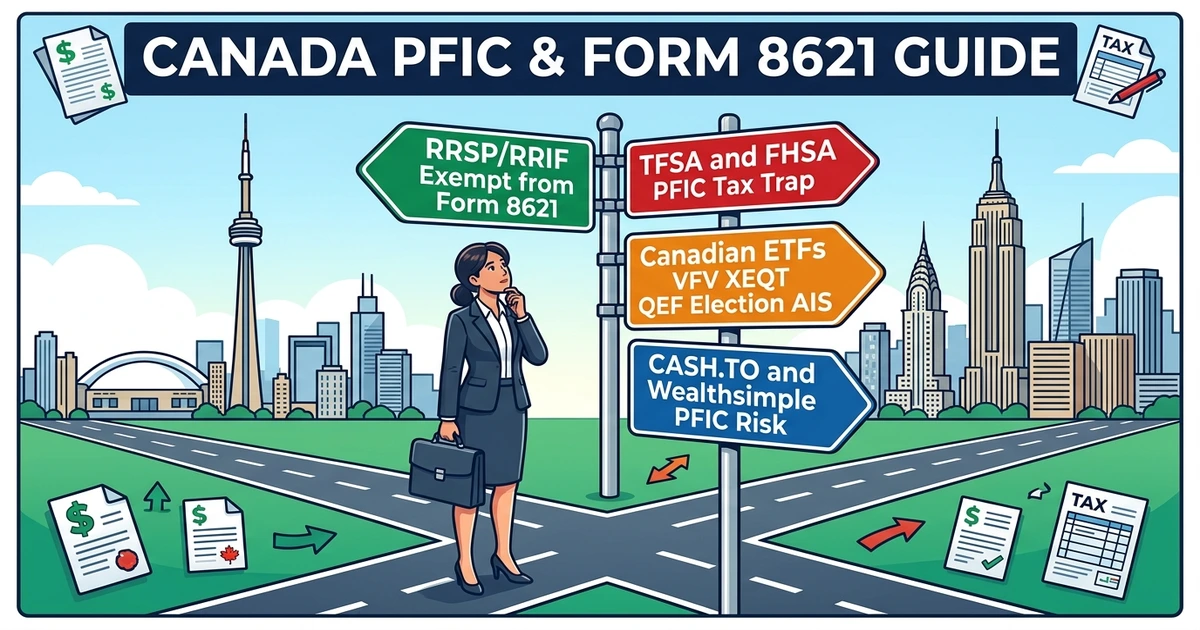
| RRSP / RRIF Registered Retirement |
Exempt · No 8621
Treaty Art. XVIII Deferred
|
Safe to hold Canadian ETFs & mutual funds. U.S. tax deferred until withdrawal. |
| TFSA Tax-Free Savings |
Taxable · Form 8621
Not Recognized by IRS
|
Avoid Canadian ETFs. Hold cash/GICs, direct stocks, or close account. |
| FHSA First Home Savings (2023+) |
Taxable · Form 8621
Earnings Taxable Annually
|
Foreign-trust reporting requires separate analysis under current §6048 guidance and the 2024 proposed regulations. Do not assume RRSP treatment or automatic Form 3520 relief. Canadian fund holdings inside an FHSA may create separate PFIC issues. |
| RESP Education Savings |
Taxable for ETFs
Form 8621 Required
|
Rev. Proc. 2020-17 waives 3520 trust filing, but 8621 still required for ETFs held. Canadian ETFs or mutual funds held inside an RESP require separate Form 8621 reporting. |
| Taxable Brokerage Non-Registered |
Taxable · Form 8621
Full U.S. Annual Exposure
|
Download AIS to elect QEF annually, or hold U.S.-domiciled ETFs (VOO/VTI) directly. Holding U.S.-domiciled ETFs directly eliminates PFIC filing, subject to CRA T1135 foreign property reporting. |
Canadian Investment Vehicles: PFIC Exposure Matrix
| Investment Vehicle | PFIC & Reporting Status | U.S. Tax Strategy & QEF Election |
|---|---|---|
| U.S.-Domiciled ETFs VOO, VTI, QQQ, BND |
Generally No PFIC
Standard U.S. 1040 Reporting
|
Standard capital gains and qualified dividends. Zero Form 8621 compliance overhead. |
| Direct Canadian Operating Stocks RY, ENB, TD, CNR, SHOP |
Outside Pooled PFIC Trap
Direct Corporate Shares
|
Direct ownership of active operating businesses avoids fund PFIC status. Test unusual cash-heavy holding companies separately under IRC §1297. |
| Canadian ETFs VFV, XEQT, VEQT, CASH.TO |
High PFIC Relevance
Form 8621 Often Required
|
Canadian ETFs are PFICs first; statutory annual reporting exceptions under §1298(f) apply in limited cases. Major issuers (Vanguard, iShares, BMO) publish annual AIS data, making timely QEF elections practical to avoid Section 1291 penal rates. |
| Canadian Mutual Funds Bank Mutual Funds, Wealthsimple |
High PFIC Relevance
Trust / Corporation Wrapper
|
Determine whether the specific fund publishes an annual PFIC AIS. Without a compliant AIS, funds default to punitive Section 1291 excess distribution taxation. |
| Corporate-Class Funds Mutual Fund Corporations |
High PFIC Relevance
Foreign Corporation Structure
|
Structured as shares of a mutual fund corporation. Passive income/asset tests apply directly under §1297; investigate fund-level AIS availability for QEF elections. |
| Segregated Funds Insurance-Wrapped Portfolios |
Classification Required
Insurance / Trust / PFIC Review
|
Perform contractual and asset-ownership analysis first. Evaluate §7702 life insurance rules, investor-control doctrine (Rev. Rul. 2003-91), and potential underlying PFIC exposure. |
| Canadian REITs Real Estate Investment Trusts (TSX) |
Structure-Specific
Entity Classification Test
|
Apply IRC §1297 75% income and 50% asset tests based on active vs. passive real estate management and underlying operating partnership tiers. Do not assume automatic PFIC status. |
Cross-Border Investor Decision Flowchart: Canada to U.S. Tax Rules
Follow this interactive decision sequence to determine your exact Form 8621 filing obligations, treaty protections, and foreign trust reporting exposure for Canadian assets:
Step 1: Where are your Canadian assets held?
Canada PFIC Knowledge Base & Strategy Guides
Explore our comprehensive 15 guides covering Canadian registered accounts, ETF factor engines, and cross-border migration.
Frequently Asked Questions: Canada PFIC & Cross-Border Taxes
Are Canadian ETFs considered PFICs for U.S. taxpayers?
Yes. Canadian-domiciled ETFs (such as VFV, XEQT, VEQT, VGRO, and CASH.TO) are organized as Canadian mutual fund trusts or corporations. Under IRC §1297, they are foreign collective investment vehicles that earn passive income, classifying them as PFICs for U.S. citizens, Green Card holders, and tax residents.
Do I need to file Form 8621 for Canadian ETFs inside an RRSP or RRIF?
No. Under Treas. Reg. §1.1298-1(c)(4) and Rev. Proc. 2014-55, Canadian registered retirement plans (RRSP and RRIF) recognized under Article XVIII of the Canada-U.S. Income Tax Treaty are exempt from annual PFIC Form 8621 reporting, as tax is deferred until distribution.
Can I make a QEF election on Canadian ETFs?
Yes. Major Canadian fund providers—including Vanguard Canada, BlackRock iShares, BMO, Horizons/Global X, and CI Global—publish annual PFIC Annual Information Statements (AIS). This allows U.S. taxpayers to make a Qualified Electing Fund (QEF) election on Form 8621, avoiding punitive Section 1291 tax rates.
Why is a TFSA dangerous for U.S. citizens in Canada?
The IRS does not recognize the tax-exempt status of the Tax-Free Savings Account (TFSA). All interest, dividends, and realized capital gains inside a TFSA are taxable annually on U.S. Form 1040. Holding Canadian ETFs inside a TFSA triggers complex annual Form 8621 filings.
Does the $25,000 PFIC exemption apply to Canadian ETFs?
Under Treas. Reg. § 1.1298-1(c)(2), the $25,000 aggregate exemption ($50,000 for married filing jointly) is a Form 8621 Part I annual reporting exception that applies only if: (1) the aggregate value of all PFIC stock is ≤ $25,000/$50,000 at year-end; (2) no QEF or MTM election is in effect; (3) no excess distributions were received; and (4) no gain treated as an excess distribution was recognized on a disposition.
Content reflects Form 8621 (Rev. 12/2025), applicable Treasury Regulations, IRS guidance, and other authorities cited on this page.