
In Canada, the Tax-Free Savings Account (TFSA) is celebrated as the single best wealth-building tool for residents: capital gains, dividends, and interest grow 100% tax-free, and withdrawals are never taxed by the Canada Revenue Agency (CRA).
However, for the estimated 1 million U.S. citizens, Green Card holders, and dual citizens living in Canada, opening a TFSA is one of the most dangerous cross-border financial decisions. The Internal Revenue Service (IRS) does not recognize the TFSA as a tax-exempt vehicle under the Canada-U.S. Tax Treaty.
Worse still, populating a TFSA with popular Canadian exchange-traded funds (such as VFV, XEQT, VEQT, VGRO, or CASH.TO) triggers the U.S. Passive Foreign Investment Company (PFIC) regime under Internal Revenue Code (IRC) §§1291–1298, requiring annual IRS Form 8621 reporting unless a statutory exception (such as the $25,000/$50,000 threshold under Treas. Reg. § 1.1298-1(c)) applies.
Why the Canada-U.S. Tax Treaty Does Not Protect TFSAs
Many cross-border investors assume that because their Registered Retirement Savings Plan (RRSP) is protected by the treaty, their TFSA must be protected as well. This assumption is legally false.
Under Article XVIII of the Canada-U.S. Income Tax Convention, tax deferral is granted strictly to pension plans and retirement savings arrangements created to provide retirement income. The IRS codified this treaty exemption in Rev. Proc. 2014-55 and Treas. Reg. §1.1298-1(c)(4), which explicitly exempts qualifying foreign pension plans from annual Form 8621 reporting.
The TFSA, introduced by the Canadian federal government in 2009 under Section 146.2 of the Income Tax Act, was created as a general-purpose savings vehicle rather than a pension plan. Because the U.S. and Canada have never amended the tax treaty to include TFSAs, the IRS treats a TFSA as an ordinary, foreign taxable brokerage account.
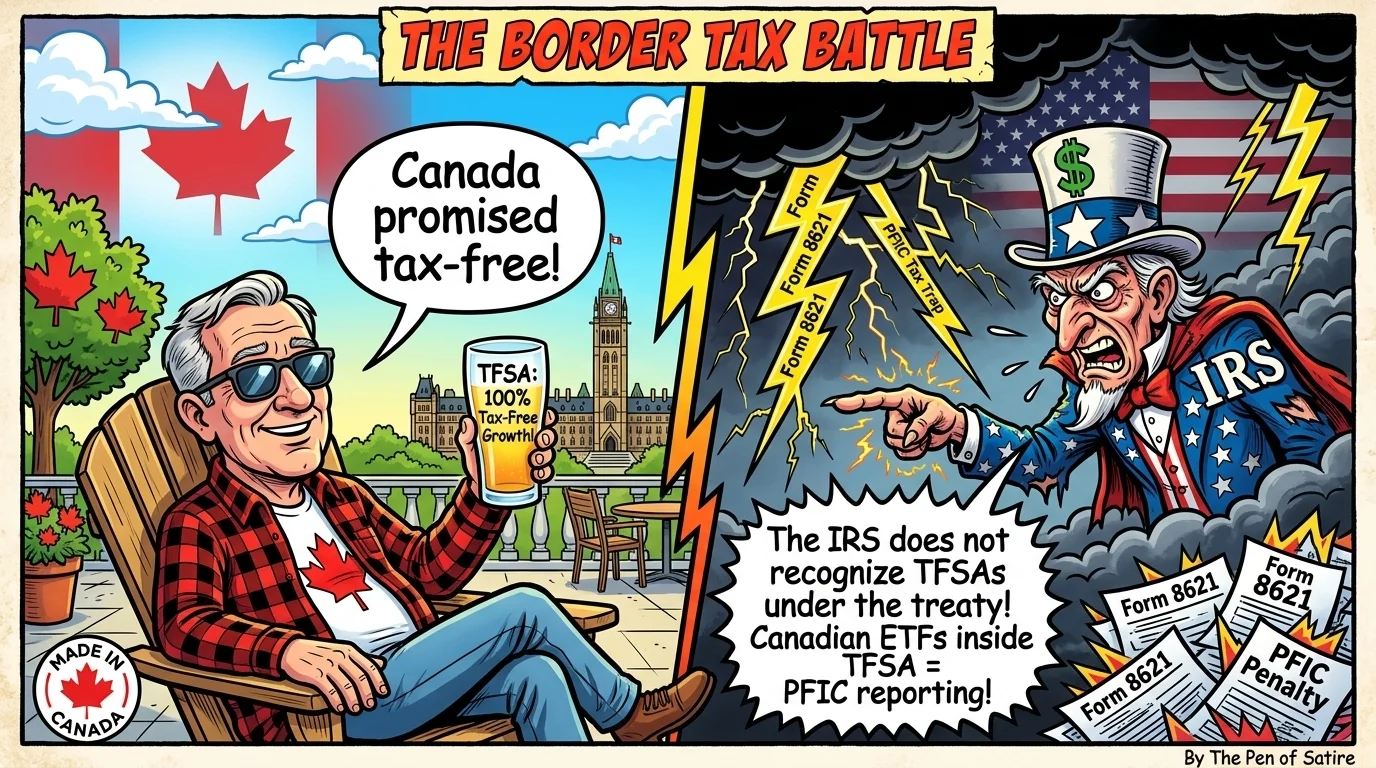
The PFIC Multiplier: Holding Canadian ETFs Inside a TFSA
When a U.S. person buys Canadian-domiciled mutual funds or ETFs inside a regular taxable account, they can often use Canadian taxes paid to offset their U.S. tax bill via the Foreign Tax Credit (FTC).
Inside a TFSA, this defense collapses completely:
- Zero FTC Shield: Since Canada levies zero tax, your foreign tax credit basket is empty. The U.S. taxes 100% of your earnings.
- Default Section 1291 Taxation: If you hold a Canadian ETF (e.g., Vanguard S&P 500 ETF -
VFV.TO) without making a timely QEF election, any sale or excess distribution is taxed at the highest marginal federal tax rate (currently 37%), plus nondeductible compounding interest under IRC §6621. - Loss of Favorable Capital Gains Rates: Under Section 1291, long-term capital gains lose their preferential 15%/20% tax rates and are recharacterized as ordinary income allocated across your entire holding period.
Vanguard VFV Inside a TFSA: §1291 vs. MTM vs. QEF (10-Year Model)
To illustrate the real-world mathematical destruction of holding a Canadian ETF inside a TFSA, consider a taxpayer who invested approximately CAD 100,000 in VFV on January 4, 2016, and liquidated on December 31, 2025 for CAD 334,740 (a net capital gain of +CAD 234,772):
| Transaction Date | Action | Price (CAD) | Position Value (CAD) |
|---|---|---|---|
| 2016-01-04 | Initial Purchase (2,009 units) | $49.76 | $99,968 CAD |
| 2025-12-31 | Full Liquidation (−2,009 units) | $166.62 | $334,740 CAD (+234.8%) |
| PFIC Tax Regime | Effective Tax Burden | Financial Impact on $234,772 Gain |
|---|---|---|
|
Default Section 1291 No Election (TFSA Default) |
48.45% Modeled Burden
$113,746 CAD IRS Tax & Interest
|
Catastrophic: Punitive throwback taxation at top 37% rate plus compounding interest consumes nearly half of all profits. |
|
Section 1296 MTM Mark-to-Market Election |
24.00% Modeled Burden
$56,345 CAD Tax Paid Annually
|
Ordinary Rates: Eliminates §1291 interest, but taxes unrealized phantom gains annually at ordinary income rates. |
|
QEF Election (or Direct VOO) Qualified Electing Fund / US ETF |
15.00% Baseline
$35,215 CAD Tax (LTCG Rates)
|
Optimal: Preserves preferential long-term capital gains tax rates and eliminates all IRS interest penalties. |
The Form 3520 / 3520-A Foreign Trust Controversy
In addition to PFIC and Form 8621 rules, U.S. taxpayers holding TFSAs have long faced confusion regarding foreign trust reporting under IRC §6048 (Forms 3520 and 3520-A).
Historically, due to the trust-like wording in the Canadian Income Tax Act governing qualifying TFSA arrangements, many conservative tax practitioners advised clients to file annual foreign grantor trust returns. Under IRC §6677, the initial penalty is generally the greater of $10,000 or the applicable percentage: 35% of property transferred for certain unreported transfers, 35% of distributions received for certain unreported distributions, or 5% of the gross value of the portion of the foreign trust's assets treated as owned by the U.S. person for certain Form 3520-A failures.
The Modern Consensus: The overwhelming majority of cross-border tax specialists today take the position that modern bank-deposit and self-directed brokerage TFSAs (offered by Wealthsimple, Questrade, TD, RBC, etc.) are custodial agency accounts rather than true foreign grantor trusts. While this eliminates the requirement to file Forms 3520/3520-A, it does not eliminate the requirement to report income on Form 1040 or file Form 8621 for PFIC assets.
What Should a U.S. Person Do With Their TFSA?
If you are a U.S. taxpayer residing in Canada, you have four distinct paths forward depending on your portfolio composition:
Option A: Close the TFSA Completely
The Cleanest Path. Withdraw your funds from the TFSA and redirect them to your RRSP (which is treaty-protected and exempt from Form 8621) or an eligible employer pension plan.
Option B: Hold Direct Operating Stocks
Direct Operating Stocks. Direct shares of active operating companies (e.g., Royal Bank of Canada, Enbridge, Apple, Microsoft) are generally less likely to be PFICs than foreign mutual funds or ETFs, but shares of a foreign corporation can still be PFIC stock if the corporation meets the IRC §1297 income or asset test. For qualifying non-PFIC operating companies, you report standard dividends and capital gains on Form 1040 Schedule B/D.
Option C: Hold High-Interest Cash / GICs
Pure Interest Income. Hold Canadian Guaranteed Investment Certificates (GICs) or cash savings. Bank interest is taxed at ordinary rates on Form 1040 (Schedule B) with zero Form 8621 filing requirements.
Option D: Use QEF Treatment if a Valid PFIC AIS Is Available
If Holding Canadian ETFs. If a valid PFIC Annual Information Statement (AIS) is available, a shareholder may make a timely QEF election for that PFIC. The election generally remains effective for subsequent years, while Form 8621 and QEF income reporting continue annually. If the QEF election is first made after an earlier PFIC year in the shareholder's holding period, additional rules may apply because the fund may remain an unpedigreed QEF unless an available purging election is made.
FBAR (FinCEN 114) and Form 8938 Requirements
Regardless of what assets you hold inside a TFSA—whether cash, GICs, or ETFs—the account itself is a foreign financial account.
- FBAR (FinCEN Form 114): Must be filed if the aggregate highest value of all your foreign financial accounts (including TFSA, chequing, savings, RRSP) exceeds $10,000 USD at any point during the calendar year.
- FATCA Form 8938: Must be attached to Form 1040 if your total specified foreign financial assets exceed the applicable reporting threshold. For taxpayers who qualify as living abroad for Form 8938 purposes, the thresholds are: more than $200,000 on the last day of the tax year (or $300,000 at any time during the year) if filing a return other than a joint return, and more than $400,000 on the last day of the tax year (or $600,000 at any time during the year) if married filing jointly.
Frequently Asked Questions
Can a U.S. citizen open a TFSA in Canada?
Legally, yes. Under Canadian tax law, any Canadian resident 18 or older with a valid SIN can open and contribute to a TFSA. However, from a U.S. federal tax perspective, the TFSA is completely unshielded, creating annual U.S. tax liabilities and potential PFIC Form 8621 filing obligations.
Why is holding Canadian ETFs inside a TFSA so punitive?
Canadian ETFs (like VFV, XEQT, or CASH.TO) are classified as PFICs. In a TFSA, since there is zero Canadian tax paid, you cannot claim Foreign Tax Credits (FTC) on IRS Form 1116 to offset U.S. taxes. Gains and distributions are subject to full U.S. tax, and un-elected funds face punitive Section 1291 interest rates.
Is a TFSA considered a Foreign Grantor Trust requiring Form 3520?
Historically, some CPAs took the conservative position that TFSAs were foreign grantor trusts requiring Forms 3520 and 3520-A. Today, the prevailing consensus among cross-border practitioners treats self-directed bank/brokerage TFSAs as custodial accounts rather than foreign trusts, though all underlying income and PFICs remain reportable on Form 1040 and Form 8621.
What can a U.S. citizen safely hold in a TFSA?
To eliminate PFIC exposure entirely, a U.S. person holding a TFSA should only hold cash deposits (GICs/HISA bank savings) or individual corporate stocks (such as Apple, Microsoft, RBC, or Enbridge). However, all interest, dividends, and capital gains must still be reported annually on Form 1040.
Bottom Line
For U.S. citizens and cross-border taxpayers in Canada:
- TFSA is NOT Tax-Free in the U.S.: All earnings are taxable annually on Form 1040 with zero Foreign Tax Credit offset.
- Avoid Canadian ETFs in a TFSA: Holding un-elected Canadian mutual funds or ETFs triggers Section 1291 penal rates and complex Form 8621 reporting.
- Prioritize RRSPs: Maximize your RRSP first, where Canadian ETFs and mutual funds enjoy statutory exemption from Form 8621 under Treas. Reg. §1.1298-1(c)(4).
Official Sources & Technical References
- IRS: Instructions for Form 8621 (Information Return by a Shareholder of a PFIC).
- Department of the Treasury: Canada-U.S. Income Tax Convention (Article XVIII Pensions and Annuities).
- Cornell Law (LII): 26 U.S. Code § 1291 — Interest on Tax Deferral on PFIC Distributions.
- Cornell Law (LII): Treas. Reg. § 1.1298-1 — Section 1298(f) Annual Reporting Requirements and Exceptions.
- IRS: Rev. Proc. 2014-55 — Procedures for Canadian Registered Retirement Plans.