
With Wealthsimple integrating Direct Indexing into its automated investing platform, cross-border taxpayers frequently ask whether direct indexing is the ultimate solution to avoid Passive Foreign Investment Company (PFIC) status and eliminate Form 8621 reporting in Canada.
How Wealthsimple Direct Indexing Works
Unlike traditional robo-portfolios that purchase pooled ETFs (such as XIC or VFV), Direct Indexing constructs a customized index portfolio by purchasing fractional shares of individual constituent stocks directly in your name:
Traditional Pooled ETF Structure
Canadian pooled investment vehicles such as ETFs and mutual funds commonly require PFIC analysis for U.S. investors. The U.S. tax classification of the vehicle—not the Canadian label "trust" by itself—controls the result. Because these pooled vehicles meet the passive income or asset tests of IRC §1297, annual Form 8621 filings are required. See our What Is a PFIC Master Guide →.
Direct Indexing Sleeve Structure
You hold legal title to 50 to 100 individual stocks (e.g., Royal Bank of Canada, Enbridge, Canadian Pacific Kansas City). Because there is no foreign pooled investment vehicle, there is no fund-level PFIC wrapper. Each directly held security is analyzed on its own facts.
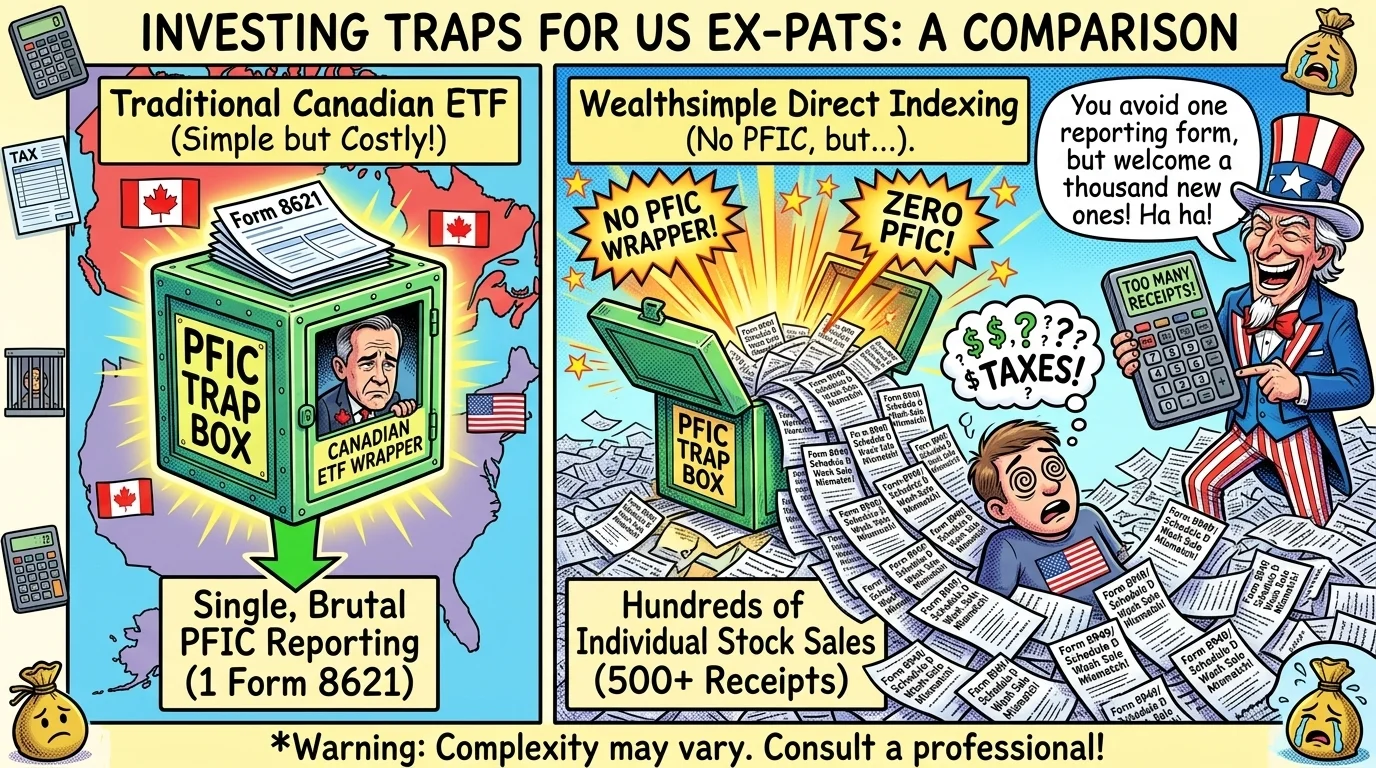
The Cross-Border Trade-Off: Eliminating PFIC vs. Form 8949 Chaos
While Direct Indexing sidesteps the §1291 punitive regime, it introduces severe operational hurdles for U.S. taxpayers preparing Form 1040:
| Investment Strategy & Structure | PFIC & IRS Reporting Burden | Cross-Border Friction & Verdict |
|---|---|---|
|
Direct U.S. ETFs VOO, VTI, VXUS (USD) |
Zero PFIC
Schedule B & Schedule D Only
|
Optimal: Zero PFIC exposure. Standard manual trading, clean 61-day wash-sale tracking, and lowest CPA preparation overhead. |
|
Canadian ETFs with QEF VFV, XEQT, XIC (CAD) |
PFIC (QEF Solves Tax)
Form 8621 Part III per ETF
|
Manageable: Eliminates §1291 interest penalties using fund AIS. No wash-sale tracking on underlying trades; moderate annual Form 8621 prep cost. |
|
Wealthsimple Direct Indexing 50–100 Fractional Equities |
Form 8949 Chaos
Zero Fund PFIC · Hundreds of Lots
|
Severe Friction: Automated TLH triggers massive Form 8949 trade volumes and irreconcilable Canadian Superficial Loss vs. U.S. §1091 Wash-Sale rule conflicts. |
U.S. Wash-Sale Rules vs. Canadian Superficial Loss Rules
Wealthsimple’s automated tax-loss harvesting (TLH) engine is coded strictly to optimize Canadian tax rules under Section 54 of the Income Tax Act (Superficial Loss Rule). It does not account for U.S. Internal Revenue Code §1091:
- U.S. Wash-Sale Window (IRC §1091): Disallows a capital loss if substantially identical stock is acquired within a 61-day window (30 days before the sale date, the sale date, and 30 days after the sale date).
- Canadian Superficial Loss Rule (ITA s. 54): Disallows a loss only if the property is acquired during the 30-day pre/post-settlement period and held at the end of that period by the taxpayer or an affiliated person.
- The Conflict: Automated trades that successfully claim a loss for Canadian CRA purposes may be completely disallowed on your U.S. return, creating dual adjusted cost basis (ACB) divergence for every harvested stock.
USD Currency Translation & Form 8949 Reporting Load
For U.S. income tax purposes, capital gains and losses cannot be calculated simply by converting the net CAD gain at year-end:
- Spot Rate at Acquisition: Every single share purchase must be translated to USD at the historical exchange rate on the acquisition date.
- Spot Rate at Disposition: Every sale must be translated to USD at the spot exchange rate on the settlement date.
- FX Realization: A position that is a capital loss in Canadian Dollars can easily become a taxable capital gain in U.S. Dollars due to currency exchange rate fluctuations between trade dates.
Practical Verdict: Is Direct Indexing Worth It for U.S. Expats?
For most U.S. citizens living in Canada:
- Avoid Automated Tax-Loss Harvesting in Managed Portfolios: The hundreds of micro-transactions will dramatically increase your cross-border accounting fees.
- Prefer Direct U.S. ETFs (VOO / VTI / VXUS): Converting CAD to USD via Norbert's Gambit and buying U.S.-domiciled ETFs in a self-directed account remains the cleanest, lowest-cost cross-border strategy.
- Use Core Canadian ETFs if CAD Automation is Required: If you must invest in CAD directly, holding 1 to 2 broad Canadian ETFs with reliable annual AIS data (e.g., VFV, XIC) is significantly easier to report than managing 80 individual direct index lots.
Frequently Asked Questions
Does Wealthsimple Direct Indexing avoid PFIC classification?
Direct Indexing removes the pooled Canadian ETF wrapper that commonly triggers PFIC classification because you directly own shares of individual operating companies rather than units of a trust. However, individual foreign securities must still be evaluated on their own facts, and automated tax-loss harvesting creates extensive U.S. Form 8949 reporting requirements.
What is the biggest cross-border tax problem with Wealthsimple Direct Indexing?
The primary issue is reporting volume and rules conflict. Wealthsimple's automated tax-loss harvesting executes dozens or hundreds of micro-transactions annually. On U.S. Form 1040, every trade must be converted to USD at the historical spot rate, tracked for U.S. wash-sale rules, and reported on Form 8949 and Schedule D.
How do U.S. wash-sale rules conflict with Canadian superficial loss rules in Direct Indexing?
Under U.S. IRC §1091, a loss is disallowed if substantially identical stock is repurchased within a 61-day window. Canada's superficial loss rule (ITA s. 54) uses a 30-day post-settlement window and requires that the property be held at the end of the period. Automated robo-algorithms designed strictly for Canadian tax laws can trigger U.S. wash-sale disallowances that complicate dual-country cost basis tracking.
Official Sources & Technical References
- Wealthsimple: Wealthsimple Help Centre — Direct Indexing & Automated Investing.
- Cornell Law (LII): 26 U.S. Code § 1091 — Loss from Wash Sales of Stock or Securities.
- Cornell Law (LII): 26 U.S. Code § 1297 — Passive Foreign Investment Company Defined.
- IRS: Instructions for Form 8949 (Sales and Other Dispositions of Capital Assets).