
Launched in 2023 by the Canadian federal government, the First Home Savings Account (FHSA) is arguably Canada's most generous registered program for domestic residents, combining the upfront tax deduction of an RRSP with the tax-free growth and tax-free qualifying withdrawal features of a TFSA.
However, for U.S. citizens, Green Card holders, and U.S. tax residents living in Canada, the FHSA is completely unshielded under the Canada-U.S. Income Tax Treaty. Opening and funding an FHSA creates immediate cross-border tax friction, potential foreign trust reporting exposure under IRC §6048, and severe PFIC penalties if invested in Canadian exchange-traded funds.
- Zero U.S. Deduction: Your $8,000 CAD annual contribution is deductible on Canadian Form T1, but is completely non-deductible on U.S. Form 1040.
- Annual U.S. Income Tax: All interest, dividends, and realized capital gains inside the FHSA are fully taxable annually in the United States.
- Zero Foreign Tax Credits (FTC): Because Canada imposes $0 tax on FHSA growth, you generate $0 in Canadian foreign tax credits on Form 1116 to offset your U.S. tax liability.
Core U.S. Tax Mechanics: How the IRS Views an FHSA
The Canada-U.S. Income Tax Treaty provides tax deferral for Canadian pension and retirement plans under Article XVIII(7) (specifically covering RRSPs and RRIFs). Because the FHSA was created decades after the treaty protocol and is designed for housing rather than retirement, the IRS treats an FHSA as an unrecognized foreign arrangement.
On your annual U.S. tax return, you must report:
- Interest & Dividends: Reported on Form 1040 Schedule B in the year earned.
- Capital Gains & Losses: Reported on Schedule D and Form 8949 upon each sale or rebalancing event.
- Foreign Reporting (FBAR / Form 8938): The account balance must be included on FinCEN Form 114 (FBAR) and IRS Form 8938 (FATCA) once filing thresholds are met.
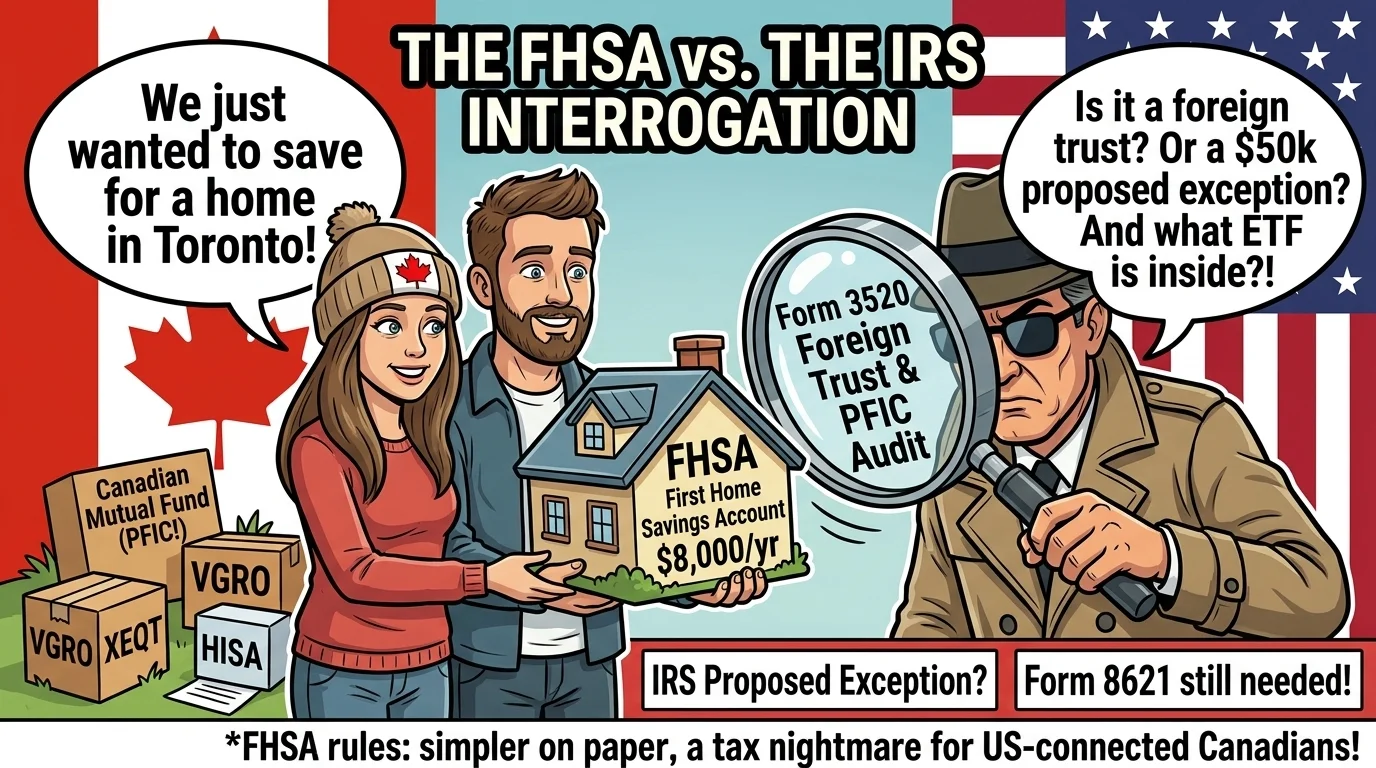
Form 3520 / 3520-A & PFIC Compliance: The Three-Tier Legal Analysis
Cross-border practitioners analyze the U.S. tax treatment of an FHSA using a strict three-tier sequence: Entity Classification, followed by Foreign Trust Exemption Analysis, and finally Underlying Asset PFIC Analysis.
1. Entity Classification under IRC §7701 & Plan Documentation: Whether an FHSA constitutes a foreign grantor trust under IRC §§671–679 depends strictly on the governing legal agreements executed with the Canadian financial institution. While some Canadian institutions draft FHSA arrangements as formal trusts (with a designated institutional trustee), others structure them as simple custodial or agency deposit accounts. If an account is legally a deposit/custodial arrangement rather than a separate trust entity under U.S. tax principles, IRC §6048 trust reporting does not apply from the outset.
2. Foreign Trust Exemption Analysis (REG-124850-08 & Rev. Proc. 2020-17): If an FHSA is structured under a trust agreement, taxpayers evaluate the safe harbors provided by Prop. Treas. Reg. § 1.6048-5(b) and Rev. Proc. 2020-17:
- Non-Retirement Savings Safe Harbor: The 2024 proposed regulations exempt tax-favored non-retirement savings trusts with annual contribution limits of $10,000 USD or less (or lifetime limits up to $200,000 USD). The Canadian FHSA—statutorily restricted to $8,000 CAD/year (~$6,000 USD) and $40,000 CAD lifetime (~$30,000 USD)—falls comfortably within these safe-harbor limits.
- Government Oversight & Information Exchange: The account must be subject to annual local tax reporting and oversight, which the CRA strictly enforces for all registered FHSA plans.
Crucial Rule: Even when an FHSA successfully avoids Form 3520/3520-A reporting under entity classification or the proposed trust safe harbor, it does not shield you from Form 8621.
Because the Canada-U.S. Tax Treaty does not extend Article XVIII pension deferral to FHSAs, the IRS treats the account as a taxable transparent wrapper. If you hold Canadian-domiciled ETFs (such as VFV, XEQT, or CASH.TO) inside an FHSA, each fund is a Passive Foreign Investment Company under IRC §1297, requiring annual Form 8621 reporting and PFIC taxation.
FHSA Asset Allocation Matrix: What to Hold Inside
If you choose to utilize an FHSA to capture the Canadian tax deduction on your T1 return, selecting the correct asset inside the account is critical to avoiding a PFIC disaster:
| Asset Type Held | U.S. PFIC Exposure? | Annual U.S. Tax Reporting | Cross-Border Assessment |
|---|---|---|---|
| Canadian ETFs (VFV, XEQT, CASH.TO) | YES (PFIC) | Form 8621 per ETF + QEF computation | Worst Choice: Complex PFIC filings destroy the tax benefit. |
| Canadian Bank GICs / Term Deposits | NO (Deposit Contract) | Schedule B (Ordinary interest) | Recommended: Capital preservation for down payment, zero Form 8621. |
| Direct High-Interest Cash / HISA | NO (Deposit) | Schedule B (Ordinary interest) | Recommended: Liquidity for home purchase, simple Schedule B reporting. |
| Single U.S. or Canadian Equities | NO (Single Stock) | Schedule B / Schedule D | Acceptable: Volatile for short-term down payments, but no PFIC. |
Best Cross-Border Planning Strategies for the FHSA
Cross-border couples and U.S. taxpayers should evaluate two primary operational pathways:
- Strategy 1: The Non-U.S. Spouse Solution: If you are married to a Canadian citizen or non-U.S. person, have the non-U.S. spouse open and fund the FHSA in their name exclusively. They claim the full Canadian tax deduction, enjoy 100% tax-free growth and withdrawal, and zero U.S. filings are generated (assuming you file Married Filing Separately or the non-U.S. spouse is not a U.S. taxpayer).
- Strategy 2: U.S. Citizen Holding Pure Cash/GIC: If both spouses are U.S. citizens, max out the FHSA to secure the Canadian T1 tax deduction against high Canadian marginal tax rates (often 40–53%), but hold only Canadian bank GICs or cash deposits inside the account. You pay moderate U.S. tax on the interest annually, completely bypass Form 8621, and withdraw the principal tax-free in Canada for your home purchase.
Frequently Asked Questions
Are qualifying home-purchase withdrawals from an FHSA taxable in the United States?
No, provided the annual growth was already taxed as earned. Because the U.S. treats the FHSA as a standard brokerage/custodial account, you have already paid U.S. tax on the interest, dividends, and realized gains annually. When you withdraw the accumulated cash to buy a house, the withdrawal of your cost basis is non-taxable on Form 1040.
What happens if I transfer unused FHSA funds to an RRSP?
In Canada, unused FHSA funds can be transferred directly to an RRSP without consuming RRSP contribution room. From a U.S. tax perspective, once the funds enter the RRSP, they become fully sheltered under Treaty Article XVIII, deferring all future U.S. tax until ultimate retirement distribution.
Do I have to report an FHSA on FinCEN Form 114 (FBAR)?
Yes. An FHSA held at a Canadian financial institution (like TD, RBC, Wealthsimple, or Questrade) is a foreign financial account. If the aggregate maximum value of all your foreign accounts exceeds $10,000 USD at any point during the calendar year, the FHSA must be listed on your FBAR.
Can I buy Canadian ETFs like VFV or CASH.TO inside an FHSA?
You legally can under Canadian law, but you should strongly avoid doing so. Holding Canadian ETFs inside an FHSA requires annual Form 8621 filings for every single ETF, adding massive CPA preparation costs and potential Section 1291 tax penalties to a short-term savings account.
Official Authorities & Technical References
- Internal Revenue Bulletin: Proposed Regulations REG-124850-08 — Foreign Trust Reporting and Section 6048 Relief (May 2024).
- IRS: Rev. Proc. 2020-17 — Relief from Information Reporting on Transactions With Certain Foreign Trusts.
- Canada Revenue Agency (CRA): First Home Savings Account (FHSA) Rules and Guidelines.
- IRS: Instructions for Form 8621 (Rev. 12/2025).