
For U.S. taxpayers investing in foreign collective investment vehicles, the Qualified Electing Fund (QEF) election under IRC §1295 is the gold standard of PFIC compliance.
Unlike investors in India, the UK, or Australia—where fund managers rarely provide the required U.S. accounting data—investors in Canada hold a massive structural advantage: nearly all major Canadian ETF issuers publish annual PFIC Annual Information Statements (AIS).
By making a timely QEF election on IRS Form 8621, you replace the punitive, compounding interest penalties of default Section 1291 taxation with clean, annual pass-through taxation that preserves preferential long-term capital gains rates.
What is a PFIC Annual Information Statement (AIS)?
Under Treas. Reg. §1.1295-1(g), a foreign corporation or fund must provide specific accounting disclosures to enable its U.S. shareholders to make and maintain a valid QEF election. This statement must include:
- The taxable year of the PFIC to which the statement applies.
- The U.S. shareholder's pro-rata share of the fund's Ordinary Earnings (stated per share per day or per unit per day).
- The U.S. shareholder's pro-rata share of the fund's Net Capital Gain (long-term).
- The amount of cash and fair market value of other property distributed to the shareholder during the tax year.
- A statement permitting the shareholder to inspect the fund's books and records upon IRS request.
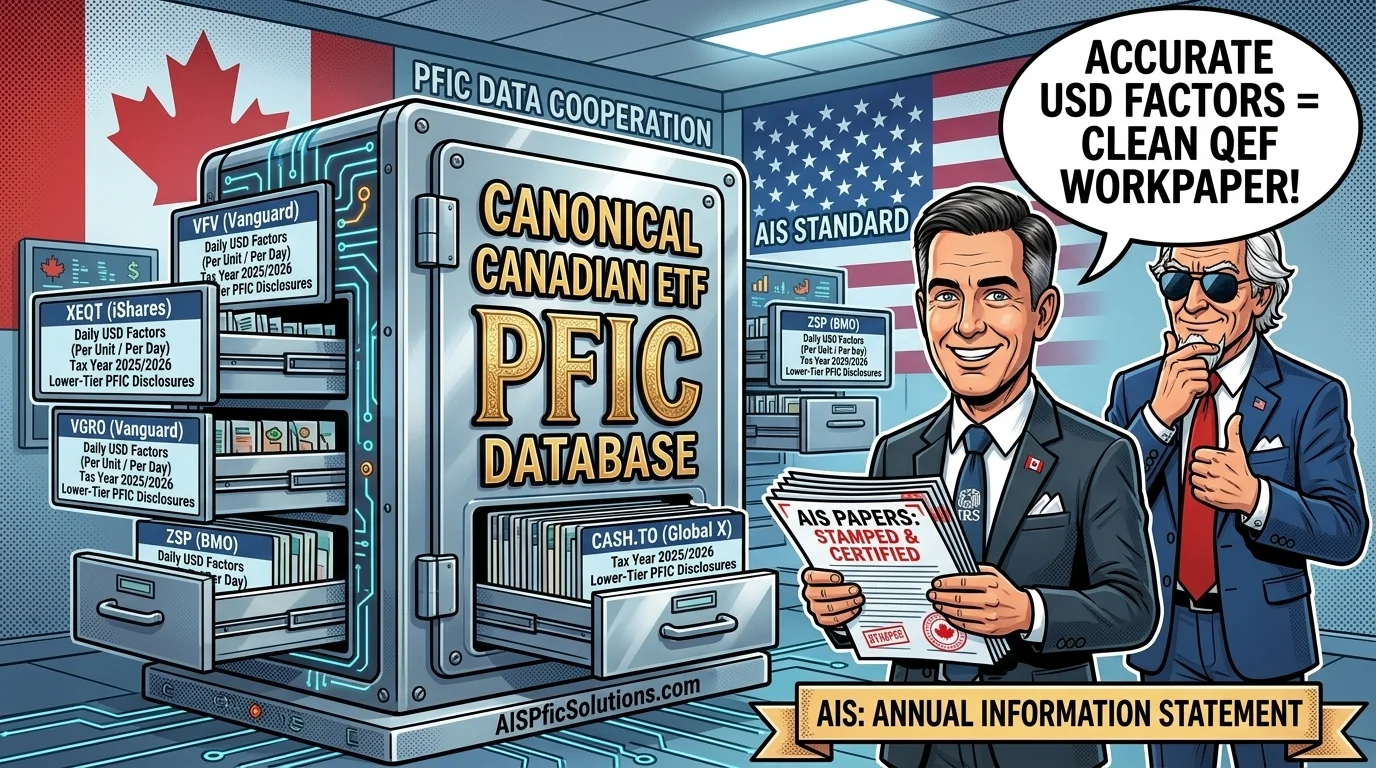
Canadian ETF PFIC & QEF AIS Database (2024–2025 Benchmarks)
Canadian fund managers publish PFIC Annual Information Statements (AIS) pursuant to Treas. Reg. § 1.1295-1(g). Crucially, both Vanguard Canada and BlackRock iShares report their daily accounting factors in U.S. Dollars (USD), not CAD. Below is our canonical database tracking AIS availability, factor methodology, lower-tier PFIC holdings, and verification dates:
| Canadian ETF & Issuer | QEF AIS Status & Currency | Underlying Holdings & Filing Scope |
|---|---|---|
|
VFV Vanguard S&P 500 Index ETF (Vanguard) |
AIS Published · Verified
Per-unit / per-day (USD)
|
Direct PFIC: Direct U.S. equities. Single Form 8621 Part III filing with zero lower-tier complexity. |
|
VCN Vanguard FTSE Canada All Cap (Vanguard) |
AIS Published · Verified
Per-unit / per-day (USD)
|
Direct PFIC: Direct TSX equities. Single Form 8621 Part III filing. |
|
VGRO Vanguard Growth ETF Portfolio (Vanguard) |
AIS Published · Tiered
Per-unit / per-day (USD)
|
Tiered PFIC: Fund of funds. Vanguard AIS provides underlying factor breakdown for VCN, VUN, VIU, VEE, VAB. |
|
VEQT Vanguard All-Equity Portfolio (Vanguard) |
AIS Published · Tiered
Per-unit / per-day (USD)
|
Tiered PFIC: All-equity fund of funds. Vanguard AIS discloses factors for VCN, VUN, VIU, VEE. |
|
XEQT iShares Core Equity Portfolio (BlackRock) |
AIS Published · Tiered
Per-share / per-day (USD)
|
Tiered PFIC: BlackRock AIS details pass-through factors for top-level XEQT + lower-tier XIC, XEF, XEC. |
|
XGRO iShares Core Growth Portfolio (BlackRock) |
AIS Published · Tiered
Per-share / per-day (USD)
|
Tiered PFIC: Discloses factor schedules for XGRO + lower-tier XIC, XBB, XEF, XEC. |
|
XIC iShares Core S&P/TSX Capped (BlackRock) |
AIS Published · Verified
Per-share / per-day (USD)
|
Direct PFIC: Direct TSX equities. Single Form 8621 Part III filing. |
|
ZSP BMO S&P 500 Index ETF (BMO AM) |
AIS Published · Verified
Per-unit / per-day (USD)
|
Direct PFIC: Direct S&P 500 stocks. Single Form 8621 Part III filing. |
|
CASH.TO Global X High Interest Savings (Global X) |
AIS Published · Verified
Annual / Daily (USD)
|
Direct PFIC: 100% Ordinary Interest earnings pass-through via QEF. |
|
DLR / DLR.U Global X US Dollar Currency ETF (Global X) |
AIS Published · Verified
Annual / Daily (USD)
|
Currency PFIC: Used for Norbert's Gambit. Discloses currency trust factors. |
How to Read Canadian ETF AIS Factor Formats
Canadian ETF issuers publish annual AIS factors formatted as daily per-unit or per-share amounts in USD (not CAD). For example, Vanguard Canada and BlackRock iShares compute their AIS figures under U.S. income tax principles, reflecting daily pro-rata ordinary earnings and net capital gain allocations.
To compute your Part III entries, multiply the daily USD factor by your units held and the number of days in your holding period during the fund's tax year. The resulting ordinary earnings are reported on Line 6a, and net capital gains are reported on Line 7a.
Fund-of-Funds AIS Disclosure (XEQT, VGRO, VEQT)
Popular Canadian all-in-one ETFs (such as iShares XEQT / XGRO and Vanguard VGRO / VEQT) are fund-of-funds structures that hold underlying Canadian and international ETFs.
Official statements from BlackRock and Vanguard Canada explicitly disclose underlying lower-tier funds (e.g., XIC, XEF, XEC). While top-tier AIS statements provide consolidated factors, U.S. taxpayers must be aware of indirect PFIC holding rules under Treas. Reg. §1.1291-1(b)(8).
To evaluate whether an all-in-one ETF requires separate tiered reporting or benefits from consolidated treatment, see our deep dive: Fund of Funds PFIC Risk: One Ticker ≠ One Form 8621 →.
Tracking Adjusted Tax Basis: IRC §1293(d) vs. Canadian ACB
Under IRC §1293(d), your U.S. tax basis increases by taxable QEF inclusions (Lines 6a and 7a) and decreases by actual cash distributions treated as previously taxed income. This U.S. dollar basis operates completely independently from your Canadian Adjusted Cost Base (ACB) tracked on Form T5008 or broker reports.
Frequently Asked Questions
Why is a QEF election better than default Section 1291 treatment?
A QEF election taxes your pro-rata share of the fund's earnings currently. Long-term capital gains retain their favorable 15%/20% tax rates, and you completely avoid the punitive Section 1291 highest marginal tax rate (37%) and compounding interest penalties upon sale or distribution.
How does a QEF election affect my cost basis?
Under IRC §1293(d), every dollar of undistributed ordinary earnings and net capital gain you include in taxable income increases your tax basis in the ETF shares. When the fund pays a cash distribution, your basis is reduced by the amount treated as previously taxed income.
What happens if I forget to make a QEF election in the first year?
If you fail to make a timely QEF election in the first year you hold the PFIC stock as a U.S. person, the fund becomes an 'unpedigreed QEF.' To purge the prior Section 1291 taint, you must make a deemed sale election under IRC §1291(d)(2) and pay §1291 tax and interest on the unrealized gain up to the election date.
Bottom Line
For cross-border investors holding Canadian ETFs in taxable or non-shielded accounts:
- Download AIS Early: Check Vanguard, iShares, or BMO investor portals between March and April for published AIS statements.
- Elect QEF in Year One: Always make a timely QEF election on Form 8621 Part II Box A in your first year of ownership to secure pedigreed status.
- Track Section 1293(d) Basis: Maintain rigorous USD basis workpapers reflecting upward earnings adjustments and downward distribution deductions.
Official Sources & Technical References
- IRS: Instructions for Form 8621 (Rev. December 2025).
- Cornell Law (LII): 26 U.S. Code § 1295 — Qualified Electing Fund.
- Cornell Law (LII): Treas. Reg. § 1.1295-1 — Qualified Electing Funds and Annual Information Statements.
- Cornell Law (LII): 26 U.S. Code § 1293 — Current Taxation of Income from Qualified Electing Funds.