Quick Answers: Form 8621 Line 15b
What goes on Form 8621 Line 15b?
Is Line 15b just the prior three years of cash distributions?
Why is Line 15b often the hardest line in a §1291 calculation?
💡 Key Takeaways: Form 8621 Line 15b Base Compliance
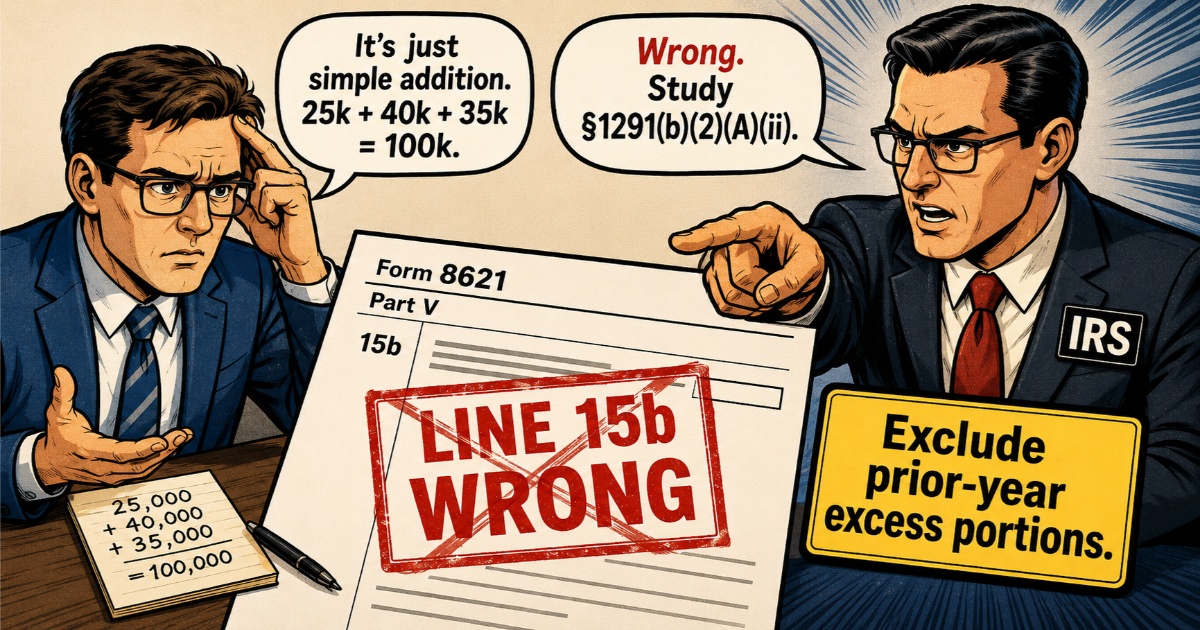
- Not a Raw Cash Sum: Line 15b is the permitted prior-year base, which must be reduced by prior excess distributions that were not included in income under IRC §1291(b)(2)(A)(ii).
- Lot-Level Base Controls: Base calculations are strictly lot-by-lot based on applicable stock block holding histories, rather than account-level aggregate totals.
- The Divisor Denominator: The Line 15c average calculation divides Line 15b by 3, or the shorter number of preceding years in the taxpayer's actual holding period.
- Critical Gateway Function: Understating Line 15b falsely inflates current excess distributions, while overstating it can run foul of the small-PFIC reporting exception limits.
Official Rule for Form 8621 Line 15b
Line 15b does not ask for the taxpayer's prior-year cash receipts. Form 8621 asks for distributions made by the fund with respect to the applicable stock, with this required reduction:
- IRS Form 8621, Line 15b, Rev. December 2025
IRC §1291(b)(2)(A)(ii) states the same control rule for a prior excess distribution:
So Line 15b is not completed by adding prior-year cash. The preparer must determine what the fund distributed with respect to the applicable stock, then exclude any prior excess-distribution amount the statute does not allow back into the base.
Why Line 15b Determines More Than the Tax Calculation
Line 15b determines the base used to test whether a current-year PFIC distribution is an excess distribution under Form 8621 Line 15e. If Line 15b is wrong, the result is not limited to a wrong tax calculation: the taxpayer may also reach the wrong conclusion on whether the small-PFIC Part I annual-reporting exception is available.
| Form 8621 Line | Role |
|---|---|
| 15a | Current-year distribution being tested |
| 15b | Permitted prior-year distribution base |
| 15c | Average derived from Line 15b |
| 15d | 125% threshold |
| 15e(1) | Determines whether, and how much of, the current-year distribution is excessive |
| 16 | Applies §1291 tax-and-interest treatment if an excess distribution exists |
Why the Line 15b Result Matters
| If Line 15b Is... | Calculation Result | Small-PFIC Exception Impact |
|---|---|---|
| Overstated | The 125% threshold is too high; an excess distribution may be understated or missed | The return may incorrectly claim the US$25,000 / US$50,000 Part I exception |
| Understated | The 125% threshold is too low; an excess distribution may be overstated | The taxpayer may unnecessarily lose the Part I exception and compute §1291 tax and interest |
Line 15b is the gatekeeper. It controls whether the distribution crosses into §1291 excess-distribution treatment and whether a small section 1291 holding can still use the Part I reporting exception.
Worked Example: Calculating Line 15b in the Fourth Year
This simplified example uses one PFIC lot acquired on January 1, 2022, held continuously through 2025. The fund makes one distribution each year on December 31. No QEF or mark-to-market election applies.
| Year | Distribution | 15e(1) | 15b Base |
|---|---|---|---|
| 2022 | $100.00 | $0.00 | $100.00 |
| 2023 | $1,000.00 | $875.00 | $562.50 |
| 2024 | $100.00 | $0.00 | $100.00 |
| 2025 | $500.00 | To be calculated | To be calculated |
For 2023, the excess distribution is:
Because this simplified example contains 365 holding days in 2022 and 365 holding days in 2023 through the distribution date, one-half of the $875.00 excess distribution is allocated to 2023 and included in income under §1291(a)(1)(B).
2025 Calculation: Correct vs. Raw-Cash Method
| Method | 2025 Line 15b | Line 15c | Line 15d | 2025 Line 15e(1) |
|---|---|---|---|---|
| Correct §1291 method | $762.50 | $254.17 | $317.71 | $182.29 |
| Incorrect raw-cash method | $1,200.00 | $400.00 | $500.00 | $0.00 |
Result
The correct 2025 Line 15b is:
Using raw cash distributions would incorrectly eliminate the $182.29 excess distribution in 2025. Line 15b therefore controls both the §1291 calculation and whether an excess distribution blocks the small-PFIC Part I reporting exception. Read our dedicated article on Why Form 8621 Line 15e is Not Equal to Line 15a minus Line 15d to see how this affects your reporting.
For a detailed breakdown of the math, refer to the full §1291 excess distribution calculation walkthrough. To see Line 15b feed the 125% test in a real distribution case, use the PFIC dividend example. Note that certain pensions like Australian Super fund distributions that trigger Line 15b require special attention under these rules.
Form 8621 requires prior excess distributions to enter the Line 15b base only to the extent included in gross income under §1291(a)(1)(B).
Line 15b Is Computed by Applicable Stock, Not Account Total
A brokerage statement may show one PFIC position. Form 8621 Part V can require separate calculations for blocks of shares with different holding periods.
| Data Problem | Line 15b Impact |
|---|---|
| Monthly purchases of the same PFIC | Different lots may have different holding-period histories |
| Reinvested distributions | Additional blocks may require separate tracking |
| Partial redemptions or switches | Disposed blocks must be identified |
| Account-level annual dividend total only | Insufficient to reconstruct applicable-stock calculations |
For CPA and EA review, the minimum workpaper should preserve the PFIC identifier, applicable stock or lot group, acquisition date, distribution currency, prior-year distribution history, prior excess-distribution split, Line 15b permitted base, Line 15c denominator, Line 15d threshold, and Line 15e excess-distribution result.
CPA / EA Quick Error Check for Line 15b
For an applicable-stock block held as PFIC stock throughout the relevant prior holding period, compare current-year Line 15b with the total of Lines 15a from the preceding three years, or the shorter prior holding period.
Related §1291 Guides
Form 8621 Line 15b FAQ
Do I complete Line 15b during the first tax year I acquire PFIC stock?
Generally no. If the holding period began in the current tax year, there is no excess distribution under this test. Enter current-year distributions on Line 15a; if no disposition occurred, stop completing Part V. If stock was disposed of, skip Lines 15b through 15e and complete Line 15f and the supporting Line 16a throwback statement.
Does Line 15c always divide Line 15b by three?
No. If the number of preceding tax years in the shareholder's holding period is less than three, divide Line 15b by that number instead.
What record proves the allowed Line 15b amount after a prior excess distribution?
The prior Form 8621 and attached §1291 computation should show the split between the portion included in income under §1291(a)(1)(B) and the portion not included in income under that rule. A brokerage cash ledger alone may be insufficient.
What if I received more than one PFIC distribution during the current year?
The current-year excess distribution is apportioned among all actual distributions, and each apportioned amount is treated as a separate excess distribution.
Can software calculate Line 15b from a single distribution total?
Only if it already contains the required prior-year §1291 split and applicable-stock history. Without those inputs, software may calculate from the wrong base.

Official Sources Used
This guide applies the current IRS Form 8621 Part V structure and the §1291 excess-distribution rules. Line 15b calculations must be tested by applicable stock and supported by prior distribution workpapers.
| Issue | Official Source |
|---|---|
| Current Line 15b-15f form fields | IRS - Form 8621, Rev. December 2025 |
| Line 15a first-year rule, Line 15c divisor, multiple-distribution treatment and Line 16 mechanics | IRS - Instructions for Form 8621, Rev. December 2025 |
| Statutory prior-excess-distribution filter | IRC §1291(b)(2)(A)(ii) |
Content reflects Form 8621 (Rev. 12/2025), applicable Treasury Regulations, IRS guidance, and other authorities cited on this page.