
U.S. citizens, Green Card holders, and U.S. tax residents living in Canada face a unique tax dilemma: Canadian financial institutions heavily market local products (like TFSA robo-portfolios, Canadian mutual funds, and TSX-listed ETFs) that trigger punitive U.S. Passive Foreign Investment Company (PFIC) rules under IRC §§1291–1298.
The Cross-Border Tax Architecture Matrix
The table below illustrates how different asset types interact with each Canadian account structure from both a Canada (CRA) and U.S. (IRS) tax perspective:
| Account & Asset Combination | U.S. Tax & 8621 Status | Cross-Border Strategy & Action |
|---|---|---|
| RRSP / RRIF / LIRA Canadian/U.S. ETFs, Funds, Stocks |
Exempt · No 8621
Treaty Art. XVIII(7) Deferral
|
Optimal: Complete tax deferral. You can freely hold Canadian ETFs or funds with zero annual Form 8621 reporting. |
| Taxable (U.S. ETFs) Direct VOO, VTI, VXUS, VT |
Not a PFIC (U.S.-domiciled)
Form 1040 Schedule B / D
|
Recommended: Standard U.S. capital gains rates. Claim Canadian Foreign Tax Credits (FTC) on Form 1116 without PFIC drag. |
| Taxable (Direct Stocks) Operating Equities (RY, TD, ENB) |
Issuer test required
Active Business Exception
|
Direct shares avoid a pooled-fund wrapper, but each foreign issuer still requires a PFIC test. Foreign tax credits remain subject to the normal limits. |
| Taxable (Canadian ETFs) VFV, XIC, ZSP with AIS |
PFIC (QEF Eligible)
Check annual Form 8621 triggers
|
Moderate: Tax-efficient only if timely QEF election is made in Year 1 using fund AIS. Requires annual Form 8621 prep. |
| TFSA / FHSA (Cash/GICs) HISA, Term Deposits, TSX Stocks |
Depends on asset
Form 1040 Schedule B
|
Cash and GIC interest is generally outside PFIC rules. Direct foreign shares remain issuer-specific; a foreign tax credit may apply when qualifying Canadian tax was paid. |
| TFSA / FHSA (Canadian ETFs) VFV, XEQT, Bank Mutual Funds |
Severe PFIC Trap
Form 8621 + $0 FTC Relief
|
Avoid: Zero treaty shield plus $0 Canadian tax to credit against U.S. tax. Unwind funds into RRSP or direct U.S. ETFs. |
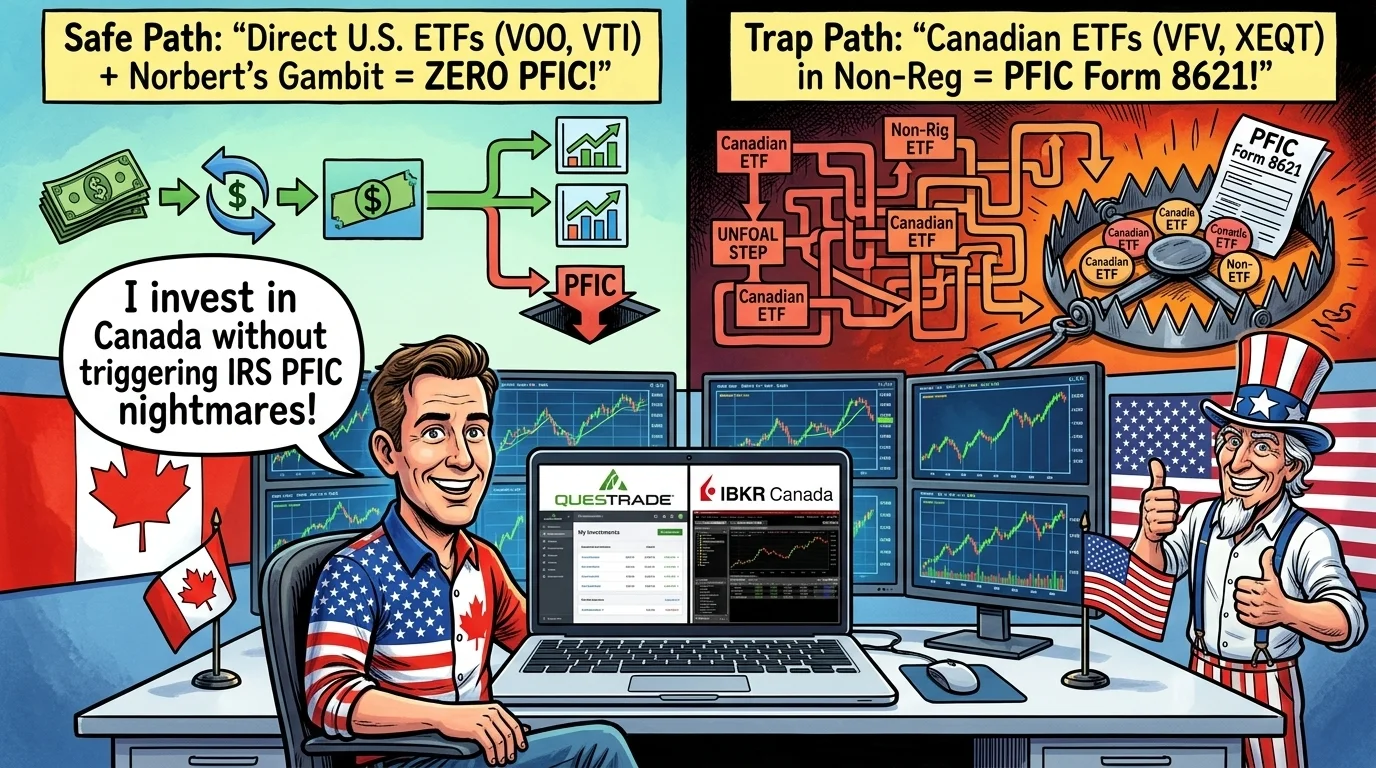
Holding U.S.-Domiciled ETFs in Canadian Brokerages
The most powerful strategy for U.S. taxpayers in Canada is to hold U.S.-domiciled ETFs (such as Vanguard's VOO, VTI, BND, or BlackRock's IVV, ITOT) directly within Canadian brokerage accounts:
Brokerage Compatibility
Major Canadian self-directed brokerages—including Interactive Brokers Canada, Questrade, TD Direct Investing, and RBC Direct Investing—allow investors to hold dual-currency CAD/USD sub-accounts and trade U.S. exchanges directly.
Foreign Exchange & Norbert's Gambit
To avoid retail bank FX markups (1.5%–2.5%), investors use Norbert's Gambit (via DLR/DLR.U) or Interactive Brokers' spot FX conversion to change CAD into USD at institutional rates before buying U.S. ETFs.
When Canadian ETFs with QEF AIS Make Sense
Holding Canadian-domiciled ETFs in taxable accounts is often viewed as a disaster, but this is a common misconception. When a Canadian fund issuer publishes an official PFIC Annual Information Statement (AIS), electing Qualified Electing Fund (QEF) status transforms the tax profile:
A pervasive myth among cross-border investors is that Canadian ETFs automatically trigger confiscatory 50%+ tax rates. In reality, our empirical multi-year financial modeling shows that a pedigreed QEF election eliminates all §1291 excess distribution interest penalties and preserves preferential U.S. long-term capital gains rates (15% / 20%).
Under QEF mechanics, fund ordinary earnings and net capital gains flow through annually to your Form 1040, and your Canadian tax basis increases by the amount taxed, preventing double taxation upon eventual sale. As a result, the net after-tax return of holding a Canadian ETF (like Vanguard VFV) with a QEF election is virtually indistinguishable from holding a direct U.S. ETF (like VOO).
- Automated Pre-Authorized Contributions (PAPs): If you want to contribute small monthly CAD amounts from your Canadian payroll directly into an ETF without constantly executing currency conversions, Canadian ETFs (like VFV or XEQT) provide operational simplicity.
- The QEF Requirement: If you choose QEF treatment and a valid AIS is available, a timely first-year election generally avoids creating an unpedigreed QEF history on Form 8621 Part III. This avoids default §1291 interest and taxes fund growth at standard U.S. long-term capital gain rates.
- The Cost Trade-Off: You must weigh the annual cost of preparing Form 8621 workpapers ($200–$500 per form) against the convenience of keeping CAD-denominated funds.
The Direct Canadian Stocks Strategy
Holding individual shares of Canadian operating corporations (such as Royal Bank of Canada, TD Bank, Canadian National Railway, or Enbridge) on the Toronto Stock Exchange (TSX) provides a clean alternative:
- Operating Company Classification: Operating businesses that earn active commercial revenue are excluded from PFIC classification under the 75% income and 50% asset tests of IRC §1297.
- Foreign Tax Credit (FTC) Flow-Through: Canadian non-resident withholding taxes or Canadian taxes paid on dividend income can be claimed on U.S. Form 1116 to prevent double taxation.
- Zero Form 8621 Filings: Individual stocks require only standard Schedule B (Dividends) and Schedule D (Capital Gains) reporting on Form 1040.
Frequently Asked Questions
What is the simplest way for a U.S. citizen in Canada to invest without PFIC complications?
The cleanest cross-border architecture is to hold U.S.-domiciled ETFs (such as VOO, VTI, VXUS, or BND) in Canadian non-registered brokerage accounts. Because U.S.-domiciled funds are domestic entities under IRC §7701, they are completely immune to PFIC classification and Form 8621.
Does holding a U.S.-domiciled ETF in a Canadian brokerage account make it a PFIC?
No. Under IRC §1297, PFIC classification is determined strictly by the legal entity and country of domicile of the fund itself, not where your brokerage account is located. A U.S.-domiciled Vanguard ETF (VOO) held in a Questrade or TD Direct account remains a 100% domestic U.S. asset.
Should a U.S. citizen living in Canada completely avoid opening a TFSA?
Not necessarily, but it requires careful asset selection. Because TFSA earnings are taxable in the U.S. on Form 1040, holding Canadian mutual funds or ETFs inside a TFSA triggers annual Form 8621 requirements. Holding simple high-interest bank cash, GICs, or individual direct stocks inside a TFSA avoids PFIC complications while preserving Canadian tax-free growth.
Official Sources & Technical References
- IRS: Instructions for Form 8621 (Information Return by a Shareholder of a PFIC).
- Cornell Law (LII): 26 U.S. Code § 1297 — Passive Foreign Investment Company Defined.
- Cornell Law (LII): Treas. Reg. § 1.1298-1(c)(4) — Treaty Pension Exception.
- IRS: Rev. Proc. 2014-55 — Procedures for RRSP/RRIF Treaty Tax Deferral.