
Every year, thousands of Canadian professionals, dual citizens, and cross-border families move to the United States on work visas (TN, H-1B, L-1, O-1) or as new Green Card holders. In doing so, they run headfirst into one of the most perilous traps in international tax: the collision between the CRA Departure Tax and the U.S. PFIC regime.
Under Section 128.1 of Canada's Income Tax Act, departing residents are deemed to have sold all non-registered capital assets at fair market value (FMV) on the day they emigrate. However, because the U.S. Internal Revenue Code does not automatically step up asset basis upon establishing tax residency, immigrants risk paying Canadian departure tax on unrealized gains, followed later by full U.S. capital gains tax and Section 1291 PFIC interest on the exact same historical growth.
How CRA Departure Tax Works (Forms T1243 & T1161)
When you cease to be a Canadian resident for tax purposes:
- Deemed Disposition: You are deemed to have disposed of all taxable property (stocks, ETFs, mutual funds, corporate shares, foreign real estate) at FMV immediately before departure.
- CRA Form T1243: Used to compute deemed capital gains and calculate Canadian departure tax.
- CRA Form T1161: Mandatory list of properties owned if total aggregate fair market value exceeds $25,000 CAD.
- Excluded Assets: Canadian real estate, Canadian pensions, and registered plans (RRSPs, RRIFs, RESPs, TFSAs) are exempt from CRA deemed disposition, though TFSAs lose all cross-border tax utility.
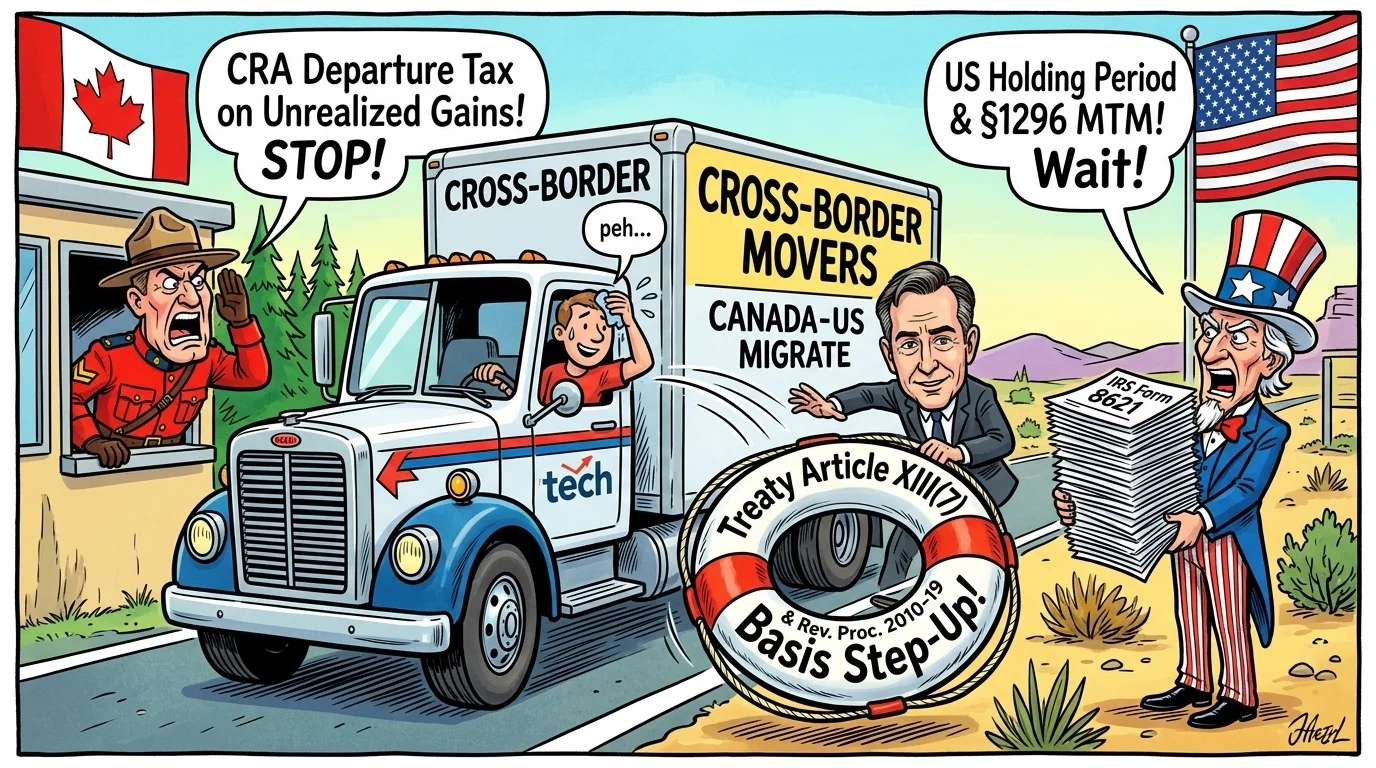
Treaty Article XIII(7) Election: Coordinating Canadian Departure Tax and U.S. Basis on Form 8833
To prevent the same capital gain from being taxed twice, Article XIII(7) of the Canada-U.S. Income Tax Treaty (enacted under the Fifth Protocol and governed by IRS Rev. Proc. 2010-19) allows an individual emigrating from Canada to elect a deemed disposition and reacquisition for U.S. federal tax purposes:
- File Form 8833 with First U.S. Return: Attach IRS Form 8833 (Treaty-Based Return Position Disclosure) to your first U.S. income tax return (Form 1040 or Form 1040-NR dual-status).
- Cite Rev. Proc. 2010-19: Disclose the exact departure date, Canadian deemed sale proceeds, and adjusted U.S. cost basis equal to the departure-date FMV in USD.
- Reset U.S. Tax Basis: Your new U.S. tax basis becomes the FMV on the date of departure, providing a stepped-up U.S. basis equal to fair market value on the departure date for eligible properties.
Pre-U.S.-Person PFIC Holding Periods & IRC §1296(l) MTM Transition
If you enter the U.S. tax system still holding Canadian ETFs without executing an Article XIII(7) treaty election, two distinct statutory rules govern your historical holding period and basis:
Treas. Reg. § 1.1291-9(j)(1) (Holding Period Rule)
Under Treas. Reg. § 1.1291-9(j)(1), a foreign corporation is not treated as a PFIC with respect to a shareholder for any days in the shareholder's holding period before the shareholder became a U.S. person. This rule restricts §1291 excess distribution throwback allocations to your post-arrival days, but does not provide an automatic general FMV basis step-up.
IRC §1296(l) (Mark-to-Market Basis Transition Rule)
If you make a Mark-to-Market election under §1296 in your first taxable year as a U.S. person, IRC §1296(l) provides that solely for purposes of Section 1296, your adjusted basis in marketable PFIC stock held on the first day of such taxable year (typically January 1) is treated as the greater of fair market value or adjusted basis on that first day. This statutory reset shields pre-immigration capital appreciation from being taxed as MTM ordinary income.
Pre-Immigration PFIC Cleansing vs. Holding Canadian ETFs
Even with an Article XIII(7) basis step-up, continuing to hold Canadian ETFs (like VFV, XEQT, or bank funds) after becoming a U.S. resident forces you into annual Form 8621 filings and ongoing QEF tracking. The table below outlines the optimal pre-move strategy for each Canadian account type:
| Canadian Account Type | U.S. Tax Status After Move | Pre-Move Recommended Action |
|---|---|---|
| Taxable Brokerage (Canadian ETFs) | Full PFIC exposure (Form 8621 annually) | Liquidate Before Moving: Sell all Canadian ETFs/funds before departure. Reinvest in direct U.S. ETFs (VOO/VTI) after arrival. |
| TFSA (Tax-Free Savings) | Tax-free status abolished; fully taxable | Liquidate & Close 100%: Withdraw all funds tax-free in Canada prior to establishing U.S. tax residency. |
| FHSA (First Home Savings) | Unrecognized; taxable growth + trust debate | Withdraw or Transfer to RRSP: Close or roll over into an RRSP before becoming a U.S. tax resident. |
| RRSP / RRIF (Retirement) | Shielded under Treaty Article XVIII; exempt from 8621 | Keep Open: No liquidation necessary. Safe to leave invested in Canadian or U.S. assets. |
The 6-Month Cross-Border Departure Checklist
Follow this chronological roadmap prior to your physical relocation date:
- 60 Days Pre-Move: Audit all brokerage accounts. Sell all Canadian-domiciled mutual funds, robo-advisor holdings, and ETFs held outside of RRSPs.
- 30 Days Pre-Move: Empty and close your TFSA and FHSA. Transfer cash to a Canadian bank account or use Norbert's Gambit to convert CAD to USD.
- Departure Day: Document official closing market values (FMV) for all remaining capital property, Canadian real estate, and pension balances for CRA Form T1243.
- First Filing Season: File your final part-year Canadian T1 return (with Forms T1243 & T1161) and your first U.S. dual-status return with Form 8833 attached.
Frequently Asked Questions
Should I close my Canadian TFSA before moving to the United States?
Yes, absolutely. The IRS does not recognize the tax-exempt status of a TFSA. Once you become a U.S. tax resident, all income inside the TFSA is taxable on Form 1040, and Canadian ETFs trigger annual Form 8621 filings. Because withdrawals in Canada are completely tax-free, liquidating the TFSA prior to departure eliminates all future U.S. compliance risk with zero Canadian tax cost.
Does Article XIII(7) apply to Canadian real estate?
No. Article XIII(7) applies only to property that is subject to deemed disposition under CRA Section 128.1. Because Canadian real property (taxable Canadian property) is not subject to deemed disposition upon emigration, its historical U.S. cost basis remains unchanged.
Do I have to collapse my RRSP before moving to the United States?
No. Under Article XVIII of the Canada-U.S. Income Tax Treaty and Rev. Proc. 2014-55, RRSPs and RRIFs enjoy automatic tax deferral in the U.S. Furthermore, Treas. Reg. §1.1298-1(c)(4) exempts Canadian registered retirement plans from annual Form 8621 filing.
What is a Dual-Status tax year, and when does PFIC reporting begin?
In your year of relocation, you are generally a nonresident alien for the part of the year before arrival and a resident alien for the remainder (a dual-status year). PFIC reporting obligations under IRC §1298 begin on the exact day you establish U.S. tax residency under the Substantial Presence Test or Green Card test.
Official Authorities & Technical References
- IRS: Rev. Proc. 2010-19 — Guidance for Making Elections Under Article XIII(7) of the U.S.-Canada Income Tax Treaty.
- Canada Revenue Agency (CRA): Emigrants and Departure Tax (Section 128.1, Form T1243 & Form T1161).
- IRS: About Form 8833: Treaty-Based Return Position Disclosure.
- IRS: Instructions for Form 8621 (Rev. 12/2025).