
Simplest for U.S. tax → Restricted by EU retail PRIIPs rules.
The Spain–U.S. Investment Map
PFIC status is determined under IRC §1297. A foreign corporation is a PFIC if it satisfies either the 75% passive-income test or the 50% passive-asset test. The table below maps common investment vehicles available in Spain against U.S. tax consequences:
| Investment | Spain / EU Access | U.S. PFIC Risk | Key Issue |
|---|---|---|---|
| Spanish mutual or index fund | Easy | High PFIC | Foreign pooled fund; Form 8621 analysis required. |
| MyInvestor index fund portfolio | Easy if account accepted | High PFIC | Platform does not change fund foreign domicile. |
| Indexa Capital fund portfolio | U.S. persons currently not accepted | High if held | Underlying European investment funds trigger PFIC rules. |
| Irish / Luxembourg UCITS ETF | Easy for EU retail investors | High PFIC | PRIIPs-friendly, but foreign corporation for U.S. PFIC regime. |
| U.S.-domiciled ETF (VOO / VTI) | Often restricted for EU retail purchase | No PFIC | PRIIPs / KID access roadblock for EU retail accounts. |
| Direct U.S. stocks | Generally accessible | No PFIC | Ordinary capital gains and dividend reporting on Schedule D/B. |
| Direct foreign operating stocks | Generally accessible | Usually Not PFIC | §1297 applies to foreign corporations generally; test unusual holding companies. |
| Bank deposit / cash account | Easy | No PFIC | FBAR, Form 8938, and Spanish Modelo 720 reporting may apply. |
| Spanish pension / insurance (PIAS) | Product-specific | Classification First | Pension, foreign trust, insurance, and underlying-fund analysis required. |
1. Why Americans in Spain Get Caught Between PFIC and PRIIPs
Suppose a Spanish resident wants a simple global index portfolio.
A domestic Spanish investor typically selects low-cost index mutual funds through MyInvestor, Indexa Capital, or buys an Irish-domiciled UCITS ETF (such as Vanguard VWCE or iShares IWDA). For a U.S. taxpayer, however, a non-U.S. mutual fund or ETF falls squarely into the PFIC regime.
The obvious U.S. tax alternative is a U.S.-domiciled ETF such as VOO or VTI. Then the European Union regulatory framework intervenes:
- EU PRIIPs Regulation: Under the Packaged Retail and Insurance-based Investment Products (PRIIPs) framework, financial intermediaries cannot sell investment products to EEA retail investors without providing a standardized European Key Information Document (KID).
- U.S. ETF Stance: Most U.S.-domiciled ETFs do not publish European KIDs because they are governed by U.S. SEC regulations.
- Broker Execution: Major platforms—including MyInvestor and Interactive Brokers—restrict EEA retail accounts from buying U.S. ETFs lacking compliant KIDs.
The Result: EU fund → accessible, but PFIC. U.S. fund → U.S.-tax friendly, but retail purchase is blocked by PRIIPs. PRIIPs does not turn a U.S. ETF into a PFIC, and PFIC rules do not legally prohibit owning European funds; they are separate regulatory barriers creating cross-border friction from opposite sides.
2. DEGIRO, MyInvestor, Indexa and IBKR: The Platform Does Not Solve PFIC
A major source of confusion is treating the brokerage platform as if it determines U.S. tax classification. The platform only determines account eligibility; U.S. tax classification depends on the assets held inside:
- DEGIRO: DEGIRO's Spanish eligibility rules explicitly state that they cannot accept clients who are considered U.S. persons under IRS rules. An accidental American born in Spain who has never lived in the U.S. can face account rejection or closure.
- Indexa Capital: Indexa is similarly explicit: its public documentation confirms it does not open fund or pension accounts for clients with U.S. nationality or U.S.-person status due to U.S. regulatory and FATCA restrictions.
- MyInvestor: MyInvestor reports client positions to the Spanish Tax Agency (AEAT) and acknowledges PRIIPs restrictions on U.S. ETFs. While it does not publish an automatic blanket prohibition against all U.S. persons, holding European or Spanish index funds through MyInvestor still triggers individual PFIC reporting for every fund position.
- Interactive Brokers (IBKR): IBKR accommodates U.S. citizens resident in Spain, but opening an IBKR account does not override EU PRIIPs. Spain-resident retail accounts remain blocked from buying U.S. ETFs without a KID, though they can freely trade direct U.S. equities, European operating stocks, and bonds.
Key Distinction: Broker eligibility ≠ Product eligibility ≠ U.S. tax treatment.
3. MyInvestor Index Funds: The Spanish Tax Advantage Can Become a U.S. PFIC Problem
Spanish investing forums frequently recommend traditional index mutual funds (from Vanguard, Amundi, or iShares) over ETFs.
Under Spain's special fund-transfer regime (régimen de traspasos), an investor can transfer capital from one qualifying fund to another without recognizing capital gains tax for Spanish IRPF purposes. The new fund carries forward the original acquisition cost basis and acquisition date.
While rebalancing across equity and bond index funds without Spanish tax friction is advantageous under domestic law, the Spanish tax benefit provides zero relief under IRC §§1291–1298. For a U.S. taxpayer, each fund remains a separate PFIC holding.
4. The Traspaso Trap: One Transaction, Two Tax Timelines
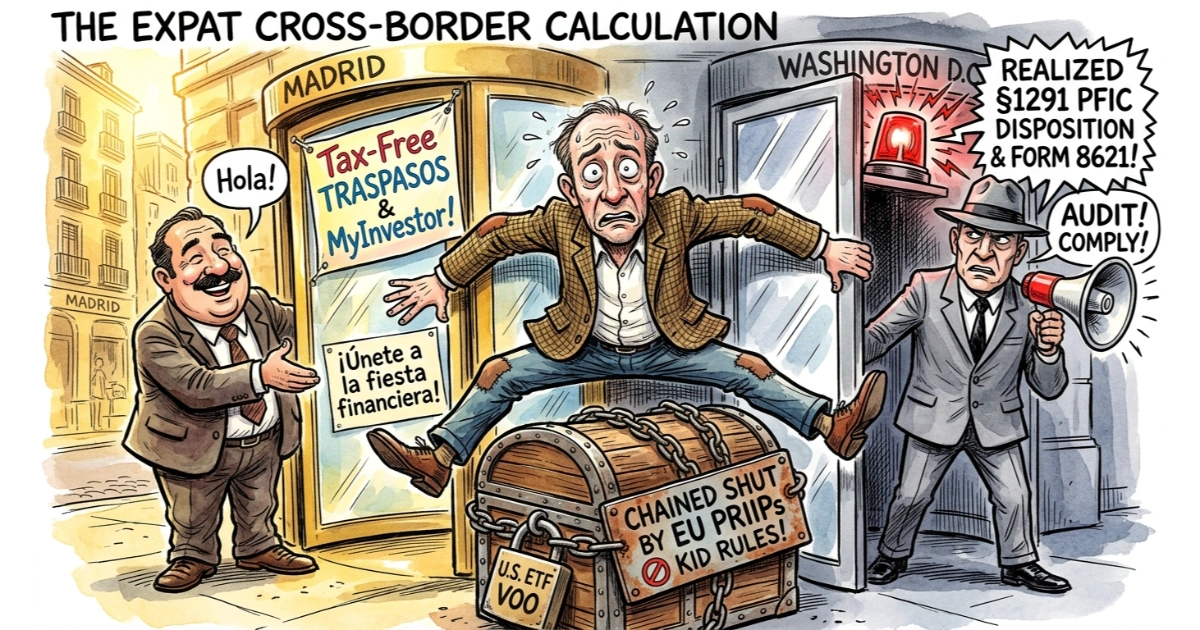
Consider a U.S. citizen resident in Spain who invests €40,000 in Spanish Fund A. Years later, the position grows to €55,000, and she executes a Spanish traspaso into Fund B:
| Event | Spain (AEAT / IRPF) | United States (IRS / IRC) |
|---|---|---|
| Buy Fund A for €40,000 | Cost basis begins at €40,000 | PFIC holding period and USD cost basis begin |
| Fund A grows to €55,000 | No tax on unrealized appreciation | PFIC rules continue to accrue throwback time |
| Traspaso: Fund A → Fund B | Tax-deferred: Gain of €15,000 is not recognized | Taxable disposition: IRC §1291 excess distribution throwback on €15,000 gain |
| Fund B Acquired | Original basis (€40,000) and date carry over | New PFIC holding begins with fresh basis and holding period |
| Fund B Eventually Sold | Spain taxes entire accumulated gain | U.S. taxes only gain accrued during Fund B holding period |
The Timing Mismatch: The U.S. taxes the disposition in Year 3 under §1291, but Spain taxes the gain in Year 8 upon final redemption. Because U.S. Foreign Tax Credits (Form 1116) are generally tied to the year foreign tax is paid or accrued, a Spanish tax payment years later cannot easily offset earlier U.S. PFIC throwback interest charges.
Note on ETFs: Spain's traspaso deferral regime does not apply to listed ETFs (including foreign-listed ETFs since January 1, 2022). Selling an ETF in Spain triggers immediate Spanish tax and U.S. PFIC disposition rules simultaneously.
5. UCITS ETFs: Solving PRIIPs Does Not Solve PFIC
An Ireland- or Luxembourg-domiciled UCITS ETF (such as Vanguard VWCE or iShares CSPX) satisfies EU PRIIPs, is easily purchased on European exchanges, and offers low expense ratios.
However, European fund regulation has no bearing on U.S. tax status. A foreign-domiciled UCITS ETF is a foreign corporation under IRC §1297. Furthermore, accumulating (acc) UCITS ETFs are not safer than distributing (dist) ETFs: accumulation eliminates dividend cash payouts but does not prevent §1291 excess distribution taxation upon eventual sale. (See our detailed guide on Irish UCITS ETFs & Form 8621).
6. “I Only Have $15,000 of UCITS ETFs”—What the $25,000 Exception Really Means
Under Treas. Reg. §1.1298-1(c)(2), an individual shareholder is exempt from filing Form 8621 Part I for a specific Section 1291 fund if:
- The total aggregate value of all direct PFIC holdings across all foreign accounts is $25,000 or less ($50,000 for married filing jointly) on the last day of the tax year; and
- The taxpayer received no excess distributions and recognized no disposition gain on that PFIC during the tax year.
Critical Caution: This is an annual reporting threshold, not a tax exemption. The fund remains a PFIC. If you sell the fund or execute a traspaso, the exception vanishes, and full Section 1291 calculations become mandatory.
7. §1291, QEF or Mark-to-Market: What Is Realistic for a Spanish Fund?
- Default Section 1291: Without a timely election, Spanish funds default to Section 1291. Gains on sale are thrown back across all holding days, taxed at top marginal rates, and subjected to compounding IRC §6621 interest.
- QEF Election (IRC §1295): Legally invalid unless the fund provides a certified PFIC Annual Information Statement (AIS). Unlike Canadian fund managers, Spanish AMCs and European UCITS issuers do not publish AIS statements.
- Section 1296 Mark-to-Market: Exchange-listed UCITS ETFs may qualify as marketable stock under Treas. Reg. §1.1296-2 if trading volume criteria are met. Traditional Spanish unlisted mutual funds require careful factual review before attempting MTM. (Learn more in our guide on §1291 vs. Mark-to-Market Tax Consequences).
8. Accidental American in Spain: Already Own MyInvestor or European Funds?
If you discovered your U.S. citizenship obligations after years of investing in Spain, follow this step-by-step remediation workflow:
- Step 1 — Identify Every Pooled Holding: Collect legal fund names, ISINs, transaction dates, units, euro costs, and every fund-to-fund traspaso.
- Step 2 — Identify First Relevant Tax Year: Establish when U.S. tax residency or citizenship began.
- Step 3 — Separate Each Position: Six funds represent six distinct PFIC calculations; do not blend holdings.
- Step 4 — Test Filing Exceptions: Verify whether aggregate values remained under $25,000 / $50,000 for non-disposition years.
- Step 5 — Reconstruct Dispositions: A typical redemption and subscription is a U.S. disposition. Review mergers, share-class conversions and in-kind events by their legal form.
- Step 6 — Evaluate Remediation: Unfiled back years can often be cured under IRS Streamlined Procedures (see our Streamlined Form 8621 Filing Guide).
Reconstruct multi-year Spanish fund lots, fund-to-fund traspaso dispositions, and IRS §1291 throwback interest workpapers using our standard calculation engine.
Calculate Form 8621 Workpapers →9. What Can a U.S. Taxpayer Hold in Spain Without Automatically Creating a PFIC?
- Direct U.S. Equities & U.S. ETFs: Held through expat-friendly brokers. Direct U.S. corporate shares and U.S.-domiciled ETFs are never PFICs.
- Direct Foreign Operating Company Stocks: Shares of active operating businesses (e.g., Santander, Inditex, Iberdrola) are generally outside the fund PFIC trap.
- Cash and Bank Deposits: Spanish bank accounts (BBVA, Santander, CaixaBank) are not PFICs (reportable on FBAR and Form 8938 if thresholds are met).
- Direct Bonds: Sovereign and corporate debt securities are not PFIC stock.
- Spanish Pensions & PIAS: Requires classification under foreign pension, insurance, and trust rules before determining Form 8621 exposure.
10. Moving to Spain With an Existing U.S. Brokerage Account
Existing U.S. ETFs (VOO, VTI) do not become PFICs upon moving to Spain. However:
- Broker Restrictions: Many U.S. retail brokers (Schwab, Fidelity, Vanguard) restrict accounts or freeze new ETF purchases once a Spanish residential address is declared.
- Spanish Worldwide Taxation: Spain taxes Spanish tax residents on worldwide income and realized capital gains.
11. Modelo 720: Avoiding PFIC Does Not Mean Avoiding Spanish Reporting
Holding U.S. brokerage accounts avoids PFIC rules but triggers Spain's Modelo 720 (Declaration of Assets Abroad) if foreign financial accounts or foreign securities exceed €50,000 in aggregate. Spanish domestic platforms (like MyInvestor) report directly to AEAT, whereas foreign brokerage accounts require manual Spanish reporting.
12. Why an American in Spain Needs Two Sets of Investment Records
A single investment trade in Spain requires independent calculations:
- U.S. IRS Workpapers: Denominated in USD, historical spot rates on purchase dates, lot-by-lot tracking, Section 1291 holding periods, and traspaso realization events.
- Spanish AEAT Workpapers: Denominated in EUR, average cost basis where permitted, deferred traspaso carrying values, and Spanish IRPF tax brackets.
A Practical Decision Tree for a U.S. Person in Spain
1. Do you already own Spanish funds or UCITS ETFs?
→ Identify ISINs → Reconstruct acquisition lots and traspasos → Test §1298(f) $25,000 threshold → Prepare §1291 workpapers before liquidating.
2. Considering new investments in Spain?
→ Prioritize direct operating equities or U.S.-domiciled investments where accessible → Avoid un-hedged European retail mutual funds without compliant AIS data.
3. Using foreign accounts while resident in Spain?
→ Track Modelo 720 foreign asset thresholds (€50,000) alongside IRS FBAR and Form 8938 requirements.
Frequently Asked Questions
Can a U.S. citizen use DEGIRO in Spain?
DEGIRO currently states that it cannot offer brokerage services to a person considered a U.S. person under IRS rules.
Can a U.S. citizen use MyInvestor?
Do not assume either automatic acceptance or automatic rejection. Confirm current eligibility directly with MyInvestor based on your U.S. citizenship and Spanish tax residence. Separately, any non-U.S. mutual funds held through MyInvestor still require PFIC analysis.
Does Indexa Capital accept U.S. citizens?
Indexa currently states that it does not open fund accounts to U.S. persons.
Can I buy VOO or VTI through Interactive Brokers while living in Spain?
Account access and product access are separate questions. An EEA retail client can be restricted from purchasing a U.S. ETF when the product does not provide the KID required under PRIIPs.
Does a Spanish traspaso avoid U.S. tax?
Not automatically. The Spanish traspaso regime is a Spanish domestic tax-deferral rule. A redemption or exchange must separately be analyzed under U.S. tax law and the PFIC rules.
Are ETFs eligible for Spain's traspaso tax deferral?
Generally not under the current rules. AEAT specifically excludes listed investment funds/ETFs from the ordinary traspaso regime, including analogous foreign-listed ETFs from January 1, 2022, subject to statutory transitional rules.
If my PFICs are worth less than $25,000, can I ignore Form 8621?
No blanket rule says that. There is a limited annual reporting exception under Treas. Reg. §1.1298-1(c)(2) for certain Section 1291 holdings when aggregate-value and zero-disposition conditions are satisfied. It does not convert the investment into a non-PFIC.
Are individual Spanish stocks PFICs?
Not merely because they are Spanish. PFIC status depends on whether the foreign corporation satisfies the statutory 75% income or 50% asset test. Ordinary active operating companies (like Inditex or Santander) commonly avoid PFIC status, but issuer-level facts control.
Explore related technical resources: Do I Need to File Form 8621? · §1291 vs. MTM Guide · Global PFIC Directory.