
In the Canadian DIY investing world, four exchange-traded funds represent the core building blocks of millions of portfolios: Vanguard S&P 500 Index ETF (VFV), iShares Core Equity ETF Portfolio (XEQT), Vanguard All-Equity ETF Portfolio (VEQT), and Vanguard Growth ETF Portfolio (VGRO).
Canadian ETFs commonly require PFIC review, but TSX listing alone does not determine PFIC status. Apply the §1297 income and asset tests to the issuer for the relevant year, then check the Form 8621 filing triggers and exceptions.
The VFV Paradox: Why U.S. Stocks in a Canadian Wrapper Equal a PFIC
One of the most common confusions among cross-border investors is: "VFV holds 100% U.S. companies like Apple, Microsoft, and Nvidia. How can it be a Foreign Investment Company?"
Under IRC §1297, the IRS classifies PFICs based on the legal jurisdiction of the issuing trust, not the geographic location of the underlying securities. Because VFV is established as an unincorporated Canadian mutual fund trust domiciled in Ontario:
- It is a foreign corporation for U.S. federal tax purposes.
- More than 75% of its gross income is passive income (dividends and capital gains).
- Therefore, VFV is 100% a PFIC.
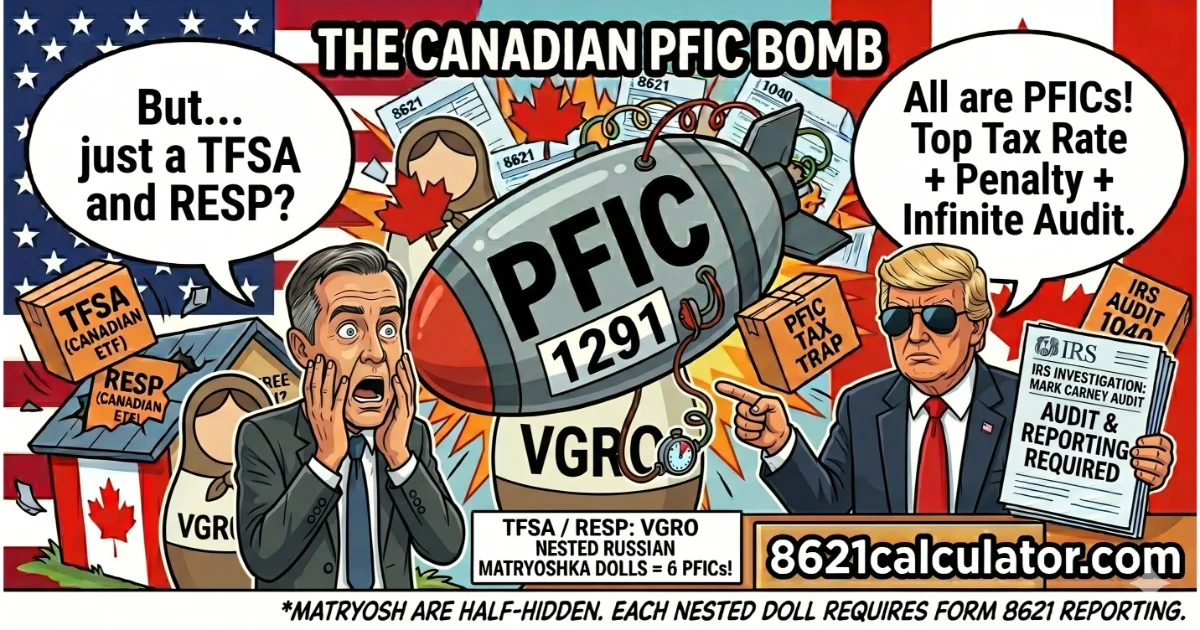
Canadian ETFs vs. Direct U.S.-Domiciled Equivalents
| Canadian ETF (TSX / CAD) | U.S. Domiciled Equivalent (NYSE / USD) | Asset Class / Target | U.S. Tax Status |
|---|---|---|---|
| VFV / ZSP / XUS | VOO / SPY / IVV | S&P 500 Large-Cap US | Zero PFIC Risk (Form 1040 1099-DIV) |
| XEQT / VEQT / ZEQT | VT / ITOT + IEFA + IEMG | Global Total Equity | Zero PFIC Risk (Form 1040 1099-DIV) |
| VGRO / XGRO | AOA / 80% VTI + 20% BND | 80/20 Growth Balanced | Zero PFIC Risk (Form 1040 1099-DIV) |
| VCN / XIC / ZCN | EWC (iShares MSCI Canada) | Canadian Equity Market | Zero PFIC Risk (U.S.-domiciled fund) |
The Norbert's Gambit Solution: Eliminating PFIC at Minimal Cost
The single most effective strategy for a U.S. citizen living in Canada is to hold U.S.-domiciled ETFs directly in their Canadian non-registered or TFSA accounts.
However, converting Canadian Dollars (CAD) to U.S. Dollars (USD) at traditional banks incurs retail foreign exchange markups of 1.5% to 2.5%. To avoid this fee, Canadian investors use Norbert's Gambit:
- Buy shares of the interlisted Global X US Dollar Currency ETF in Canadian Dollars (
DLR.TO). - Contact your brokerage (Questrade, Interactive Brokers, TD Direct, RBC, BMO InvestorLine) to "journal" the shares to the U.S. Dollar ticker (
DLR.U.TO). - Sell
DLR.U.TOfor U.S. Dollars with near-zero exchange markup (paying only standard trade commissions). - Use the USD proceeds to buy VOO, VT, or VTI directly.
While purchasing destination U.S.-domiciled ETFs (VOO/VTI) permanently eliminates ongoing PFIC reporting, DLR/DLR.U is itself a Canadian-domiciled ETF for which Global X publishes annual PFIC reporting data.
Holding DLR for only a few days during currency conversion does not magically waive PFIC rules. You must confirm that the trade generated zero excess distribution and that your sale did not realize a taxable gain treated as an excess distribution under §1291. Retain your trade confirmations showing buy and sell prices in USD.
Result: By moving CAD into USD and purchasing U.S. ETFs directly, you achieve lower management expense ratios (MER) and eliminate annual Form 8621 filings for your core equity portfolio.
Vanguard vs. iShares Canadian ETF Architecture
Vanguard Canada and BlackRock iShares represent over 80% of Canadian ETF market assets. For cross-border taxpayers, their structural differences impact Form 8621 preparation:
Vanguard Canada (VFV, VGRO, VEQT)
- AIS Reporting: Publishes daily per-share factors (reported in USD ($) per unit, per day).
- Underlying Holdings: VFV holds direct U.S. stocks; VGRO/VEQT hold underlying Vanguard ETFs (VCN, VUN, VIU, VEE, VAB).
- Multi-Lot Computation: Requires multiplying daily factor by exact calendar days held per lot.
iShares Canada (XEQT, XGRO, XIC)
- AIS Reporting: Check BlackRock's PFIC statements for the specific fund and tax year.
- Underlying Holdings: XEQT's holdings change over time; use the applicable annual statement for lower-tier analysis.
- Partial Year Proration: Requires calendar-day fraction proration for lots acquired mid-year.
How Different PFIC Elections Change the Tax Result
For U.S. taxpayers holding Canadian ETFs like VFV or XEQT in taxable accounts or TFSAs, your election choice on Form 8621 Part II produces radically different tax liabilities:
- Qualified Electing Fund (§1295 QEF): Taxes pro-rata earnings currently at ordinary/LTCG rates and elevates basis under §1293(d), preserving capital gains treatment upon sale.
- Mark-to-Market (§1296 MTM): Taxes annual unrealized gains as ordinary income, completely eliminating compounding interest penalties.
- Default Excess Distribution (§1291): Imposes the highest statutory marginal rate (37%) and compounding daily interest charges under §6621 upon sale or excess distribution.
For the complete 10-year numerical modeling and mathematical simulation comparing §1291, QEF, MTM, and direct VOO holdings, consult our site-wide benchmark: PFIC Tax: §1291 vs. QEF vs. MTM (Full VFV Case Study) →.
Frequently Asked Questions
Is VFV a PFIC even though Vanguard Canada calls it a mutual fund trust?
Yes. Canadian provincial trust law categorizes Canadian ETFs as unincorporated mutual fund trusts. However, under U.S. federal tax classification rules (Treas. Reg. §301.7701-2 and IRC §1297), foreign pooled investment trusts are classified as foreign corporations for PFIC purposes. Because over 75% of income and 50% of assets are passive, VFV is treated as a PFIC. Learn more in our What Is a PFIC Master Guide →.
Does XEQT require only one Form 8621?
XEQT is an all-in-one fund-of-funds that holds underlying Canadian and international iShares ETFs (such as XIC, XEF, and XEC). BlackRock's official PFIC statement discloses these lower-tier funds. While a top-tier QEF election often simplifies pass-through accounting, indirect ownership rules (IRC §1298(a)) require careful multi-tier verification. See our dedicated analysis: Fund of Funds PFIC Risk: One Ticker ≠ One Form 8621 →.
Why is Vanguard VFV a PFIC if it holds U.S. S&P 500 stocks?
Under IRC §1297, PFIC classification is determined by the domicile and entity structure of the investment vehicle itself, not its underlying portfolio. Because VFV (Vanguard S&P 500 Index ETF) is a Canadian mutual fund trust domiciled in Canada, it is a foreign corporation for U.S. tax purposes.
How does Norbert's Gambit help U.S. persons in Canada avoid PFICs?
Norbert's Gambit allows Canadian investors to convert CAD to USD at minimal cost using interlisted shares (like DLR/DLR.U). With USD in a Canadian brokerage (e.g., Questrade, Interactive Brokers, TD), a U.S. person can buy U.S.-domiciled ETFs (like VOO or VT), completely eliminating PFIC Form 8621 filing requirements.
What is the 'fund-of-funds' problem with XEQT and VGRO?
All-in-one ETFs can create indirect PFIC ownership. Use the issuer's annual PFIC statements and the indirect-ownership rules to determine each required Form 8621; a top-level AIS is not automatically enough.
Bottom Line
For U.S. taxpayers in Canada holding core ETF portfolios:
- Test the named Canadian ETFs each year: Review issuer PFIC statements, filing triggers and any available exception.
- Consider Direct U.S. ETFs: Use Norbert's Gambit to convert CAD to USD and purchase VOO, VT, or ITOT directly to avoid PFIC status completely.
- Elect QEF in Year One: If you keep Canadian ETFs in taxable accounts, always download the AIS and file Form 8621 Part III.
Official Sources & Technical References
- IRS: Instructions for Form 8621 (Rev. December 2025).
- Cornell Law (LII): 26 U.S. Code § 1297 — Passive Foreign Investment Company Defined.
- Vanguard Canada: Vanguard Investments Canada Tax & PFIC Reporting Portal.
- BlackRock iShares: iShares Canada Regulatory & PFIC Reporting Centre.