
For U.S. citizens and Green Card holders living in Canada, managed investment platforms like Wealthsimple Managed Investing, Questwealth Portfolios, and traditional bank mutual fund programs (such as TD e-Series, RBC Select Portfolios, BMO Mutual Funds, and CI Investments) appear to offer effortless, hands-off investing.
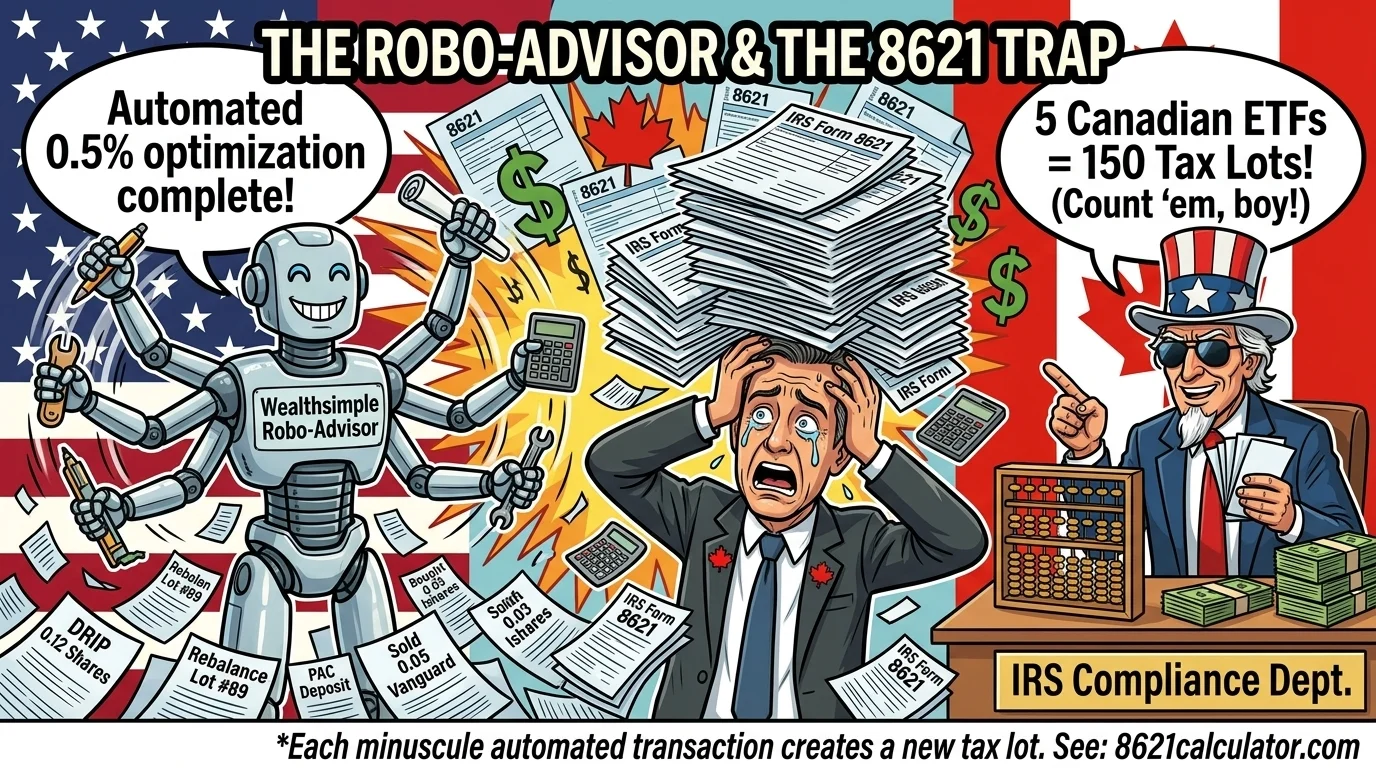
However, for U.S. taxpayers, robo-advisors and bank mutual funds represent the frequent source of significant tax preparation complexity and IRS compliance errors. Underneath their simplified user interfaces lies an algorithmic engine that continuously buys fractional shares across multiple Canadian-domiciled funds, creating an explosion of discrete tax lots and multi-tiered PFIC filing obligations.
The Micro-Lot Explosion: How DRIP & Algorithmic Rebalancing Break Form 8621
Under Treas. Reg. §1.1295-1 (for QEF elections) and IRC §1291 (for default excess distributions), PFIC taxation is strictly computed on a share-lot by share-lot basis. Unlike standard U.S. equities where IRS rules permit aggregate average cost basis for mutual funds, PFICs require tracking the exact holding period, cost basis, and unreversed inclusions for every individual acquisition block.
Robo-advisors trigger compounding complexity through three mechanisms:
- Monthly Pre-Authorized Contributions (PAC): Depositing $500/month across 8 ETFs generates 96 separate acquisition lots per year.
- Fractional Dividend Reinvestment (DRIP): When underlying ETFs pay monthly or quarterly distributions, the robo-advisor buys fractional shares (e.g., 0.142 shares of VCN or XEF), creating another 30–50 micro-lots.
- Algorithmic Tax-Loss Harvesting & Rebalancing: Automated threshold rebalancing sells micro-fractions from overweight funds to buy underweight ones, triggering taxable dispositions on individual lots subject to PFIC gain/loss rules.
Bank Mutual Funds: The "Fund of Funds" & Missing AIS Crisis
Investors holding classic Canadian bank mutual funds—such as RBC Select Balanced Portfolio, TD Comfort Portfolios, or Scotia Canadian Growth Fund—face an even harsher structural trap: Multi-Tiered Nested PFICs and missing Annual Information Statements.
| Product Category | Underlying Structure | PFIC Annual Information Statement (AIS)? | U.S. Tax Impact / Action |
|---|---|---|---|
| Wealthsimple Managed | Holds direct Canadian ETFs (Vanguard, iShares, BMO) | Available (Underlying ETFs issue AIS) | QEF election is viable, but requires lot-by-lot computation across 6–10 separate Forms 8621. |
| TD e-Series Index Funds | Direct mutual fund trusts (e.g., TDB900, TDB902) | Available (TD publishes annual AIS) | QEF election possible; clean single-tier structure, but must avoid frequent DRIP to keep lots manageable. |
| Bank "Portfolio / Balanced" Funds | Fund-of-Funds (holds 5–15 underlying bank funds) | Partial / Missing (Tier-2 AIS often omitted) | High Risk: If top fund holds underlying PFICs without tier-2 statements, forced into Section 1291 punitive regime. |
| Direct U.S. ETFs (Self-Directed) | U.S.-domiciled funds (e.g., VOO, VTI, VXUS via Questrade/IBKR) | Not Applicable (Domestic U.S. entity) | Zero PFIC exposure. Reported normally on Schedule B/D with standard 1099/T5. |
Why Wealthsimple and Canadian Bank Funds Create §1291 Workpaper Complexity
If your bank mutual fund fails to provide a qualifying PFIC AIS, or if the sheer volume of lots prevents a timely QEF election, the IRS treats the investment under the default Section 1291 Excess Distribution regime:
- Loss of Capital Gains Treatment: Any capital gain realized upon rebalancing or fund redemption is recharacterized as ordinary income.
- Section 1291 Excess Distribution Regime: Gains and excess distributions are allocated ratably across your entire holding period and taxed at the highest statutory individual tax rate in effect for each year (currently 37%), regardless of your actual tax bracket.
- Non-Deductible Compound Interest: The IRS assesses compounding statutory interest on the deemed deferred tax liability from each prior year, which can consume over 50% of your total return. For the complete statutory computation, throwback algorithms, and interest mechanics, consult our dedicated Section 1291 Excess Distribution Master Guide →.
Strategic Roadmap: How U.S. Persons in Canada Should Clean Up Managed Portfolios
If you currently hold a Wealthsimple managed account or bank mutual funds in a non-registered (taxable) account or TFSA, follow this 4-step remediation plan:
- Turn Off Automatic Dividend Reinvestment (DRIP): Instruct your broker or robo-advisor to pay all dividends into cash. This immediately stops the creation of new micro-lots each month.
- Pause Automatic Portfolio Rebalancing: Switch your managed account settings or transfer assets to a self-directed brokerage account (such as Interactive Brokers Canada or Questrade) to prevent unwanted algorithmic trades.
- Acquire Historical Broker CSVs and AIS Statements: Export full transaction histories with exact settlement dates, share quantities, Canadian dollar proceeds, and exchange rates for every lot.
- Transition to Compliant Cross-Border Portfolio Architecture: Replace Canadian mutual funds and multi-asset robo-portfolios with either:
- Direct U.S.-domiciled ETFs (VOO, VTI, BND): Completely immune to PFIC rules. You can use Norbert's Gambit (via DLR/DLR.U) to convert CAD to USD at minimal cost, noting that the temporary DLR ETF position itself is a Canadian fund requiring transaction review.
- Consolidating into Core Canadian ETFs (e.g., VFV, XIC): Reduces the sprawling complexity of managed robo-portfolios. However, fund-of-funds ETFs such as XEQT or VGRO disclose lower-tier PFICs in their AIS and should not be assumed to require only a single simplistic Form 8621.
- Alternative Fund Structures: Corporate-class share series and insurance-linked segregated funds require specialized cross-border tax analysis to determine entity classification and reporting obligations.
Frequently Asked Questions
Can I hold Wealthsimple Managed accounts inside an RRSP without Form 8621?
A qualifying RRSP or RRIF may use the Form 8621 reporting exception in Treas. Reg. §1.1298-1(c)(4). Confirm the arrangement and treaty conditions. TFSA, FHSA and taxable holdings require separate PFIC review.
Can I just summarize my Wealthsimple ETF lots into a single line on Form 8621?
No. IRS Form 8621 instructions and Treas. Reg. §1.1295-1 require lot-level accounting for pro-rata ordinary earnings, net capital gains, and distribution adjustments. Grouping distinct acquisition dates into an arbitrary single block violates IRS substantiation rules and can invalidate a QEF election during an audit.
Does Wealthsimple provide an annual PFIC Annual Information Statement?
Wealthsimple itself does not issue an AIS because it is an investment dealer, not the fund manufacturer. However, the underlying ETFs held in Wealthsimple portfolios (primarily Vanguard Canada and BlackRock iShares ETFs) publish official annual AIS documents on their respective corporate websites.
What is the fastest way to compute 50+ lots across multiple robo-advisor ETFs?
Manual calculation by hand or spreadsheet is practically impossible without making formula errors. Utilizing an automated engine like 8621calculator.com allows you to import your transaction history via the standard CSV template, computing complex Section 1291 excess distributions, throwback allocations, and §6621 interest accurately ($10 per calculation, no registration required).
Official Authorities & Technical References
- IRS: Instructions for Form 8621 (Rev. 12/2025).
- Cornell Law (LII): Treas. Reg. § 1.1295-1 — Qualified Electing Funds (Rules on pro-rata share inclusions & AIS requirements).
- Cornell Law (LII): 26 U.S. Code § 1291 — Interest on Tax Deferral for Passive Foreign Investment Companies.
- IRS: Rev. Proc. 2014-55 — Procedures for Canadian RRSP and RRIF Treaty Deferral.