
1. Denmark PFIC & Investment Tax Map for U.S. Citizens
An American taxpayer in Denmark must navigate both Danish tax law (Aktieavancebeskatningsloven - ABL) and U.S. federal tax law. The table below illustrates how Denmark and the IRS treat the primary investment asset classes:
| Asset / Vehicle | Danish Tax Treatment (SKAT) | U.S. Tax Treatment (IRS) | Core Cross-Border Friction |
|---|---|---|---|
| Individual Operating Equities (e.g., Novo Nordisk, DSV, Apple) |
Taxed as share income (aktieindkomst) upon realization (27% / 42%). | Standard direct stock taxation on Form 1040 Schedule D. Operating companies generally avoid pooled PFIC status. | Clean alignment. Foreign tax credits (FTC) generally match realization timing. |
| Aktiesparekonto (ASK) (Holding individual stocks) |
17% annual mark-to-market tax (lagerbeskatning). 2026 deposit ceiling: DKK 174,200. | Not recognized as a tax-deferred pension. Annual dividends and realized capital gains reported on Form 1040. | Timing mismatch: Denmark taxes annual unrealized value changes at 17%, while U.S. taxes realization events. |
| SKAT Positive List UCITS ETF (e.g., iShares Core MSCI World, VWCE) |
Lagerbeskatning taxed as aktieindkomst (27% up to DKK 79,400, then 42%). | Classified as a foreign corporate PFIC. Requires PFIC testing and potential Form 8621 filing. | Severe timing mismatch under default §1291. An MTM election on Form 8621 Part II Box C can improve annual synchronization. |
| Danish Index Funds (e.g., Sparindex INDEX Globale Aktier) |
Minimum-distributing funds may qualify for realization principle in taxable accounts under Danish law. | Pooled Danish investment associations (investeringsforeninger) commonly create PFIC exposure under §1297. | SKAT annual reporting does not satisfy Treas. Reg. §1.1295-1(g) for QEF elections. |
| U.S.-Domiciled ETFs (e.g., VOO, VTI, QQQ) |
Evaluated under ABL §19; unregistered funds taxed annually under lagerbeskatning as capital income (up to ~42%). | Domestic U.S. asset. Zero PFIC risk. Form 1099 reporting. | EU PRIIPs rules restrict retail purchase access through Danish brokers; SKAT taxes annual market value changes. |
2. SKAT Positive List 2026: Aktieindkomst vs. Kapitalindkomst
Under the Danish Capital Gains Act (Aktieavancebeskatningsloven, ABL §19), foreign investment companies and ETFs are by default taxed as capital income (kapitalindkomst) at progressive rates up to approximately 42% unless the fund manager officially registers the fund with SKAT and obtains inclusion on SKAT's Positive List (Positivlisten).
When an equity fund is included on the Positive List:
- Returns are taxed under the more favorable share income (aktieindkomst) regime.
- For 2026, share income is taxed at 27% on the first DKK 79,400 for an individual (DKK 158,800 for cohabiting spouses), with returns above this threshold taxed at 42%. (Verify thresholds annually as they are indexed).
- Inclusion on the Positive List applies for the entire income year 2026, but fund managers must maintain qualification annually.
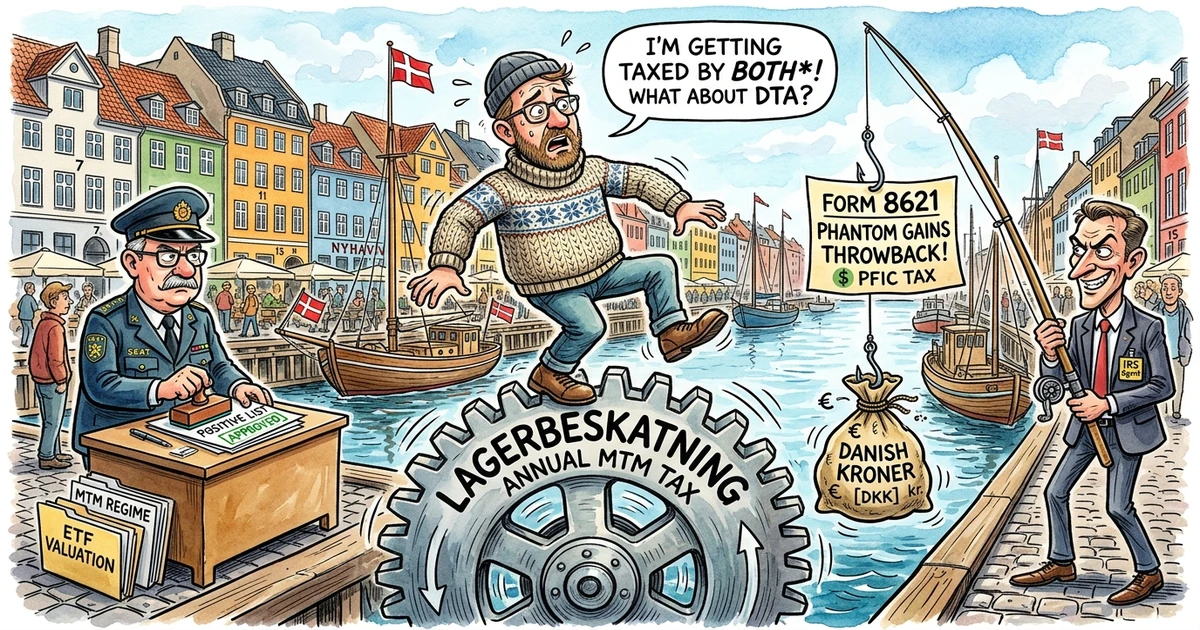
3. Lagerbeskatning in Denmark: How ETFs Are Taxed on Unrealized Gains
Denmark applies two distinct taxation principles to investments:
- The Realization Principle (Realisationsprincippet): Tax is triggered only when shares are actually sold or distributed. Applies to individual stocks held in standard taxable accounts and qualifying distributing Danish investment associations.
- The Mark-to-Market Principle (Lagerprincippet / Lagerbeskatning): Tax is levied annually on the net change in portfolio value between January 1 and December 31, regardless of whether any shares were sold.
Under Danish law, investment companies and ETFs governed by ABL §19 are subject to mandatory lagerbeskatning. If an ETF portfolio rises in value during the calendar year, SKAT taxes the unrealized gain in that tax year, stepping up your Danish tax basis for the subsequent year.
4. Aktiesparekonto (ASK) for U.S. Citizens: 17% Danish Tax vs. PFIC
The Aktiesparekonto (ASK) is Denmark's special equity savings account offering a concessionary flat tax rate of 17% under lagerbeskatning. For 2026, the ASK deposit ceiling (indskudsloft) is DKK 174,200. The amount that can actually be deposited during 2026 depends on the account value at December 31, 2025 and applicable net-contribution rules.
For U.S. citizens in Denmark, holding investments inside an ASK creates specific compliance outcomes:
| Investment Type Inside ASK | Danish Tax Impact | U.S. Tax Impact | U.S. Compliance Consequence |
|---|---|---|---|
| Individual Listed Stocks (e.g., Danish or U.S. equities) |
17% annual mark-to-market tax paid to SKAT. | No PFIC. Dividends and realized capital gains reported annually on Form 1040. U.S. basis remains historical purchase cost. | Maintains straightforward U.S. reporting, but creates annual Danish cash tax on unrealized gains. |
| European UCITS ETFs (Approved for ASK) |
17% annual mark-to-market tax paid to SKAT. | Subject to IRC §1297 PFIC regime. | The ASK wrapper does not shelter the fund from U.S. PFIC rules; Form 8621 reporting and elections must be analyzed separately. |
5. Danish Index Funds, Sparindex & Danske Invest: Are They PFICs?
Danish retail mutual funds and investment associations (investeringsforeninger)—such as Sparindex INDEX Globale Aktier KL or Danske Invest Global Indeks—commonly create PFIC exposure for U.S. taxpayers.
The cross-border analysis requires two steps:
- U.S. Entity Classification: Determine the legal form of the collective vehicle under Treas. Reg. §301.7701-2. Pooled investment trusts and corporate associations are generally treated as foreign corporations for U.S. tax purposes.
- IRC §1297 Tests: If treated as a foreign corporation, its predominantly passive investment income (dividends, capital gains) and passive assets will commonly cause it to satisfy the 75% income test or 50% asset test.
Furthermore, Danish fund managers prepare annual statements strictly formatted for SKAT tax reporting (IFPA indberetning). These documents do not constitute valid PFIC Annual Information Statements under Treas. Reg. §1.1295-1(g).
6. Nordnet, Saxo & PRIIPs: Can Americans in Denmark Buy U.S. ETFs?
When investing through Danish brokerages like Nordnet and Saxo Bank, two separate regulatory issues must be distinguished:
- Broker Account Eligibility: Onboarding policies for U.S. citizens and Green Card holders depend on internal compliance rules. Nordnet currently processes U.S. taxpayers who provide Form W-9 under Danish FATCA Model 1 agreements. Platform policies can evolve over time.
- Product Distribution Restrictions (PRIIPs): Under EU Regulation 1286/2014, brokers in Denmark cannot distribute packaged retail products without a Key Information Document (KID). Because U.S.-domiciled ETFs do not issue EU KIDs, Danish retail brokers block buy orders for U.S. ETFs regardless of the investor's citizenship.
7. U.S.-Domiciled ETFs in Denmark: PFIC Status & SKAT Tax Treatment
A U.S.-domiciled ETF is not a PFIC for U.S. tax purposes. However, its Danish tax treatment must be evaluated under Danish domestic law:
- Taxpayers should verify whether the specific fund appears on SKAT's annual Positive List.
- Unregistered foreign investment companies are generally taxed under ABL §19 on an annual mark-to-market basis (lagerbeskatning) as capital income (kapitalindkomst) at progressive rates up to approximately 42%.
- Taxpayers declare annual December 31 valuation changes on their Danish tax return (årsopgørelse Rubrik 38/39).
8. Denmark–U.S. Tax Timing: Lagerbeskatning, §1291 & Foreign Tax Credits
Holding European UCITS ETFs under default Section 1291 while residing in Denmark creates a structural timing mismatch:
| Tax Event | Danish Treatment (SKAT) | U.S. Default Treatment (§1291) | Cross-Border Result |
|---|---|---|---|
| Holding Period (Years 1–4) | Taxes annual unrealized gains every December 31 at 27% / 42%. Taxes paid currently in Denmark. | No current taxable income recognized on accumulating funds. | Current utilization of Danish foreign tax credits may be limited because there is no corresponding U.S. taxable income on Form 1040. Unused foreign taxes are subject to Form 1116 carryover and basket rules. |
| Disposition Year (Year 5) | Taxes only the final year's gain from the stepped-up Danish basis. | Gain on disposition is allocated across the PFIC holding period under §1291; prior PFIC-year portions receive the highest-rate plus §6621 interest-charge treatment. | The resulting U.S. liability may materially exceed the current-year Danish tax associated with the disposition, leaving insufficient Year 5 Danish tax to offset the throwback liability. |
9. Section 1296 MTM for Danish ETFs: Can It Align With Lagerbeskatning?
For exchange-traded UCITS ETFs where the shares satisfy the Section 1296 marketable-stock rules—including trading on a qualified exchange or other market and meeting applicable regularly-traded requirements under Treas. Reg. §1.1296-2—a U.S. taxpayer can elect Mark-to-Market on Form 8621 Part II Box C.
Why MTM improves the cross-border alignment:
- Both SKAT (lagerbeskatning) and the IRS (§1296 MTM) recognize annual changes in market value on December 31.
- Annual unrealized gains become current ordinary income for U.S. tax purposes, allowing current-year Danish taxes paid to be evaluated for Foreign Tax Credits on Form 1116.
- Section 1291 interest charges are avoided for all years in which the MTM election is in effect.
10. Moving to Denmark With U.S. Investments: Entry Value & SKAT Reporting
When a U.S. taxpayer moves to Denmark and becomes subject to Danish unlimited tax liability, specific cross-border basis rules take effect:
- Danish Entry Basis (Tilflytterbeskatning): Under Danish tax law, foreign securities newly entering Danish tax jurisdiction generally receive a Danish tax acquisition value equal to their fair market value at the date Danish tax liability begins.
- U.S. Historical Basis: For U.S. federal income tax purposes, the original historical USD purchase cost remains unchanged. As a result, Danish and U.S. tax basis diverge from day one.
- SKAT Reporting Requirement: New residents must report their foreign security holdings (name, ISIN, quantity, and market value on arrival date) to SKAT to preserve future tax deduction rights.
11. Already Own Danish Funds? Form 8621 & PFIC Reconstruction Workflow
If you previously acquired Danish investment association units or European UCITS ETFs:
- Gather Trade Records: Download historical trade confirmations and annual statements from your brokerage.
- Reconstruct USD Lots: Convert each acquisition into USD at historical exchange rates and track distributions.
- Evaluate Compliance Options: Determine whether filing exceptions apply, assess Streamlined procedures if unfiled prior years exist, or calculate §1291/§1296 workpapers.
Convert DKK transaction histories into reconciliation-ready Section 1291 excess distribution and §1296 Mark-to-Market Form 8621 schedules using our standard calculation engine on 8621calculator.com.
$10 per calculation · No registration required · Instant PDF/CSV workpapers
Calculate §1291 / MTM Workpapers →