
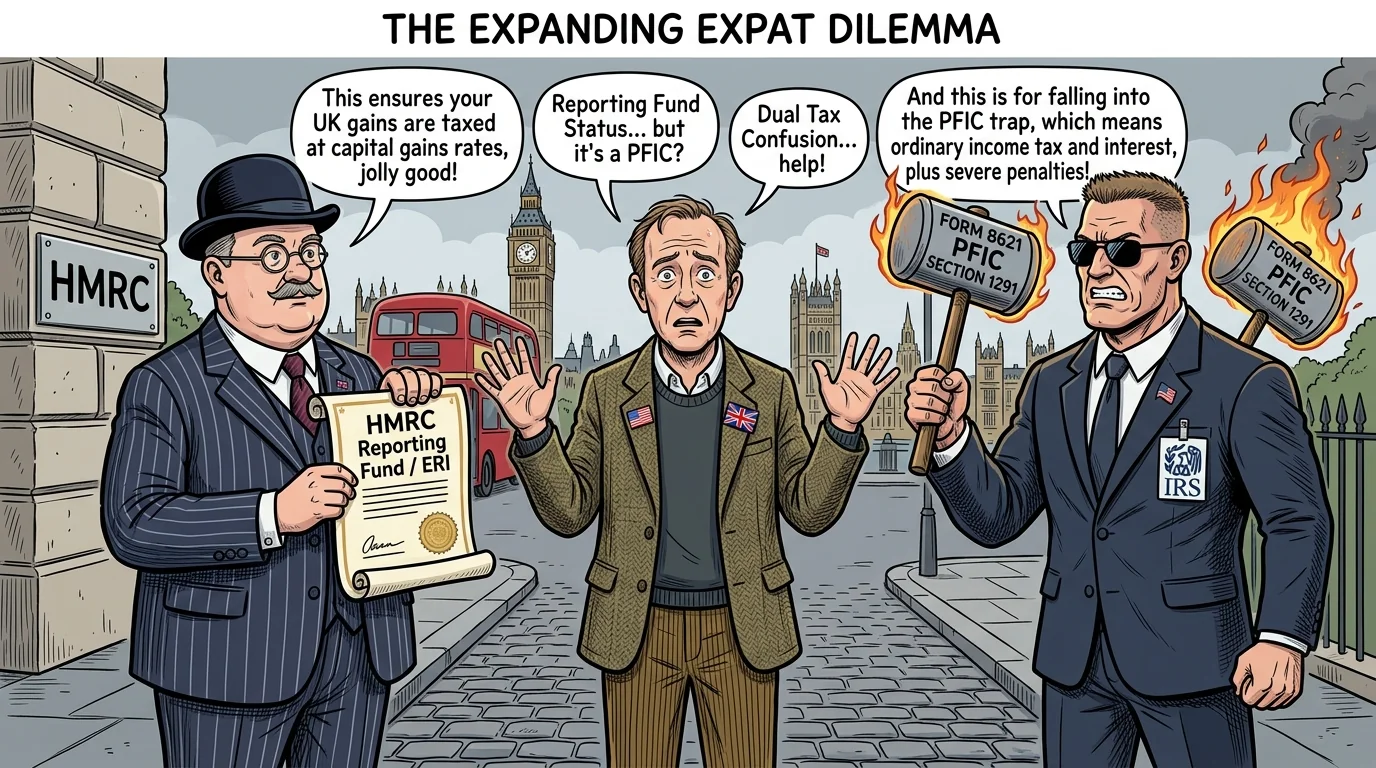
1. What Is HMRC Reporting Fund Status?
Under the UK Offshore Funds (Tax) Regulations 2009, foreign collective investment arrangements (such as Irish or Luxembourg UCITS ETFs and U.S. mutual funds) may fall within the statutory definition of an Offshore Fund by HM Revenue & Customs (HMRC).
To obtain Reporting Fund Status, the fund manager must register the fund with HMRC and commit to calculating and reporting its reportable income to investors annually.
2. Reporting Funds vs Non-Reporting Funds: UK Tax Treatment
The distinction between Reporting and Non-Reporting funds determines how a UK resident is taxed upon disposition:
| UK Classification | UK Capital Gains Tax (CGT) Eligibility | UK Disposal Gain Tax Rate (2026) | Annual Income Reporting |
|---|---|---|---|
| HMRC Reporting Fund | Yes. Qualifies for standard UK Capital Gains Tax. | 18% (basic rate band) / 24% (higher/additional rate band). | Actual cash distributions + Excess Reportable Income (ERI). |
| Non-Reporting Fund | No. Disallowed from standard UK CGT treatment. | Taxed as Offshore Income Gain (OIG) at income tax rates up to 45%. | Taxed only on actual cash distributions received. |
3. Excess Reportable Income (ERI): Tax Without a Cash Distribution
For accumulating share classes of Reporting Funds, the fund calculates Excess Reportable Income (ERI)—representing undistributed net income generated within the fund.
Key UK Tax Rules for ERI:
- ERI is deemed distributed to investors 6 months after the fund's accounting year-end.
- UK residents must declare ERI on their UK Self Assessment return as dividend or interest income for that tax year, even though no cash was received.
- The declared ERI increases the investor's UK acquisition cost basis (preventing double taxation upon final disposal).
4. Offshore Income Gains (OIG): What Happens to Non-Reporting Funds
If a UK resident invests in an offshore fund that lacks HMRC Reporting status (e.g., standard U.S.-domiciled mutual funds or non-reporting European funds):
- Any profit realized upon sale is classified as an Offshore Income Gain (OIG) under Regulation 17.
- OIG is taxed as ordinary income at rates up to 45%, completely forfeiting the UK annual CGT exemption allowance and lower 18%/24% CGT rates.
5. Why HMRC Reporting Fund Status Does Not Prevent PFIC Treatment
A widespread misconception among U.S. expats in London and Edinburgh is that holding an “HMRC Reporting Fund” eliminates U.S. tax complications.
This is legally false:
- HMRC Reporting status is purely a domestic UK tax regime. It has zero legal authority under the U.S. Internal Revenue Code.
- An Irish UCITS ETF (such as
VUSAorCSPX) with HMRC Reporting status remains a foreign corporation holding passive assets under IRC §1297. - A foreign corporate UCITS reporting fund can still satisfy §1297. HMRC Reporting Fund status does not remove U.S. PFIC classification, and Form 8621 may be required depending on applicable election and reporting rules.
6. U.S.-Domiciled ETFs With HMRC Reporting Status
Important U.S. tax distinction: HMRC Reporting Fund status for any fund?including U.S.-domiciled ETFs?governs UK capital gains tax eligibility only. It has no effect on U.S. PFIC classification. A U.S.-domiciled ETF registered under the Investment Company Act of 1940 is not a PFIC regardless of HMRC Reporting status. Conversely, an Irish UCITS ETF with HMRC Reporting status remains a PFIC for U.S. tax purposes.
Certain U.S.-domiciled ETFs have historically registered for HMRC Reporting Fund status. Because reporting status is granted on a per-share-class and per-tax-year basis, verify the current HMRC list by exact ISIN before relying on it for UK tax filing
For a dual U.S./UK taxpayer who has brokerage access to purchase U.S. ETFs, holding a U.S.-domiciled ETF with HMRC Reporting status can produce a cleaner alignment between U.S. and UK fund-tax treatment, subject to current share-class reporting status and brokerage access:
- U.S. Side: 100% exempt from PFIC reporting (standard Form 1099 / Schedule D).
- UK Side: Qualifies for UK CGT rates (18%/24%) instead of punitive 45% Offshore Income Gains.
7. How to Check HMRC Reporting Status by Exact Fund and Share Class
HMRC publishes an official spreadsheet listing all approved reporting funds. When checking a fund:
- Verify the exact ISIN and share class. Often, distributing share classes have reporting status while accumulating classes of the same fund do not (or vice versa).
- Verify the effective start date. Reporting status must cover the entire period of your holding.
8. UK CCI Rules: The 2026–2027 PRIIPs Transition
Following Brexit, the UK Financial Conduct Authority (FCA) is replacing the retained EU PRIIPs framework with a new domestic regime for Consumer Composite Investments (CCI):
- Transitional Period: 6 April 2026 to 7 June 2027.
- Full CCI Implementation: 8 June 2027.
This regulatory reform aims to address retail disclosure friction, but product access for U.S.-domiciled ETFs remains subject to UK brokerage distribution policies.
Tax wrapper analyses (including Stocks & Shares ISAs, SIPP pensions under Article 18, and UK unit trusts) are covered in our comprehensive UK Country Pillar Guide →
Read our dedicated country pillar on UK ISAs, SIPPs, and foreign fund reporting for Americans living in the United Kingdom.
Read UK ISA & SIPP PFIC Guide →