
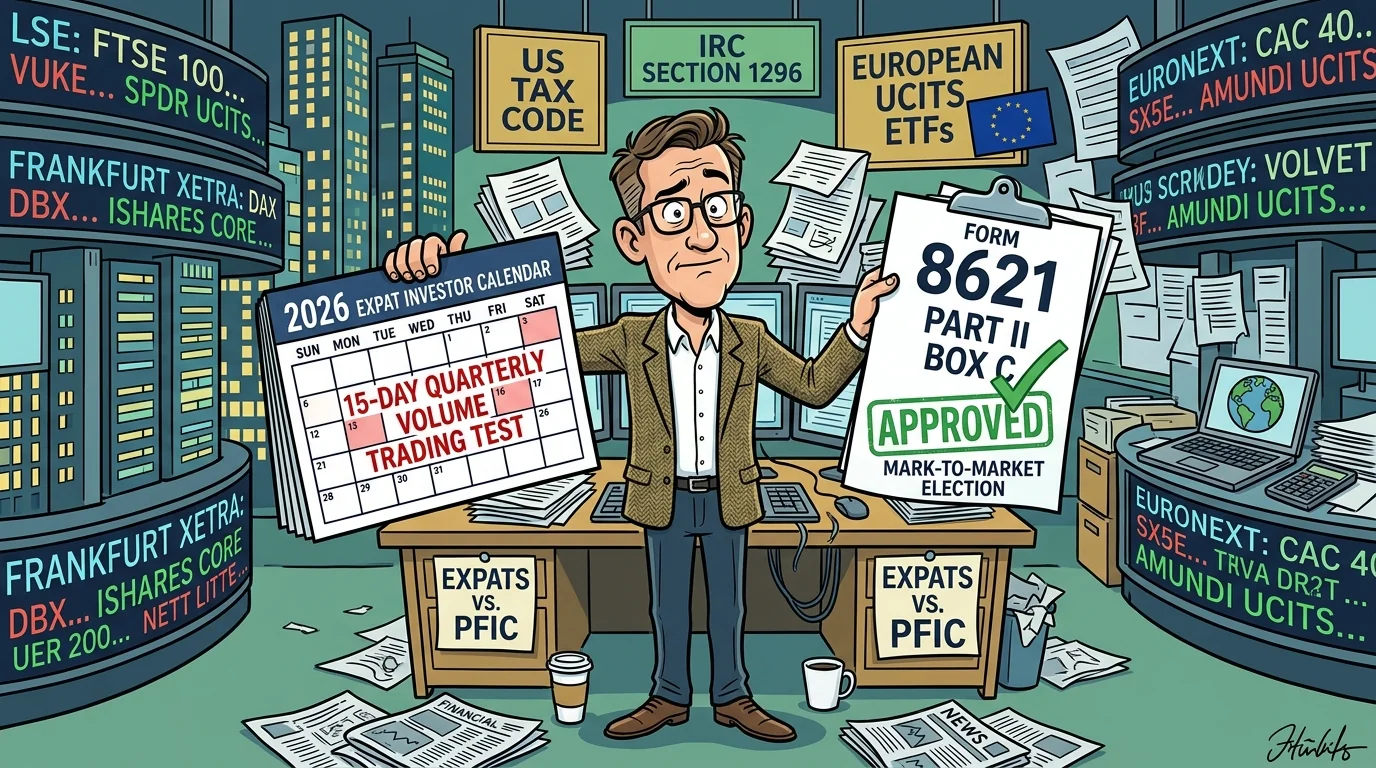
1. Can a UCITS ETF Use the §1296 Mark-to-Market Election?
When a U.S. taxpayer holds European UCITS funds and cannot obtain a certified PFIC Annual Information Statement for a QEF election, the primary alternative to punitive Section 1291 default taxation is the Section 1296 Mark-to-Market (MTM) election.
Under §1296, an election is available only if the underlying PFIC stock is considered “marketable stock”.
2. What Counts as Marketable Stock Under §1296?
Under IRC §1296(e)(1) and Treasury Regulation §1.1296-2, marketable stock includes:
- Stock of a PFIC that is regularly traded on a qualified exchange or other market.
- Stock in certain foreign open-end collective investment vehicles that offer continuous redemption at net asset value (provided specific regulatory conditions are satisfied).
3. Qualified Exchange or Other Market: What Must Be Verified?
Under Treas. Reg. §1.1296-2(c), a foreign exchange is a qualified exchange if:
- It is regulated by a foreign government authority in the jurisdiction in which the exchange is located;
- The trading volume on the exchange is meaningful and not de minimis; and
- The laws of the foreign jurisdiction and rules of the exchange ensure that the rules of the exchange are effectively enforced.
Major European regulated markets—such as the Frankfurt Stock Exchange (Xetra), Euronext Paris/Amsterdam, the London Stock Exchange (LSE), and the SIX Swiss Exchange—are candidate qualified foreign exchanges. However, eligibility must be evaluated by specific trading tier and exchange listing.
4. The Regularly Traded Test: 15 Trading Days Per Quarter
Treasury Regulation §1.1296-2(b)(1) establishes the standard regularly traded test:
Highly traded European UCITS share classes may readily satisfy the 15-day trading frequency requirement, but the specific share class, exchange listing/tier, and tax year must still be verified and documented
5. ETF Share Class, Exchange Listing & Trading-Tier Pitfalls
Taxpayers must avoid common pitfalls when verifying MTM eligibility:
- Multiple Share Classes: A fund manager may issue both EUR-hedged, USD-unhedged, accumulating, and distributing share classes. Each specific share class (distinguished by ISIN and ticker) must independently trade on a qualified exchange.
- Over-the-Counter / Unregulated Segments: Shares trading exclusively on unregulated multilateral trading facilities (MTFs) or unofficial quotation boards without formal market oversight may fail qualified exchange standards.
- How to verify: Download the fund's exchange trading data for the specific ISIN and calendar year. Confirm the Market Identifier Code (MIC) of the listing venue, verify the share class and ticker, and check daily volume across all four calendar quarters to confirm the 15-day quarterly standard is met. Retain this documentation as part of the Form 8621 return.
6. When Must the §1296 Election Be Made?
A §1296 election is made on a timely filed return for the tax year in which the taxpayer wants the election to become effective. Making the election in the first year of ownership avoids Section 1291 coordination rules; making the election in a later year triggers transition-year coordination rules
For deep technical analysis on late elections and IRS protective relief, see our dedicated guide on Late QEF & MTM Elections →.
7. The Unpurged §1291 Taint If Not Made in Year One
Making an MTM election on previously un-elected PFIC stock without a purging election results in a "pedigreed" or dual-character PFIC:
- Section 1291 “Coordination Rules” in Year of Election: Under §1296(j)(1), the unrealized gain attributable to prior Section 1291 holding years is treated as an excess distribution and taxed under §1291 throwback rules in the initial MTM year.
- Prospective MTM: For subsequent tax years, only annual unrealized gains/losses are recognized as ordinary income/deduction without retroactive interest charges.
For purging election strategies and Line 15e mechanics, see our Form 8621 Line 15e Deep Dive →.
8. Form 8621 Part IV: MTM Reporting Breakdown
Key Form 8621 Part IV line entries for MTM elections:
- Line 10a: Fair market value of the PFIC stock at the close of the tax year.
- Line 10b: Adjusted basis of the stock at the close of the tax year (adjusted for prior-year MTM inclusions).
- Line 10c: Unreversed Inclusions (UNI) — cumulative prior-year ordinary income inclusions not yet reversed by a loss deduction.
- Lines 11–12: Annual mark-to-market gain (Line 11) recognized as ordinary income, or annual MTM loss (Line 12) deductible as ordinary loss, subject to the UNI limitation.
- Lines 13a–14c: Report actual realized gain or loss from shares disposed of during the tax year.
For full line-by-line mechanics — including Unreversed Inclusion (UNI) calculations, negative mark-to-market adjustments, and Form 8621 Part IV line entries — read our dedicated Section 1296 Master Calculation Guide →
Check exchange eligibility for your European UCITS ETF and generate complete Form 8621 Part IV calculation workpapers on 8621calculator.com.