
When an investor holds a marketable foreign fund under §1291 for several years and subsequently decides to adopt Mark-to-Market (§1296), making the election is only half the battle. Prior accumulated gains are tainted under §1291. To adopt MTM on a clean basis going forward, that historical exposure must be settled first. This guide explains how the transition operates under IRC §1296(j), how to report it correctly on Form 8621 without double taxation, and how to execute the two-step transition workflow in your workpapers.
Quick Summary: §1291 to MTM Transition Q&A
How do you purge §1291 taint when switching to MTM?
Do you check Election D for a §1291-to-MTM transition?
Where is first-year transition gain reported on Form 8621?
When PFIC §1291 Taint Exists & Why It Must Be Purged
A PFIC position is considered "tainted" if the taxpayer:
- Held the PFIC in one or more tax years without a valid QEF or MTM election in effect, and
- Accumulated unrealized appreciation or received distributions governed by §1291 rules.
Once tainted, under IRC §1298(b)(1) ("once a PFIC, always a PFIC"), any future gain or excess distribution will trigger:
- Look-back ratable allocation across all prior holding years,
- The highest U.S. tax rate applicable to the shareholder for each relevant prior PFIC year, and
- Mandatory daily compounded interest under IRC §6621 and §6622.
To move into Mark-to-Market (MTM) on a clean basis, that §1291 exposure must be settled in the transition year — this is what practitioners refer to as purging the PFIC taint.
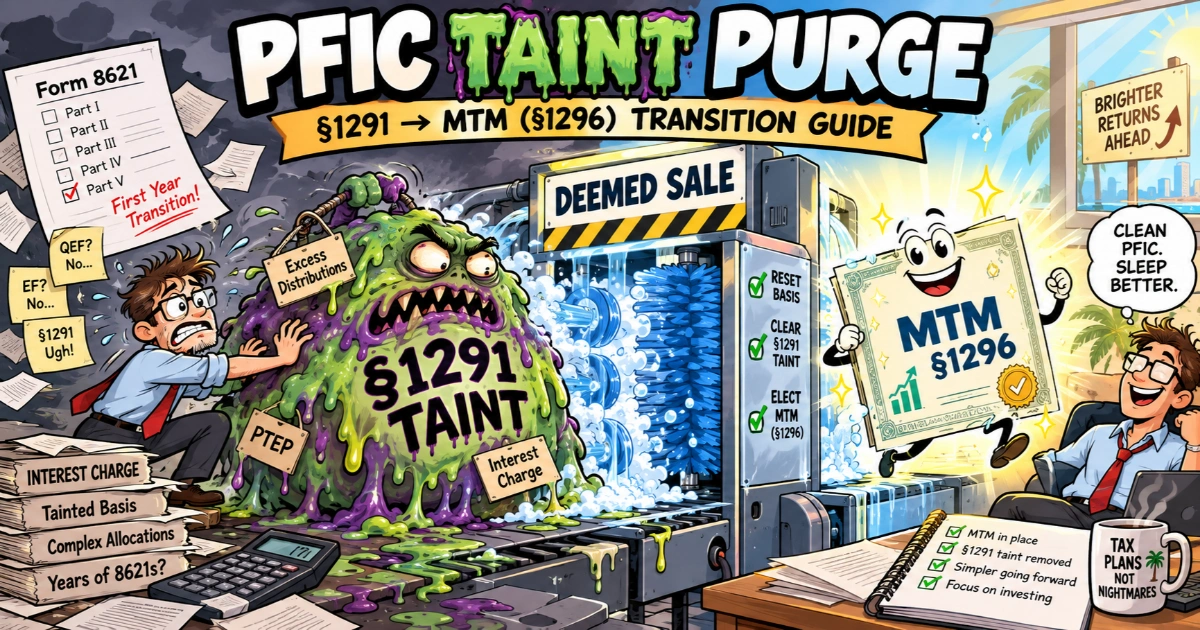
Deemed Sale vs. Deemed Dividend: IRC §1296(j) Statutory Coordination
This is legally inaccurate:
- Election D (IRC §1291(d)(2); Treas. Reg. §1.1291-10) is exclusively the "Deemed Sale Election in Connection With a QEF Election", designed to cleanse unpedigreed QEFs under §1295.
- For §1296 MTM transitions, you do NOT check Election D. You simply check Election C (Mark-to-Market Election).
- The year-end deemed sale treatment is mandatorily triggered by statute under IRC §1296(j)(1) and Treas. Reg. §1.1296-1(i) (the First-Year Coordination Rule). You do not need to file a separate purging election statement.
Deemed Sale / Deemed Disposition (The Mandatory MTM Path)
Governing Authority: IRC §1296(j)(1); Treas. Reg. §1.1296-1(i)
The PFIC shares are treated as sold at fair market value (FMV) on the last day of the first MTM election year:
Deemed Disposition Gain = December 31 FMV (USD) − Adjusted Basis (USD, FIFO required)
- The deemed gain is taxed as a §1291 excess distribution,
- §6621 daily compounding interest applies to prior tainted years,
- The cost basis is stepped up to December 31 FMV, and
- For PFIC coordination purposes, the position moves into the §1296 regime after the first-year coordination rules are applied.
Deemed Distribution Election (QEF Only — Inapplicable to MTM)
Governing Authority: IRC §1291(d)(2)(B); Treas. Reg. §1.1291-9
Under this alternative mechanism, the PFIC is treated as distributing its post-1986 undistributed earnings and profits (E&P). However, this election is only available if the PFIC is also a Controlled Foreign Corporation (CFC) and provides a certified QEF Annual Information Statement. For retail investors holding marketable foreign ETFs or UCITS transitioning to MTM, the deemed distribution path is unavailable. For a standard §1291-to-MTM transition, the operative coordination rule is §1296(j), not Election D.
December 31 Deemed Disposition Timing & Effective Year Rules
Timing is one of the most frequent sources of practitioner error. When a taxpayer first elects MTM after holding the fund under §1291:
- The deemed disposition occurs on the last day of the first MTM election year (December 31 for calendar-year filers), and
- The resulting gain is recognized as a §1291 excess distribution on that same year's Form 8621. It does not take place on December 31 of the prior year.
- 2017-2021: PFIC held under default §1291 rules (no QEF, no MTM election made).
- 2022: First year in which the taxpayer timely elects MTM on Form 8621 (Election C).
- Deemed Disposition Date: December 31, 2022 (not December 31, 2021).
- Tax Treatment: The entire appreciation from 2017 through December 31, 2022 is processed under §1291 throwback rules.
- Form 8621: Tax and §6621 interest are reported on the 2022 Form 8621 Part V.
Form 8621 Line Mapping: Part V vs. Part IV to Prevent Double Counting
In the first MTM year where §1291 taint exists, Form 8621 must be completed with strict line-level coordination to avoid double counting the gain:
- Part II: Check Box C (Mark-to-Market election under §1296). Leave Box D blank.
- Part V: Required when the §1296(j) first-year coordination rule applies. Report the deemed disposition gain on Line 15f. If the PFIC also made actual distributions during the transition year, report those separately under the applicable Lines 15a–15e. Complete Line 16 as required to compute the §1291 tax and §6621 interest, and attach the mandatory Line 16a supporting statement.
- Part IV: When the §1296(j) coordination rule applies, the IRS instructions direct the shareholder to complete Part V rather than Part IV for the first-year transition calculation. Do not duplicate the same deemed disposition gain in Part IV. Keep the December 31 FMV and adjusted basis in your workpapers because they establish the post-coordination basis used for subsequent §1296 reporting.
| Filing Scenario | Form 8621 Section | Specific Line Reporting |
|---|---|---|
| Making the MTM Election | Part II (Elections) | Check Box C (Election C). Leave Box D blank. |
| Year-End Deemed Disposition Gain | Part V (§1291 Excess Distributions) | Report the deemed disposition gain on Line 15f. |
| Actual Distributions Received During Transition Year | Part V (§1291 Excess Distributions) | If actual dividends received, compute excess distribution on Line 15e. |
| Tax Increase & Daily Interest | Part V (§1291 Lines 16c & 16f) | Compute tax increase on Line 16c; §6621 interest on Line 16f. Attach Line 16a statement. |
| Part IV First-Year Treatment | Part IV (§1296 Mark-to-Market) | Do NOT report transition gain as Line 11 MTM income. Gain is settled via Part V. |
| Subsequent Tax Years (Year 2+) | Part IV (§1296 Mark-to-Market) | Standard MTM accounting on Lines 10–14 (see §1296 MTM Guide). Part V is left blank. |
Starting with the second MTM year, once the PFIC has a clean, FMV-based opening basis and the taint has been settled, annual mark-to-market adjustments are reported exclusively in Part IV under §1296(a)/(d), with no further use of Part V.
Step-by-Step Transition Workflow & Establishing Clean MTM Basis
To produce verifiable, structured workpapers, 8621calculator.com models the transition using two coordinated calculation steps:
Step 1 – Deemed Sale for the §1291 Settlement
In your §1291 calculation file, record all actual purchase and reinvestment history. Then, add one final transaction dated December 31 of the first MTM year representing the deemed liquidation:
- Date: December 31 of the first MTM year (e.g.,
2022-12-31) - Details:
§1291 Deemed Sale - Units: Full remaining share balance as a negative number
- Value: Total Fair Market Value (native currency)
| Date | Details | Units | Value | Purpose |
|---|---|---|---|---|
| 2020-05-03 | Purchase | 1,000.00 | $10,000.00 | Initial lot acquisition |
| 2021-09-18 | Reinvestment | 12.45 | $185.72 | Dividend reinvestment lot |
| 2022-12-31 | §1291 Deemed Sale | -1,012.45 | $24,980.00 | Runs §1291 engine → Form 8621 Part V output |
Run this file in the §1291 Engine to compute the excess distribution, daily holding period throwback, and §6621 interest. Report the totals on Form 8621 Part V.
Step 2 – Create the Clean MTM Opening Basis
Now create the forward-looking MTM ledger. On the exact same December 31 date, establish the new opening position at FMV:
- Date:
2022-12-31 - Details:
FMVexactly (use this label for the calculator workflow) - Units: Full position as a positive number (e.g.,
1,012.45) - Value: Total Fair Market Value ($24,980.00)
- Opening UNI: Record the Step 1 gain as the beginning Unreversed Inclusions balance.
| Date | Details | Units | Value | Purpose |
|---|---|---|---|---|
| 2020-05-03 | Purchase | 1,000.00 | $10,000.00 | Historical reference |
| 2021-09-18 | Reinvestment | 12.45 | $185.72 | Historical reference |
| 2022-12-31 | FMV | 1,012.45 | $24,980.00 | Establishes the clean §1296 opening basis for subsequent-year MTM reporting |
The PFIC is now treated as newly acquired at FMV on December 31. No §1291 taint remains, and standard Mark-to-Market accounting begins cleanly in the subsequent tax year.
Common Transition Filing Errors & IRS Substantiation Workpapers
Frequent Errors Seen in Practice
- Wrong purge date: Treating the deemed sale as occurring on the prior year's December 31 instead of the first MTM year-end date.
- Double counting: Reporting the same deemed disposition gain in both Part IV and Part V on Form 8621.
- Average cost basis: Using single-category average cost rather than specific lot FIFO for the §1291 calculation.
- Partial purges: Attempting to purge only a portion of the shares while retaining tainted shares in the same fund.
- Mischaracterization: Reporting the deemed sale gain on Schedule D at preferential capital gains rates rather than as ordinary income on Form 8621 Part V.
- Lost UNI deductions: Failing to track the first-year deemed gain as Unreversed Inclusions, forfeiting ordinary loss deductions in future down years.
Recommended Workpapers for IRS Substantiation
For MTM transitions with a §1291 purge, practitioners should retain at least:
- December 31 FMV price confirmation from an established exchange or fund administrator,
- FIFO cost basis reconciliation and lot-by-lot currency translation workpapers,
- Section 1291 excess distribution throwback allocation schedules,
- IRC §6621 interest schedules reflecting quarterly compounding rates, and
- Form 8621 Line 16a explanatory statement documenting the §1296(j) statutory coordination.
Primary Authorities
For filing positions, confirm the current-year rules against IRS Instructions for Form 8621, IRC §1296(j), and Treas. Reg. §1.1296-1(i). The regulation also defines the special first-year UNI adjustment in Treas. Reg. §1.1296-1(a)(3)(ii).
Frequently Asked Questions: §1291 to MTM Transitions
Do I check Election D for a §1291-to-MTM transition?
In the first MTM year, do I file Part IV or Part V?
What exact date is the deemed disposition recognized?
What if the PFIC paid distributions during the transition year?
What if I elected MTM in my very first PFIC holding year?
Related Form 8621 Guides & Resources
- Form 8621 Line 15f: PFIC Sale Gain/Loss, USD Basis & No-Netting Rules — Comprehensive line instructions for reporting taxable dispositions and deemed sales.
- Form 8621 Line 15e: Calculating PFIC Excess Distributions & 125% Historical Rule — How actual distributions received during the transition year are computed and reported.
- Form 8621 Line 16a: Required Supporting Statement Template — IRS-ready attachment layout for documenting holding-period throwback allocations and statutory due dates.
- IRC §1296 Mark-to-Market Calculation & Basis Adjustment Guide — Complete reference for marketable stock qualifications, annual NAV adjustments, and UNI tracking.
- IRC §1291 Excess Distribution Calculation Guide — In-depth breakdown of the default PFIC throwback regime, marginal tax rate lookup, and compounding interest.
- IRC §6621 Daily Compounding Interest Calculation on Form 8621 — Exact quarterly IRS interest rate tables and statutory computation mechanics.
- PFIC Taxation Comparison: §1291 vs. MTM vs. QEF — Strategic decision matrix for tax professionals and cross-border fund investors.