
Are SBI mutual funds PFICs for U.S. taxpayers?
How Are SBI Mutual Funds Taxed in the U.S.?
For U.S. tax purposes, an India-domiciled SBI mutual fund commonly requires PFIC classification review. If the investment is a PFIC, Form 8621 may apply under the default Section 1291 regime or, when available and validly elected, the QEF or mark-to-market rules. Monthly investments must still be preserved through the SBI SIP Form 8621 calculation, and a later sale or redemption requires a U.S.-dollar gain calculation.
FBAR and Form 8938 reporting is separate from Form 8621. Filing an FBAR or Form 8938 does not replace the PFIC analysis or any required Form 8621.
SBI Large Cap Fund PFIC Example: 5 Years of Monthly SIP Investments
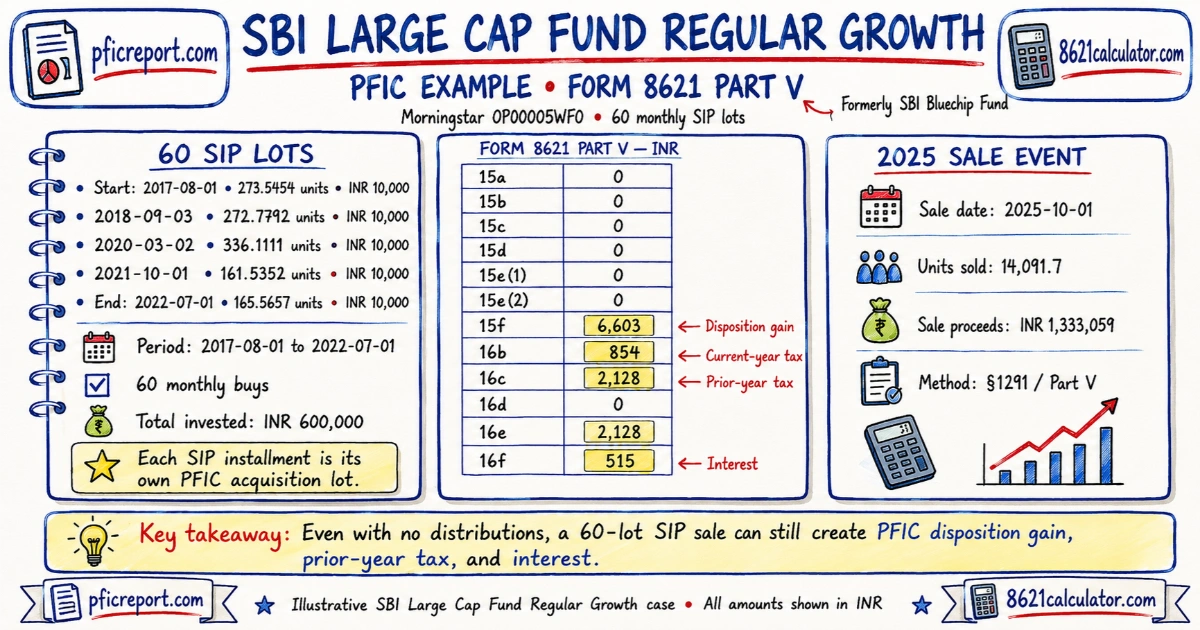
A ₹10,000 monthly SIP from August 2017 through July 2022 created 60 separate acquisition lots. The investor then redeemed the entire SBI Large Cap Fund Regular Growth position on October 1, 2025. This worked example follows those monthly investments through the Form 8621 Part V Section 1291 calculation.
| Fund | SBI Large Cap Fund Regular Growth (0P00005WF0) |
|---|---|
| Former fund name | SBI Bluechip Fund |
| Monthly SIP | ₹10,000 |
| Investment period | August 2017–July 2022 |
| Number of monthly purchases | 60 |
| Total INR invested | ₹600,000 |
| Full redemption | October 1, 2025 |
| Sale proceeds | ₹1,333,058.95 |
| PFIC calculation | Form 8621 Part V · Section 1291 |
SBI SIP PFIC Exchange-Rate Error: Using One Sale-Date Rate
A common mistake is to calculate the SBI mutual fund gain in INR first:
₹1,333,058.95 − ₹600,000 = ₹733,058.95
Then convert that entire gain using the 2025 sale-date exchange rate:
₹733,058.95 ÷ 88.7078 = $8,263.75
This is incorrect because each SIP purchase has its own cost basis under IRC §1012, translated separately into U.S. dollars under the applicable foreign-currency rules; the final INR gain cannot be converted at one sale-date rate.
SBI Large Cap Fund Regular Growth (0P00005WF0)
Monthly price history · August 2017–October 2025 · monthly NAV observations in Indian rupees
How Is a Monthly SBI SIP Reported on Form 8621?
Each monthly SBI SIP investment is tracked as a separate acquisition lot for PFIC calculation purposes. Each installment has a different purchase date, NAV, number of units, INR/USD exchange rate, U.S.-dollar basis and holding period. The five representative rows below show how the monthly INR investments become lot-level U.S. tax basis.
| SIP date | INR invested | NAV | Units | INR per USD | USD basis |
|---|---|---|---|---|---|
| 01 Aug 2017 | ₹10,000 | ₹36.557 | 273.5454222 | 64.0524 | $156.12 |
| 01 Jan 2018 | ₹10,000 | ₹39.232 | 254.8939641 | 63.7080 | $156.97 |
| 02 Mar 2020 | ₹10,000 | ₹29.752 | 336.1118580 | 72.5675 | $137.80 |
| 01 Oct 2021 | ₹10,000 | ₹61.906 | 161.5352308 | 74.1288 | $134.90 |
| 01 Jul 2022 | ₹10,000 | ₹60.399 | 165.5656551 | 78.8804 | $126.77 |
Exchange rates are quoted as INR per USD. Each USD basis amount equals ₹10,000 divided by the transaction-date rate. The complete monthly transaction history is available in the CSV, and the full U.S.-dollar PFIC calculation is available in the Excel workbook above.
Correct SBI SIP Form 8621 Line 15f Calculation
Each ₹10,000 SIP purchase is converted into U.S. dollars using its own purchase-date exchange rate. The sum of all 60 lot-level USD costs produces an aggregate USD basis of $8,424.22.
The October 1, 2025 sale proceeds are converted separately using the sale-date exchange rate: ₹1,333,058.95 ÷ 88.7078 = $15,027.53.
Line 15f gain: $15,027.53 USD amount realized − $8,424.22 aggregate USD basis = $6,603.31, rounded to $6,603 on Form 8621.
See the real-world Form 8621 Line 15f exchange-rate error example.
Form 8621 Part V Results for the SBI Monthly SIP Example
The October 1, 2025 redemption produced ₹1,333,058.95 of sale proceeds. After establishing the U.S.-dollar basis of each monthly purchase and allocating the Section 1291 gain across the holding periods, the completed Form 8621 reports:
| Form 8621 Part V line | Result |
|---|---|
| 15f — disposition gain | $6,603 |
| 16b — current-year allocation | $854 |
| 16c — aggregate increase in tax | $2,128 |
| 16e — additional tax | $2,128 |
| 16f — Section 6621 interest | $515 |
These results come from a single SBI mutual fund position built through 60 monthly SIP purchases—not 60 separate PFICs. The calculation connects the Line 15f disposition gain, the Line 16a allocation statement and the Section 6621 interest charge.
Why Monthly SIP Investments Create Multiple PFIC Acquisition Lots
A monthly SIP is a recurring investment method, but it is not one tax acquisition. Every installment occurs at a new NAV and on a new date. When measured for U.S. tax, each purchase also receives its own transaction-date USD basis and holding period. A later redemption therefore requires lot-level matching and Section 1291 allocation rather than one blended INR cost.
Five years of monthly investing created 60 lots in this example, but the lots normally feed into the Form 8621 calculation for the same fund. They do not automatically require 60 Forms 8621. See how the different holding periods feed into the Form 8621 Line 16a allocation statement.
SBI Mutual Fund US Tax Rules for U.S. Residents and NRIs
Owning an SBI mutual fund becomes a U.S. reporting issue when the investor is a U.S. citizen, green card holder or U.S. tax resident. This often affects NRIs and visa holders—including some H-1B, L-1 and other substantial-presence-test residents—who acquired SBI funds before moving to the United States.
Becoming a U.S. tax resident does not erase older SBI purchases. Existing holdings, continuing SIP installments, later distributions and redemptions must be reconstructed from the relevant U.S. tax years. Stopping an SIP also does not remove the reporting analysis for investments already held. Review the first-year PFIC rules for a new U.S. resident, then determine Form 8621, FBAR and Form 8938 obligations separately.
Is SBI Bluechip Fund the Same as SBI Large Cap Fund?
SBI Bluechip Fund was renamed SBI Large Cap Fund. The name change does not reset the investor's acquisition history. Older statements may show SBI Bluechip Fund while current records show SBI Large Cap Fund, so the workpaper must preserve the original SIP dates and costs while reconciling both names to the same verified fund history. As an India-domiciled pooled mutual fund scheme, the fund should be reviewed under the U.S. PFIC rules.
Can SBI Large Cap Fund Use the PFIC Mark-to-Market Election?
Potentially, but only if all requirements of Treas. Reg. §1.1296-2(d) are verified. Many tax practitioners assume that non-exchange-traded foreign funds can never qualify for Mark-to-Market. However, Treasury Regulation §1.1296-2(d) provides an independent pathway for open-ended funds offering regular NAV redemptions.
As a major retail scheme, SBI Large Cap Fund generally satisfies criteria such as having over 100 shareholders, a low minimum investment (₹500 SIP), daily NAV publication, and SEBI regulation. However, MTM eligibility cannot be assumed solely from daily NAV. In particular, Treas. Reg. §1.1296-2(d)(1)(vi) requires the fund to have no senior securities or more-than-de-minimis debt at all times during the calendar year. Because SEBI regulations permit mutual funds to borrow up to 20% of net assets for temporary liquidity, the fund's annual balance sheets and borrowings must be independently checked before electing MTM.
If no valid MTM or QEF election is established, the fund defaults to the Section 1291 regime, requiring lot-by-lot tracking for all 60 monthly SIP installments as demonstrated in this case study. See the Section 1296 MTM calculation guide and §1291 vs MTM comparison.
Other SBI Mutual Fund Schemes and PFIC Identification
This article's worked calculation is limited to SBI Large Cap Fund Regular Growth. Other SBI schemes require separate identification and PFIC review. The AMFI code and ISIN below identify representative direct-plan growth options; they do not determine a shareholder's U.S. filing result.
| Representative SBI option | AMFI scheme code | ISIN | Workpaper flag |
|---|---|---|---|
| SBI Large Cap Fund — Direct Plan — Growth | 119598 | INF200K01QX4 | Former BlueChip name may appear in history |
| SBI Contra Fund — Direct Plan — Growth | 119835 | INF200K01RA0 | Keep scheme-level lots distinct |
| SBI Flexicap Fund — Direct Plan — Growth | 119718 | INF200K01UG1 | SIP lots; direct/regular plan separation |
| SBI Midcap Fund — Direct Plan — Growth | 119716 | INF200K01TP4 | Former-name reconciliation may be needed |
| SBI ELSS Tax Saver Fund — Direct Plan — Growth | 119723 | INF200K01UM9 | Indian lock-in does not decide U.S. treatment |
AMFI listing date checked: August 13, 2026. Confirm the investor's exact statement because regular plans, IDCW options, renamed schemes and discontinued options use different identifiers.
How to Build an SBI Transaction History for Form 8621
Start with the detailed statement available from the AMC, registrar (see why a CAMS Capital Gains Statement cannot be used directly for U.S. Form 8621) or consolidated statement source. A current-value dashboard is insufficient when the portfolio contains old SIPs, sold schemes or prior switches.
- Collect all folios, including closed and zero-balance positions.
- Retain the exact scheme, plan and option name for every transaction.
- Identify SIP purchases, top-ups, IDCW, STP, SWP, switches and redemptions.
- Reconcile scheme renames, mergers and transaction history.
- Confirm U.S. residency years and any prior Form 8621 elections.
SBI Mutual Fund Redemption: U.S. Tax & Form 8621
A sale, redemption or systematic withdrawal plan transaction must be matched to the relevant acquisition lots. For a Section 1291 fund, the workpaper first calculates the disposition result in U.S. dollars—including transaction-date USD basis and proceeds—before carrying a positive gain into the Section 1291 tax-and-interest calculation. The Form 8621 Line 15f guide follows that process from foreign-currency records through the U.S.-dollar disposition result.
Does an SBI Mutual Fund Switch Trigger U.S. Tax?
An SBI switch-out should be reviewed as a possible disposition and the switch-in as a new acquisition. Moving value between SBI schemes does not become invisible for U.S. tax merely because the transaction remains on the same AMC platform. Preserve both legs, their dates and values.
How Are SBI IDCW Distributions Reported?
An SBI IDCW cash payout must be reviewed as a distribution under the applicable PFIC regime. If the IDCW amount is reinvested, preserve the distribution analysis and record the reinvestment as a new acquisition lot when applicable. “Reinvested” does not mean the transaction can be omitted simply because no cash reached the investor's bank account. See the Form 8621 Section 1291 distribution example for the transaction-level workflow.
Do SBI Mutual Funds Go on FBAR or Form 8938?
They may. FBAR and Form 8938 depend on how the SBI investment is held, the relevant foreign account and asset values, and the applicable filing thresholds. These information returns are separate from Form 8621, so filing one does not automatically satisfy the others. Compare the requirements in FBAR vs Form 8938 vs Form 8621.
Common SBI Mutual Fund PFIC and Form 8621 Mistakes
Combining Multiple SBI Mutual Funds Into One Form 8621
Owning several SBI mutual fund schemes does not usually mean they can all be reported on one Form 8621. SBI Large Cap Fund, SBI Contra Fund and SBI ELSS Tax Saver Fund are separate schemes and generally require separate PFIC identification and Form 8621 analysis.
Treating a Five-Year SBI SIP as One Purchase
A monthly SBI SIP is not one ₹600,000 acquisition for PFIC calculation purposes. Five years of ₹10,000 monthly investments create 60 separate acquisition lots, each with its own acquisition date, units, exchange rate, U.S.-dollar basis and holding period.
Ignoring SBI ELSS Funds Because of the Indian Lock-In Period
The Indian ELSS lock-in period does not remove the need to review the fund under U.S. PFIC rules. Indian tax treatment and redemption restrictions are separate from the U.S. Form 8621 analysis.
Calculating SBI Mutual Fund Gain Only in Indian Rupees
PFIC gain cannot be determined only by comparing the INR purchase price with INR redemption proceeds. Each SBI SIP acquisition needs its own U.S.-dollar basis, and sale proceeds must also be translated into U.S. dollars under the applicable exchange-rate methodology.
Treating an SBI Mutual Fund Switch as Tax-Free
An SBI switch may appear to be only an internal transfer between schemes, but for U.S. tax purposes the switch-out may be a disposition of one PFIC and the switch-in may create a new acquisition in another fund. Old switch transactions should remain in the PFIC transaction history.
Assuming Daily NAV Automatically Qualifies SBI Funds for MTM
While Treas. Reg. §1.1296-2(d) allows open-ended NAV-redeemable funds to qualify for MTM, daily NAV alone does not prove eligibility. Taxpayers must verify all six regulatory tests, especially the absence of more-than-de-minimis debt under SEBI temporary borrowing powers.
Have Multi-Lot Indian Mutual Funds or SIPs?
8621calculator.com computes Section 1291 excess distributions, daily throwback allocations, and Section 1296 MTM using the standard CSV transaction template. $10 per calculation, no registration required.
Frequently Asked Questions
Is SBI Bluechip Fund a PFIC?
Do U.S. residents need to report SBI mutual funds on Form 8621?
How are SBI mutual funds taxed in the U.S.?
Do H-1B holders need Form 8621 for SBI mutual funds?
Does each SBI SIP installment have a separate cost basis?
Does every monthly SIP investment require a separate Form 8621?
Does switching SBI mutual funds count as a sale for U.S. tax?
Do SBI mutual funds need to be reported on FBAR or Form 8938?
Can SBI Large Cap Fund use the PFIC mark-to-market election?
Form 8621 technical guides
Sources
- 26 CFR § 1.1296-2 — Definition of marketable stock (§1.1296-2(d) NAV-redemption rules)
- SEBI (Mutual Funds) Regulations, 1996 — Scheme borrowing powers and disclosures
- AMFI: current scheme code, ISIN, option and NAV listing
- SBI Mutual Fund: 2026 all-schemes factsheet
- SBI Mutual Fund: Open-Ended vs. Close-Ended Mutual Funds
- SEBI: Consolidated Account Statement
- IRS Instructions for Form 8621