
If you are a U.S. citizen, Green Card holder, or a foreign national who is treated as a U.S. tax resident—including many H-1B and L-1 visa holders—and you hold Indian mutual funds, you may naturally download a CAMS Capital Gains Statement when preparing your U.S. tax return. The fundamental problem is that the report was engineered for Indian tax—not U.S. PFIC taxation. Indian mutual funds held by U.S. persons are commonly subject to the PFIC rules under IRC §1297 and may require Form 8621 reporting.
Not directly.
A CAMS Capital Gains Statement is designed to calculate mutual fund gains under Indian tax rules. It typically organizes redemptions using Indian financial years, INR values, FIFO matching, and Indian short-term or long-term capital-gain classifications.
Form 8621 asks a completely different question. For a U.S. taxpayer holding a Section 1291 PFIC, gain recognized on a sale or redemption can require a U.S.-dollar cost basis for the units disposed of, separate acquisition dates and holding periods for SIP lots, a U.S.-dollar amount realized, daily allocation of the gain across the PFIC holding period, historical maximum tax rates, and a Section 6621 interest-charge calculation.
The CAMS Capital Gains Statement can be evidence and source data. It is not the Form 8621 workpaper.
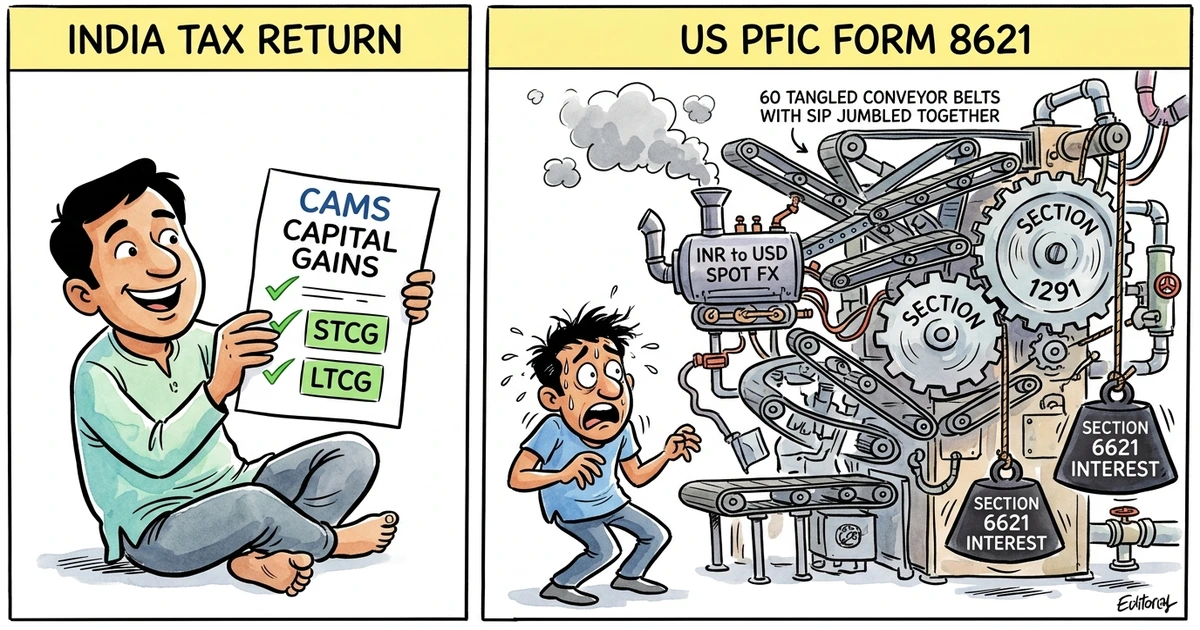
A CAMS Capital Gains Statement is designed for Indian tax reporting. For a U.S. taxpayer holding Indian mutual funds, however, the CAMS STCG or LTCG result is not the final PFIC result reported on Form 8621.
The differences include SIP lot reconstruction, USD basis, switches, IDCW distributions and the Section 1291 interest-charge regime.
What the CAMS Capital Gains Statement Is Actually Designed to Do
For Indian tax filing, the CAMS Capital Gains Statement is extremely useful. It can show information such as:
- folio and scheme;
- purchase date;
- redemption date;
- units sold;
- purchase and sale NAV;
- gain or loss;
- FIFO lot matching; and
- Indian STCG or LTCG classification.
It also separates SIP installments because each installment has its own purchase date and NAV. Indian tax guides therefore commonly use the report as a direct source for completing the capital-gain sections of an Indian ITR.
That is precisely why the report can create problems for U.S. taxpayers. The numbers look complete. They look tax-ready. They may even have been accepted by your Indian CA. But they answer an Indian tax question, not the U.S. PFIC question required by Form 8621.
CAMS Capital Gain vs Form 8621: Seven Important Differences
| CAMS Capital Gains Statement | U.S. PFIC / Form 8621 |
|---|---|
| Indian financial year (April 1 to March 31) | Generally calendar year for individual U.S. taxpayers |
| INR tax calculation | U.S. federal income-tax determination in USD |
| Indian STCG / LTCG classification | Section 1291, QEF or §1296 treatment |
| Indian basis and grandfathering rules (e.g. Jan. 31, 2018 FMV rules) | U.S. adjusted basis determined under U.S. tax rules |
| Indian FIFO gain/loss | PFIC lot-level disposition calculation |
| Indian capital-gain tax result | Section 1291 excess-distribution regime where applicable |
| No §1291 historical interest calculation | Daily allocation + tax + §6621 interest under Part V |
The problem is therefore not that CAMS data is "wrong." It is calculated under a different tax system.
Problem #1: Indian Financial Year Does Not Match the U.S. Tax Year
A CAMS Capital Gains Statement is commonly requested by Indian financial year, running from April through March. A U.S. individual generally files using a calendar tax year.
Consider a CAMS report for 1 April 2025 – 31 March 2026. That single Indian tax report contains transactions falling into two different U.S. calendar tax years:
- April–December 2025 → U.S. tax year 2025
- January–March 2026 → U.S. tax year 2026
Copying the CAMS annual gain total into one U.S. return can therefore put transactions into the wrong U.S. tax year before the PFIC calculation even begins.
Problem #2: CAMS STCG and LTCG Are Not PFIC Tax Categories
CAMS may tell you that a redemption generated ₹150,000 Long-Term Capital Gain. That classification matters under Indian tax law. It does not determine the U.S. treatment of a section 1291 PFIC.
For a section 1291 fund, the IRS states that the entire gain recognized on a disposition is treated as an excess distribution. The Form 8621 calculation then allocates the gain over the shareholder's holding period and applies the special tax-and-interest regime.
So this shortcut is wrong: CAMS LTCG → convert ₹ to $ → report as long-term capital gain on Schedule D. The U.S. PFIC calculation must happen first.
Problem #3: A Rupee Gain Is Not Necessarily Your U.S.-Dollar Gain
U.S. federal income-tax determinations are generally made in U.S. dollars. The IRS has long applied the principle that foreign-currency acquisition cost and disposition proceeds must be translated into dollars at the relevant transaction dates.
This creates a result that surprises many Indian investors. Suppose you bought an investment for ₹100,000 and later sold it for ₹100,000. From an INR perspective: Gain = ₹0.
But if the INR/USD exchange rate changed significantly between the acquisition date and sale date, the U.S.-dollar cost basis and U.S.-dollar proceeds can be different. The reverse can also occur.
CAMS calculates an Indian rupee tax result. Form 8621 ultimately needs a U.S. tax result. That distinction becomes much more important when an investor has dozens of historical SIP purchases.
Converting net INR gain directly to USD at a single sale-date or year-end exchange rate is one of the most widespread PFIC errors. For a real-world case comparing an Indian CPA workpaper that made this INR-first conversion mistake against the proper transaction-date method, see our detailed guide on Form 8621 Line 15f: PFIC Gain/Loss & USD Cost Basis Rules.
Problem #4: A Five-Year SIP Is Not One PFIC Lot
This is where Indian mutual funds become especially difficult. Suppose you invested monthly through an SIP for five years. That is not one acquisition. It may be 60 separate purchases.
Each SIP installment can have its own:
- acquisition date;
- number of units;
- NAV;
- INR cost;
- USD cost basis;
- holding period; and
- share of a later redemption.
A single "average cost" or aggregate CAMS gain cannot replace those historical lot records when the U.S. calculation requires the actual holding period and basis of the units disposed of.
| SIP Lot | Purchase Date | INR Cost | Units | USD Basis |
|---|---|---|---|---|
| Lot 1 | 15-Jan-2021 | ₹25,000 | 250.000 | separately determined |
| Lot 2 | 15-Feb-2021 | ₹25,000 | 238.095 | separately determined |
| Lot 3 | 15-Mar-2021 | ₹25,000 | ... | separately determined |
| ... | ... | ... | ... | ... |
| Lot 60 | 15-Dec-2025 | ₹25,000 | ... | separately determined |
When some units are later redeemed, the PFIC workpaper must identify the affected acquisition lots and preserve their separate holding periods. The current Form 8621 instructions specifically require separate Part V treatment where shares have different holding periods and require the excess distribution or disposition gain to be allocated to each day in the relevant holding period.
This is why the "SIP nightmare" is not simply a data-entry problem. It is a lot-reconstruction problem.
Want to see how 60 monthly SIP installments, individual USD spot rates, and a 2025 full redemption are processed into complete Form 8621 Part V workpapers? Explore our step-by-step SBI Mutual Fund 60-Lot SIP Benchmark Case Study →
Problem #5: Mutual Fund Switches and STPs Can Be U.S. Tax Events
Indian investors often move money between schemes using Switch Out, Switch In, STP Out, or STP In. Operationally, it can feel as though the money never left the mutual fund platform.
For U.S. tax purposes, however, a switch out of one fund generally requires analysis as a disposition of that fund, while the units acquired in the target fund establish a new investment position. For a section 1291 PFIC, gain recognized on the disposition must be processed under the section 1291 rules.
A typical workpaper therefore treats the transaction chain as:
(Disposition & §1291 Gain/Loss)
(New Lot & USD Spot Basis)
This is not something that can be solved by taking a single CAMS annual LTCG total.
Problem #6: IDCW Payouts and Reinvestments Require Separate PFIC Analysis
IDCW creates another common trap:
- IDCW Payout: A cash distribution from the fund is a distribution that may need to be tested under the section 1291 excess-distribution rules.
- IDCW Reinvestment: Reinvestment does not make the distribution disappear. Economically, the investor receives a distribution and uses it to acquire additional units. That means the transaction can create: (1) a distribution event; and (2) a new acquisition lot.
The December 2025 Form 8621 instructions also introduced an important foreign-currency rule for Part V: If all distributions used in the excess-distribution calculation are made in a single foreign currency, the IRS instructions require the excess distribution to first be determined in that foreign currency. The relevant amount is then translated into U.S. dollars under the Part V rules.
For an INR-denominated fund where all relevant distributions are made in INR, the 125% excess-distribution test is performed in INR under the current Form 8621 instructions, rather than converting three years of distributions into USD first and then averaging them. A CAMS Indian capital-gain total does not perform this calculation.
For full details on 125% threshold tests, first-year rules, and reinvestment lots, explore our dedicated Indian Mutual Fund IDCW US Tax Guide →.
Problem #7: CAMS Does Not Calculate the Section 1291 Interest Charge
Even if the underlying disposition gain happened to be numerically identical in INR-equivalent terms, the CAMS report would still not produce the final U.S. PFIC liability.
Under section 1291, the relevant gain or excess distribution may need to be allocated across the shareholder's holding period. The Form 8621 instructions require the taxpayer to:
- allocate the amount to each day in the holding period;
- total the amount allocated to each tax year;
- determine the applicable increase in tax for prior PFIC years; and
- calculate interest using section 6621 rates.
This calculation can span many years and is completely outside the purpose of a CAMS Capital Gains Statement. For complete mechanics on compounding rates and allocation schedules, read our technical breakdown on Section 1291 & Section 6621 Interest Calculations.
Worked Example: CAMS Gain vs U.S. PFIC Gain
Consider an investor in HDFC Flexi Cap Fund:
1. CAMS Transaction History
| Date | Transaction | Amount | Units | NAV |
|---|---|---|---|---|
| 15-Jan-2021 | SIP Purchase | ₹25,000 | 250.000 | ₹100 |
| 15-Feb-2021 | SIP Purchase | ₹25,000 | 238.095 | ₹105 |
| 20-Mar-2022 | IDCW Reinvestment | ₹4,880.95 | 40.675 | ₹120 |
| 10-Oct-2025 | Partial Redemption | ₹60,000 | 300.000 | ₹200 |
Assume the 300-unit redemption is matched to all 250 units from the January 2021 lot and 50 units from the February 2021 lot.
2. U.S.-Dollar Lot Reconstruction
Using historical spot exchange rates (15-Jan-2021: 73.10; 15-Feb-2021: 72.75; 10-Oct-2025: 84.00):
| Lot | Acquisition | Units Sold | USD Basis | USD Proceeds | Holding Days | Gain |
|---|---|---|---|---|---|---|
| Lot 1 | 15-Jan-2021 | 250 | $342.00 | $595.24 | 1,729 | $253.24 |
| Lot 2 | 15-Feb-2021 | 50 | $72.16 | $119.05 | 1,698 | $46.89 |
| Total | $414.16 | $714.29 | — | $300.13 | ||
The U.S. section 1291 disposition gain is therefore: $714.29 − $414.16 = $300.13.
That number—not the CAMS INR STCG/LTCG total—is the starting point for the applicable Form 8621 Part V disposition calculation. The $300.13 then must be associated with the relevant historical lots and holding periods for the section 1291 allocation and interest calculation.
So What Should You Download From CAMS?
The Capital Gains Statement is still useful. Do not throw it away. It may provide useful redemption-level information such as purchase date, sale date, units and NAV.
But for a complete Form 8621 reconstruction—particularly where you have long-running SIPs, switches, reinvestments or historical positions—you may also need a Detailed CAS or complete transaction history extending far enough back to identify the actual acquisition lots.
The objective is to obtain enough underlying data to reconstruct: acquisition → lot → disposition/distribution → U.S. PFIC calculation.
If your investments span CAMS and KFintech-serviced fund houses, confirm that your records cover all relevant schemes rather than assuming a CAMS-only report contains the entire portfolio.
What a Proper CAMS-to-Form-8621 Workpaper Should Show
A defensible PFIC calculation should normally preserve enough information to trace the Form 8621 result back to the underlying Indian records. For a disposition, that can include:
- fund and folio identification;
- acquisition date for each lot;
- units acquired and disposed of;
- original INR cost and U.S.-dollar cost basis;
- disposition date, INR proceeds, and U.S.-dollar proceeds;
- holding-period days;
- section 1291 gain, daily/yearly allocation, and historical tax rates; and
- section 6621 interest and final Form 8621 Part V amounts.
What About the $25,000 Form 8621 Exception?
Certain small PFIC holdings may qualify for a reporting exception in limited circumstances. For an individual, the Form 8621 instructions provide a $25,000 aggregate-value threshold, increased to $50,000 for a joint return.
Crucially: the exception does not apply where the shareholder recognizes gain on the sale or disposition of the section 1291 fund or receives an excess distribution. So the fact that your Indian mutual funds were worth less than $25,000 does not automatically solve the problem after a taxable redemption.
Already Filed FBAR or Form 8938? That Does Not Perform the PFIC Calculation
Another common misunderstanding is: "My Indian accounts were already disclosed on FBAR or Form 8938, so the IRS already knows about them."
Disclosure of the account balance and computation of PFIC income are completely different legal obligations. If a required Form 8621 was omitted, IRC §6501(c)(8) can suspend the statute of limitations for assessment with respect to the unreported PFIC information and, depending on the circumstances, potentially other items on the return. Explore our Missed Form 8621 Remediation Guide for streamlined resolution.
Have Multi-Lot Indian Mutual Funds or SIPs?
8621calculator.com computes Section 1291 excess distributions, daily throwback allocations, and Section 1296 MTM using the standard CSV transaction template. $10 per calculation, no registration required.
Frequently Asked Questions
Can I give my CAMS Capital Gains Statement to my U.S. CPA?
Yes. It can be a useful source document. But the preparer should not simply transfer its Indian STCG/LTCG totals into the U.S. return. The relevant transactions need to be analyzed under U.S. PFIC rules.
Is CAMS LTCG treated as long-term capital gain in the United States?
Not automatically. If the fund is a section 1291 PFIC, gain recognized on its disposition is subject to the special section 1291 regime rather than simply retaining the Indian LTCG classification.
Does every SIP installment matter?
Potentially, yes. Separate SIP purchases have different acquisition dates, basis and holding periods. Those differences can matter when units are disposed of.
Can I use an average INR/USD exchange rate?
Use the shared FX rules to select the rate for each event. Keep the dated INR purchases and redemption proceeds from CAMS; the worked example above shows why translating one net INR gain can produce a different result.
Is a mutual fund switch taxable for U.S. PFIC purposes?
A switch out of one fund generally requires analysis as a disposition of that fund, while the switch into the new fund creates a new investment position. If the source fund is a section 1291 PFIC and a gain is recognized, section 1291 applies to that gain.
Is IDCW reinvestment harmless because I received no cash?
No. Reinvestment can still involve a distribution followed by the acquisition of additional units. The distribution may require analysis under the section 1291 excess-distribution rules.
My PFIC holdings are below $25,000. Can I ignore Form 8621 after selling?
Not on the basis of the $25,000 exception alone. The IRS exception is unavailable when gain is recognized on a sale or disposition of the section 1291 fund or an excess distribution is received.
Do FBAR and Form 8938 replace Form 8621?
No. They address different reporting obligations. Form 8621 is the form on which the PFIC regime itself is reported and calculated.
Continue Exploring the India PFIC Compliance Hub
Technical Sources
- IRS Instructions for Form 8621 (Rev. December 2025)
- IRC §1291: Treatment of Distributions from PFICs
- IRC §1296: Election of Mark to Market for Marketable Stock
- IRC §1298: Special Rules and Definitions
- IRC §6621: Determination of Rate of Interest
- Treas. Reg. §1.988-2: Foreign Currency Transactions
- IRS Chief Counsel Advice 200303021, citing Rev. Rul. 54-105 and Rev. Rul. 78-281 (Foreign Currency Basis and Proceeds Translation)
- CAMS Online: Capital Gain / Capital Loss Statement