
Indian parents often leave long-held SBI, HDFC, ICICI Prudential, UTI or other Indian mutual fund units to children who are U.S. taxpayers. Because Indian mutual funds commonly meet the U.S. PFIC tests under IRC §1297, U.S. heirs face both Form 8621 compliance and inherited-basis questions.
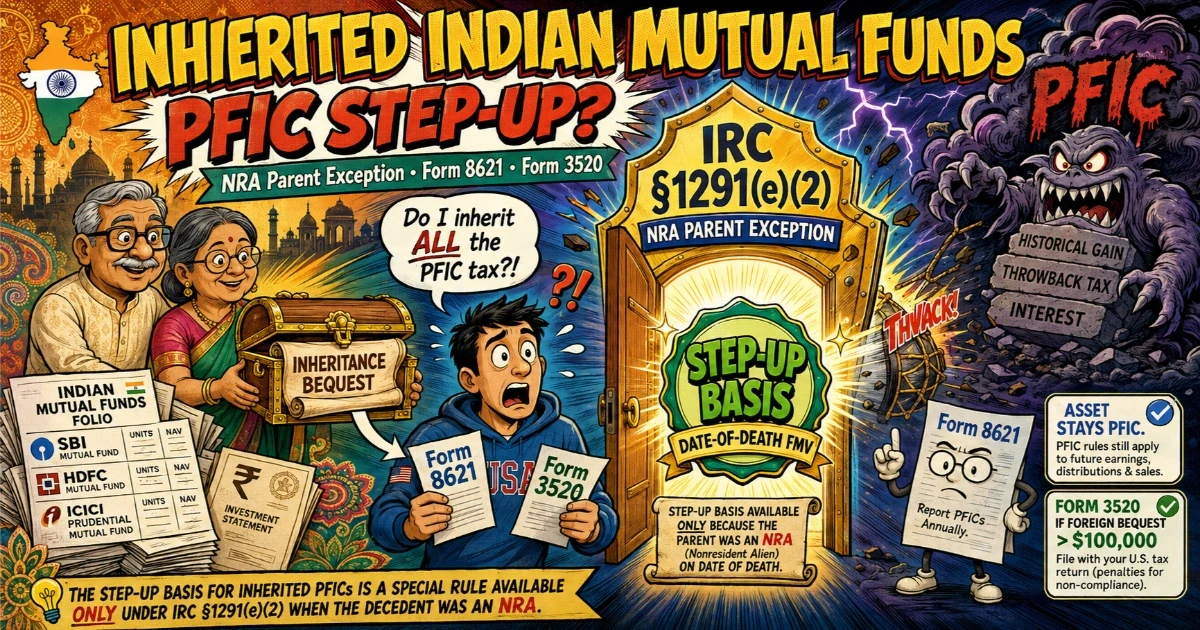
The key surprise: for a default §1291 PFIC inherited from a parent who was a nonresident alien (NRA) throughout the holding period, IRC §1291(e)(2) switches off the special PFIC basis limitation and allows the normal IRC §1014 date-of-death fair market value (FMV) basis rule to apply.
- The IRC §1291(e)(2) NRA Exception: For default §1291 funds, while §1291(e)(1) generally restricts step-up basis for PFICs, §1291(e)(2) explicitly turns off this limitation when the deceased shareholder was an NRA throughout their holding period. The heir receives a date-of-death FMV basis under IRC §1014(a).
- Asset Remains Subject to PFIC Rules: The fund remains subject to the PFIC rules after inheritance. Post-death gains and IDCW distributions can trigger IRS Form 8621 reporting, subject to applicable filing rules and exceptions.
- Form 3520 Aggregate Threshold ($100,000): U.S. beneficiaries receiving more than $100,000 in aggregate foreign bequests or inheritances from an NRA or foreign estate in a tax year must report the receipt on Form 3520 (Part IV).
Are Inherited Indian Mutual Funds Taxable in the U.S.?
Receiving Indian mutual funds as a genuine inheritance from a nonresident alien parent is generally not itself taxable income to the U.S. heir. However, reporting obligations may begin immediately: a foreign bequest above the applicable threshold may require Form 3520, while Indian mutual fund units owned by a U.S. person may be subject to the PFIC rules and Form 8621.
The key question is therefore not simply “Is the inheritance taxable?” but “What is my U.S. cost basis, and what happens when I hold, receive distributions from, or sell the inherited PFIC?”
Do Inherited Indian Mutual Funds Get a Step-Up in Basis?
Under general U.S. tax principles in IRC §1014(a), property acquired from a decedent receives a basis equal to the fair market value (FMV) of the property at the date of the decedent's death.
For foreign corporations subject to PFIC rules, IRC §1291(e)(1) generally limits the basis of PFIC stock acquired from a decedent to the lesser of the decedent's adjusted basis immediately before death or the date-of-death FMV. However, Congress enacted an explicit exception for foreign estates.
IRC §1291(e)(2): The NRA Decedent Exception
IRC §1291(e)(2) provides an explicit exception for stock acquired from a decedent who was a nonresident alien at all times during the decedent's holding period:
Statutory Text of 26 U.S. Code § 1291(e)(2)
“Paragraph (1) shall not apply to any stock in a foreign corporation acquired from a decedent if the decedent was a nonresident alien at all times during his holding period in such stock.”
When §1291(e)(2) applies, the carryover basis limitation in §1291(e)(1) is eliminated, and the heir takes a full IRC §1014(a) date-of-death FMV basis. Inherited-property holding-period rules, including IRC §1223(9) (treating inherited property satisfying §1014 as held for more than 1 year), must be analyzed separately when the heir later disposes of the fund.
Numerical Example: How §1291(e)(2) Changes the PFIC Gain
Consider an example illustrating how IRC §1291(e)(2) changes the PFIC gain entering Form 8621:
Numerical Comparison: Carryover vs. §1291(e)(2) Step-Up
• Deceased Parent: Resided in India, lifelong Indian citizen and NRA for U.S. tax purposes.
• Parent's Historical Purchase (2005): ₹15,00,000 (~$35,000 USD historical equivalent).
• Date of Death FMV: ₹1,20,00,000 ($144,000 USD equivalent at valuation date spot rate).
• Subsequent Sale by U.S. Heir: Folios redeemed for $147,000 USD.
| Factor | Incorrect Carryover Assumption | §1291(e)(2) + §1014 Treatment |
|---|---|---|
| Parent Historical Basis | $35,000 | — |
| Date-of-Death FMV | — | $144,000 |
| Sale Proceeds | $147,000 | $147,000 |
| Gain Entering PFIC Disposition Analysis | $112,000 | $3,000 |
The key result is not that the inherited PFIC becomes tax-free. Rather, the §1014 basis can remove the parent's pre-death appreciation from the heir's gain computation. The remaining post-death gain ($3,000) is then analyzed under the PFIC rules applicable to the heir.
What If the Parent Was a U.S. Citizen or U.S. Tax Resident?
The availability of the step-up under §1291(e)(2) hinges strictly on whether the deceased parent was an NRA at all times during their holding period:
| Parent / Decedent Status | U.S. Heir Basis Outcome | Statutory Basis & Reporting Consequence |
|---|---|---|
| Nonresident Alien (NRA) at all times | Full FMV Step-Up under IRC §1014(a) | IRC §1291(e)(2) switches off the penalty. Pre-death appreciation is eliminated from the heir's gain computation. |
| Was a U.S. citizen or U.S. tax resident during any portion of the holding period | NO Step-Up (Carryover Basis) under §1291(e)(1) | For default §1291 stock, the §1014 step-up limitation may leave pre-death appreciation embedded in the heir's later PFIC disposition analysis. Existing QEF, MTM, or other PFIC elections can change the result. The controlling question is whether the decedent was a nonresident alien for U.S. federal income tax purposes throughout the entire PFIC holding period. Prior Green Card status, U.S. residence, or substantial U.S. presence can therefore require a closer residency analysis rather than a simple immigration-status assumption. |
Exception: Existing §1296 Mark-to-Market Election
If a valid Section 1296 mark-to-market (MTM) election was in effect at death, the normal §1291(e)(2) analysis above is not enough. Under IRC §1296(i) and Treas. Reg. §1.1296-1(d)(4), inherited basis is generally limited to the decedent's adjusted basis immediately before death or the otherwise applicable §1014 basis, whichever is lower.
Form 3520 for Inheritance From India: The $100,000 Rule for Mutual Funds
Under IRS Form 3520 Part IV rules, any U.S. person who receives more than $100,000 in aggregate foreign bequests or inheritances from a nonresident alien or foreign estate during a calendar year must report the transaction on Form 3520:
- Aggregate Annual Threshold: The $100,000 threshold applies to the total aggregate value of all reportable foreign gifts and bequests received from the relevant foreign person/estate (and related foreign entities) in that calendar year—not on a fund-by-fund basis. Once exceeded, individual bequests above $5,000 must be separately identified.
- Strictly Informational: Form 3520 is an informational disclosure; filing it does not generate an income tax liability.
- Substantial Penalties for Non-Filing: Under IRC §6039F, failure to file Form 3520 Part IV carries penalties starting at 5% per month, up to a maximum of 25% of the gross bequest value.
Cost Basis of Inherited Indian Mutual Funds: Date-of-Death NAV & USD Basis
To establish supportable records for an inherited Indian mutual fund position:
- Obtain the Official Date-of-Death NAV: Under Treas. Reg. §20.2031-8, open-end mutual fund units are valued at their public redemption price (NAV) on the applicable valuation date; if no redemption price is quoted because the date falls on a weekend or market holiday, use the applicable preceding quoted price.
- Apply the Supportable Spot Exchange Rate: Convert the total INR valuation into USD using a supportable USD/INR spot exchange rate for the valuation date from a reliable published source, applied consistently and retained in the workpapers.
- Establish Unit-Level USD Basis: Divide the total USD date-of-death valuation by total transmitted units to fix the per-unit basis.
Selling Inherited Indian Mutual Funds: Form 8621 & PFIC Tax
When a U.S. heir subsequently redeems or sells inherited Indian mutual fund units, the transaction is reported on Form 8621 Part V:
- Gross Proceeds: Sale proceeds translated to USD on the trade date.
- Adjusted Basis: Stepped-up USD basis established on the date of death.
- Gain Allocation: Only the net post-death gain enters the Section 1291 disposition allocation engine. For a detailed breakdown of redemption rules, currency conversions, and Line 15f calculations, review our Selling Inherited Indian Mutual Funds: Form 8621 Guide →.
Inherited Indian Mutual Fund Documents: NAV, Death Certificate & Transmission Records
Maintain the following documentary evidence in your permanent tax files:
- Official certified death certificate of the parent
- Documentation substantiating the parent's NRA status throughout their holding period (Indian passport, Aadhaar, PAN, residency proof)
- CAMS / KFintech transmission statements reflecting transferred folios and unit counts
- Official AMC/AMFI NAV statement on the valuation date
- Published USD/INR spot exchange rate documentation for the valuation date
- Copy of timely filed Form 3520 (if total inheritances exceeded $100,000)
- Lot ledger recording the stepped-up cost basis per unit
Indian Mutual Fund Transmission After Death: CAMS & KFintech Records
In India, transferring mutual fund units after the death of the registered holder is generally called transmission of units, not a normal sale or transfer. CAMS and KFintech transmission records can therefore become important evidence of the inherited folio, unit count, claimant or nominee, and the date the units were moved into the heir's name. The Indian transmission date should not automatically be substituted for the U.S. date-of-death valuation date.
Frequently Asked Questions
Are inherited Indian mutual funds taxable when I inherit them?
Receiving mutual funds as a bona fide inheritance from a nonresident alien parent is generally not itself taxable income to the U.S. heir. However, informational reporting on Form 3520 (Part IV) applies if total foreign inheritances exceed $100,000, and ongoing PFIC reporting on Form 8621 applies to post-death distributions or sales.
Do inherited Indian mutual funds get a step-up in basis?
For a default Section 1291 PFIC, generally yes if the deceased parent was a nonresident alien throughout their holding period. Under IRC §1291(e)(2), the restrictive PFIC basis limitation in §1291(e)(1) is switched off, allowing the heir to receive a date-of-death fair market value basis under IRC §1014(a).
What if my parent was previously a U.S. tax resident or Green Card holder?
The controlling statutory requirement is whether the decedent was a nonresident alien throughout the entire PFIC holding period. If the parent was a U.S. citizen, Green Card holder, or met the substantial presence test during any part of their holding period, §1291(e)(2) fails and the heir generally takes a carryover basis under §1291(e)(1).
Do inherited Indian mutual funds require Form 8621?
Indian mutual funds commonly meet U.S. PFIC tests under IRC §1297. A U.S. heir becomes the PFIC shareholder upon inheritance and must evaluate Form 8621 annually for post-death excess distributions, mark-to-market events, or dispositions, subject to filing exceptions under Treas. Reg. §1.1298-1.
Do I need Form 3520 for inherited Indian mutual funds over $100,000?
Yes. If the aggregate value of all foreign gifts and bequests received from the foreign decedent/estate (and related foreign persons) exceeds $100,000 in a calendar year, you must file Form 3520 Part IV. Individual bequests exceeding $5,000 must be separately identified.
Should I sell inherited Indian mutual funds immediately?
Not automatically without preparation. First establish your §1014 stepped-up basis, secure the date-of-death NAV and spot exchange rate workpapers, and complete Indian transmission procedures. When you redeem, only the post-death gain enters the Form 8621 Section 1291 disposition calculation.
Bottom Line
For the common case where an Indian parent was an NRA at all times and a U.S. heir inherits Indian mutual funds:
- Do not assume you must carry over the parent's decades-old purchase cost.
- IRC §1291(e)(2) preserves your date-of-death FMV basis under §1014.
- Report the foreign bequest on Form 3520 (Part IV) if total inheritances exceed $100,000.
- Manage ongoing Form 8621 compliance based on your stepped-up basis and post-death transactions.
Official Tax Authorities & Sources
- IRS: About Form 8621 (Information Return by a Shareholder of a Passive Foreign Investment Company).
- IRS: Instructions for Form 8621 (Rev. December 2025).
- Cornell Law (LII): 26 U.S. Code § 1291(e)(2) — Exception Where PFIC Held by Nonresident Alien Decedent.
- Cornell Law (LII): 26 U.S. Code § 1014(a) — Basis of Property Acquired from a Decedent.
- Cornell Law (LII): 26 U.S. Code § 1296(i) — Mark-to-Market Stock Acquired from a Decedent.
- Cornell Law (LII): Treas. Reg. § 20.2031-8 — Valuation of Shares in an Open-End Investment Company.
- IRS: About Form 3520 (Annual Return to Report Transactions With Foreign Trusts and Bequests).
- Cornell Law (LII): 26 U.S. Code § 6039F — Notice of Large Gifts Received from Foreign Persons.