
When investing in Indian mutual funds through Asset Management Companies (AMCs) like SBI, HDFC, ICICI Prudential, Nippon India, Axis, or Mirae Asset, investors generally choose between two primary scheme options: Growth and IDCW (Income Distribution cum Capital Withdrawal).
For a U.S. taxpayer, an IDCW payment must be tested under the PFIC rules. Form 8621 filing depends on whether the payment is an excess distribution and whether another filing trigger or exception applies.
Unlike domestic U.S. mutual fund dividends, IDCW distributions from Indian funds are subjected to the punitive default regime of IRC §1291, requiring mathematical 125% sliding average tests (Part V), multi-year holding period ratable proration, and compounding interest charges.
- Zero Qualified Dividend Treatment: Under IRC §1(h)(11)(C)(iii), PFIC distributions can never qualify for preferential 0%/15%/20% long-term qualified dividend tax rates.
- 125% Historical Distribution Baseline: Current-year distributions exceeding 125% of the preceding 3-year average are classified as excess distributions, thrown back across prior holding years at maximum historical federal rates plus §6621 interest.
- Reinvestment Creates Phantom Lots: Reinvested IDCW is treated as a constructive cash distribution entering Form 8621 Part V, followed immediately by an acquisition of new units that creates an independent purchase lot.
- Foreign Tax Credit (TDS) Apportionment: Indian NRI TDS (20%+) cannot simply be dumped into Form 1040 Schedule 3; it must be split between non-excess distributions and Form 8621 Line 16d creditable excess distributions.
IDCW Demystified: Why SEBI's Terminology Matters for U.S. PFIC Law
In April 2021, the Securities and Exchange Board of India (SEBI) officially renamed all mutual fund "Dividend Options" to "Income Distribution cum Capital Withdrawal (IDCW)". SEBI mandated this to emphasize to investors that distributions are not pure earnings yields; funds frequently distribute capital gains and even paid-in unit capital.
From the perspective of the IRS, however, all transfers of value from a foreign corporation or pooled fund to a shareholder constitute distributions under IRC §301 and IRC §1291.
Under Section 1291 default rules, an IDCW event is segregated into two distinct tax tiers:
- Non-Excess Distribution: The portion equal to or less than 125% of the average distributions of the preceding 3 tax years (or the taxpayer's holding period if shorter). This amount is taxed under normal IRC §301 rules as ordinary non-qualified dividend income to the extent of the fund's earnings and profits (E&P).
- Excess Distribution (Form 8621 Line 15e): Any dollar amount above the 125% threshold. This excess is ratably allocated over every single day of the taxpayer's holding period for that lot. Amounts allocated to prior PFIC years are taxed at the highest individual statutory rate in effect for those years (e.g., 37% or 39.6%) plus compounding interest under IRC §6621.
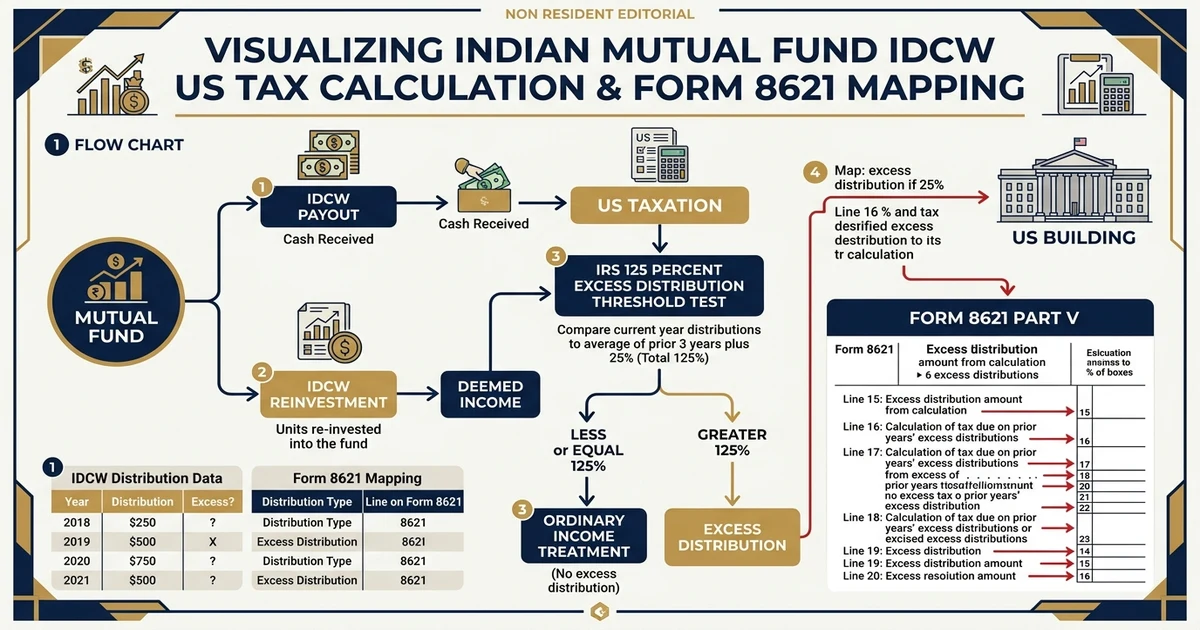
The 125% Historical Baseline Calculation (Form 8621 Part V)
To execute Part V of Form 8621 for an IDCW distribution, you must reconstruct the historical distribution history of the specific fund position for the preceding three tax years:
| Form 8621 Line | IRS Field Description | Statutory Rule & Mechanical Calculation |
|---|---|---|
| Line 15a | Total distributions received in the current tax year | Gross INR distribution translated to USD at the spot exchange rate on the actual distribution date. |
| Line 15b | Total distributions received in preceding 3 tax years | Sum of all gross USD distributions received in Year t-1, Year t-2, and Year t-3 for the exact fund units held. |
| Line 15c | 3-Year Average Distribution | Line 15b ÷ 3 (or divided by the number of preceding years in the holding period if held < 3 years). |
| Line 15d | 125% Threshold Ceiling | Line 15c × 1.25 |
| Line 15e(1) | Excess Distribution (Functional Currency) | Line 15a − Line 15d in functional currency (INR). If Line 15a ≤ Line 15d, enter $0. |
| Line 15e(2) | Excess Distribution in U.S. Dollars | Line 15e(1) converted to USD spot rate, or calculated directly in USD. This amount flows to Line 16a allocation. |
Case Study: 125% Excess Distribution on ICICI Prudential Multi-Asset IDCW
An H-1B engineer acquired 10,000 units of ICICI Prudential Multi-Asset Fund - IDCW Plan on January 15, 2023. The position paid the following historical distributions:
- 2023 Gross IDCW: $400 USD equivalent
- 2024 Gross IDCW: $600 USD equivalent
- 2025 Gross IDCW: $500 USD equivalent
- 2026 Gross IDCW (Current Year): $1,250 USD equivalent (paid on September 10, 2026)
Step 2: Calculate Line 15c Average: $1,500 ÷ 3 = $500
Step 3: Calculate Line 15d 125% Threshold: $500 × 1.25 = $625
Step 4: Non-Excess Distribution: $625 (Reported as ordinary non-qualified dividend on Form 1040 Line 3b)
Step 5: Excess Distribution (Line 15e(2)): $1,250 − $625 = $625
Step 6: Ratable Throwback Allocation (Line 16a): The $625 excess is allocated evenly across 1,335 total holding days (from Jan 15, 2023 to Sep 10, 2026). The portions assigned to 2023, 2024, and 2025 are taxed at 37% plus daily compounding §6621 interest!
For a dedicated guide on how multi-tier prior distributions are filtered on Line 15b, read our technical breakdown: Form 8621 Line 15b: Prior-Year Distribution Base & 125% Test Guide →. For full Line 16a calendar allocation statements, see Form 8621 Line 16a Ratable Allocation Statement →.
IDCW Payout vs. IDCW Reinvestment vs. Growth: Tax Comparison Matrix
Indian mutual fund platforms like CAMS, KFintech, Zerodha Coin, and Groww offer multiple distribution methods. Each produces vastly different compliance overhead under IRS Form 8621:
| Plan Feature | IDCW Payout (Cash) | IDCW Reinvestment | Growth Option (Accumulating) |
|---|---|---|---|
| Cash Flow | Deposited into NRI NRE/NRO bank account. | Zero cash received; automatically buys additional fund units. | Zero cash; profits reflected solely in NAV appreciation. |
| Annual U.S. Tax Event? | YES (Form 8621 Part V 125% test every distribution year). | YES (Form 8621 Part V 125% test on gross constructive payout). | NO (No annual distribution; annual §1298(f) Part I summary only). |
| Impact on Lot Architecture | Unit count remains constant. | CREATES NEW LOTS with unique purchase dates and USD cost basis. | Original SIP lots remain pristine without fragmented distribution lots. |
| Subsequent Sale / Redemption | Standard §1291 disposition gain calculation (Sold Indian Mutual Funds Guide). | Complex multi-lot disposition requiring lot-by-lot FIFO matching. | Standard multi-lot SIP disposition (60-Lot SBI Benchmark). |
| IRS Audit Complexity | High (Requires 3-year prior proof & FX verification). | Extreme (Requires reconciling phantom units and historical basis). | Moderate (Clean historical transaction ledger). |
The First-Year Exception & The Zero-Baseline Trap
Understanding holding period boundaries is essential to avoid overpaying or misreporting Form 8621:
A. The First-Year Exception
Under official IRS Form 8621 Instructions (Part V), if your holding period for the mutual fund stock began in the current tax year, there is no excess distribution.
- The distribution is entered on Line 15a ($500).
- Lines 15b through 15e are left blank or zeroed out because the stock was acquired in the current tax year.
- The full $500 is treated as a normal dividend under IRC §301(c)(1) and reported as ordinary dividend income on Form 1040 (Schedule B). No throwback tax or §6621 interest applies.
B. The Zero-History Baseline Trap
Conversely, if you acquired the mutual fund in 2023 under the IDCW option, but the AMC declared zero distributions in 2023, 2024, and 2025, and then declared a massive distribution in 2026:
- Line 15b Prior Base: $0 + $0 + $0 = $0
- Line 15c Average: $0 ÷ 3 = $0
- Line 15d 125% Ceiling: $0 × 1.25 = $0
- Line 15e Excess Distribution: 100% of the 2026 distribution becomes an excess distribution!
In this scenario, because the holding period began before the current tax year, every dollar of the payout is thrown back over the 4-year holding period, incurring maximum federal marginal tax rates and multiple years of compound interest penalties.
Indian NRI TDS & Form 8621 Line 16d Foreign Tax Credit Apportionment
Under Section 194K and Section 195 of the Indian Income Tax Act, AMCs deduct Tax Deducted at Source (TDS) at a flat 20% (plus applicable surcharge and health/education cess, typically totaling 20.8% to 23.92%) on IDCW distributions paid to Non-Resident Indians (NRIs).
Many U.S. preparers erroneously claim the entire Indian TDS on Form 1116 as a general dividend foreign tax credit. Under Treas. Reg. §1.1291-9 and Form 8621 Line 16d, creditable foreign taxes must be strictly bifurcated:
| Distribution Component | Proportion of Indian TDS | U.S. Tax Reporting & Crediting Mechanism |
|---|---|---|
| Non-Excess Distribution Portion (Line 15a − Line 15e) | Total TDS × (Non-Excess ÷ Line 15a) |
Reported on Form 1116 (Passive Category Income) to offset regular U.S. tax on the ordinary dividend income. |
| Excess Distribution Portion (Form 8621 Line 15e) | Total TDS × (Excess ÷ Line 15a) |
Entered on Form 8621 Line 16d. Ratably allocated across prior PFIC years on Line 16e to directly reduce the §1291 throwback tax liabilities. |
CAMS and KFintech IDCW Statement Parsing Workflow
To transform raw Indian Mutual Fund records into audit-proof Form 8621 workpapers, follow this structured five-step workflow:
-
Extract Gross Distributions from Consolidated Account Statements (CAS):
In your CAMS or KFintech statement, locate transaction descriptions labeled "IDCW Reinvest" or "IDCW Payout". Always record the Gross Distribution INR Amount (before Indian TDS deduction) and the Record/Payment Date. -
Convert at Historical Spot Exchange Rates:
Translate each distribution event into USD using the published consistent with Form 8621 instructions spot exchange rate (e.g., Federal Reserve or Treasury FX rates) on the specific payment date. -
Reconstruct the 3-Year Prior Base per Folio:
Retrieve previous tax returns or CAS histories for the exact folio and ISIN. Sum distributions received in years t-1, t-2, and t-3 to populate Line 15b. -
Create New Purchase Lots for Reinvested Units:
For every "IDCW Reinvest" entry, create a new lot row:Lot Acquisition Date = Distribution DateLot Unit Quantity = Units AllocatedLot Cost Basis = Gross Reinvested INR converted to USD spot rate -
Execute Section 1291 Calendar Throwback Engine:
Rigorously prorate any Line 15e excess distribution across each day of the holding period, apply maximum historical statutory rates, and compute §6621 daily compounding interest.
Frequently Asked Questions
Is an Indian mutual fund IDCW payout treated as a normal U.S. qualified dividend?
No. Under IRC §1(h)(11)(C)(iii), distributions from a PFIC never qualify for preferential U.S. qualified dividend tax rates (0%/15%/20%). For a Section 1291 PFIC, non-excess distributions are taxed as nonqualified ordinary dividend income to the extent of E&P under IRC §301(c)(1), while excess distributions are allocated across the holding period, taxed at the highest historical statutory rates, and subject to compounding §6621 interest.
How does IDCW Reinvestment work for U.S. tax and Form 8621 purposes?
Under U.S. tax principles, IDCW Reinvestment is treated as a two-step transaction: (1) receipt of a gross constructive cash distribution entering Form 8621 Part V on the distribution date, and (2) simultaneous purchase of additional mutual fund units, which creates a separate acquisition lot with its own purchase date, unit count, and USD spot cost basis.
What happens if I receive IDCW during the first year of purchasing an Indian mutual fund?
Under current IRS Form 8621 instructions, if your holding period for the specific mutual fund stock began in the current tax year, there is no excess distribution. The distribution is entered on Line 15a and taxed under normal IRC §301 rules as ordinary dividend income, without triggering throwback taxes or Section 6621 interest penalties.
Does Indian TDS deducted on IDCW distributions qualify for the U.S. Foreign Tax Credit?
Yes, Indian TDS deducted from IDCW payouts (commonly 20% plus surcharge/cess for NRIs) may qualify for the U.S. Foreign Tax Credit on Form 1116. However, for a Section 1291 PFIC, foreign taxes must be apportioned between the non-excess distribution portion and the excess distribution portion under Form 8621 Line 16d.
If I switch my Indian mutual fund from IDCW to Growth, is it a taxable event in the U.S.?
Yes. In U.S. tax law, a switch between mutual fund scheme options (e.g., from SBI Bluechip IDCW to SBI Bluechip Growth) constitutes an exchange and disposition under IRC §1001. For a Section 1291 PFIC, this switch triggers full Form 8621 Part V disposition reporting (Line 15f), requiring lot-by-lot gain allocation and interest calculation.
How is Form 8621 Line 15b calculated when prior-year IDCW distributions were zero?
If you held the fund during the prior 3 tax years but received $0 in distributions, your Line 15b prior base is $0, yielding a 3-year average (Line 15c) and 125% threshold (Line 15d) of $0. Consequently, 100% of the current-year IDCW becomes an excess distribution under Line 15e(1) and Line 15e(2), triggering throwback allocation across the entire holding period.
Bottom Line & Planning Takeaways
For U.S. tax residents holding Indian mutual funds:
- Avoid IDCW Plans Going Forward: The annual Form 8621 Part V compliance burden, combined with the loss of qualified dividend rates and compound §6621 interest, makes IDCW options tax-inefficient for U.S. residents.
- Growth Option Superiority: Growth schemes eliminate annual distribution reporting on Part V, preserving clean purchase lot histories for when you eventually sell or execute a Mark-to-Market election.
- Beware of Option Switches: Switching existing IDCW holdings to Growth plans triggers an immediate taxable redemption under U.S. law (IRC §1001), requiring full Part V gain computation (see Sold Indian Mutual Funds Guide).
Official Tax Authorities & Sources
- IRS: About Form 8621 (Information Return by a Shareholder of a Passive Foreign Investment Company).
- IRS: Instructions for Form 8621 (Rev. December 2025).
- IRS: IRS Form 8621 Official Return (PDF).
- Cornell Law (LII): 26 U.S. Code § 1291 — Taxation on Distributions and Dispositions.
- Cornell Law (LII): 26 U.S. Code § 6621 — Determination of Rate of Interest on Tax Underpayments.
- SEBI: Securities and Exchange Board of India — Mutual Fund IDCW Categorization Circulars.
- Income Tax Department of India: Section 194K & Section 195 TDS Provisions on Mutual Fund Income.
Related Form 8621 Technical Guides
- Form 8621 Line 15b: §1291 Prior-Year Base & 125% Test Guide
- PFIC Dividend 125% Excess Distribution Numerical Walkthrough
- Form 8621 Line 15f No-Netting Rule & USD Basis Rebuilding
- Form 8621 Line 16a Daily Ratable Allocation Statement
- IRC §6621 Compound Interest Engine for Line 16f
- SBI Mutual Fund 60-Lot SIP Case Study
- Sold Indian Mutual Funds: Part V Allocation & Foreign Tax Credit
- CAMS Capital Gains Statement vs. Form 8621
- KFintech CAS to Form 8621 Normalization
- Missed Form 8621 for Indian Mutual Funds: Remediation & Penalties