
If you hold Indian mutual funds through Zerodha Coin or Groww after becoming a U.S. taxpayer, the platform does not determine the PFIC treatment—the underlying mutual fund does.
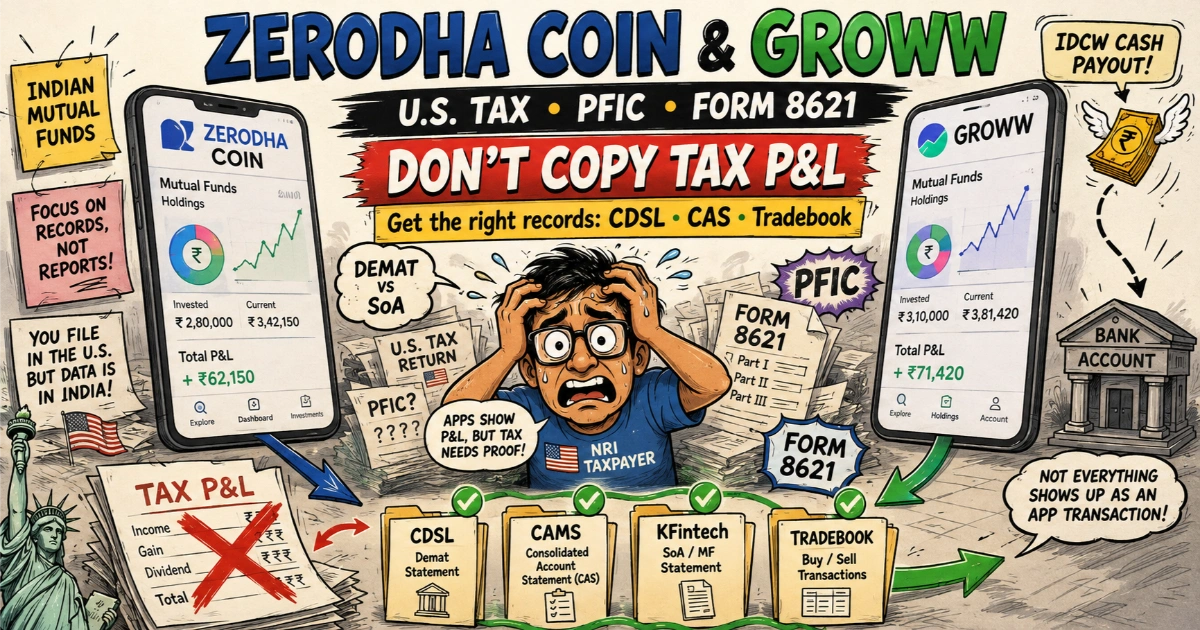
The real Form 8621 problem is data. Zerodha Coin holdings are generally held in demat form, while Groww investors may have either Demat or AMC Folio (Statement of Account / SoA) holdings. That determines where you should retrieve the original acquisition dates, units, NAV, transaction amounts, and disposition records needed to rebuild the U.S.-dollar PFIC ledger.
| Platform / Holding Format | Primary Records Required for Form 8621 | Key Function in PFIC Workpaper |
|---|---|---|
| Zerodha Coin (Demat) | Coin Transaction History + Console Tradebook (MF) + CDSL Demat Statements | Establishes exact purchase date, INR cost, allotment NAV, and unit counts per SIP lot. |
| Groww SoA (AMC Folio) | Detailed CAMS + KFintech CAS (Jan 1990 to present, zero-balance folios included) | Reconciles direct AMC folio transactions across RTA databases. |
| Groww Demat | Groww Transaction Report + CDSL Monthly Transaction Statements | Captures depository unit credits, debits, and redemption settlement proceeds. |
| Transferred / Imported Funds | Original broker, depository, or historical RTA CAS records | Do not rely only on displayed average cost; proves original acquisition date and historical basis. |
Zerodha Coin: What Records to Download for Form 8621
Zerodha Coin holds mutual funds in demat form with Central Depository Services Limited (CDSL). To reconstruct your historical lot-by-lot U.S. tax ledger, download the following three reports:
- Coin Transaction History: Log in to Coin to view the allotment date, investment amount in INR, Net Asset Value (NAV), and allocated units for every SIP installment or lump-sum purchase.
- Console → Reports → Tradebook (Mutual Funds): Navigate to Zerodha Console to download your comprehensive historical tradebook. This provides complete timestamps, order execution details, and downloadable records for older processed transactions.
- CDSL Demat Statement: Access CDSL Easi/Easiest to download monthly transaction and holding statements. This serves as third-party depository verification of unit balances, demat transfers, and remaining balances.
IDCW Funds on Zerodha Coin: Where Are the Dividend Records?
IDCW payouts on Coin are paid by the AMC directly to the bank account registered with Zerodha and may not appear in your Coin order history. Reconcile the cash credits against your bank statements and AMC/RTA IDCW records. CAMS, for example, provides a dedicated Statement on IDCW showing payout dates, amounts, payment status and payment mode. For the U.S. PFIC treatment, see our IDCW US Tax: PFIC Excess Distributions & 125% Test Guide →.
Groww: First Determine Demat vs. SoA Holdings
Do not assume all Groww mutual funds are held in the same format. While Groww historically operated in Statement of Account (SoA) format with individual AMCs, newer accounts and migrations may use Groww Demat (CDSL). Check your account profile first:
1. If Your Groww Holdings Are SoA (AMC Folio)
Units are held directly with AMC registrars. Do not rely solely on in-app summaries. Request a Detailed Consolidated Account Statement (CAS) directly from CAMS and KFintech:
- Select statement type: Detailed.
- Set date range: From Jan 1, 1990 to Present (captures inception history).
- Check option: Include Zero-Balance Folios (ensures historical redeemed lots are visible).
2. If Your Groww Holdings Are in Demat
Download your Groww Transaction / Order History from the Reports section and reconcile the lot entries against your monthly CDSL Demat Statements to verify unit credits and redemptions.
Why Zerodha & Groww Tax P&L Reports Are Not Enough for Form 8621
Both platforms provide convenient annual "Tax P&L" or Capital Gains statements. While useful for filing Indian income tax returns, they cannot be used directly for U.S. Form 8621 due to fundamental legal differences:
- Different Tax Regime (IRC §1291 vs. Indian LTCG/STCG): Under default Section 1291 rules, gain on disposition is treated as an excess distribution and allocated over the entire PFIC holding period. Prior-PFIC-year allocations can be subject to the highest applicable marginal tax rate plus IRC §6621 compounding interest, rather than standard U.S. capital gains rates.
- INR Reporting vs. U.S.-Dollar Tax Basis: Indian broker reports calculate cost and gain in INR. Form 8621 workpapers require each acquisition and disposition to be translated into U.S. dollars using the applicable transaction-specific exchange rate under U.S. tax rules. Currency fluctuations can turn an INR profit into a U.S. Dollar loss (or vice versa).
- Fiscal Year Mismatch: Indian Tax P&L reflects the Indian financial year (April 1 to March 31), whereas U.S. individual returns require calendar-year reporting (January 1 to December 31).
Transferred Mutual Funds Into Zerodha or Groww: Watch the Cost-Basis Gap
If mutual fund units were transferred into Zerodha or Groww from another broker, distributor, or demat account, the receiving platform frequently lacks original trade data. On Zerodha, for example, transferred-in units often appear as discrepant holdings, requiring the investor to manually input a "buy average."
Form 8621 Warning: Do not reconstruct U.S. cost basis from a manually entered average cost. Form 8621 calculations require reconstructing the underlying acquisition lots rather than relying on a manually entered portfolio average. You must retrieve the original purchase records from the prior broker, depository statements, or historical RTA CAS statements to document each lot's true inception.
Can U.S. Residents Continue Buying Mutual Funds on Zerodha Coin?
Once you become a U.S. tax resident, platform terms and regulatory restrictions become relevant:
- Zerodha Operational Restrictions: Zerodha's current support guidance states that USA- and Canada-based NRI clients cannot presently invest in mutual fund schemes through Coin due to operational restrictions, although its Coin terms describe AMC-level restrictions more generally.
- Existing Holdings: Existing units may remain in the demat account, but eligibility for new purchases, SIPs, switches or other transactions depends on current Zerodha and AMC rules.
Frequently Asked Questions
Does using Zerodha Coin or Groww change the PFIC status of my mutual funds?
No. Zerodha Coin and Groww are investment platforms; they do not determine PFIC classification. The classification depends strictly on the underlying foreign mutual fund corporation, and Indian mutual funds commonly meet the PFIC definition under IRC §1297. A separate Form 8621 is generally required for each PFIC scheme when a filing requirement applies.
Can I use the Zerodha or Groww Tax P&L statement directly for U.S. tax filing?
No. Broker Tax P&L statements are calculated in Indian Rupees under Indian tax law using the Indian financial year (April 1 to March 31). They do not perform lot-by-lot USD spot-rate currency translations or calculate Section 1291 excess distributions, holding-day proration, or IRC §6621 interest charges required for IRS Form 8621.
Where do I get complete transaction history for Zerodha Coin and Groww?
For Zerodha Coin, download your Coin Transaction History, Console Tradebook (Mutual Funds), and monthly CDSL demat transaction statements. For Groww, determine whether your units are Demat (download Groww transaction history and CDSL records) or SoA (request a Detailed Consolidated Account Statement from CAMS/KFintech from Jan 1990 to present with zero-balance folios).
What if I transferred old mutual funds into Zerodha or Groww from another broker?
Transferred holdings often show missing acquisition history or require a manual buy-average entry in the app. For IRS Form 8621, you cannot use a manually entered average cost. You must retrieve the original purchase date, units, and INR cost from the prior broker, depository transaction statement, or historical CAMS/KFintech CAS.
Bottom Line
For U.S. taxpayers holding Indian mutual funds via modern Indian fintech apps:
- Identify the Holding Format: Zerodha Coin uses Demat (CDSL); Groww uses either Demat or SoA (CAMS/KFintech).
- Retrieve Raw Trade Records: Download Console Tradebooks, CAS statements, and CDSL transaction ledgers to establish verifiable lot dates and costs.
- Do Not Rely on Indian Tax P&L: Perform independent lot-by-lot USD conversions and Section 1291 proration for Form 8621 compliance.
Official Sources & Technical References
- IRS: Instructions for Form 8621 (Rev. December 2025).
- Cornell Law (LII): 26 U.S. Code § 1291 — Taxation of Shareholders of Passive Foreign Investment Companies.
- Zerodha: Zerodha Coin Terms of Service & Operational Policies.
- Zerodha Support: Tracking Mutual Fund Portfolio & Tradebook Records in Coin.
- Groww Help: How to Generate Detailed CAS for Mutual Funds via CAMS.
- CDSL: Central Depository Services Limited (CDSL) — Investor Services & Demat Statements.
- CAMS: Statement on IDCW — Payout, Reinvestment and Payment-Status Records.