
When a U.S. citizen, Green Card holder, or dual resident moves across the border into Canada, one of their most crucial financial decisions is what to do with their existing U.S. investment portfolio: should they sell everything and buy Canadian funds, or maintain their U.S. brokerage accounts and U.S.-domiciled ETFs?
From an international tax perspective, the from a PFIC-compliance perspective, retaining U.S.-domiciled ETFs can substantially simplify ongoing U.S. reporting: retaining and continuing to invest in U.S.-domiciled ETFs (such as Vanguard's VOO, VTI, BND, or Schwab's SCHD) is the cleanest, most effective way to eliminate U.S. PFIC exposure. Because these funds are incorporated in the United States, they are completely exempt from IRS Form 8621 and punitive Section 1291 tax rates.
Comparative Analysis: Holding U.S. ETFs vs. Canadian ETFs as a U.S. Person in Canada
The table below contrasts how U.S. and Canadian tax authorities treat U.S.-domiciled ETFs versus Canadian-domiciled ETFs held in a non-registered Canadian brokerage account:
| Factor | U.S.-Domiciled ETF (e.g., VOO, VTI) | Canadian-Domiciled ETF (e.g., VFV, XEQT) |
|---|---|---|
| U.S. Tax Classification | Domestic Entity (Zero PFIC) | Foreign Entity (PFIC) |
| Annual U.S. Tax Form | Standard Form 1040 (Sched. B / D) | Mandatory Form 8621 per ETF |
| PFIC AIS Tracking Required? | No (Standard Form 1099-DIV) | Yes (Annual AIS download & QEF election) |
| Canadian Tax Treatment | Taxed on CAD-converted dividends/gains | Taxed on Canadian T3/T5 slips |
| CRA Form T1135 Reporting? | Yes (If aggregate foreign cost > $100k CAD) | No (Canadian-domiciled property is exempt) |
| Annual CPA Compliance Cost | Low ($0–$50) | High ($200–$500 per fund) |
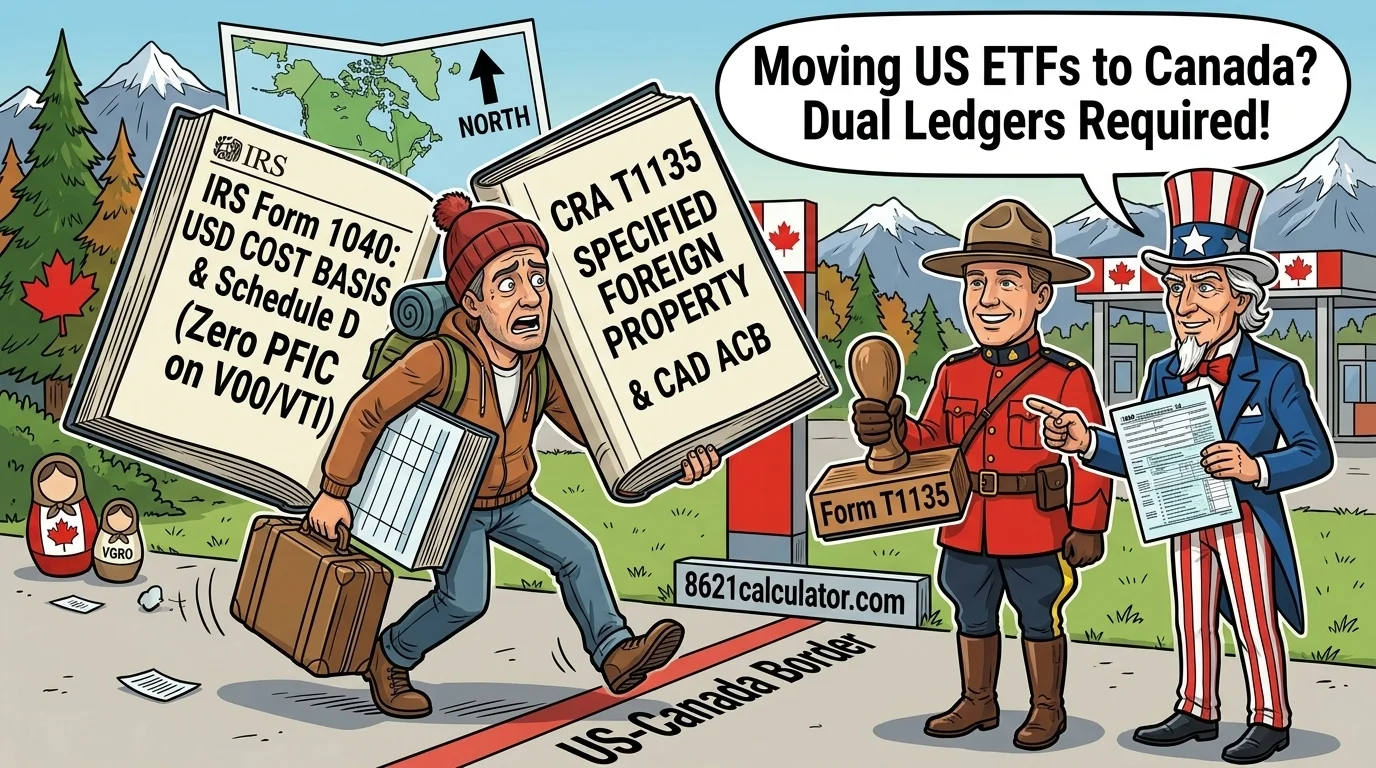
The Canadian Trade-Off: CRA Form T1135 (Foreign Property Reporting)
While holding U.S. ETFs completely frees you from U.S. Form 8621, it triggers a Canadian reporting requirement under the Income Tax Act: Form T1135 (Foreign Income Verification Statement).
- The $100,000 CAD Threshold: If the total aggregate cost amount (not fair market value) of all Specified Foreign Property exceeds $100,000 CAD at any time during the tax year, Form T1135 is mandatory.
- Specified Foreign Property Includes: U.S.-domiciled ETFs (even if held inside a Canadian brokerage like Questrade or TD), U.S. stocks (Apple, Microsoft), foreign bank accounts, and foreign rental property.
- First-Year New Resident Exemption: Under CRA rules, you are exempt from filing Form T1135 for the first tax year in which you become a Canadian resident. Filing begins in your second tax year in Canada.
- Severe Penalties: Failure to file Form T1135 on time carries a penalty of $25 per day, up to a maximum of $2,500 CAD per year.
Tracking Adjusted Cost Base (ACB) vs. U.S. Cost Basis
When you hold U.S. ETFs as a Canadian tax resident, you must maintain two parallel sets of cost basis records:
- Canadian ACB (Weighted Average in CAD): Under CRA rules, identical securities must use the weighted average cost method in Canadian dollars, converted using the Bank of Canada exchange rate on each transaction date. Reinvested dividends increase your CAD ACB.
- U.S. Cost Basis (Specific ID or FIFO in USD): For U.S. Form 1040 Schedule D, your cost basis is tracked in USD, typically using Specific Identification or First-In-First-Out (FIFO).
Practical Brokerage & Currency Architecture
To execute this strategy smoothly from Canada:
- Open a Dual-Currency Canadian Brokerage Account: Use platforms like Interactive Brokers Canada, Questrade, or big-bank brokerages (TD Direct Investing, RBC Direct Investing) that support native holding of both CAD and USD in non-registered accounts.
- Convert CAD to USD Efficiently: Use Norbert's Gambit (buying and journaling shares of DLR/DLR.U on the TSX) or Interactive Brokers' spot FX market to convert funds at institutional exchange rates rather than paying 1.5%–2.0% bank conversion spreads.
- Buy Broad-Market U.S. ETFs: Invest directly in low-cost U.S. ETFs such as VOO (S&P 500, 0.03% MER), VTI (Total U.S. Stock), or VXUS (Total International).
- Claim Foreign Tax Credits Seamlessly: U.S. dividend withholding tax (if applicable) and Canadian taxes are coordinated via FTC on IRS Form 1116 and CRA Schedule 1, avoiding double taxation.
Frequently Asked Questions
Can I buy U.S. ETFs directly through a Canadian bank brokerage like TD or RBC?
Yes. Canadian brokerages allow retail clients to buy U.S.-listed stocks and ETFs directly on the NYSE and NASDAQ in USD sub-accounts. Unlike in the European Union, Canada has no PRIIPs/KID restrictions blocking retail access to U.S. ETFs.
If I hold U.S. ETFs inside a Canadian brokerage, do they count toward CRA Form T1135?
Yes. The location of the brokerage does not determine property character; the domicile of the fund does. A U.S.-domiciled ETF (like VOO or VTI) is Specified Foreign Property regardless of whether it sits at Charles Schwab in the U.S. or Questrade in Canada.
Do U.S. ETFs held inside a Canadian RRSP trigger Form T1135?
No. Specified Foreign Property held inside registered plans—such as RRSPs, RRIFs, RESPs, and TFSAs—is explicitly exempt from CRA Form T1135 reporting.
How are U.S. ETF dividends taxed when received by a Canadian resident?
U.S. ETF dividends received in a non-registered account are treated as foreign investment income in Canada, fully taxable at marginal rates without the Canadian dividend tax credit. As a U.S. citizen, you report the gross dividend on U.S. Schedule B and Canadian Form T1, utilizing Foreign Tax Credits to eliminate double taxation.
Official Authorities & Technical References
- Canada Revenue Agency (CRA): CRA Questions and Answers on Form T1135 (Foreign Income Verification Statement).
- IRS: Instructions for Form 1116 (Foreign Tax Credit for Individuals).
- Cornell Law (LII): 26 U.S. Code § 1297 — Passive Foreign Investment Company Definition.
- IRS: Instructions for Form 8621 (Rev. 12/2025).