
With Canadian interest rates remaining elevated, high-yield cash ETFs like Global X High Interest Savings ETF (CASH.TO), CI High Interest Savings ETF (CSAV.TO), Purpose High Interest Savings Fund (PSA.TO), and Treasury bill ETFs like Global X 0-3 Month T-Bill ETF (CBIL.TO) have become wildly popular cash-parking tools across Canada.
Many U.S. citizens and cross-border taxpayers treat these funds as equivalent to an ordinary high-yield bank savings account. However, from the perspective of the U.S. Internal Revenue Code, CASH.TO and its peers are Canadian-domiciled mutual fund trusts—making them 100% Passive Foreign Investment Companies (PFICs) under IRC §1297.
Why Cash & Money Market ETFs Meet the Strict PFIC Definition
Under IRC §1297(a), any foreign entity that is organized as a corporation or trust and satisfies either of the following tests is classified as a PFIC:
- 75% Passive Income Test: 75% or more of its gross income is interest, dividends, or passive investment income. CASH.TO earns 100% of its income from bank deposit interest.
- 50% Passive Asset Test: 50% or more of its average gross assets produce passive income. CASH.TO holds 100% of its assets in interest-bearing deposit accounts at Schedule I Canadian banks (such as National Bank, CIBC, Scotiabank).
PFIC classification does not depend on whether a fund holds equities or cash instruments. Both VFV and CASH.TO require issuer-level PFIC and Form 8621 analysis.
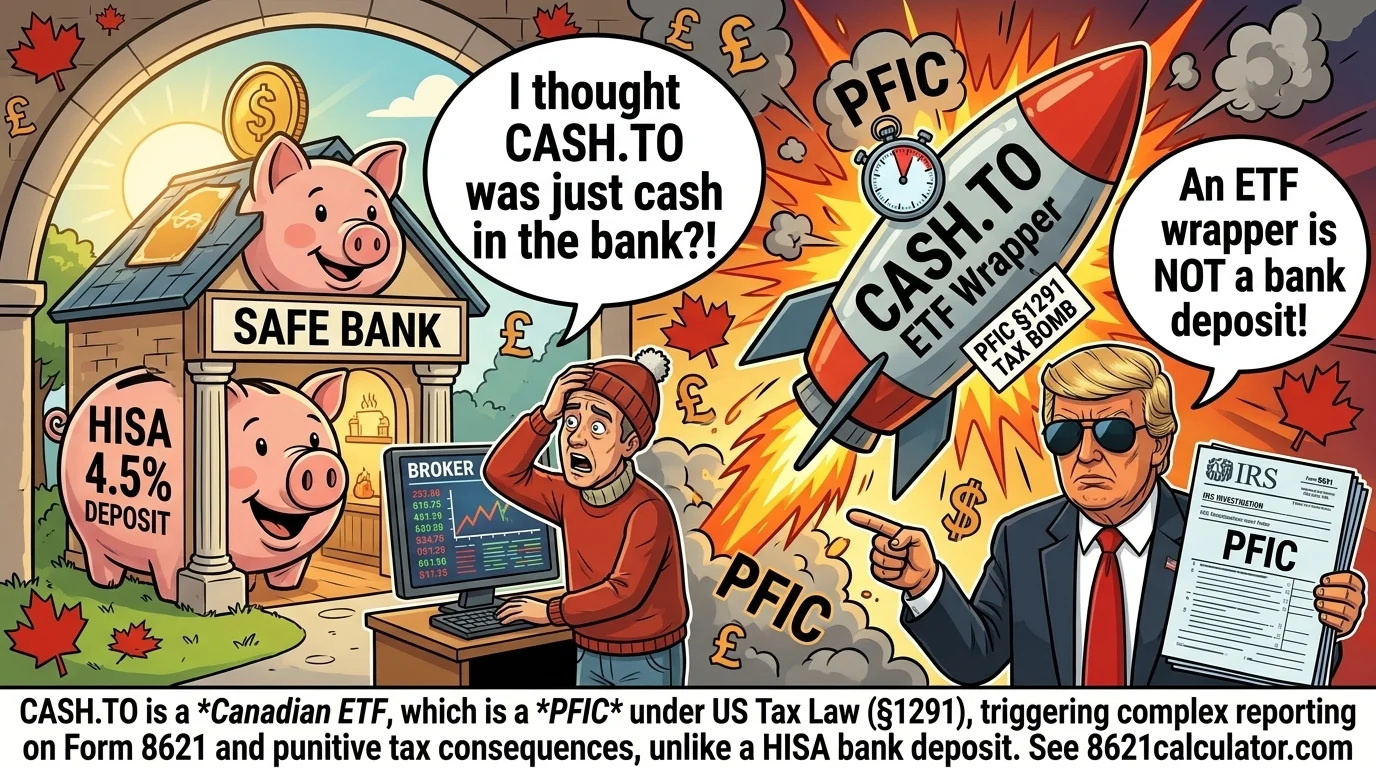
Product Comparison: CASH.TO vs. Bank HISA vs. GICs vs. U.S. Cash ETFs
Cross-border investors have several options to park Canadian and U.S. dollars. The table below illustrates their respective U.S. tax treatment, reporting forms, and risk profiles:
| Cash Vehicle & Examples | U.S. Tax & 8621 Status | Cross-Border Assessment & Action |
|---|---|---|
|
Canadian Cash ETF CASH.TO, CSAV, PSA |
YES (PFIC)
Form 8621 per ETF + Schedule B
|
Poor Choice: High Form 8621 accounting overhead easily destroys the net interest yield. |
|
Canadian T-Bill ETF CBIL.TO, UBIL.U |
YES (PFIC)
Form 8621 Required
|
Poor Choice: Carries identical PFIC compliance friction despite holding sovereign government debt. |
|
Direct Bank HISA EQ Bank, Tangerine, RBC |
NO (Bank Deposit)
Schedule B Ordinary Interest
|
Excellent: Clean interest reporting, zero Form 8621 overhead, and CDIC deposit insurance. |
|
Bank GICs 1-Year Cashable / Non-Cashable |
NO (Debt Contract)
Schedule B Accrued Interest
|
Excellent: Guaranteed locked yields, complete PFIC immunity, and simple tax reporting. |
|
U.S. T-Bill ETF (USD) SGOV, BIL, SHV |
NO (U.S. Domestic)
1099-DIV / Schedule B
|
For USD: U.S.-domiciled and outside PFIC rules. State exemption depends on the state and the fund's qualifying U.S. government-obligation income. |
How to Report CASH.TO on Form 8621 (If You Already Own It)
If you already hold CASH.TO, CSAV, or PSA in a non-registered account or TFSA, you should evaluate whether a timely QEF election is appropriate when a compliant AIS is available under IRC §1295 rather than letting it default to Section 1291.
- Download the PFIC AIS: Visit the Global X Canada (formerly Horizons) or Purpose Investments website and download the annual PFIC Annual Information Statement for the relevant tax year.
- Check Part II Box A: Make the election under Section 1295 on Form 8621.
- Report Ordinary Earnings in Part III: Multiply your pro-rata share factor from the AIS by the number of days and shares held, entering the ordinary earnings on Line 6a.
- Adjust Cost Basis: Increase your tax basis by the taxable income included, and reduce basis by actual cash distributions received (Line 6c). Because CASH.TO pays out nearly 100% of income monthly, net basis adjustments are minimal.
Recommended Cash Allocation Architecture for Americans in Canada
To earn top yields while completely eliminating PFIC compliance burdens:
- For Canadian Dollars (CAD): Open a high-interest savings account with direct deposit institutions like EQ Bank, Simplii, or Tangerine, or buy short-term Canadian Bank GICs through your brokerage. Report the total interest converted to USD on Schedule B.
- For U.S. Dollars (USD): Convert CAD to USD using Norbert's Gambit (DLR/DLR.U) and purchase ultra-short U.S. Treasury ETFs like iShares 0-3 Month Treasury Bond ETF (SGOV) or SPDR Bloomberg 1-3 Month T-Bill ETF (BIL). These are U.S.-domiciled entities with zero PFIC exposure.
Frequently Asked Questions
Does CASH.TO qualify for the $25,000 PFIC de minimis filing exemption?
Possibly, depending on whether you meet all conditions under Treas. Reg. §1.1298-1(c)(2). Receiving a regular distribution is not by itself an excess distribution. If your aggregate PFIC value is ≤$25,000 ($50,000 for married filing jointly), you received no excess distribution, recognized no disposition gain treated as an excess distribution, and made no QEF/MTM election, you may qualify for the annual Form 8621 Part I reporting exception. See the complete statutory conditions in our Filing Exemption Master Guide →.
Are CASH.TO monthly distributions taxed as interest or dividends on the U.S. return?
If you elect QEF status, the fund's income is reported on Form 8621 Part III as pro-rata "Ordinary Earnings" and flows to Form 1040 Schedule 1 (Other Income) or Schedule B, taxed at ordinary income tax rates. If un-elected, distributions are tested under the Section 1291 excess distribution rules.
Can I hold CASH.TO inside my RRSP without Form 8621?
Yes. RRSPs and RRIFs are fully shielded from annual PFIC Form 8621 reporting under Treas. Reg. §1.1298-1(c)(4). However, holding CASH.TO inside a TFSA, FHSA, or taxable account requires annual Form 8621 filing.
Do Canadian Bank GICs require Form 8621?
No. A Guaranteed Investment Certificate (GIC) is a direct debt deposit agreement with a Canadian bank, not an equity interest in a foreign corporation or collective fund. GICs are never classified as PFICs.
Official Authorities & Technical References
- IRS: Instructions for Form 8621 (Rev. 12/2025).
- Cornell Law (LII): 26 U.S. Code § 1297 — Definition of Passive Foreign Investment Company (Passive Asset & Income Tests).
- Cornell Law (LII): Treas. Reg. § 1.1298-1(c)(2) — Exception for PFIC Stock Below Specified Dollar Threshold.
- Global X Investments Canada: PFIC Annual Information Statements for CASH, CBIL, and Money Market ETFs (published annually by fund management).