
For cross-border families in Canada saving for higher education or supporting family members with severe disabilities, the Registered Education Savings Plan (RESP) and Registered Disability Savings Plan (RDSP) are among Canada's most effective wealth-building programs, offering substantial federal government matching grants.
However, for U.S. citizens, Green Card holders, and dual-national parents, managing an RESP or RDSP requires navigating a sharp legal distinction: IRS Rev. Proc. 2020-17 exempts qualifying plans from draconian foreign trust reporting (Forms 3520 and 3520-A), but provides ZERO exemption from annual PFIC Form 8621 filings for underlying Canadian ETFs.
Who Pays the U.S. Tax? Subscriber vs. Beneficiary Dynamics
Under Canadian trust principles and IRS grantor trust rules:
- The Subscriber (Account Owner): In an RESP, the subscriber retains the legal right to change beneficiaries or withdraw contributions. Consequently, for U.S. tax purposes, if the subscriber is a U.S. person, they are treated as the owner of the underlying assets. All annual income, dividends, and PFIC reporting obligations fall squarely on the subscriber's Form 1040.
- Canadian Government Grants (CESG / CLB): The Canada Education Savings Grant (CESG, up to $7,200 lifetime) and Canada Learning Bond (CLB) are considered taxable gross income to the U.S. subscriber in the year received, or treated as foreign grant income upon distribution.
- Educational Assistance Payments (EAPs): In Canada, investment growth and grants are taxed in the student's hands upon withdrawal. In the U.S., because the growth was already taxable to the U.S. subscriber annually, distribution of basis to the student is not double-taxed.
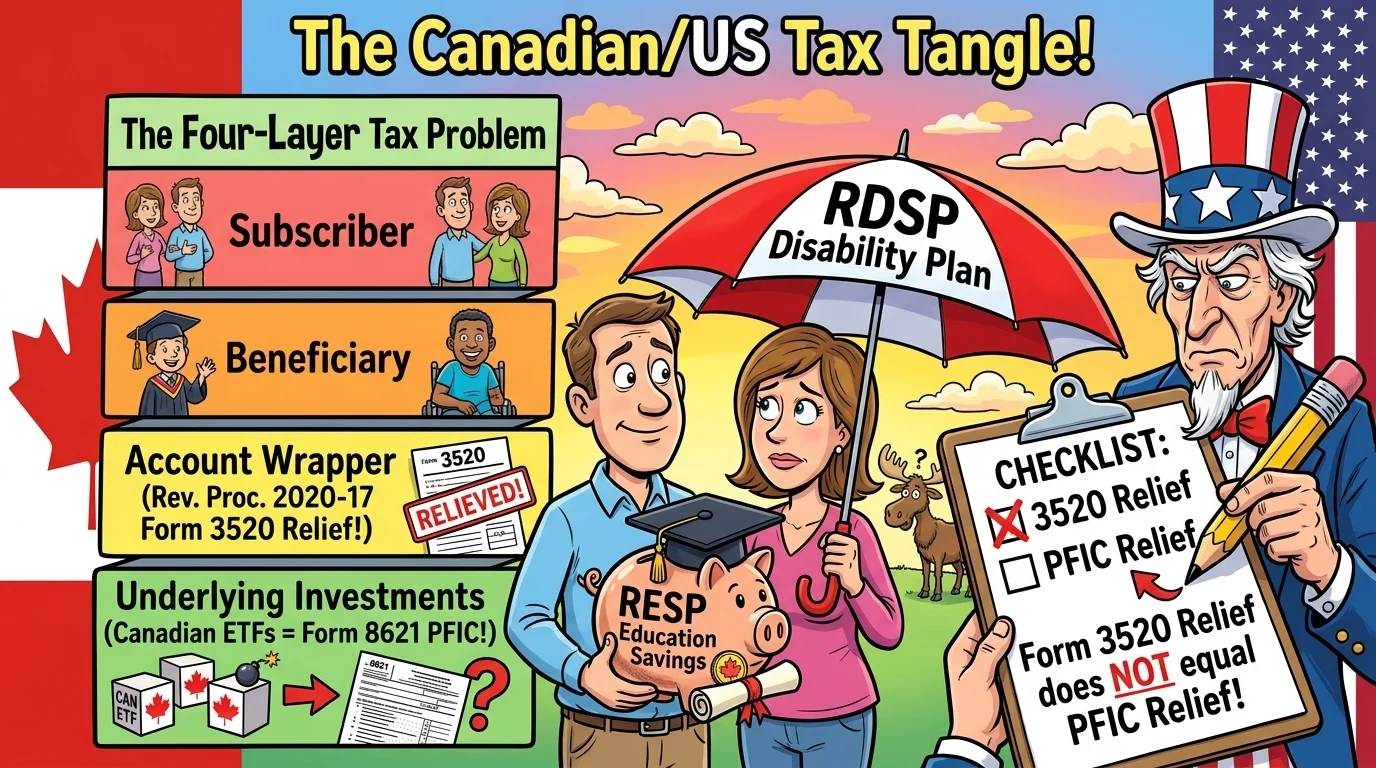
Cross-Border Architecture: Asset Selection & Account Ownership Matrix
Cross-border parents can dramatically reduce IRS tax and reporting headaches by optimizing who owns the account and what assets are held inside:
| Ownership & Asset Strategy | Form 3520 & 8621 Status | Cross-Border Assessment & Action |
|---|---|---|
|
Non-U.S. Spouse Sole Subscriber Canadian/U.S. ETFs or Funds |
Exempt · Zero IRS Filing
Outside U.S. Tax Net
|
The Gold Standard: Completely removes the RESP from U.S. tax jurisdiction during growth. No annual 3520 or 8621 filings. |
|
U.S. Subscriber: Cash & GICs Bank HISAs, Term Deposits |
Exempt 3520 · Zero 8621
Rev. Proc. 2020-17 Relief
|
Recommended for U.S. Filers: Captures CESG grant match; report ordinary interest on Schedule B with zero PFIC complexity. |
|
U.S. Subscriber: U.S. ETFs Direct VOO, VTI (USD) |
Exempt 3520 · Zero 8621
Rev. Proc. 2020-17 Relief
|
Solid Growth Strategy: Broad equity market exposure with standard Schedule B/D reporting; zero Form 8621 filings. |
|
U.S. Subscriber: Canadian ETFs XEQT, VFV, Bank Mutual Funds |
Form 8621 Mandatory
Rev. Proc. 2020-17 + §1291
|
Avoid: While exempt from Form 3520, annual Form 8621 compliance prep costs quickly wipe out the benefit of the CESG grant. |
RDSP Cross-Border Nuances
The Registered Disability Savings Plan (RDSP) qualifies for foreign trust relief under Rev. Proc. 2020-17 (qualifying as a tax-favored non-retirement trust established for disability savings).
- Canada Disability Savings Grants (CDSG) & Bonds (CDSB): Massive federal matching (up to $70,000 CDSG and $20,000 CDSB) makes RDSPs essential for disabled Canadian residents.
- Asset Strategy: To avoid imposing Form 8621 compliance on a disabled U.S. beneficiary or parent holder, the RDSP portfolio should be strictly invested in Canadian bank GICs, direct single equities, or U.S.-domiciled ETFs.
Practical Step-by-Step Guide for Cross-Border Parents
To secure Canadian educational grants while protecting your family from IRS penalties:
- Single-Subscriber Setup: If one parent is a pure Canadian citizen (non-U.S. person), open the RESP with the non-U.S. parent as the sole subscriber. Do NOT open a joint RESP.
- If Both Parents Are U.S. Persons: Open the RESP, collect the annual $500 CESG government match (on a $2,500 contribution), but direct the funds exclusively into Canadian bank GICs or direct U.S. ETFs (VOO/VTI).
- Report Annual Earnings on Form 1040: If you are a U.S. subscriber, convert annual interest/dividends to USD and include them on Schedule B. No Form 3520 is required under Rev. Proc. 2020-17.
- Document Educational Withdrawals (EAP): Maintain clean records when funds are distributed to the student for tuition, demonstrating that the underlying growth was already taxed as earned.
Frequently Asked Questions
If a Canadian grandparent opens an RESP for my U.S. citizen child, does my child file Form 8621?
No. In an RESP owned by a Canadian grandparent (a non-U.S. person), the grandparent is the sole subscriber and owner of the trust assets. The U.S. citizen child is merely a contingent beneficiary with no present ownership interest. Neither the child nor the U.S. parents have any Form 8621 or Form 3520 filing duties while the funds remain inside the plan.
Are CESG government matching grants taxable income in the United States?
If the subscriber is a U.S. citizen, the IRS treats the deposit of government grant money (CESG/CLB) as taxable gross income in the tax year it is paid into the account. It is typically reported as Other Income on Form 1040 Schedule 1.
Does an RESP need to be reported on FinCEN Form 114 (FBAR)?
Yes. If you are a U.S. person listed as the subscriber of an RESP or holder of an RDSP, you have financial authority over a foreign financial account. If aggregate foreign balances exceed $10,000 USD, the account must be disclosed on your annual FBAR.
What happens if an RESP holding Canadian ETFs is audited by the IRS?
If a U.S. subscriber holds Canadian ETFs in an RESP without filing Form 8621, the IRS can assess failure-to-file penalties, leave the statute of limitations open indefinitely under IRC §6501(c)(8), and tax all accumulated ETF gains under the Section 1291 excess distribution regime upon withdrawal.
Official Authorities & Technical References
- IRS: Rev. Proc. 2020-17 — Relief from Information Reporting on Transactions With Certain Tax-Favored Foreign Trusts.
- Canada Revenue Agency (CRA): Registered Education Savings Plans (RESP) Overview and Rules.
- IRS: Instructions for Form 8621 (Rev. 12/2025).
- Employment and Social Development Canada (ESDC): Canada Education Savings Grant (CESG) Guidelines.