
Quick Answer: Is an ELSS Fund a PFIC?
Yes. An Equity Linked Savings Scheme (ELSS) registered with the Securities and Exchange Board of India (SEBI) is organized as an Indian mutual fund scheme. Because its underlying assets consist predominantly of equities and its income is investment-derived (dividends and capital gains), it meets the statutory PFIC criteria under IRC §1297:
- 75% Passive Income Test: Substantially all of the fund's gross income consists of dividends, interest, and capital gains from securities trading.
- 50% Passive Asset Test: More than 50% of the scheme's assets produce or are held for the production of passive income.
Neither the Indian Income-tax Act Section 80C benefit nor the statutory 36-month lock-in period creates any U.S. tax exemption. ELSS holdings generally fall within the PFIC/Form 8621 regime. Annual reporting is required unless the taxpayer qualifies for statutory filing exceptions under IRC §1298(f) (such as the aggregate $25,000 / $50,000 threshold for non-electing §1291 funds where no excess distributions or disposition gains occur during the year, and no QEF/MTM elections are in effect).
Why ELSS Creates a Unique India-U.S. Tax Mismatch
ELSS funds are engineered specifically for Indian domestic taxpayers to reduce income tax under Section 80C (up to ₹1.5 lakh per financial year) while encouraging disciplined long-term equity exposure. However, when an investor becomes a U.S. tax resident, this domestic optimization transforms into a cross-border friction point:
| Jurisdiction | Tax Incentive & Rules | Practical Effect |
|---|---|---|
| India (IT Act, 1961) | Up to ₹1,50,000 deduction under Section 80C; 3-year lock-in per installment; 12.5% LTCG on redemption beyond ₹1.25 lakh. | Highly tax-efficient domestic wealth building tool with tax deferral during the lock-in. |
| United States (IRC) | Foreign pooled investment vehicle; IRC §1297 PFIC regime; default Section 1291 penal interest; no 80C recognition. | No tax deduction allowed on Form 1040; annual reporting friction; high effective tax rates on eventual redemption. |
The 3-Year Lock-In Applies Separately to Every ELSS SIP Lot
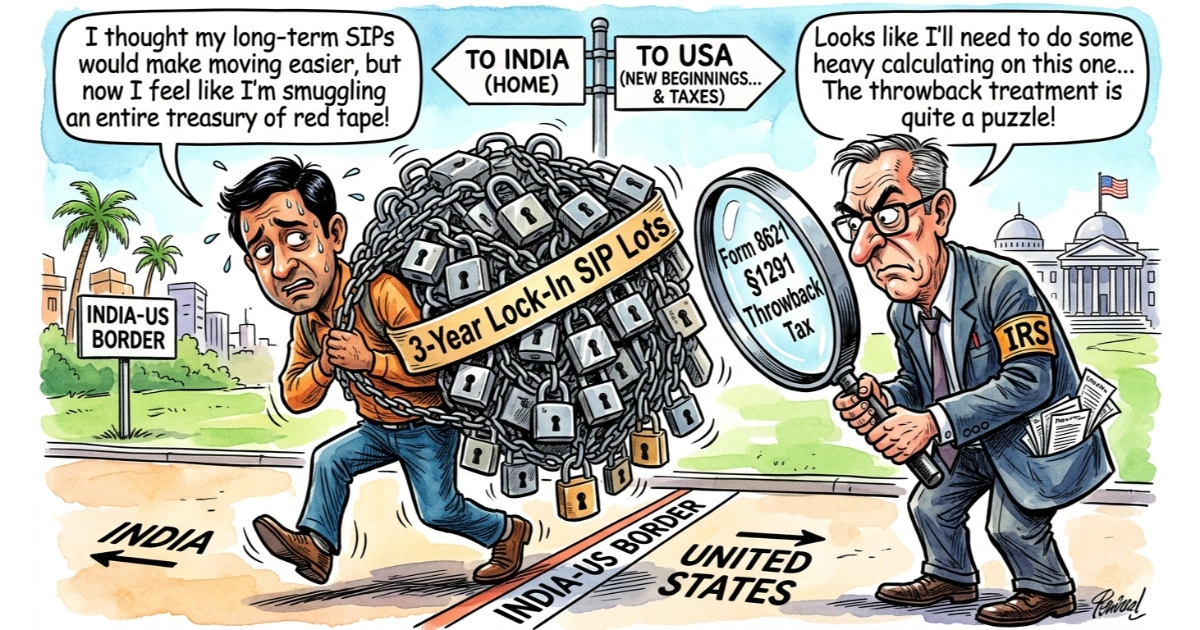
The defining operational characteristic of ELSS is that the 3-year lock-in is not calculated from the date the SIP started, but from the date of each individual monthly purchase.
Consider a typical scenario: an investor commits ₹10,000 per month into an ELSS fund via a Systematic Investment Plan (SIP) over a 3-year span:
- 36 Monthly Purchases: Results in 36 distinct acquisition lots.
- 36 Staggered Maturity Dates: The units purchased in Month 1 mature after 36 months, but units purchased in Month 36 do not unlock until Month 72 (6 years from the initial start date).
- 36 Unique USD Cost Bases: Each installment must be translated from INR to USD using the prevailing spot exchange rate on that specific purchase date.
When preparing Form 8621, the IRS does not allow blending these lots into a single average cost. Each lot retains its own acquisition date, holding period, and USD basis. For a detailed guide on managing multi-lot calculations, see our Indian SIP PFIC Calculator Guide.
| SIP Lot | Purchase Date | INR Cost Basis | U.S. Residency Status | Lock-In Expiry |
|---|---|---|---|---|
| Lot 1 | Jan 10, 2024 | ₹10,000 | Pre-U.S. Non-Resident | Jan 10, 2027 |
| Lot 2 | Feb 10, 2024 | ₹10,000 | Pre-U.S. Non-Resident | Feb 10, 2027 |
| Lot 3 | Jul 10, 2025 | ₹10,000 | U.S. Tax Resident | Jul 10, 2028 |
What Happens If You Move to the U.S. While ELSS Is Still Locked?
A frequent dilemma for tech professionals on H-1B, L-1, or immigrant visas is relocating to the United States while holding locked ELSS units.
Under Indian regulations, AMCs cannot permit early redemption or exit prior to the completion of the 36-month period for that specific lot, even if the investor emigrates. Consequently:
- Inability to Pre-Liquidate: Unlike open-ended mutual funds which can be liquidated before establishing U.S. tax residency (as detailed in our Pre-Immigration Indian Mutual Funds Guide), locked ELSS units must remain in place until maturity.
- Commencement of PFIC Taint: From the first day you become a U.S. tax resident, the ELSS holding becomes subject to U.S. PFIC reporting.
- Annual Form 8621 Compliance: If the total aggregate foreign fund holdings exceed statutory thresholds (or if distributions occur), Form 8621 must be filed each year during the remainder of the lock-in period.
ELSS Under Section 1291: Taxation and Interest Throwback
Because Indian AMCs (such as SBI, HDFC, ICICI Prudential, Nippon India, and Mirae Asset) do not provide PFIC Annual Information Statements, ELSS holdings default to IRC §1291 Excess Distribution taxation upon redemption or distribution.
Under Section 1291:
- Gains Treated as Excess Distributions: Upon redemption after the 3-year lock-in, any realized capital gain is treated as an excess distribution under Form 8621 Part V.
- Pro-Rata Allocation Across Holding Period: The gain is allocated ratably across all days in your holding period. Gain allocated to prior U.S. tax years is taxed at the highest statutory marginal rate (currently 37%), regardless of your actual tax bracket.
- Section 6621 Interest Charge: Compound interest is imposed on the deferred tax for each prior tax year, significantly eroding net investment returns.
If you have recently redeemed locked units, review our comprehensive breakdown on Sold Indian Mutual Funds & Section 1291.
Can ELSS Use the Section 1296 Mark-to-Market Election?
Taxpayers often ask whether they can make a Section 1296 Mark-to-Market (MTM) election on ELSS funds to eliminate the §6621 interest charge.
Under IRC §1296, MTM is available only for "marketable stock." Stock in a foreign investment company is marketable if it is regularly traded on a qualified exchange or if the fund offers regular redemptions at net asset value (NAV).
The Lock-In Conflict: Because ELSS units cannot be redeemed at NAV during their statutory 3-year lock-in, there is substantial technical doubt as to whether un-matured ELSS units meet the continuous redemption liquidity criteria of Treas. Reg. §1.1296-2. Once the units unlock and become freely redeemable daily at NAV, the MTM argument strengthens, but transitioning from §1291 to MTM requires addressing the unpurged Section 1291 PFIC taint.
Can ELSS Make a QEF Election?
Under IRC §1295, a Qualified Electing Fund (QEF) election allows a U.S. shareholder to include their pro-rata share of the fund's ordinary earnings and net capital gain annually, preserving favorable capital gains rates.
However, a QEF election is legally invalid unless the foreign fund issues a compliant PFIC Annual Information Statement (AIS) meeting the strict substantiation requirements of Treas. Reg. §1.1295-1(g). In practice, Indian mutual fund houses do not calculate, audit, or publish AIS reports for ELSS schemes. A shareholder cannot create a valid QEF election merely by reconstructing U.S.-tax earnings from publicly available annual reports. The shareholder must receive the PFIC Annual Information Statement or other qualifying information permitted under Treas. Reg. §1.1295-1(g).
What Records Do You Need for Form 8621?
To accurately construct Form 8621 workpapers for an ELSS holding, you must obtain primary source transaction statements from Indian Registrar and Transfer Agents (RTAs):
- CAMS Consolidated Account Statement (CAS): Details exact SIP execution dates, units allotted, purchase NAVs, and stamp duty deductions. (See our guide on CAMS Statement for Form 8621).
- KFintech CAS: Required if your ELSS fund is serviced by KFin Technologies (such as Axis, UTI, or Mirae Asset schemes). (See KFintech Statement for Form 8621).
- IDCW History: Income Distribution cum Capital Withdrawal records, if you opted for dividend payout or reinvestment rather than Growth.
A monthly ELSS SIP can create dozens of separate PFIC acquisition lots. Reconstruct purchase dates, USD basis, §1291 excess distribution allocations, and IRS compound interest before preparing Form 8621.
Calculate ELSS PFIC Workpapers →Back to the central directory: India PFIC Resource Hub & Matrix.