
PPF vs. EPF: Why They Are Not the Same
Many Indian professionals moving to the U.S. lump PPF and EPF together under "provident funds," but they are governed by distinct legal frameworks:
| Feature | Public Provident Fund (PPF) | Employees' Provident Fund (EPF / VPF) |
|---|---|---|
| Legal Basis | Government Savings Promotion Act, 1873 | Employees' Provident Funds and Miscellaneous Provisions Act, 1952 |
| Account Nature | Voluntary individual government savings scheme | Mandatory employment-linked retirement fund |
| Employer Contribution | None (100% individual deposits) | Yes (Matching 12% basic wage by employer) |
| Investment Control | None (Fixed rate set quarterly by Ministry of Finance) | None (Managed centrally by EPFO Board of Trustees) |
| U.S. Classification | Foreign deposit / statutory savings arrangement | Foreign employee retirement / pension trust structure |
| Automatic PFIC? | No (No corporate equity interest owned) | No (Requires structural trust review) |
Is a Public Provident Fund (PPF) Account a PFIC?
No. Under IRC §1297, a PFIC must be a foreign corporation. A PPF account held with the State Bank of India (SBI), Post Office, or other authorized bank is a statutory deposit scheme backed directly by the Central Government of India.
The account holder possesses a creditor claim for principal plus guaranteed interest, not stock or shares in a foreign corporation or pooled mutual fund. Consequently, PPF does not trigger Form 8621.
Is an Employees' Provident Fund (EPF / VPF) Account a PFIC?
EPF is managed by the Employees' Provident Fund Organisation (EPFO) through a central board of trustees or an employer-exempt private PF trust.
Like PPF, an employee's interest in the EPFO is a statutory retirement entitlement rather than direct shares in a foreign corporation. While the EPFO invests up to 15% of incremental inflows into domestic equity ETFs (Nifty 50 and Sensex ETFs), EPFO's underlying ETF exposure does not by itself establish participant-level PFIC ownership. Taxpayers must first determine the U.S. classification of the overall arrangement (such as a foreign pension trust under §402(b)) and apply the indirect-ownership rules of Treas. Reg. §1.1291-1(b)(8). In standard statutory EPFO plans, individual participants hold no direct equity ownership in underlying ETF units.
U.S. Tax Treatment of Contributions
Because the U.S.-India Income Tax Treaty does not contain a comprehensive pension reciprocity provision (unlike Article XVIII of the Canada treaty or Article 18 of the UK treaty):
- PPF Contributions: Made with after-tax money. No U.S. tax deduction is allowed on Form 1040 (India's Section 80C deduction is ignored).
- Employee EPF Contributions: Must be included in gross income for U.S. purposes; cannot be deducted as pre-tax 401(k)-style contributions.
- Employer EPF Contributions: Employer matching contributions represent taxable compensation to the employee in the year contributed under IRC §83 / §402(b), unless subject to a substantial risk of forfeiture.
U.S. Tax on Annual Growth: PPF vs. EPF Distinction
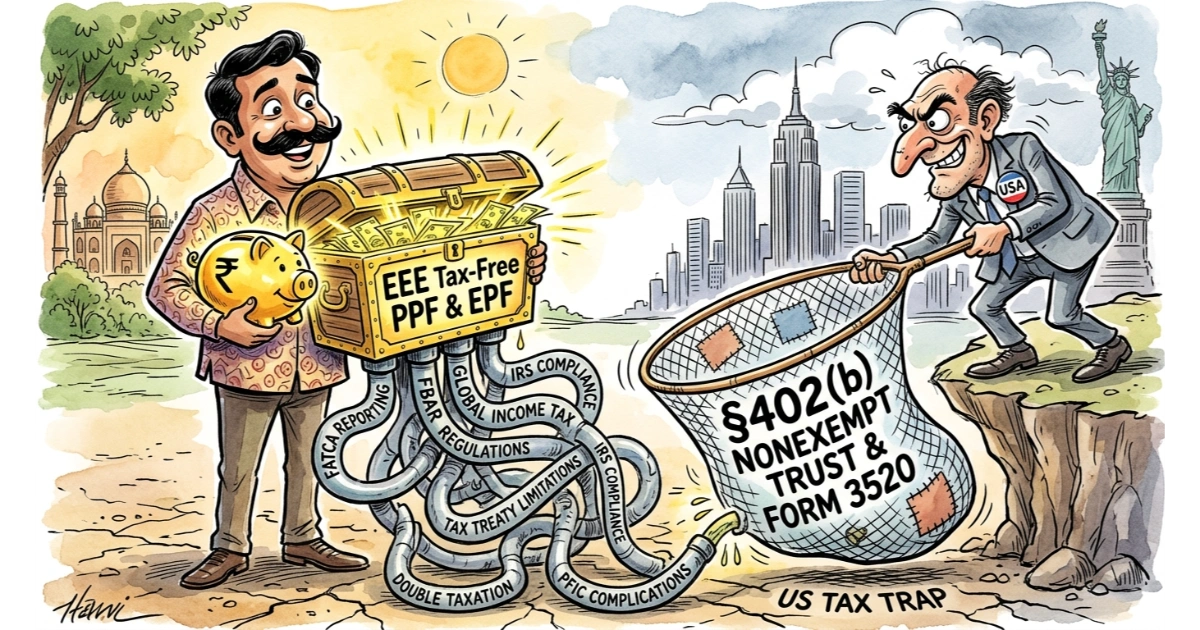
PPF remains broadly tax-exempt under Indian domestic rules. EPF is also highly tax-favored, but its domestic "EEE" treatment is no longer absolute: interest attributable to employee contributions exceeding statutory annual thresholds (₹2.5 lakh where employer contributions exist, or ₹5 lakh without employer contributions) and certain aggregate employer contributions exceeding ₹7.5 lakh can be taxable in India. For U.S. tax purposes, PPF and EPF follow fundamentally different income-recognition regimes:
- Public Provident Fund (PPF): Because PPF is a government-backed individual bank deposit arrangement, credited annual interest is analyzed under standard U.S. cash-basis income rules and is generally reportable annually on Form 1040 Schedule B as foreign interest income.
- Employees' Provident Fund (EPF / VPF): U.S. taxation of EPF requires a separate foreign-pension analysis under IRC §402(b) (nonexempt employees' trust). Employer contributions, vesting schedules, trust earnings, and lump-sum distributions follow complex compensation and pension rules, and should not automatically be collapsed into simple annual Schedule B bank interest.
- U.S.–India Tax Treaty Article 20: The U.S.?India tax treaty contains a private-pension article (Article 20), but it does not provide the same explicit current-income deferral mechanism for undistributed plan earnings that Article XVIII(7) provides for qualifying Canadian retirement plans. Proper entity characterization under domestic U.S. tax law is therefore essential.
U.S. Tax on Withdrawals and Repatriation
When you withdraw funds from a PPF or EPF account upon retirement or maturity:
Only amounts that have not previously been taxed in the United States are subject to tax. If you consistently reported annual interest and after-tax contributions throughout your period of U.S. tax residency, the principal withdrawal is a tax-free return of basis. Any foreign exchange gain or loss realized upon converting INR to USD upon withdrawal is treated as ordinary Section 988 currency gain/loss.
When Does the Foreign-Trust Question Arise? (Form 3520 / 3520-A)
A major area of debate among cross-border practitioners is whether EPF (especially employer-exempt PF trusts) constitutes a foreign grantor trust under IRC §671§679 requiring annual Form 3520 and Form 3520-A filings:
- IRS Revenue Procedure 2020-17: Provides an exemption from Form 3520/3520-A reporting for "tax-favored foreign retirement trusts" meeting specific contribution limits, government oversight, and withdrawal restrictions. Many standard EPF arrangements qualify under this relief.
- PPF Exemption: PPF is a bank deposit / government debt instrument, not a trust, and is wholly outside the foreign trust reporting regime.
Foreign Account & Asset Reporting: FBAR and Form 8938
Both PPF and EPF accounts are foreign financial accounts subject to standard foreign asset transparency laws:
- FinCEN Form 114 (FBAR): Both PPF bank accounts and EPF account balances must be reported if the aggregate value of all foreign financial accounts exceeds $10,000 at any time during the calendar year.
- Form 8938 (FATCA): Reportable on Form 8938 if you exceed the applicable filing threshold (e.g., $50,000 for single filers in the U.S. at year-end).
Comparison With the National Pension System (NPS)
While PPF and EPF are fixed-interest or debt-heavy statutory vehicles, India's National Pension System (NPS) operates on a market-linked multi-scheme framework. In NPS, subscribers choose explicit equity allocations (Scheme E) managed by pension fund managers, which raises a separate PFIC and ownership-classification analysis because the arrangement is market-linked and invests through managed investment schemes on Auto-Choice rebalancing.
First, classify your provident accounts to avoid unnecessary reporting. Then, separate any actual Indian mutual fund or ETF holdings that may trigger Form 8621 reporting and PFIC calculations.
Back to the central directory: India PFIC Resource Hub & Matrix.