
What Is an Indian Portfolio Management Service (PMS)?
Regulated under SEBI (Portfolio Managers) Regulations, 2020, a Portfolio Management Service is a customized investment facility tailored for high-net-worth individuals (minimum statutory ticket size ₹50 lakh).
Unlike a mutual fund—where investor money is pooled into a collective trust and units are issued—a PMS operates via individual segregated holdings:
- Individual Demat Account: Securities are purchased and held directly in the client's own Demat account linked to their PAN.
- Discretionary vs. Non-Discretionary: In discretionary PMS (the most common format), the portfolio manager executes buy/sell decisions based on a power of attorney, while in non-discretionary PMS, the client approves each trade.
Is an Indian PMS Account Itself a PFIC?
No. An Indian PMS account is an asset management arrangement and agency relationship, not a foreign corporation. Under U.S. tax classification principles, the IRS ignores the PMS contract wrapper and looks directly through to the underlying assets held by the taxpayer.
Four Holding Scenarios Inside a PMS Portfolio
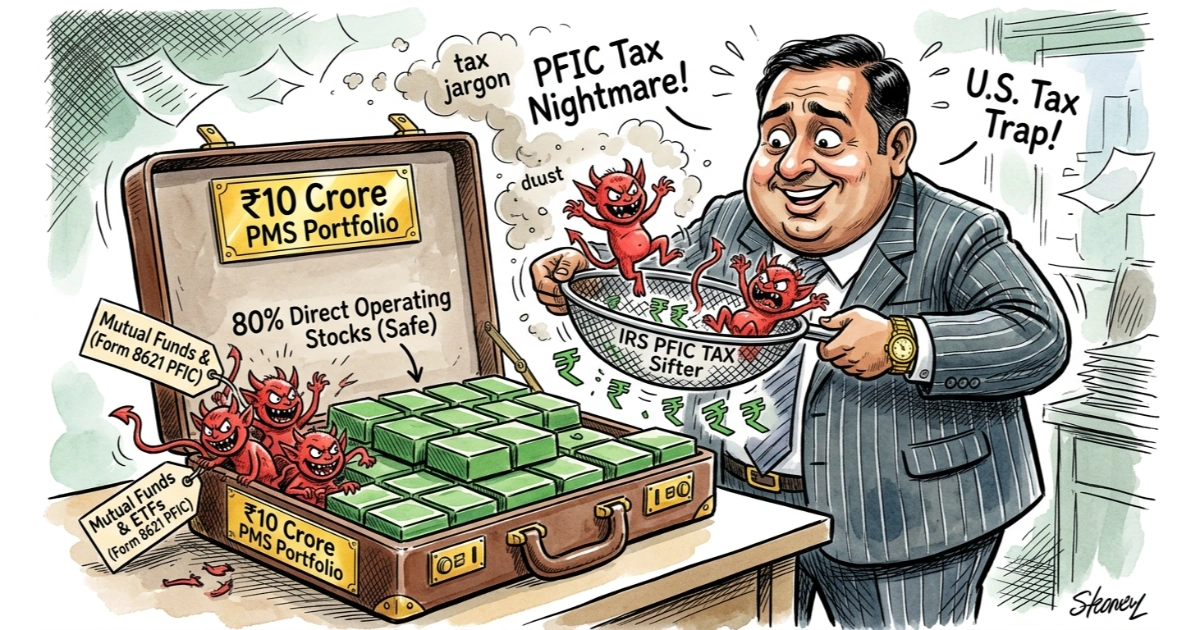
Depending on your portfolio manager's strategy, a PMS portfolio may contain a blend of several asset classes:
| Underlying Asset | PFIC Status | U.S. Tax Reporting |
|---|---|---|
| 1. Direct Indian Operating Equities HDFC Bank, TCS, Infosys, Reliance, L&T |
Usually Not PFIC | Active operating businesses are generally not PFICs. Report capital gains on Form 8949 / Schedule D; report dividends under normal U.S. rules (qualified dividend status depends on treaty and issuer criteria). Test holding entities under §1297 in unusual cash-heavy cases. |
| 2. Indian Mutual Funds Large-cap, mid-cap, sectoral mutual fund schemes |
High PFIC | Individual Form 8621 review required per fund scheme. Absent a valid QEF or §1296 mark-to-market election, the default Section 1291 regime applies upon distribution or redemption. |
| 3. Indian ETFs / AIFs Nifty BeES, Sectoral ETFs, Category III AIFs |
High PFIC / Entity Test | Form 8621 required for ETFs (may qualify for §1296 MTM if the marketable-stock requirements are satisfied under Treas. Reg. §1.1296-2). AIFs require U.S. entity classification (partnership vs. corporation). |
| 4. Cash & Bank Fixed Deposits Operational cash balance, short-term FDs |
No PFIC | Report ordinary interest income on Schedule B. Standard FBAR / Form 8938 reporting apply. |
Does Discretionary Management Change U.S. Tax Ownership?
Investors sometimes wonder if granting full investment discretion to an Indian portfolio manager relieves them of U.S. tax reporting obligations or changes the character of the trades.
The answer is no. Under U.S. agency and tax law principles, acts committed by an authorized investment manager on your behalf are attributed directly to you as the beneficial owner. Frequent trading by the portfolio manager generates realized capital gains and losses on Form 8949, regardless of whether profits are withdrawn from the PMS or reinvested.
What Records Should U.S. Taxpayers Request From the PMS Manager?
To enable your CPA or EA to prepare an accurate U.S. return without missing PFIC exposures, request an annual U.S.-compliance packet from your PMS provider (Motilal Oswal, ASK, Kotak, WhiteOak, Marcellus, etc.):
- Complete Transaction Ledger: Trade-by-trade buy and sell records with trade date, settlement date, security name, ISIN, quantity, gross consideration in INR, and brokerage fees.
- Holding Statement as of Dec 31: Opening and closing security positions with quantity and market value.
- Dividend and Corporate Action Report: Gross dividend credits, Indian withholding tax (TDS deducted under Section 195/194), stock splits, and bonus issues.
- Segregated Mutual Fund Folios: If the PMS allocated any portion to mutual funds or ETFs, individual scheme names, folio numbers, and allotment statements.
Worked Example: Dissecting a ₹10 Crore PMS Portfolio
Consider an NRI living in California holding a ₹10,00,00,000 (₹10 crore) portfolio in an Indian discretionary PMS:
| Portfolio Component | Value (INR) | Underlying Assets | U.S. Tax Treatment |
|---|---|---|---|
| Direct Large-Cap Stocks | ₹5,00,00,000 | 15 NSE Operating Companies | Standard 1040 reporting (Sched D + Sched B). 0 Forms 8621. |
| Active Mutual Funds | ₹2,00,00,000 | 3 Indian Mutual Fund Schemes | 3 Separate Forms 8621 required. §1291 excess distribution throwback. |
| Index ETFs | ₹1,00,00,000 | Nifty 50 & Junior BeES | 2 Forms 8621 required. May qualify for §1296 MTM if marketable-stock requirements are satisfied. |
| Fixed Deposits | ₹1,00,00,000 | Bank FDs | Interest on Schedule B; FBAR/8938. 0 Forms 8621. |
| Operational Cash | ₹1,00,00,000 | Bank Cash Account | Ordinary interest; FBAR/8938. 0 Forms 8621. |
Crucial Insight: You do not throw the entire ₹10 crore portfolio into Form 8621. You cleanly separate the ₹5 crore direct equities and ₹2 crore cash/FDs into standard 1040 reporting, and isolate the remaining 5 pooled fund positions for Form 8621 calculations. Learn more about clean NRI investment structures in our US NRI Investing in India Guide.
Extract each mutual fund and ETF position, reconstruct individual acquisition lots, and calculate Section 1291 excess distributions or Section 1296 Mark-to-Market workpapers.
Found Mutual Funds or ETFs Inside Your PMS? Calculate PFIC Workpapers →Back to the central directory: India PFIC Resource Hub & Matrix.