
What Is a Canadian Corporate-Class Fund?
In Canada, mutual funds generally take one of two legal forms:
- Mutual Fund Trusts (MFTs): The traditional open-ended unit trust structure, where each fund is a standalone legal trust distributing income and capital gains directly to unitholders annually.
- Mutual Fund Corporations (MFCs) / Corporate-Class Funds: A single corporate entity that issues multiple classes or series of shares. Each class tracks a distinct investment mandate (e.g., Canadian Equity Class, Global Dividend Class, US Equity Class).
Under Canadian tax rules, corporate-class structures allow income, expenses, and capital gains to be pooled and offset within the single umbrella corporation, minimizing taxable distributions to Canadian investors.
Are Corporate-Class Funds PFICs Under U.S. Law?
A Canadian mutual fund corporation is a foreign corporation for U.S. purposes if classified as a corporation under Treas. Reg. §301.7701-2, and PFIC status then depends on the §1297 passive-income and passive-asset tests. Investment-fund corporations commonly create substantial PFIC exposure:
- IRC §1297(a)(1) Income Test: 75% or more of the corporation's gross income for the taxable year is passive income (dividends, interest, capital gains).
- IRC §1297(a)(2) Asset Test: 50% or more of the average value of assets held by the corporation produce or are held for the production of passive income.
Because the sole business activity of a mutual fund corporation is investing in securities, corporate-class funds almost universally satisfy both PFIC tests.
Corporate-Class Fund vs. Mutual Fund Trust: U.S. Tax Comparison
The table below highlights the structural differences between Canadian mutual fund trusts and corporate-class funds from a U.S. tax perspective:
| Dimension | Mutual Fund Trust (MFT) | Corporate-Class Fund (MFC) |
|---|---|---|
| Canadian Legal Form | Mutual Fund Trust (MFT) | Mutual Fund Corporation (MFC - Multi-Class) |
| U.S. Entity Classification | Trust vs. Foreign Corporation Analysis (Treas. Reg. §301.7701-4) | Per Se or Association Taxable as Foreign Corporation (§301.7701-2) |
| PFIC Testing Scope | Tested under §1297 once corporate status established | Tested directly under §1297 75% income / 50% asset rules |
| PFIC AIS Availability | Issuer-specific (Vanguard, iShares, BMO, CI) | Class-specific (CI Global, Dynamic, Purpose, Mackenzie) |
| QEF Election Feasibility | Practical with fund AIS | Practical with share-class AIS (preserves capital gains) |
| Form 8621 Requirement | Often required in taxable accounts (§1298(f) exceptions apply) | Often required in taxable accounts (subject to statutory thresholds) |
Does the Fund Publish a PFIC Annual Information Statement?
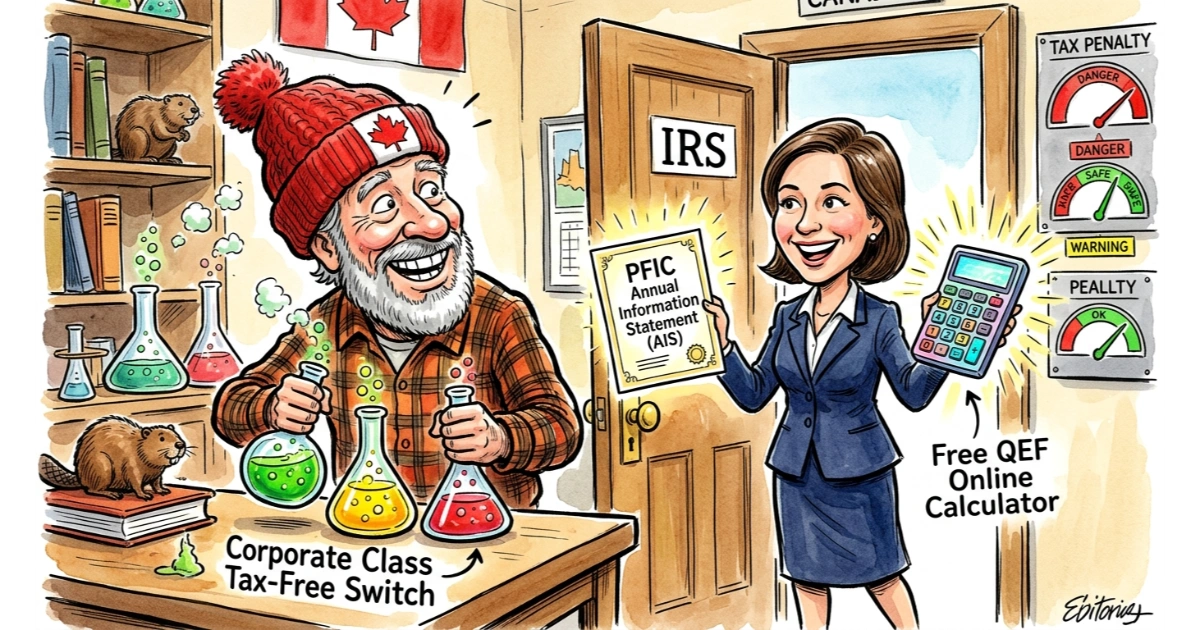
To elect Qualified Electing Fund (QEF) treatment on Form 8621, you must obtain a formal PFIC Annual Information Statement (AIS) issued by the Canadian fund manager. Major Canadian institutions (such as CI Financial, Dynamic Funds, Purpose Investments, and Mackenzie) publish annual PFIC statements on their tax centers.
When examining an AIS for a corporate-class share series, you will find:
- Exact Legal Fund / Share Class Name: Matches your brokerage account statement.
- Fund's U.S. Tax Year: Typically ending December 31 or the fund's fiscal year-end.
- Ordinary Earnings Per Share / Unit: Daily or annual factor to calculate your pro-rata ordinary income inclusion.
- Net Capital Gain Per Share / Unit: Factor to calculate your pro-rata long-term capital gain inclusion.
- Cash / Property Distributions: Actual cash paid or reinvested during the calendar year.
Making a QEF Election for Corporate-Class Shares
A timely QEF election can avoid §1291 treatment and replace it with current annual inclusions of ordinary earnings and net capital gains when a compliant AIS is available:
- Part II Election A: Check box A on Form 8621 to elect Qualified Electing Fund status in the first year of ownership.
- Part III Income Inclusions: Enter your pro-rata ordinary earnings on Line 6c (transferred to Form 1040 Schedule 1 / other income) and net capital gains on Line 7c (transferred to Schedule D as long-term capital gains).
- Basis Adjustment: Under IRC §1293(d), your U.S. tax basis in the corporate-class shares increases by amounts included in income and decreases by tax-free distributions of previously taxed earnings.
What If QEF Was Not Elected in the First Year? (Unpedigreed QEF)
If you held corporate-class shares during a year when you were a U.S. tax resident and did not make a timely QEF election, the fund becomes an unpedigreed QEF.
Even if you make a QEF election in a subsequent year, the stock remains tainted by Section 1291 unless you make a "purging election":
- Deemed Sale Election (IRC §1291(d)(2)(A)): You recognize gain as if the shares were sold on the first day of the QEF year at fair market value. The gain is subject to Section 1291 throwback tax and interest, but eliminates the taint for all future appreciation.
- Deemed Dividend Election (IRC §1291(d)(2)(B)): Available if the fund qualifies as a controlled foreign corporation (rare for retail mutual funds).
Account Layer: RRSP vs. TFSA vs. Taxable Account
How corporate-class funds impact your U.S. return depends entirely on the account wrapper:
- RRSP / RRIF: A qualifying arrangement may use the Form 8621 reporting exception under Treas. Reg. §1.1298-1(c)(4). Confirm the treaty and arrangement conditions. (See our RRSP PFIC Guide).
- TFSA / FHSA: Not recognized as tax-exempt by the IRS. Holding corporate-class funds inside a TFSA triggers annual Form 8621 filings. (See our TFSA U.S. Tax Guide).
- Taxable / Non-Registered Brokerage: Full annual Form 8621 exposure. A timely QEF election supported by an AIS is essential to prevent Section 1291 penal rates. Learn more in our Canadian ETF QEF & AIS Guide and Canadian Mutual Funds Guide.
Enter the fund's ordinary earnings and net capital gain factors alongside your holding records to calculate your exact annual QEF income inclusion, previously taxed earnings, and basis adjustments.
Have a PFIC AIS? Calculate QEF Inclusions →Back to the central directory: Canada PFIC Resource Hub & Matrix.