
What Is a Canadian Segregated Fund?
In Canada, a segregated fund (often marketed as an Individual Variable Insurance Contract or IVIC) is an investment vehicle issued exclusively by life insurance companies (such as Canada Life, Manulife, and Sun Life).
While it functions economically like a mutual fund—pooling investor capital into equity and fixed-income portfolios—it is legally an insurance contract. Features include:
- Principal Guarantees: Typically guarantees 75% to 100% of the invested principal upon contract maturity or death.
- Creditor Protection: Provided certain family beneficiaries are designated under Canadian provincial insurance acts.
- Estate Bypass: Death benefits pass directly to designated beneficiaries outside of probate.
Why PFIC Classification Is Not Automatic
Under IRC §1297, a PFIC is defined specifically as a foreign corporation where 75% of income is passive or 50% of assets produce passive income. Form 8621 reporting applies to U.S. persons who are direct or indirect shareholders of that foreign corporation.
In a segregated fund arrangement, the investor does not hold share certificates in a fund corporation or trust units in a mutual fund trust. The investor holds a contractual claim against the insurance company. Therefore, before asserting that Form 8621 is required, a tax practitioner must determine whether the investor is treated as the beneficial tax owner of the underlying assets.
Who Legally Owns the Underlying Assets?
Analyzing the ownership chain is essential:
| Party | Legal Status | U.S. Tax Significance |
|---|---|---|
| Policyholder (Investor) | Holds contractual rights against the life insurer | Owns an insurance contract; not direct legal owner of securities |
| Life Insurance Company | Legal owner of all assets within the segregated fund | Foreign life insurance company holding pooled portfolio |
| Segregated Portfolio | Accounting reserve segregated from general insurer assets | Not a standalone legal corporation; separate internal account |
| Beneficiary | Designated recipient of proceeds upon death | Contingent contractual beneficiary |
The 4-Step U.S. Tax Classification Framework
Rather than forcing a Canadian segregated fund into a rigid single box, U.S. cross-border tax analysis requires addressing four sequential questions:
| Sequential Question | What to Test | Why It Matters for U.S. Tax |
|---|---|---|
| 1. What Is the Legal Contract? | Life Insurance Contract: Tested under IRC §7702 (CVAT or guideline premium rules) + §817 variable contract rules. Annuity / Variable Annuity: Tested under IRC §72 + §817 (variable contracts). |
Determines the applicable statutory baseline rules (e.g., life insurance mortality testing vs. annuity growth rules). |
| 2. Who Owns the Assets for U.S. Tax? | IRS Investor-Control Doctrine (Rev. Rul. 2003-91, Rev. Rul. 81-225) & §817(h) diversification. | If the policyholder retains excessive discretionary investment control over publicly available retail funds, the IRS looks through the wrapper and treats the investor as the direct beneficial owner of the underlying assets. |
| 3. Are Underlying Assets PFICs? | IRC §1297 passive income and asset tests on underlying pooled funds/ETFs. | PFIC analysis begins here. If the investor is treated as beneficial owner and the underlying assets are Canadian mutual funds or ETFs, Form 8621 compliance is triggered. |
| 4. Is There Foreign Trust Exposure? | IRC §§671–679 grantor trust rules & §6048 reporting. | Commercial insurance products generally do not create foreign trusts, but unusual custodial arrangements must be distinguished before considering Form 3520 / 3520-A. |
Does the Investor-Control Doctrine Matter?
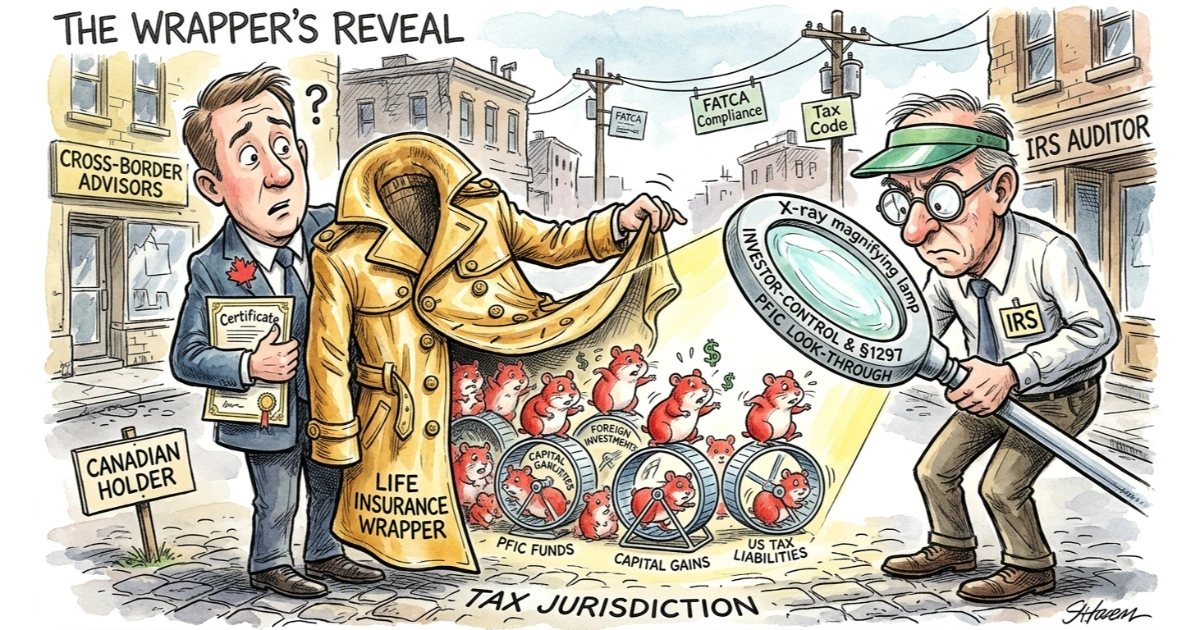
Under established IRS precedent (including Rev. Rul. 2003-91, Rev. Rul. 81-225, and Rev. Rul. 77-85), if a policyholder possesses significant incidents of ownership—such as the unfettered ability to direct investments among publicly available retail mutual funds—the IRS looks through the insurance wrapper and treats the policyholder as the direct owner of the underlying assets.
Similar principles apply to Indian insurance products (see our detailed analysis in Indian ULIPs & §7702 U.S. Tax Guide). If a segregated fund allows the investor to freely allocate among open-market mutual funds without insurance restriction, the IRS may deem the investor to indirectly own the underlying PFIC assets.
RRSP-Held vs. TFSA / Non-Registered Segregated Funds
Account location significantly simplifies or complicates the compliance burden:
- Inside an RRSP / RRIF: Even if the segregated fund is deemed to hold underlying PFICs, Article XVIII of the Canada-U.S. tax treaty and Treas. Reg. §1.1298-1(c)(4) exempt registered retirement accounts from annual Form 8621 filings. (See RRSP PFIC Guide).
- Inside a TFSA or Non-Registered Account: No treaty protection exists. If the contract fails §7702 or triggers investor-control, each underlying fund holding must be evaluated for Form 8621 filing. (See TFSA PFIC Guide and Canadian Mutual Funds Guide).
FBAR, Form 8938, Form 3520 and Form 8621 Are Separate Questions
A common mistake among cross-border filers is conflating foreign asset reporting obligations:
- FinCEN Form 114 (FBAR): A segregated fund account with a Canadian insurance company having cash surrender value is reportable on FBAR if aggregate foreign accounts exceed $10,000.
- Form 8938 (FATCA): Foreign life insurance contracts and segregated funds with cash values are Specified Foreign Financial Assets reportable under IRC §6038D.
- Form 3520 / 3520-A: Only applies if the contract creates a foreign trust relationship; not triggered automatically by standard commercial insurance contracts.
- Form 8621: Only applies if direct or indirect foreign corporation PFIC stock ownership is established under Form 8621 Filing Rules.
Before calculating Form 8621, identify whether you actually own PFIC stock directly or indirectly, what entity issued the contract, and what assets sit underneath the arrangement.
Start With the Canada PFIC Guide →If your tax analysis determines that your segregated fund holds reportable PFICs and the manager provides a PFIC Annual Information Statement, use our Free QEF Online Calculator to compute annual inclusions.
Back to the central directory: Canada PFIC Resource Hub & Matrix.